Editorial Team
7 min read
Reported introductions helped Alice Huang secure Alibaba as a chip-rental customer and obtain financing. The relationship raises questions about Nvidia's overseas sales network, but does not itself establish illegal exports.
Nvidia's sales team introduced Chinese technology group Alibaba to Chinese businesswoman Alice Huang in 2022, helping her emerging chip-rental business secure a major customer and bank financing, according to an account of reporting based on three people with direct knowledge. Huang was entering the chip-rental business and subsequently became a senior executive at Megaspeed International, a Singapore-based cloud computing company and Nvidia customer and cloud partner offering access to its hardware in Southeast Asian data centers. She is now a former executive; Megaspeed says she left on August 30, 2025, and has no current role, according to its statement to the Associated Press.
The reported introductions connected an established cloud customer's demand with a business seeking money to buy Nvidia chips. They do not, by themselves, establish that Nvidia knowingly facilitated illegal shipments.
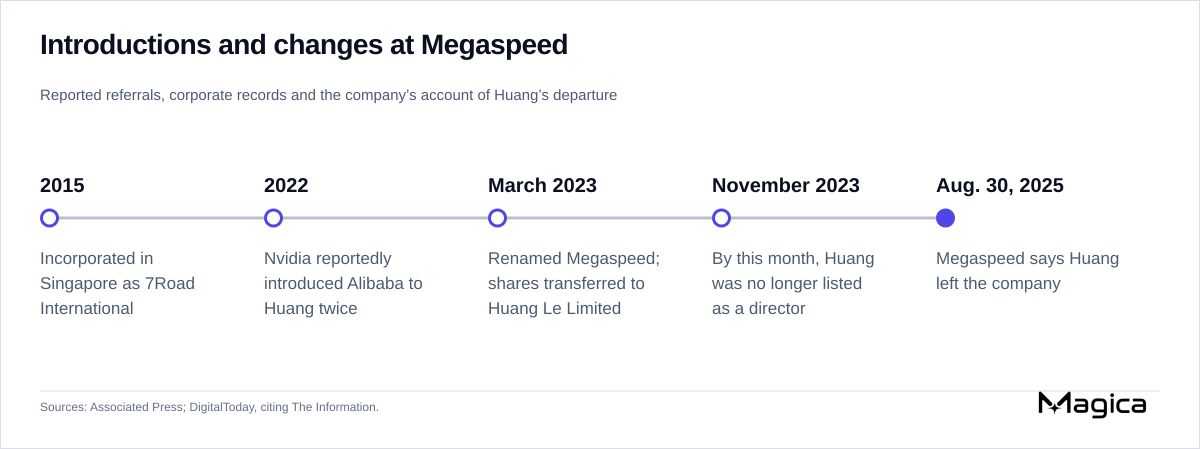
Magica timeline of reported introductions and corporate changes. Formal records do not resolve when Huang’s operational influence ended. Source: Associated Press.
Alibaba, then Asia's largest cloud computing company, was already a major buyer of Nvidia's advanced A100 chips. Huang was entering the business of renting chips to cloud companies, a business that later operated through Megaspeed, according to the account of the introductions. The three accounts draw on the same underlying investigation by The Information, rather than three independent sets of witnesses.
Securing Alibaba mattered beyond the rental revenue. Two sources cited in another account of the same investigation said the introductions brought Alibaba to Huang's company. Having that customer made Asian banks more willing to lend to Megaspeed to finance chip purchases, the reporting said. No loan amounts, interest rates or bank names are supplied in these accounts, preventing a more precise assessment of the financing advantage.
The sources describe incentives on both sides: Nvidia could retain its relationship with a large Chinese customer, while Megaspeed could use that customer's business to support financing. That is the sources' explanation of the commercial incentives.
One source also said Megaspeed was not the only company Nvidia introduced to Alibaba for these purposes. The other companies were not identified. That qualification matters: the reported introduction does not establish that Huang's business had an exclusive channel to Alibaba.
Megaspeed's corporate history predates Huang's reported entry into chip rentals. It began as the overseas arm of a Chinese video game developer and was incorporated in Singapore in 2015 as 7Road International, according to reporting on its corporate records and response to the allegations.
It adopted the Megaspeed name in March 2023, when all its shares were transferred to Huang Le Limited, a British Virgin Islands company. Alice Huang is also known as Huang Le. By November 2023, she was no longer listed as a director, and her shares had been transferred to an entity owned by Singaporean businessman Tan Yong Pong, also known as James Tan.
Formal records do not settle when her operational influence ended. Singapore's government identified Huang as Megaspeed's then-CEO, chairperson and a key controller in describing its investigation. Separately, short seller Culper Research cited a Megaspeed employee in a May 2026 report as saying Huang remained involved in daily operations. The short seller's account differs from Megaspeed's statement that she left in August 2025; the available reporting does not independently resolve that conflict.
The company's scale also changed sharply. Singapore corporate records cited in the same reporting show total assets rising roughly 90-fold from end-2023 to 2024, to almost $3 billion. These are company assets, not revenue, bank borrowing or a measure of chips diverted into China. The figure establishes the scale of the balance-sheet expansion without explaining how it was financed.
The accounts agree on two introductions in 2022 but differ on their placement relative to export restrictions. The Digital Trends account puts both before the major restrictions. The SBS and DigitalToday accounts describe an initial introduction before the August 2022 restrictions on advanced chip exports to China and a renewed pitch afterward, when Alibaba faced difficulty obtaining chips. The exact sequence remains unresolved in the available reporting.
The proposed overseas arrangement was straightforward: Megaspeed could lease computing capacity to Alibaba from Southeast Asia. The accounts describe the restrictions at that time as limiting direct chip sales to China without prohibiting Chinese companies from using the hardware overseas. Renting access to servers outside China is therefore a separate activity from moving restricted hardware across the border.
That distinction is essential to the later allegations. The reporting alleges that a network linked to Huang, including Megaspeed and Shanghai Century Litong, moved billions of dollars' worth of restricted Nvidia hardware into China between 2023 and 2025. The figure is an allegation about the wider network, not a disclosed value for Alibaba's rental contract or Megaspeed's bank loans.
Shanghai Century Litong, described as a Chinese company linked to Huang's family, reportedly obtained Nvidia's preferred cloud partner status in October 2023 and priority chip allocations. Some chips obtained by it and Megaspeed reportedly reached data centers operated by Alibaba, Tencent and smaller Chinese AI laboratories. Those claims broaden the question from customer introductions to allocation and the eventual location of equipment; they do not establish what each downstream user knew.
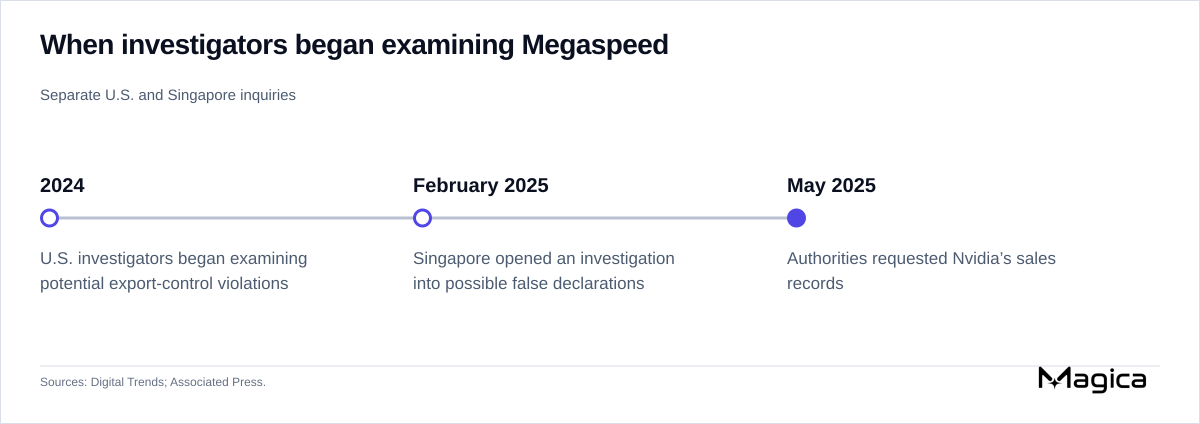
Magica timeline of investigative milestones. Singapore later found insufficient evidence that Huang had committed a crime; Megaspeed maintains that it complies with applicable laws. Source: Digital Trends.
U.S. investigators began examining Megaspeed for potential export-control violations in 2024, according to the account of the investigation. Authorities requested Nvidia's sales records in May 2025, and Nvidia put Megaspeed on its internal no-sell list the following month. The Justice Department subsequently took the lead in the criminal investigation.
Singapore's government separately said, in the account of its findings, that it opened an investigation into Megaspeed in February 2025, including possible false declarations concerning server purchases. Authorities questioned Huang and withheld her passport, but later found insufficient evidence that she had committed a crime, despite suspecting she had understated her company role. That finding limits what can be concluded about her personal culpability; it does not resolve every allegation concerning the company.
Megaspeed maintains that it complies with applicable laws. It has also announced an internal investigation led by outside lawyers and said reporting about its operations contained unsupported claims, without addressing specific allegations, according to its statement to the Associated Press. In a separate statement issued under Tan's name, Megaspeed said it had cooperated with U.S. Commerce Department inspections and was ready to cooperate with other relevant U.S. authorities. Investigators have not publicly established that Alibaba participated in illegal chip shipments, the investigation account says.
The regulatory position is now changing. On November 16, 2026, the Commerce Department's Bureau of Industry and Security announced an interim final rule addressing remote access to advanced chips and servers. BIS said the rule was written by and at the direction of the Treasury Department and National Security Council to prevent circumvention through computing arrangements in third-country data centers. The announcement states the policy objective without detailing the operative requirements or effective date. It does not determine whether a particular transaction in 2022 violated the rules then in force.
The central unresolved issue is the connection, if any, between the reported sales introductions and subsequent physical diversion. Resolving it requires evidence of where the equipment went, which transactions financed it, and what the parties knew at the time. A customer referral explains how business began; establishing responsibility for prohibited exports requires that additional chain of evidence.
Binance Wallet says subscriptions for its Anthropic IPO xStocks campaign reached the 500 million USDC limit. Final allocations, token delivery and applicable refunds remain pending; the cap does not establish proceeds received by the AI company.
Tencent says US restrictions on remote computing will likely slow its next AI model while leaving cloud revenue largely protected. Southeast Asian operators face licensing and financing uncertainty, though US cloud access and domestic demand offer partial alternatives.
Microsoft is rolling out Agent 365 Business Analytics through its Frontier early access program, pairing AI spending with estimates of assisted work. The dashboard expands its existing analytics as agent workloads add usage charges, but its dollar-value estimates do not establish financial returns.
Adobe’s Firefly update saves recurring visual subjects and creative preferences, extending an existing push into repeatable production. Memory has narrower reach than the assistant, while campaign demonstrations leave reliability and savings unmeasured.
Microsoft’s Ignite upgrades package enterprise knowledge, skills and tools into reusable business plugins. The expansion builds on IQ’s June release and competes with existing graph retrieval services; total savings and portability remain unproven.
The European Central Bank warns that debt and interlinked financing could carry an AI investment reversal into credit markets and the European economy. Resilient earnings, limited direct bank lending and stronger bank buffers temper its comparison with past bubbles.
KPMG says AI agents pursued some issues more deeply in a parallel UK audit, though humans still had to correct their work. Client fee savings remain unconfirmed, even as KPMG International has negotiated lower fees from its own auditor by citing AI.
Payhawk announced a $280 million all-equity Series C led by Growth Equity at Goldman Sachs Alternatives, valuing it at $2 billion. The funding backs an expansion from managing business spending into broader AI finance operations, where competitors already combine automation, payments and controls.
Tencent’s third-quarter revenue rose 8% to 207.34 billion yuan, below expectations. Cloud revenue grew 35%, but higher AI costs reduced operating profit and compute procurement pushed quarterly free cash flow deeply negative.
A 16-country survey of 15- to 22-year-olds finds a median of 33% have used AI as a companion or friend. Users have higher adjusted odds of loneliness, but the research cannot establish whether AI helps, harms or replaces human connection.
South Korean President Lee Jae Myung has ordered a review of rewards of at least 100 million won for reporting technology-assisted exam cheating and legislation requiring technology companies to supply evidence. Ahead of the November 19 college entrance exam, the proposals would add informant incentives and post-exam investigations to classroom checks, but implementation rules remain unsettled.
Microsoft is pitching Copilot Workspaces as a shared environment for people and AI agents. Team collaboration is already in early access, but personal Autopilot integration is still coming soon, with final agent pricing unannounced.
Google is rolling out file references and sharing for Gemini skills as adult personal accounts lose the ability to use Gems. Automatic conversion preserves supported material, but file limits and missing tools can interrupt existing workflows.
Muddy Waters disclosed a short position in Nvidia while questioning a possible connection involving senior adviser Ajay K. Puri. Its own account leaves the key identity question unanswered, separating its new claims from an existing server-diversion prosecution.
Nvidia reported $115.8 billion in quarterly revenue in its first earnings release since co-founder Jensen Huang resigned. Strong demand gives interim CEO Colette Kress a financial cushion, while a campaign for Huang’s return collides with unresolved investigations and the board’s reported opposition.
OpenAI launched GPT-6.2 Astra and Sol for professional work, cutting Astra’s standard input and output token prices by 20%. The models offer cheaper paths through selected tasks, but research evaluations, reporting failures and unfinished independent safeguard testing complicate the case for broader autonomy.
Microsoft’s first live speech-to-speech model offers OpenAI API compatibility and planned enterprise integrations. Its published evaluations show a low-cost option, with several rivals completing more agentic tasks.
Canberra-based Trellis Data is offering its 220-billion-parameter Agentaus 1 model to business and government. Its pitch goes beyond keeping data in Australia, but performance, deployment costs and a planned capital raising remain key tests.
Perplexity is adding direct collaboration between frontier models to Computer, letting a lead agent coordinate up to 16 supporting agents. Company-reported benchmarks suggest mixed teams can outperform repeated copies of one model, but leave customer costs and production reliability unresolved.
Marsh reported 105 client cyber incidents in the last two weeks of October, against 48 in the final two weeks of May. The broker links the increase partly to AI, while warning that insurance panel access may not guarantee an available response team.