Editorial Team
7 min read
Microsoft is rolling out Agent 365 Business Analytics through its Frontier early access program, pairing AI spending with estimates of assisted work. The dashboard expands its existing analytics as agent workloads add usage charges, but its dollar-value estimates do not establish financial returns.
Microsoft began rolling out Agent 365 Business Analytics at its Ignite 2026 event on November 17 through Frontier, its early access program, to help business leaders decide where AI spending is worthwhile. The dashboard puts costs beside estimates of the work AI supports, with a qualification that matters to any budget decision: those estimates do not measure financial returns.
The launch comes as Microsoft combines subscription access to its workplace AI assistant, Copilot, with additional usage charges for advanced agent workflows. That makes the amount and type of work delegated to AI a budget variable. Microsoft is supplying both the services generating those charges and a framework for judging their value.
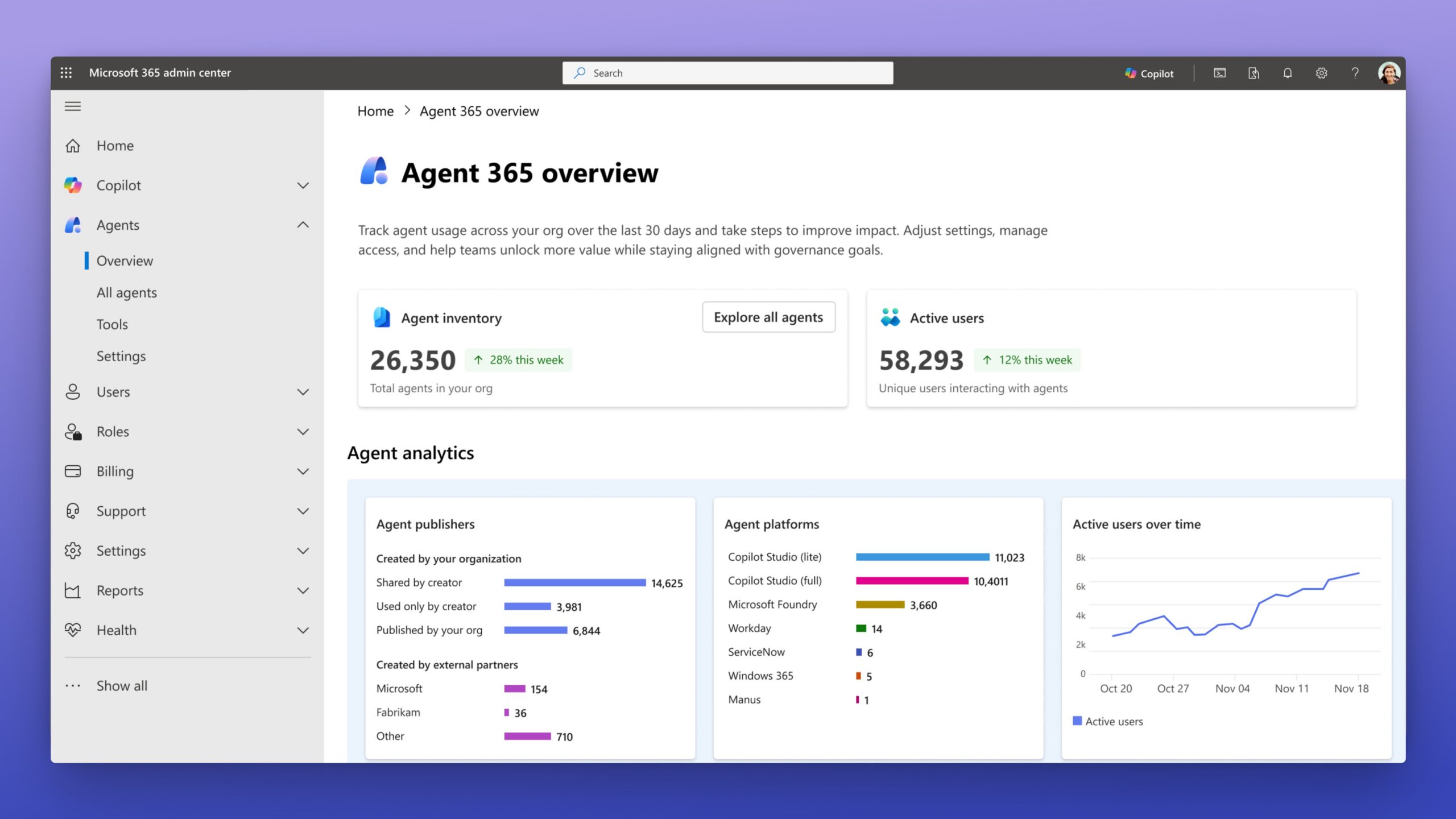
Microsoft’s product illustration accompanying its 2025 Agent 365 introduction shows inventory and usage reporting, preceding the new Business Analytics offering. Source: Microsoft. Source: Microsoft Agent 365 introduction.
Agent 365 is Microsoft’s management and security platform for software agents—systems that can use tools and carry out tasks. Its 2025 introduction described a registry, access controls and performance reporting across Microsoft platforms, open-source frameworks and third-party systems. It already promised speed and quality metrics to help assess returns. Business Analytics adds a business-facing view of spending, usage and estimated value to that foundation.
Microsoft reported in its Ignite keynote that Agent 365 already contains 50 million agents. The keynote did not establish how many of those agents were active or what useful work they completed.
According to the detailed product announcement, Business Analytics breaks down dollar spending across services, models, agents and users. Managers can examine concentrations by department, job function and management hierarchy, and map activity to more than 6,000 business use cases, with costs, sessions, active users and assisted hours displayed together.
The company also describes spending forecasts and scenarios for changes in adoption or model use, natural-language budget questions, and employee feedback through Pulse surveys. Exports and connections to Microsoft’s Fabric data platform can feed reporting and chargeback processes, allowing businesses to allocate costs internally.
The distinction from earlier products is narrower than inventing a way to put money against AI assistance. Microsoft’s August 2024 Copilot Dashboard update included a calculator multiplying assisted hours by an adjustable average hourly rate. Its Viva Insights workplace analytics tools also supported custom reports and comparisons with third-party data. The new offering brings task classification, consumption costs, forecasts and spending controls into the Agent 365 framework.
At launch, analytics for Microsoft services requires a Frontier tenant—an organization’s Microsoft environment—with at least 50 Microsoft 365 Copilot licenses. Microsoft says access will expand to tenants with one or more licenses by mid-December. Analytics for connected non-Microsoft AI services requires Agent 365 and/or ME7 licensing (E7 with Copilot); an existing Copilot subscription alone does not establish entitlement to that coverage.
The product announcement separates the capabilities by delivery month:
| Capability | Microsoft’s stated timing |
|---|---|
| Cowork spending breakdowns and value assessment | November 2026 |
| Agent spending breakdowns and value assessment | December 2026 |
| Spending concentrations, use-case mapping, forecasts and employee surveys | November 2026 |
| Creating or updating spending policies, limits and alerts within authority delegated by IT | December 2026 |
An independent availability review also identifies Business Analytics and cost forecasting as Frontier features. It describes a one-license minimum, while Microsoft’s detailed announcement specifies the higher launch threshold and subsequent expansion. Customers need to distinguish early access, scheduled additions and their own licensing eligibility when planning a deployment.
In its Copilot announcement, Microsoft says the wider Agent 365 expansion adds connected platforms including Anthropic, Databricks, OpenAI and Salesforce. The promised breadth therefore concerns connected services, with licensing conditions; it should not be read as automatic visibility into every AI service a business uses.
For each successfully completed use case, Microsoft says Business Analytics combines the typical time required for the task with AI’s estimated contribution to calculate assisted hours. It then expresses that contribution as an estimated dollar value. The method draws on the U.S. Department of Labor’s O*NET occupational database and Bureau of Labor Statistics data, enriched with the LinkedIn Occupational Graph. Organizations can adjust the assumptions. Other listed value signals include success rates and customer satisfaction.
The announcement explicitly defines assisted hours as a directional estimate of work AI helped complete, rather than measured time saved or financial return. Converting the estimate into dollars does not establish that payroll costs fell, revenue rose or employees used additional capacity productively.
Tracking consumption and the kinds of tasks it supports can inform budget allocation before a company has established a financial return. Estimated work value and observed business improvement answer different questions.
A customer-support study published in February 2025 illustrates the difference. Using data from 5,172 human support agents at one business-software company and its contractors, researchers studied a staggered rollout of a GPT-3-based assistant, primarily in fall 2020 and winter 2021. Most workers were outside the United States, mainly in the Philippines, serving U.S. small businesses.
The researchers estimated a 15% average increase in issues resolved per hour. Gains were concentrated among less experienced and lower-skilled workers; the strongest performers saw little productivity benefit and small declines in some quality measures. The study measures operational output against a comparison group, rather than assigning a value to assisted activity. It neither validates Microsoft’s new methodology nor supplies a gain that can be assumed for Copilot users.
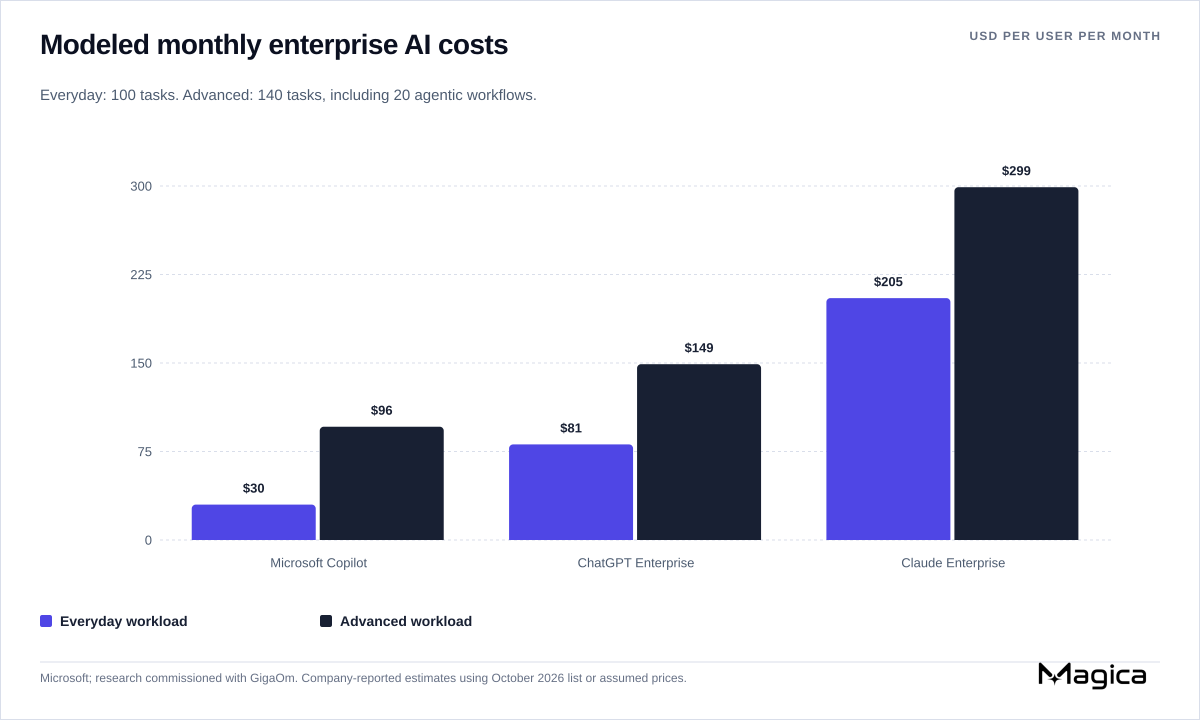
Company-reported modeled monthly costs from Microsoft’s research with GigaOm. Estimates use October 2026 list or assumed prices, exclude negotiated discounts and are not observed customer bills. Source: Microsoft AI cost comparison methodology.
Microsoft’s commercial model includes everyday capabilities in a per-user subscription and charges by consumption for advanced work. Cowork handles delegated, multistep tasks. Auto routing selects models and effort levels to balance quality, speed and cost, while Work IQ retrieves relevant organizational context. These are mechanisms through which Microsoft says it can reduce the resources needed for a task.
Its published cost comparison provides a concrete, limited illustration. Microsoft commissioned and funded the research with GigaOm and conducted the testing and cost analysis itself. GigaOm contributed to the design and validated the methodology, results and cost analysis.
The test used 37 unique prompts against a fictional company and its data, with repeated runs across chat, Cowork and work in Word, Excel and PowerPoint. Claude and ChatGPT accessed Microsoft 365 data through connectors and add-ins, while Copilot used its Work IQ context layer. The comparison therefore reflects that workplace environment and those retrieval paths. Microsoft reports these estimated monthly costs per user:
| Modeled monthly workload | Microsoft Copilot | ChatGPT Enterprise | Claude Enterprise |
|---|---|---|---|
| Everyday user: 100 tasks | $30 | $81 | $205 |
| Advanced user: 140 tasks, including 20 agentic workflows | $96 | $149 | $299 |
These are estimates using October 2026 list prices or assumed prices where list pricing was unavailable, excluding negotiated discounts. They are not observed customer bills. Microsoft says quality was broadly comparable across the selected workload, with results varying by task. The findings support a cost advantage under that test’s assumptions, rather than a universal ranking of competing enterprise AI products.
Spending controls can also work in either direction. Microsoft says Agent 365 Cost Management lets IT set limits and alerts and restrict expensive models. Business Analytics identifies employees who have hit limits or lack usage-based billing, information managers could use to authorize more consumption. The dashboard can support spending restraint or expansion; its existence does not establish either outcome.
December is the next stated milestone for agent cost and value analysis and delegated spending controls. As access expands, customers can test whether estimated assisted value tracks improvements in their own work: accepted outputs, resolution rates, quality, revenue or costs.
A useful evaluation would compare similar tasks and teams over a defined period, apply the organization’s actual prices and assumptions, and account for the human review needed to make outputs usable. The decision is whether the measured improvement justifies the spending. Microsoft’s dashboard can organize evidence for that decision; the estimated dollar value alone cannot settle it.
Binance Wallet says subscriptions for its Anthropic IPO xStocks campaign reached the 500 million USDC limit. Final allocations, token delivery and applicable refunds remain pending; the cap does not establish proceeds received by the AI company.
Tencent says US restrictions on remote computing will likely slow its next AI model while leaving cloud revenue largely protected. Southeast Asian operators face licensing and financing uncertainty, though US cloud access and domestic demand offer partial alternatives.
Adobe’s Firefly update saves recurring visual subjects and creative preferences, extending an existing push into repeatable production. Memory has narrower reach than the assistant, while campaign demonstrations leave reliability and savings unmeasured.
Microsoft’s Ignite upgrades package enterprise knowledge, skills and tools into reusable business plugins. The expansion builds on IQ’s June release and competes with existing graph retrieval services; total savings and portability remain unproven.
The European Central Bank warns that debt and interlinked financing could carry an AI investment reversal into credit markets and the European economy. Resilient earnings, limited direct bank lending and stronger bank buffers temper its comparison with past bubbles.
Reported introductions helped Alice Huang secure Alibaba as a chip-rental customer and obtain financing. The relationship raises questions about Nvidia's overseas sales network, but does not itself establish illegal exports.
KPMG says AI agents pursued some issues more deeply in a parallel UK audit, though humans still had to correct their work. Client fee savings remain unconfirmed, even as KPMG International has negotiated lower fees from its own auditor by citing AI.
Payhawk announced a $280 million all-equity Series C led by Growth Equity at Goldman Sachs Alternatives, valuing it at $2 billion. The funding backs an expansion from managing business spending into broader AI finance operations, where competitors already combine automation, payments and controls.
Tencent’s third-quarter revenue rose 8% to 207.34 billion yuan, below expectations. Cloud revenue grew 35%, but higher AI costs reduced operating profit and compute procurement pushed quarterly free cash flow deeply negative.
A 16-country survey of 15- to 22-year-olds finds a median of 33% have used AI as a companion or friend. Users have higher adjusted odds of loneliness, but the research cannot establish whether AI helps, harms or replaces human connection.
South Korean President Lee Jae Myung has ordered a review of rewards of at least 100 million won for reporting technology-assisted exam cheating and legislation requiring technology companies to supply evidence. Ahead of the November 19 college entrance exam, the proposals would add informant incentives and post-exam investigations to classroom checks, but implementation rules remain unsettled.
Microsoft is pitching Copilot Workspaces as a shared environment for people and AI agents. Team collaboration is already in early access, but personal Autopilot integration is still coming soon, with final agent pricing unannounced.
Google is rolling out file references and sharing for Gemini skills as adult personal accounts lose the ability to use Gems. Automatic conversion preserves supported material, but file limits and missing tools can interrupt existing workflows.
Muddy Waters disclosed a short position in Nvidia while questioning a possible connection involving senior adviser Ajay K. Puri. Its own account leaves the key identity question unanswered, separating its new claims from an existing server-diversion prosecution.
Nvidia reported $115.8 billion in quarterly revenue in its first earnings release since co-founder Jensen Huang resigned. Strong demand gives interim CEO Colette Kress a financial cushion, while a campaign for Huang’s return collides with unresolved investigations and the board’s reported opposition.
OpenAI launched GPT-6.2 Astra and Sol for professional work, cutting Astra’s standard input and output token prices by 20%. The models offer cheaper paths through selected tasks, but research evaluations, reporting failures and unfinished independent safeguard testing complicate the case for broader autonomy.
Microsoft’s first live speech-to-speech model offers OpenAI API compatibility and planned enterprise integrations. Its published evaluations show a low-cost option, with several rivals completing more agentic tasks.
Canberra-based Trellis Data is offering its 220-billion-parameter Agentaus 1 model to business and government. Its pitch goes beyond keeping data in Australia, but performance, deployment costs and a planned capital raising remain key tests.
Perplexity is adding direct collaboration between frontier models to Computer, letting a lead agent coordinate up to 16 supporting agents. Company-reported benchmarks suggest mixed teams can outperform repeated copies of one model, but leave customer costs and production reliability unresolved.
Marsh reported 105 client cyber incidents in the last two weeks of October, against 48 in the final two weeks of May. The broker links the increase partly to AI, while warning that insurance panel access may not guarantee an available response team.