Editorial Team
9 min read
Google has made Workspace MCP servers and its official CLI generally available ahead of February 2027 agent access rules. Administrators can configure external-agent approvals, while higher-volume MCP access requires a paid tier that starts billing Gmail, Calendar and Drive requests in April.
Google has made its managed agent interfaces generally available for Workspace, its suite of email, document and collaboration services, ahead of rules requiring AI tools to use them from February 1, 2027. The November 24 announcement combines broader developer access with controls over agent actions, downstream data use and high-volume usage.
For customers, the immediate question is which agents and actions to authorize. For developers, migration also brings a commercial choice: stay within free quotas or enroll a whole project in a higher-volume tier that begins charging for three MCP services in April. Google says Workspace serves more than 13 million organizations.
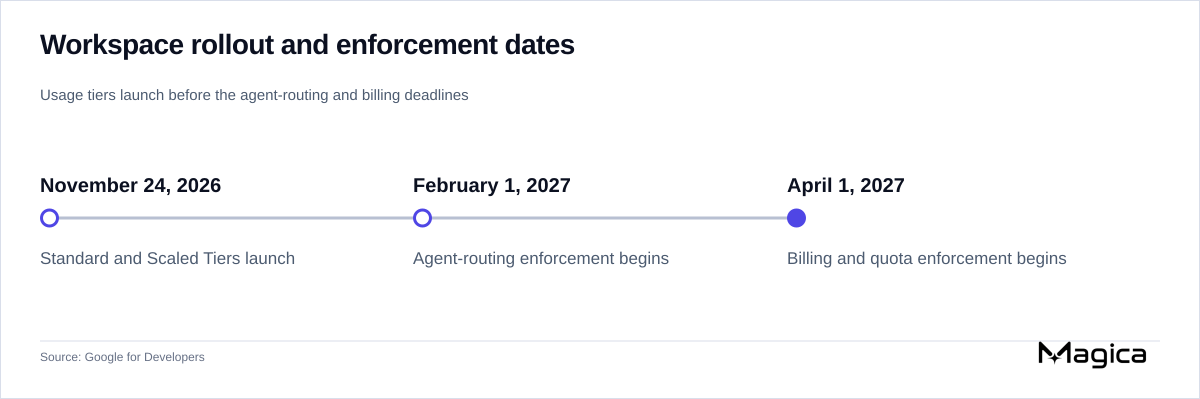
Google's published schedule separates the tier launch, agent-routing enforcement and billing. From February, agents calling REST directly face Standard Tier quotas; April brings first-request billing for Scaled Tier Gmail, Calendar and Drive MCP usage. Source: Google for Developers.
The remote servers use Model Context Protocol, an open standard connecting AI applications to tools and data, across Gmail, Drive, Docs, Sheets, Slides, Calendar, Chat and Tasks. Keep support is coming later. The official terminal client, gwscli, serves local agents, automated workflows and developers, providing structured output and scoped sign-in.
The release builds on earlier work. Google put an early CLI on GitHub in March, as described in coverage of the launch. Google's developer release notes date the Gmail, Calendar, Chat and Drive MCP developer previews to April 22. The November release promotes the eight product servers to general availability, although the notes say account availability can take up to 10 days. Universal Search, a separate server for searching across Workspace services, remains in developer preview, as do selected Chat tools.
Google says the change addresses a weakness in treating an agent's valid access token as sufficient evidence of user intent. The new interfaces put permissions, data-loss prevention rules, confirmations and audit logging into the request path. The scale is substantial: Google says Workspace APIs handle more than 2.8 trillion calls a month in its accompanying announcement. That measures API traffic, not adoption of the new agent interfaces.
Traditional applications can continue using existing REST APIs. Google says agents must instead use Workspace MCP servers or the CLI, with technical enforcement beginning February 1, 2027. The tier documentation specifies that agents calling REST APIs directly from that date will be limited to Standard Tier quotas regardless of their selected tier. That documented enforcement is a quota restriction, rather than a statement that every direct REST request will immediately stop working.
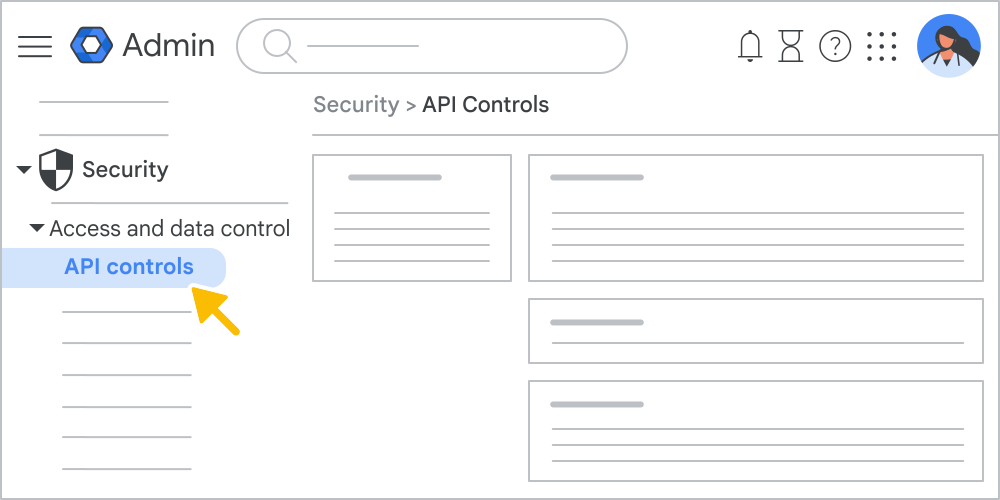
Google's illustration shows where administrators find API controls for managing application access. Credit: Google Workspace Admin Help. Source: Google Workspace Admin Help.
Administrators already control applications through OAuth scopes and trust, limit or block settings. The new agent controls extend that framework to agent client IDs and action review. User-delegated OAuth clients must be identified as AI-powered agents; integrations combining agent and conventional app features need separate client identities, according to the configuration guide.
The administrator instructions qualify the announcement's broad promise of human confirmation. These user-review rules apply to external agents using Workspace MCP tools or the CLI. Both internal and external collaboration default to requiring approval. Reading externally owned or shared resources also defaults to approval, while internal data access defaults to allowed. Administrators can allow, require approval for or block these categories.
Private actions, such as creating an email draft or editing a private file, run without confirmation. Moving items to trash always requires confirmation for each request, and external agents cannot permanently delete items. Where policy permits, users can save an “Always allow” choice for up to 90 days; administrators can instead require confirmation every time. Approval therefore does not necessarily mean a fresh prompt for every consequential action.
Service accounts impersonating users through domain-wide delegation still trigger review prompts when approval is required. That matters for unattended workflows: a machine credential does not remove the need to handle human review.
There are also unfinished controls. Google says time-limited access approvals, user-facing agent activity and access revocation, and restrictions blocking external agents from particular Gmail messages or Drive files and folders are coming later. Existing administrator revocation and DLP controls are available. The MCP configuration guide says users cannot themselves view or revoke saved tool approvals. It also warns that some interface badges can identify the user instead of the agent, although administrator audit logs retain the correct attribution.
These gateways do not remove prompt-injection risk: hidden instructions in an email or file can redirect an agent. Google's configuration guide requires screening prompts and responses for malicious content, using Model Armor, Google Cloud's screening service, or a documented alternative. Its CLI guidance recommends beginning with read-only access and says an agent must obtain explicit human confirmation before submitting an approval choice to the CLI.
The CLI supports agents including Claude Code, Codex and Google's Antigravity, so using Google's access layer does not require using only Google's AI applications. Deployment still requires care: Google warns that dynamically discovered commands and output schemas can change without backward compatibility, making fixed command signatures unreliable for static scripts.
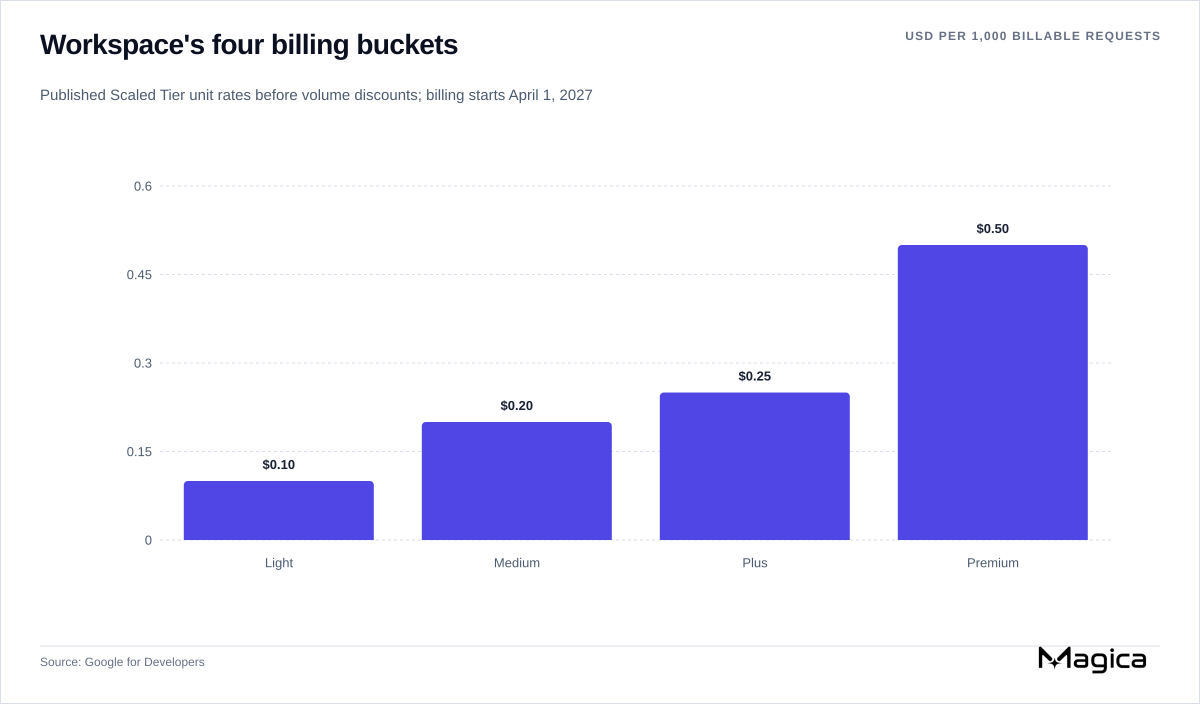
Google's published Scaled Tier rates before volume discounts. Drive uses all four buckets, Gmail uses Light, Medium and Premium, and Calendar uses Plus. Composite MCP tool calls can consume multiple billing units. Source: Google for Developers.
The usage overhaul began before this launch. Google introduced baseline quotas for new Gmail, Calendar and Drive API projects on May 1, 2026; November adds the Standard and Scaled Tiers and the monitoring dashboard.
The commercial distinction is between remaining within Standard Tier limits and opting an entire Cloud project into the Scaled Tier. Standard includes up to 5,000 MCP requests daily per project, per product, alongside per-minute limits. That daily capacity is shared across the project's users. It requires no billing account, never produces a Cloud bill and throttles excess traffic. Google describes quotas in its quota overview as a way to protect shared infrastructure and slow runaway automated actions.
Higher MCP quotas require a linked billing account, Scaled Tier enrollment and a separate quota-increase request. Enrollment alone does not raise limits. Starting April 1, 2027, Scaled Tier Gmail, Calendar and Drive MCP usage will be charged from the first successful request. Selecting that tier for a project removes its free MCP allowance; it is not simply a charge on requests above 5,000.
Google's pricing documentation sets these gross unit rates before applicable volume discounts. Drive uses all four buckets; Gmail uses Light, Medium and Premium.
| Billing bucket | Price per 1,000 billable requests | Typical operations |
|---|---|---|
| Light | $0.10 | Metadata retrieval |
| Medium | $0.20 | Message reads and single-resource changes |
| Plus | $0.25 | Drive searches and all Calendar requests |
| Premium | $0.50 | Content downloads, bulk actions and thread operations |
Some composite MCP tools make multiple underlying API calls and therefore consume multiple billing units. A workflow's number of visible tool invocations is not necessarily its billable request count. At the published Calendar rate, 10,000 billing units would cost $2.50 before volume discounts, assuming sufficient quota has been approved.
“Successful” also needs care. The Drive quota documentation says MCP tool-execution and argument-translation errors returned with HTTP 200 and an error flag count toward billing. A billable HTTP response need not mean the requested task succeeded.
Scaled Tier REST APIs receive different treatment: they retain daily no-charge allowances by service and billing bucket, resetting at midnight Pacific time. Calendar's REST allowance, for example, is 1 million requests daily per billing account; its billed MCP server has no such allowance on the Scaled Tier. Eligible internal-only organizational projects that do not share access with third-party services can request higher per-project REST quotas without entering the paid tier, but that exception does not raise MCP quotas.
Google expects fewer than 1% of active Workspace developers to need more than Standard Tier. That is the company's expectation, not an independently established measure of how many agent workloads will fit. For developers that do need more capacity, the combination of mandatory interfaces and first-request billing makes integration design a purchasing decision as well as a security decision.
The Workspace AI Tools Addendum, scheduled to take effect February 1, reaches beyond routing and permissions. It prohibits using user data or defined Google Technical Information for model training, fine-tuning, evaluation-dataset building or distillation, and for developing a product or service similar to a Workspace service.
The addendum also bars scraping or systematic probing beyond what a user-authorized task requires. Its defined Google Technical Information—which includes derived structures such as memory indexes and organizational graphs, but expressly excludes user data—cannot be stored for more than 30 days. Processing user data and Google Technical Information is limited to active, user-authorized tasks. Both must be removed after the tool is disconnected or its access revoked; the 30-day limit is not a general permission to retain all user data for that long.
Those provisions give Google control over how third parties use Workspace access to build products, alongside controls protecting customers' information. Google can restrict or terminate access when it reasonably believes the prohibited activities occurred. The addendum also disclaims Google's responsibility for third-party tools' acts or omissions, including unauthorized access and credential compromise. Governed access does not transfer those downstream risks to Google.
Builders have until February 1 to prepare for the agent-routing rules and until April 1 for Scaled Tier billing and broader quota enforcement. Projects retaining higher limits must choose the appropriate tier or eligible internal-use exception before April enforcement; otherwise, Google says they revert to Standard Tier limits.
The new quota dashboard models Standard Tier throttling for tracked API traffic, while billing-usage tools expose traffic for cost estimation. The billing-usage view covers a 30-day range ending two days before the current date and reports raw requests and tool calls, rather than billing units. Developers need to account for that distinction when estimating composite-tool costs.
Before migration, administrators need to test which actions their chosen policies actually interrupt, including saved approvals and unattended workflows. Developers need to measure both peak demand and billable units before selecting a project-wide tier. Google has yet to give delivery dates in these announcements for the promised user activity and revocation controls; those controls remain an unresolved part of the governance proposition as the two enforcement deadlines approach.
Sellers are seeking buyers for thousands of Nvidia B300 chips, while Asian data centers try to replace Chinese customers affected by U.S. controls. Rental prices have fallen, but short contracts remain scarce and operators face demanding financing terms.
Lenders are delaying or reassessing financing for Asian data centers serving Chinese technology firms as new US licensing rules put chip purchases and customers’ access to computing capacity in doubt.
Meta employees describe cuts to moderation teams and difficulty correcting mistakes as AI enforcement expands. Meta claims better accuracy, while account restrictions and an EU investigation put the effectiveness of appeals under scrutiny.
Dario Amodei rejects handing political authority to AI while defending task automation. An independent assessment finds faster progress at Anthropic, largely through AI assistance, but leaves important evidence outside public view.
OpenAI is piloting Private Inference with selected business customers. The feature targets provider access during processing, but model coverage, costs and evidence of its protections remain key questions.
Executives at rival AI developers are challenging a view reported among some Anthropic employees that people should delegate authority to superior machines. Anthropic defends human oversight, while the dispute exposes a harder question about who retains power when AI makes better decisions.
Officials told congressional staff there was no evidence China directed Alice Huang’s affair with Nvidia founder Jensen Huang. Reports of later information sharing, excluded intelligence and scrutiny of her former company complicate the security assessment.
Updates incorporating Sam Corcos’s requests appeared in his AI-built strategy game during a FinCEN cyber disruption. The Treasury CIO says computers develop it autonomously; the record does not establish time diverted from official duties or who pays the project’s costs.
SpaceX won conditional authorization for its Starmind orbital data centers, with deployment deadlines through 2040. The FCC left higher-altitude debris plans unresolved and did not judge whether the computing business will work.
NVIDIA has released Nemotron-Labs-Image-30B-A3B for non-commercial research and evaluation. The broader creation framework awaits legal clearance, and its best GenEval and GenEval2 results use GPT-6 assistance rather than the downloadable generator alone.
SpaceX reportedly lowered small-cluster Blackwell quotes to $10–$12 per GPU-hour, matching rates already offered to large customers. A possible Anthropic nonrenewal puts roughly 50,000 older H200 GPUs in focus, but does not establish an exit from the broader compute relationship.
CoreWeave’s debt sold off despite a brief stock-market rally around Nvidia’s leadership reversal. Recent fundraising and expected customer prepayments offer support, but infrastructure purchases far exceed operating cash flow and debt has more than doubled since year-end.
A public supply page advertises B300 systems at up to 18.6 million yuan apiece, alongside trader reports of nearly $3 million prices. Its verification warnings leave inventory, sellers and delivery unproven.
The Nasdaq 100 fell 4.32% in morning trading on November 25 as AI shares slid alongside tariff and inflation concerns. Its retreat approached 20% from October levels, but the comparison depends on intraday versus closing prices, and the session was unfinished.
ARK bought a reported 751,710 Anthropic shares across six ETFs before the stock opened lower Wednesday. The purchase follows an IPO and private placement totaling $119.5 billion in gross proceeds, but the Claude developer faces slowing sequential revenue growth and heavy compute obligations.
Google Research’s AI framework claims an unconditional factoring algorithm that improves on a 1992 theoretical bound. The six-paper release awaits independent scrutiny and promised machine-checkable proofs, and does not establish a practical encryption-breaking advance.
New US chip controls put Malaysian data center projects serving Chinese AI customers under scrutiny. Workloads and ownership determine exposure, while existing US tenants and private equity funding complicate predictions of a broad financing retreat.
Fujitsu is combining OpenAI Daybreak with its own assessment system and security specialists to find exploitable vulnerabilities, propose fixes and retest them. Pricing is undisclosed, and its internal results do not establish comparative performance.
EA will add an optional John Motson commentary track to FC 27 on November 26, mixing archive recordings with AI-generated speech. His family has licensed the recreation, raising a different consent question from EA’s existing work with living commentators.
Authors allege NVIDIA distributed pirated books through BitTorrent and to business partners including Adobe. The court allowed the amended pleading, but transfers of the authors’ own works remain unproven.