Editorial Team
5 min read
Intel regained five percentage points of desktop x86 CPU shipment share in Q3 2026, while AMD advanced in a growing server market. Mercury Research points to supply and channel differences as possible explanations, rather than a demonstrated shift in gaming preference.
Intel regained five percentage points of desktop x86 processor shipment share in the third quarter of 2026, reversing recent gains by AMD, its rival supplier of processors for PCs and servers. But AMD continued to advance in servers, and Intel’s gain across the broader x86 market was much smaller than its desktop rebound.
The split, in Mercury Research’s latest quarterly figures, shows why market share alone is an incomplete measure of either chipmaker’s position. The processor-market research firm suspects Intel could supply more desktop chips as laptop demand weakened. It explicitly calls that explanation speculative; the figures do not establish a change in gaming performance or consumer preference.
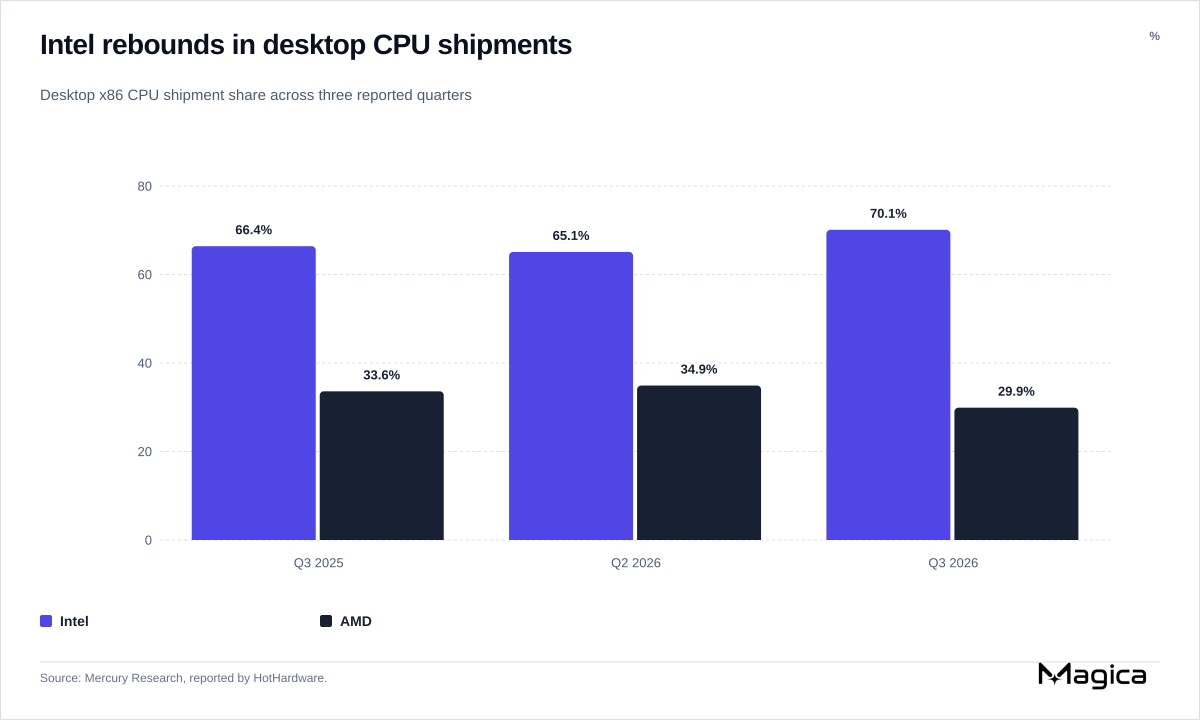
Mercury Research estimates put Intel’s desktop x86 CPU shipment share at 70.1% in Q3 2026 and AMD’s at 29.9%. Shipment share does not measure gaming performance. Chart: Magica. Source: HotHardware.
Mercury’s shipment-share estimates show Intel recovering ground both sequentially and year over year:
| Desktop x86 CPU shipment share | Q3 2025 | Q2 2026 | Q3 2026 |
|---|---|---|---|
| Intel | 66.4% | 65.1% | 70.1% |
| AMD | 33.6% | 34.9% | 29.9% |
The five-percentage-point quarterly swing follows directly from those endpoints. AMD’s latest share is below its year-earlier level as well as its Q2 record.
These are processors shipped, rather than retail purchases or the installed base of PCs, as . Unit share also does not reveal selling prices, revenue share or profitability.
Apple reportedly has Face ID prototypes for its second foldable iPhone, but integration into the outer display may miss the expected 2027 release. The experience on the unfolded phone remains unresolved.
The earlier quarter illustrates the distinction. AMD reached its Q2 record while desktop x86 shipments fell more than 20% both sequentially and year over year, according to the same report’s account of Mercury’s previous figures. A larger share can coexist with a contracting market.
Across x86 CPUs, including embedded system-on-chip and Internet of Things products, Intel’s Q3 share rose only 0.2 percentage points to 66.1%. It remained below 69.1% a year earlier. That broader category should not be substituted for the desktop comparison.
Mercury’s hypothesis is that weaker mobile-processor demand allowed Intel to allocate more products to desktops during their usual third-quarter seasonal increase. Intel had under-supplied desktops earlier in 2026, while AMD apparently did not receive the same seasonal lift. This is a possible supply explanation, rather than a measured allocation of the share swing.
A separate account of Mercury’s analysis describes Intel maintaining volumes through PC manufacturers and system builders while AMD’s gaming and enthusiast shipments weakened. Those channels matter because aggregate desktop shipments encompass more than enthusiasts buying individual processors.
Mercury also points to AMD’s greater exposure to PC gaming, where constrained graphics-card supply can impede complete-system sales. In that explanation, a graphics-card shortage affects demand for a gaming PC’s other components without implying dissatisfaction with its CPU.
AMD has acknowledged demand exceeding its ability to ship, and AMD chief executive Lisa Su has described the company as prioritizing data centers, according to the report relaying those statements. That is relevant to the company’s competing priorities. The reports do not quantify desktop capacity forgone or establish that a particular allocation decision caused the five-point decline.
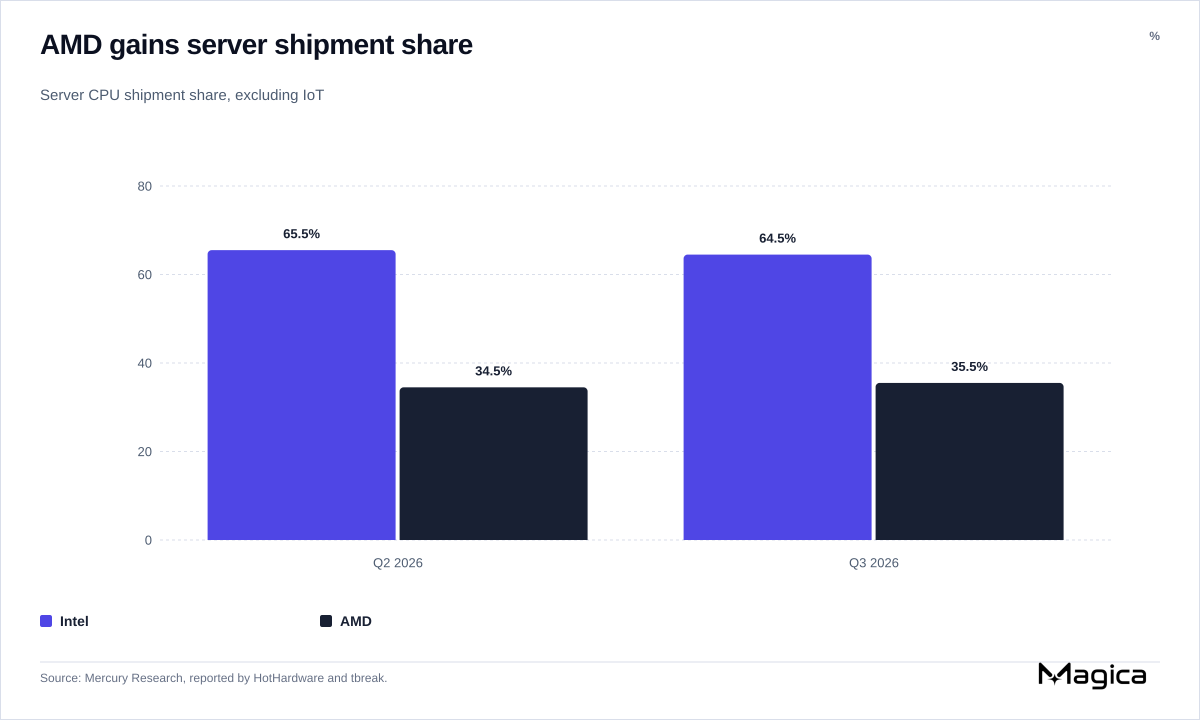
Mercury Research estimates show AMD’s server CPU shipment share rising to 35.5% in Q3 2026, excluding IoT. Intel retained 64.5%. Chart: Magica. Source: HotHardware.
AMD reached 35.5% of server CPU shipments, excluding Internet of Things products, up from 34.5% in Q2 and 27.8% a year earlier. Intel still held the majority at 64.5%, compared with 65.5% sequentially and 72.2% a year earlier, according to Mercury’s reported breakdown.
Mercury put server CPU shipment growth at 20% year over year, the segment’s strongest annual growth in nearly five years. Mercury described stronger demand for data-center-class server processors and workstation CPUs, with small departmental AI servers helping drive workstation demand. The published account does not provide separate growth rates for those categories, limiting precise vendor-level shipment calculations.
Intel’s declining server share therefore does not, by itself, show a shrinking data-center business. In an emailed response described in the same report, an Intel spokesperson highlighted $7.3 billion in quarterly Data Center and AI division revenue, up 78% year over year. That company-provided revenue figure measures something different from CPU unit share; it supplies commercial context rather than a like-for-like rebuttal to AMD’s shipment gains.
There is also competition beyond the two x86 suppliers. In the same assessment, Mercury estimated that Arm-based processors, an alternative to x86, reached a record 15.3% of PC client CPUs in Q3. The firm cautioned that Arm estimates are difficult because centralized reporting of Arm-based client and server CPU revenue is unavailable. The client estimate has a different denominator from the Intel-versus-AMD x86 figures and cannot be directly compared with Intel’s 70.1% desktop share.
The immediate test is whether Intel retains its desktop gains after the seasonal increase. Mercury said both vendors’ earnings indicated rapid PC-demand softening late in Q3 and an outlook for client CPU shipments to decline more than 20% in Q4. That is a forecast; the quoted assessment does not specify its comparison period.
Absolute desktop shipment volumes, channel inventories, processor mix and revenue would help distinguish a durable commercial recovery from a temporary supply adjustment. Retail sales and comparable game-performance tests would answer the separate question of whether gaming buyers have a reason to change their choices. The current figures establish a desktop shipment-share rebound for Intel alongside a server advance for AMD; they leave the cause and durability of the desktop reversal unresolved.
A federal court made protections for Eyes Up and ICE Sightings – Chicagoland permanent, restricting government pressure on Apple and Meta while leaving the platforms’ own decisions unresolved.
Xiaomi says its 18 Pro phones will support Google Maps, Spotify and YouTube Music on their rear displays, alongside AI-generated mini-apps. The software addresses a limitation of the previous generation, but everyday usefulness remains unproven.
Italy’s privacy regulator says Facebook accessed Android users’ photos, videos and metadata without specific consent. Meta plans to appeal, while the order requires gallery suggestions to be switched off by default and separately authorized.
Microsoft’s November 13 Release Preview builds expand Windows Search into a place to change settings and let users customize File Explorer’s right-click menu. The changes target different Windows 11 versions and are rolling out gradually.
Independent Office and web-browsing tests support long battery life for HP’s Intel OmniBook 5 14, without verifying its 42-hour local-video maximum. Memory, display and price vary substantially by configuration.
Nvidia’s GeForce evangelist has rejected speculation that its gaming graphics business is ending. His reply leaves launch schedules, supply and affordability unanswered as data centers dominate the company’s revenue.
SendCutSend’s reported Series B puts a $2.1 billion valuation on a manufacturer born from Jim Belosic’s car projects. Automated ordering makes small jobs practical, but expanding factories must still deliver on speed, quality and cost.
SpaceX’s 15th Starship test reached orbit and began deploying Starlink satellites, but Super Heavy was diverted offshore and exploded. An upper-stage return remained pending, leaving the company’s full-recovery ambition unproven.
Honor’s 700, 700 Pro and 700S will bring built-in rear displays to its midrange line. A November 23 launch will test the price of a package combining selfie previews, electronic pets and company-promoted health checks.
The German drone supplier says its fleet is operating normally after a precautionary Bundeswehr grounding. Reports of malware in the software-update chain leave questions about the intrusion’s reach and responsibility.
Microsoft plans to retire some Word compatibility settings from December 2026. Affected older documents may change pagination or image placement, but the settings list and rollout coverage remain unclear.
Apple has scheduled November 13 preorders for three LG security devices priced from $199.95 to $299.95, with December availability. Buyers also need to account for home-hub requirements and an iCloud+ subscription for event history.
AMD’s rumored Siren Halo APU could pair dedicated GDDR7 graphics memory with LPDDR system memory. The claim suggests a change from earlier Halo designs, but the naming, specifications and possible Xbox connection remain unconfirmed.
Apple’s smart display and fourth-generation streaming box are now available for $299 each, but app gaps, device requirements and Siri access on older hardware complicate the buying decision.
Microsoft is investigating printing failures after its November 2026 Windows security updates. The trigger is a document image rendered with zero height or width, including invisible objects used in layouts or inserted by document-generation tools.
Microsoft halted deployments and configuration changes during a widespread Microsoft 365 outage, saying unexpectedly unavailable servers were overloading the remaining infrastructure. Email, Teams and AI service connectors faced disruption while the cause remained under investigation.
Google is rolling out digital home keys for Android, starting in Google Home Public Preview. The feature supports tap and hands-free unlocking, but requires specific locks and a Google hub, while household access stays managed in Google Home.
Published tests of Humble Bundle’s redesigned storefront found missing two-factor authentication settings and fewer checks on password and email changes. Users face account-control concerns, but neither a breach nor AI involvement has been established.
Microsoft says Windows updates released since October 13 can leave SQL Server linked-server connections to external databases accumulating, degrading performance over time. An out-of-band fix is planned, while temporary cleanup risks interrupting active work.