Editorial Team
4 min read
Apple reportedly has Face ID prototypes for its second foldable iPhone, but integration into the outer display may miss the expected 2027 release. The experience on the unfolded phone remains unresolved.
Apple is still working to fit Face ID, its facial authentication system, into the outer display of its second-generation iPhone Duo, according to a report relaying Bloomberg Apple reporter Mark Gurman’s account. Gurman had previously put the feature on a third-generation timetable. Prototypes reportedly exist, but the feature may not be ready for the foldable phone’s expected launch in fall 2027.
The distinction matters for buyers hoping the next Duo will restore a familiar iPhone feature. Apple’s first foldable uses Touch ID, a fingerprint sensor in its side-mounted power button, rather than facial authentication, as the account of the proposed upgrade explains. Face ID would change that interaction, but the reported work does not establish support across both displays.
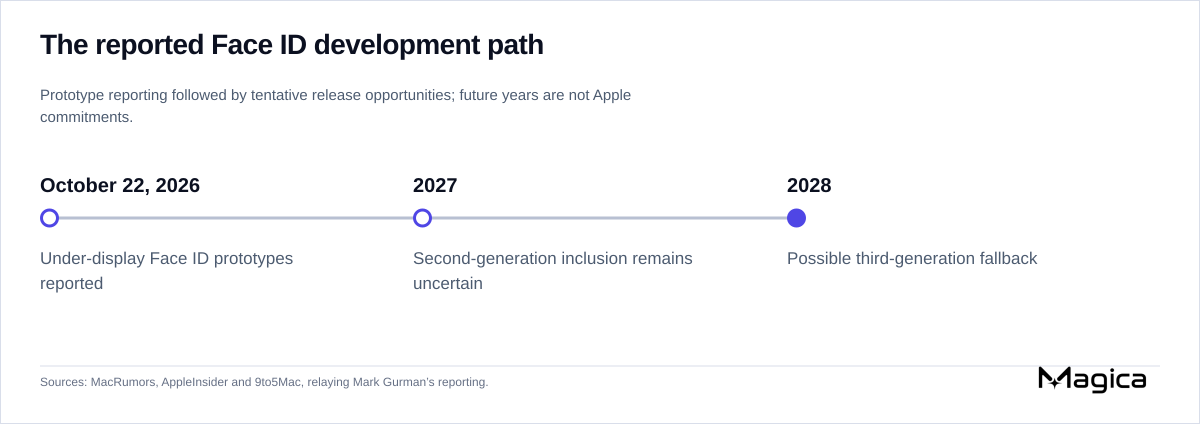
Prototypes were reported in October 2026; inclusion in 2027 remains uncertain, with 2028 described as a possible fallback. Graphic: Magica, based on accounts relaying Mark Gurman’s reporting. Source: MacRumors.
The three current accounts all trace the central claim to Gurman’s reporting. Their agreement therefore reflects coverage of one underlying account, rather than three independent confirmations of Apple’s plans.
Nor is the existence of Face ID prototypes entirely new. An October 22 report drawing on Gurman’s Power On podcast described prototypes incorporating the technology beneath the outer display. That earlier account also said Apple had not finalized whether the feature would ship. It followed his September prediction that smaller components and advances in artificial intelligence could help bring Face ID and a dedicated telephoto camera to the third generation.
A federal court made protections for Eyes Up and ICE Sightings – Chicagoland permanent, restricting government pressure on Apple and Meta while leaving the platforms’ own decisions unresolved.
The same October account put the first Duo’s launch on October 23, with a starting price of $1,999. It said the phone’s thin design leaves limited space for Face ID’s depth-sensing components. That is the hardware constraint behind the effort to bring an established iPhone capability to Apple’s first foldable. The reports provide no successor price or estimate of the cost of adding Face ID.
The November reporting sharpens the timing problem. The successor, codenamed V78, is nearing its final design stages ahead of test production, according to the account of its engineering timetable. Experimental hardware does not settle whether integration is ready for that production path. No exact engineering cutoff is supplied.
If Face ID misses the second generation, the current reporting points to iPhone Duo 3 in 2028 as a likely later opportunity. That remains a reported possibility, not a confirmed release commitment.
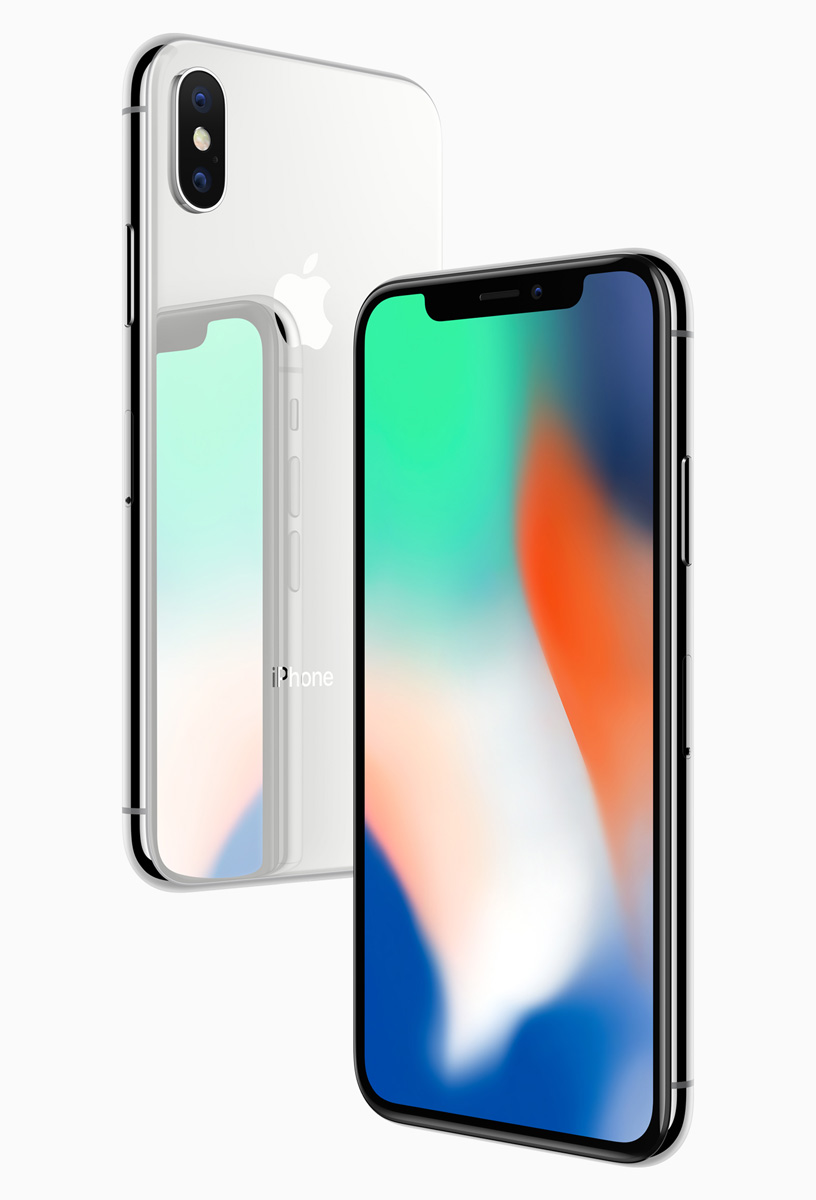
Apple introduced Face ID with iPhone X in 2017. This archival image shows that model. Image: Apple. Source: Apple.
In its September 2017 iPhone X announcement, Apple introduced Face ID as a way to unlock, authenticate in apps and pay, enabled by its TrueDepth camera. Apple described that camera system as including a dot projector, infrared camera and flood illuminator. The proposed Duo upgrade therefore involves fitting depth-sensing hardware into the foldable.
Placement changes its usefulness. The current reporting describes integration into the outer display; it does not establish facial authentication on the inner display. Commentary accompanying the latest report argues that reaching the Touch ID button can be more awkward when the phone is open, depending on grip and orientation. That is a usability judgment, not a measured finding, but it exposes a material limit to treating outer-display Face ID as a complete answer to authentication complaints.
The reports also leave unanswered whether Touch ID would remain alongside Face ID. Without that detail, buyers cannot yet assess how authentication would work as they move between the closed and unfolded phone.
Face ID is not the only reported priority. Apple also wants an Action Button function, potentially implemented through Camera Control by letting users assign its hold action to an app. A telephoto camera and a thinner, lighter design are described as goals for coming generations, not a settled package for the 2027 model.
The timetable also limits how quickly customer feedback could translate into hardware changes. The account of V78’s development says changes driven by feedback, beyond work already overlapping with Apple’s roadmap, should not be expected until the third-generation Duo.
The next consequential evidence is whether Face ID survives the second model’s design decisions—and, if it does, what authentication Apple supports with the phone open. Until those points are resolved, the reports describe an active engineering effort with a narrowing window, rather than a promised feature for next year’s buyers.
Xiaomi says its 18 Pro phones will support Google Maps, Spotify and YouTube Music on their rear displays, alongside AI-generated mini-apps. The software addresses a limitation of the previous generation, but everyday usefulness remains unproven.
Italy’s privacy regulator says Facebook accessed Android users’ photos, videos and metadata without specific consent. Meta plans to appeal, while the order requires gallery suggestions to be switched off by default and separately authorized.
Microsoft’s November 13 Release Preview builds expand Windows Search into a place to change settings and let users customize File Explorer’s right-click menu. The changes target different Windows 11 versions and are rolling out gradually.
Independent Office and web-browsing tests support long battery life for HP’s Intel OmniBook 5 14, without verifying its 42-hour local-video maximum. Memory, display and price vary substantially by configuration.
Nvidia’s GeForce evangelist has rejected speculation that its gaming graphics business is ending. His reply leaves launch schedules, supply and affordability unanswered as data centers dominate the company’s revenue.
Intel regained five percentage points of desktop x86 CPU shipment share in Q3 2026, while AMD advanced in a growing server market. Mercury Research points to supply and channel differences as possible explanations, rather than a demonstrated shift in gaming preference.
SendCutSend’s reported Series B puts a $2.1 billion valuation on a manufacturer born from Jim Belosic’s car projects. Automated ordering makes small jobs practical, but expanding factories must still deliver on speed, quality and cost.
SpaceX’s 15th Starship test reached orbit and began deploying Starlink satellites, but Super Heavy was diverted offshore and exploded. An upper-stage return remained pending, leaving the company’s full-recovery ambition unproven.
Honor’s 700, 700 Pro and 700S will bring built-in rear displays to its midrange line. A November 23 launch will test the price of a package combining selfie previews, electronic pets and company-promoted health checks.
The German drone supplier says its fleet is operating normally after a precautionary Bundeswehr grounding. Reports of malware in the software-update chain leave questions about the intrusion’s reach and responsibility.
Microsoft plans to retire some Word compatibility settings from December 2026. Affected older documents may change pagination or image placement, but the settings list and rollout coverage remain unclear.
Apple has scheduled November 13 preorders for three LG security devices priced from $199.95 to $299.95, with December availability. Buyers also need to account for home-hub requirements and an iCloud+ subscription for event history.
AMD’s rumored Siren Halo APU could pair dedicated GDDR7 graphics memory with LPDDR system memory. The claim suggests a change from earlier Halo designs, but the naming, specifications and possible Xbox connection remain unconfirmed.
Apple’s smart display and fourth-generation streaming box are now available for $299 each, but app gaps, device requirements and Siri access on older hardware complicate the buying decision.
Microsoft is investigating printing failures after its November 2026 Windows security updates. The trigger is a document image rendered with zero height or width, including invisible objects used in layouts or inserted by document-generation tools.
Microsoft halted deployments and configuration changes during a widespread Microsoft 365 outage, saying unexpectedly unavailable servers were overloading the remaining infrastructure. Email, Teams and AI service connectors faced disruption while the cause remained under investigation.
Google is rolling out digital home keys for Android, starting in Google Home Public Preview. The feature supports tap and hands-free unlocking, but requires specific locks and a Google hub, while household access stays managed in Google Home.
Published tests of Humble Bundle’s redesigned storefront found missing two-factor authentication settings and fewer checks on password and email changes. Users face account-control concerns, but neither a breach nor AI involvement has been established.
Microsoft says Windows updates released since October 13 can leave SQL Server linked-server connections to external databases accumulating, degrading performance over time. An out-of-band fix is planned, while temporary cleanup risks interrupting active work.