Editorial Team
5 min read
Italy’s privacy regulator says Facebook accessed Android users’ photos, videos and metadata without specific consent. Meta plans to appeal, while the order requires gallery suggestions to be switched off by default and separately authorized.
Italy’s data protection authority, the Garante, announced on November 14 that it had fined Meta Platforms Ireland Limited €805 million over access to Italian users’ photos, videos and related metadata through Facebook’s Android app. Meta, the parent company of the Facebook social network, disputes the decision and plans to appeal.
The regulator’s announcement couples the financial penalty with an order to change how users authorize gallery suggestions. Its finding draws a consequential distinction: permission to access a phone’s photo library for an app’s various functions does not, in the authority’s assessment, amount to informed consent for this particular use.
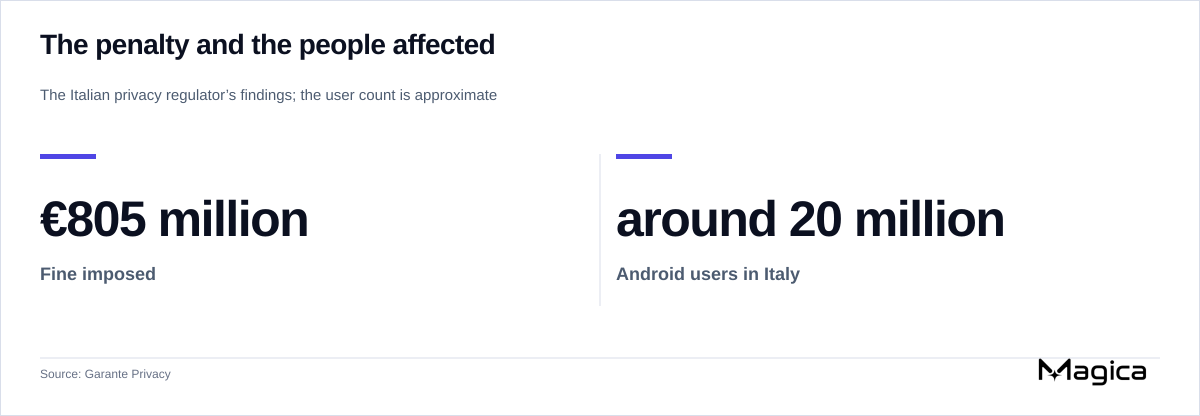
The Garante imposed an €805 million fine and cited around 20 million Android users in Italy as the affected population. Source: Garante Privacy.
The feature, available since 2023, suggests photographs and videos from a user’s phone gallery as possible Facebook posts while they browse. The investigation began in July 2025 after a complaint from the Bolzano Consumer Protection Centre and included the Garante’s technical analysis of the app.
The authority found that Facebook sought one gallery authorization covering the whole app and multiple functions with different purposes. A generic notice about enabling other features did not explain that users were also authorizing gallery suggestions, it said. The suggestions feature was enabled by default.
When granted in full, that authorization allowed the app to read the device’s entire photo archive on an ongoing basis, according to the regulator. Neither users nor the authority could verify which information was actually being used. That finding concerns the breadth and transparency of access; it does not establish that every photograph was transmitted elsewhere.
The Garante cited Article 122 of Italy’s Privacy Code, which implements the European ePrivacy Directive. In its explanation, the provision protects information on a smartphone as part of a person’s private sphere: access requires free and informed consent regardless of whether information is transmitted or harm occurs.
Apple reportedly has Face ID prototypes for its second foldable iPhone, but integration into the outer display may miss the expected 2027 release. The experience on the unfolded phone remains unresolved.
Meta challenged the Italian authority’s jurisdiction in favor of the Irish regulator. The Garante rejected that objection, saying the ePrivacy rules do not provide for the “one-stop-shop” mechanism. The legal basis therefore matters both to the permission standard and to which authority can enforce it.
The Garante put the affected population at around 20 million Android users in Italy. That is the authority’s measure of the case’s reach, rather than a count of photographs accessed or evidence that each user’s whole archive was used.
The Garante said the fine represented about 0.47% of Meta’s global revenue, without identifying the revenue year in its announcement. In setting the amount, it cited the number of people involved, the duration of the infringement, a previous 2019 decision and limited cooperation during the investigation. It said the violation remained ongoing for users who had not updated the app and those who had already granted the system authorization. Changes introduced after the complaint counted as mitigation, but the authority considered them late and limited to people who updated the app.
The prior record includes a June 2019 decision imposing a €1 million fine on Facebook in the Cambridge Analytica case. The Garante found that a third-party psychological-testing app had acquired data through Facebook about 214,077 Italian users who had not downloaded the app, been informed of the sharing or consented to it. The authority explicitly said those users’ data had not been transmitted to Cambridge Analytica.
That penalty used the former Privacy Code. It establishes a relevant history of information and consent failures, but the different legal basis and data-sharing mechanism make its amount an unsuitable direct benchmark for the gallery-access fine.
Meta said it would appeal the latest decision. A spokesperson disputed both the regulators’ assessment and the size of the penalty, calling the fine disproportionate, according to the report carrying the company’s response.
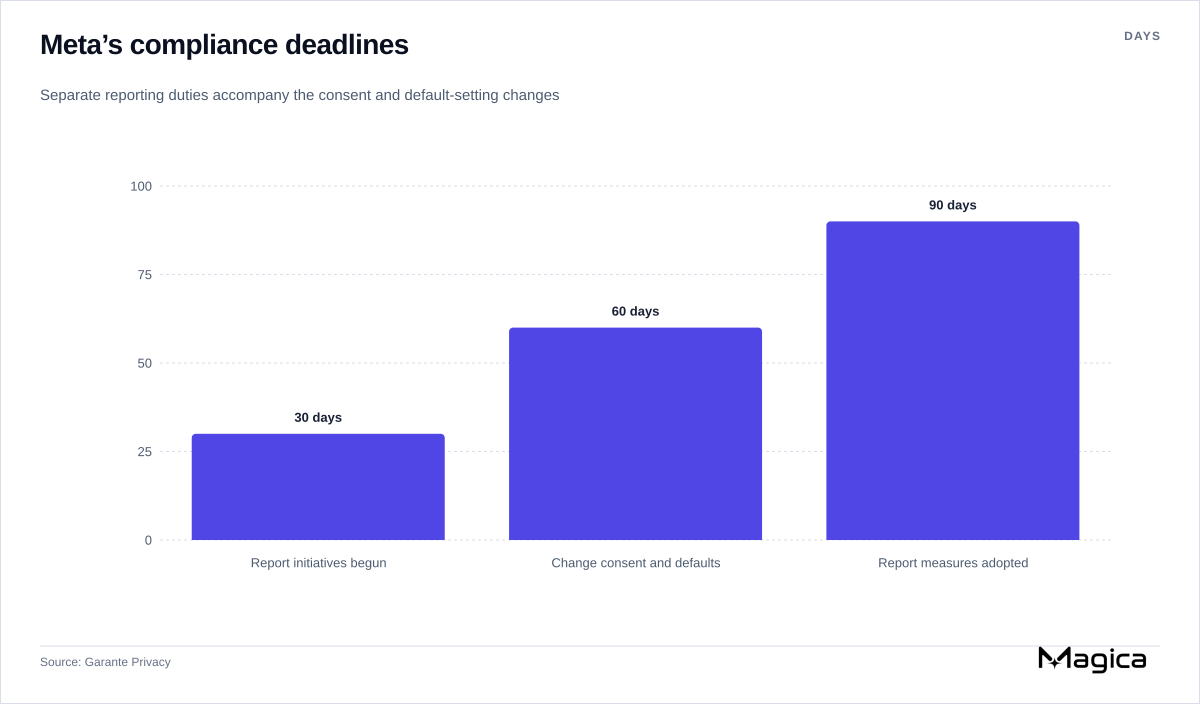
The order sets a 60-day deadline for separate consent and default-off gallery suggestions, with reporting requirements at 30 and 90 days. Source: Garante Privacy.
The order gives Meta 60 days to introduce a distinct, specific consent request explaining the feature’s purpose, its access to the gallery and how to disable it. Gallery suggestions must be off by default, including for people who previously gave authorization. After the deadline, the feature cannot be activated for users without valid consent if Meta has not complied.
Meta must also tell the Garante within 30 days what initiatives it has begun and within 90 days what measures it has adopted. Those requirements make the default setting and the treatment of existing permissions concrete tests of compliance, alongside the company’s planned appeal.
The regulator explicitly excluded possible AI training from this proceeding; Meta denies using the content for that purpose. The Garante reserved a separate assessment of a feature launched in 2026 that permits cloud processing of gallery content. The current order requires a specific user choice for gallery suggestions. Whether the newer cloud-processing feature complies will require a distinct examination.
A federal court made protections for Eyes Up and ICE Sightings – Chicagoland permanent, restricting government pressure on Apple and Meta while leaving the platforms’ own decisions unresolved.
Xiaomi says its 18 Pro phones will support Google Maps, Spotify and YouTube Music on their rear displays, alongside AI-generated mini-apps. The software addresses a limitation of the previous generation, but everyday usefulness remains unproven.
Microsoft’s November 13 Release Preview builds expand Windows Search into a place to change settings and let users customize File Explorer’s right-click menu. The changes target different Windows 11 versions and are rolling out gradually.
Independent Office and web-browsing tests support long battery life for HP’s Intel OmniBook 5 14, without verifying its 42-hour local-video maximum. Memory, display and price vary substantially by configuration.
Nvidia’s GeForce evangelist has rejected speculation that its gaming graphics business is ending. His reply leaves launch schedules, supply and affordability unanswered as data centers dominate the company’s revenue.
Intel regained five percentage points of desktop x86 CPU shipment share in Q3 2026, while AMD advanced in a growing server market. Mercury Research points to supply and channel differences as possible explanations, rather than a demonstrated shift in gaming preference.
SendCutSend’s reported Series B puts a $2.1 billion valuation on a manufacturer born from Jim Belosic’s car projects. Automated ordering makes small jobs practical, but expanding factories must still deliver on speed, quality and cost.
SpaceX’s 15th Starship test reached orbit and began deploying Starlink satellites, but Super Heavy was diverted offshore and exploded. An upper-stage return remained pending, leaving the company’s full-recovery ambition unproven.
Honor’s 700, 700 Pro and 700S will bring built-in rear displays to its midrange line. A November 23 launch will test the price of a package combining selfie previews, electronic pets and company-promoted health checks.
The German drone supplier says its fleet is operating normally after a precautionary Bundeswehr grounding. Reports of malware in the software-update chain leave questions about the intrusion’s reach and responsibility.
Microsoft plans to retire some Word compatibility settings from December 2026. Affected older documents may change pagination or image placement, but the settings list and rollout coverage remain unclear.
Apple has scheduled November 13 preorders for three LG security devices priced from $199.95 to $299.95, with December availability. Buyers also need to account for home-hub requirements and an iCloud+ subscription for event history.
AMD’s rumored Siren Halo APU could pair dedicated GDDR7 graphics memory with LPDDR system memory. The claim suggests a change from earlier Halo designs, but the naming, specifications and possible Xbox connection remain unconfirmed.
Apple’s smart display and fourth-generation streaming box are now available for $299 each, but app gaps, device requirements and Siri access on older hardware complicate the buying decision.
Microsoft is investigating printing failures after its November 2026 Windows security updates. The trigger is a document image rendered with zero height or width, including invisible objects used in layouts or inserted by document-generation tools.
Microsoft halted deployments and configuration changes during a widespread Microsoft 365 outage, saying unexpectedly unavailable servers were overloading the remaining infrastructure. Email, Teams and AI service connectors faced disruption while the cause remained under investigation.
Google is rolling out digital home keys for Android, starting in Google Home Public Preview. The feature supports tap and hands-free unlocking, but requires specific locks and a Google hub, while household access stays managed in Google Home.
Published tests of Humble Bundle’s redesigned storefront found missing two-factor authentication settings and fewer checks on password and email changes. Users face account-control concerns, but neither a breach nor AI involvement has been established.
Microsoft says Windows updates released since October 13 can leave SQL Server linked-server connections to external databases accumulating, degrading performance over time. An out-of-band fix is planned, while temporary cleanup risks interrupting active work.