Editorial Team
5 min read
SpaceX’s 15th Starship test reached orbit and began deploying Starlink satellites, but Super Heavy was diverted offshore and exploded. An upper-stage return remained pending, leaving the company’s full-recovery ambition unproven.
Rocket builder SpaceX’s Starship upper-stage spacecraft reached orbit on November 13, but the loss of its Super Heavy booster prevented the company from completing its planned double catch. The uncrewed upper stage continued its mission after the booster was diverted away from the Texas launch tower and exploded over the sea, according to the flight report.
SpaceX is developing Starship as a fully reusable launch system to reduce spaceflight costs, expand its own Starlink internet-satellite business and support the US space agency NASA’s Artemis program to return astronauts to the Moon. Friday’s flight combined operational satellite delivery with a recovery experiment; success at the former would not establish success at the latter.
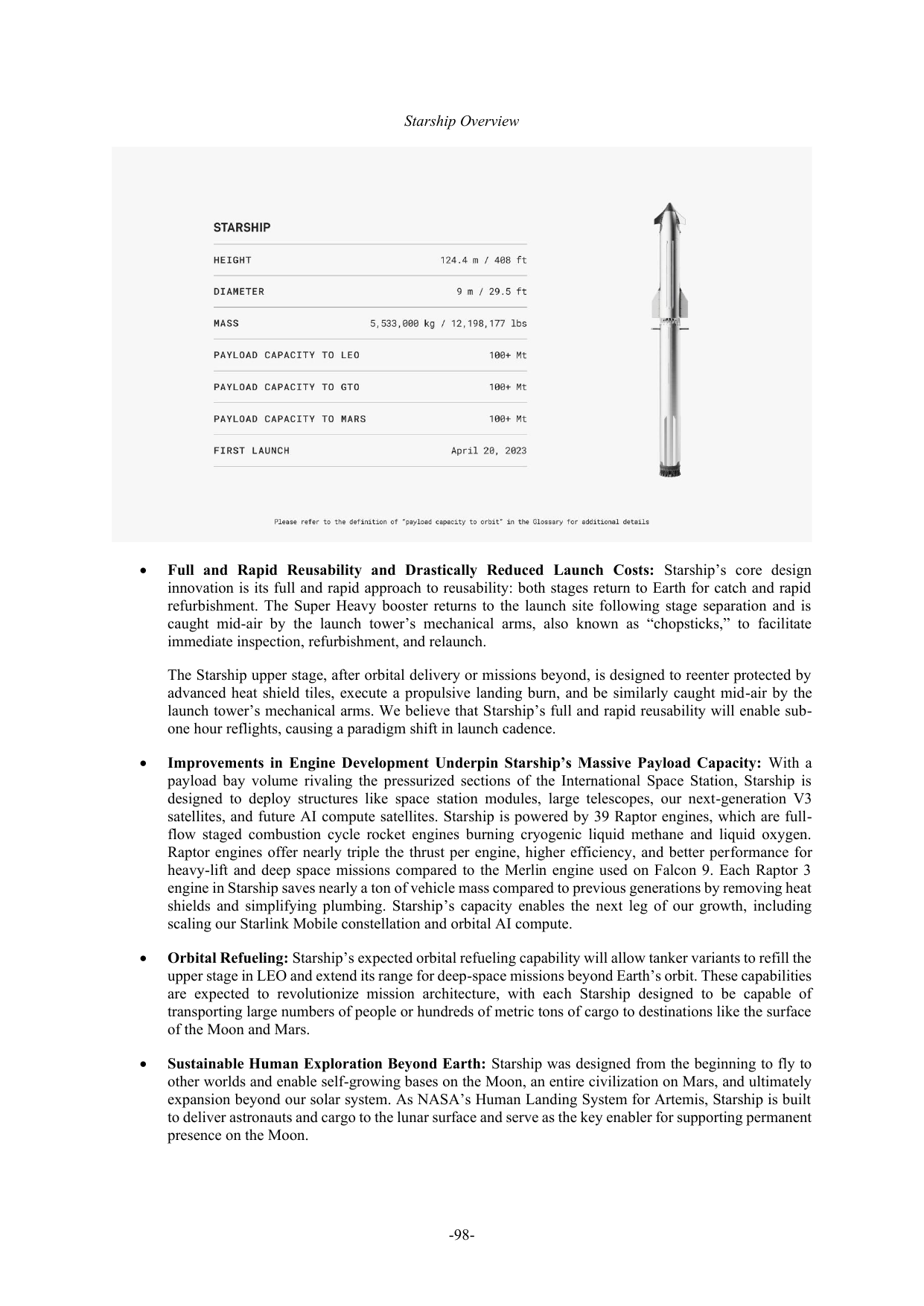
Starship’s design and company-reported specifications in SpaceX’s June 2026 prospectus, before the November test. Source: SpaceX. Source: SpaceX.
Starship consists of an upper-stage cargo-and-crew vessel mounted on the Super Heavy booster. On this flight, the two separated successfully after launching from SpaceX’s Starbase complex near Brownsville, Texas. The plan was for the booster to return within minutes and descend into mechanical arms attached to the launch tower. The upper stage was to follow roughly 22 hours later, after a planned 14 orbits.
Instead, Super Heavy diverted to a point over the Gulf of Mexico, briefly hovered and exploded just above the surface, the flight report said. The live account described an apparent thruster problem. It also relayed SpaceX’s announcement of an offshore diversion and a company commentator’s explanation that the decision followed safety checks. The precise cause was not established in the available reporting.
Apple reportedly has Face ID prototypes for its second foldable iPhone, but integration into the outer display may miss the expected 2027 release. The experience on the unfolded phone remains unresolved.
SpaceX said the upper stage reached orbit about 27 minutes after launch. In its mission livestream, the company said it began releasing its payload of 26 Starlink satellites around 36 minutes into the flight, according to the flight report. Deployment had begun; the report did not establish that the entire batch had been delivered.
SpaceX already reuses hardware on its Falcon 9 satellite-and-crew launcher. Its June 2026 prospectus describes recovering and refurbishing Falcon 9 boosters and payload fairings, while its second stage is not designed for recovery or reuse. Starship’s ambition extends recovery to both rocket stages.
This was Starship’s 15th test flight since 2023. Super Heavy had previously completed three tower catches, most recently in March 2025, according to the reported recovery history. Friday’s novelty was the attempt to bring the orbital upper stage back to the launch site as well.
The preceding flight, in September, put Starship and a satellite payload into orbit for the first time despite some engines shutting down during ascent. That mission was intended to last 10 hours but ended after roughly three hours, with the upper stage splashing down intact in the Pacific before bursting into flames. Reaching orbit, surviving descent and recovering a vehicle for another launch are distinct achievements.
SpaceX founder Elon Musk, who established the company in 2002, is pursuing full reusability to lower launch costs. He has said he expects weekly Starship launches by the first half of 2027. That remains a target; the flight reporting provides no measured Starship cost per recovered flight to substantiate the promised savings.
Friday’s mission was only the second Starship flight carrying operational Starlink satellites. SpaceX therefore has an internal customer for the vehicle while it is still being developed. The flight report also describes the company’s longer-term ambition to deploy orbital AI data-processing centers called Starmind. That remains a future application, separate from the satellite payload aboard this flight.
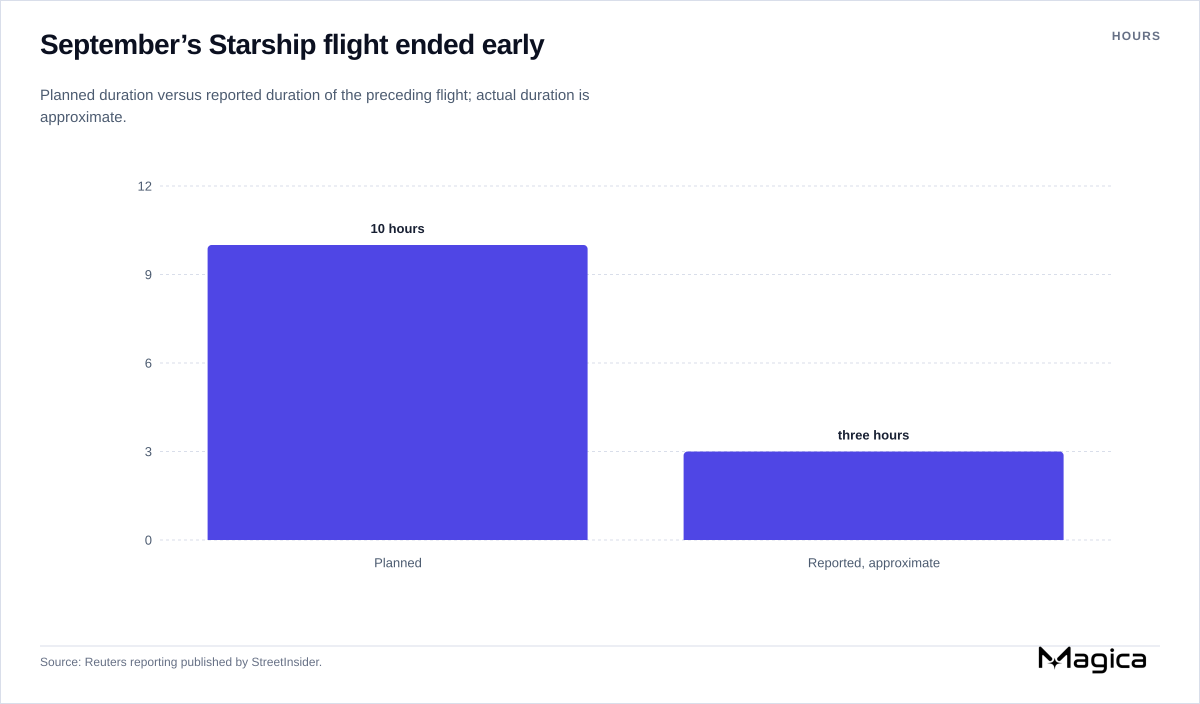
September’s Starship flight was planned to last 10 hours but ended after roughly three hours. Source: Reuters; chart: Magica. Source: StreetInsider.
At the reporting cutoff, the upper-stage catch was still planned for November 14. Recovering it would provide a result the booster failure had not made irrelevant, even though recovering both stages on this mission was no longer possible.
NASA’s stake adds another set of requirements. The agency selected a lunar-lander version of Starship in 2021. Its selection announcement described a $2.89 billion fixed-price, milestone-based award and cited the lander’s use of SpaceX’s Raptor engines and the flight heritage of its Falcon rockets and Dragon spacecraft. The report on the program’s financing and milestones puts NASA’s development support since selection at roughly $3.2 billion and SpaceX’s own investment at at least $15 billion. Those development figures are not launch prices or a measure of savings from reuse.
NASA and SpaceX expect a human Moon landing using Starship by 2028, but analysts and industry engineers cited in that report believe unfinished tests could push the schedule back. Those include transferring fuel between Starship tanker vehicles in orbit, which is needed for travel beyond Earth orbit to the Moon.
SpaceX also faces a competing lunar-lander program. Jeff Bezos’s space company Blue Origin is developing Blue Moon for NASA, with both landers expected to participate alongside NASA’s Orion astronaut capsule in an Earth-orbit docking test during Artemis III next year. The report places the start of planned lunar landings with Artemis IV.
The immediate questions are whether Starship can complete its own return and what caused Super Heavy’s failed recovery. Beyond those results, SpaceX still needs to demonstrate that recovered hardware can support the repeated launches its commercial and lunar plans require.
A federal court made protections for Eyes Up and ICE Sightings – Chicagoland permanent, restricting government pressure on Apple and Meta while leaving the platforms’ own decisions unresolved.
Xiaomi says its 18 Pro phones will support Google Maps, Spotify and YouTube Music on their rear displays, alongside AI-generated mini-apps. The software addresses a limitation of the previous generation, but everyday usefulness remains unproven.
Italy’s privacy regulator says Facebook accessed Android users’ photos, videos and metadata without specific consent. Meta plans to appeal, while the order requires gallery suggestions to be switched off by default and separately authorized.
Microsoft’s November 13 Release Preview builds expand Windows Search into a place to change settings and let users customize File Explorer’s right-click menu. The changes target different Windows 11 versions and are rolling out gradually.
Independent Office and web-browsing tests support long battery life for HP’s Intel OmniBook 5 14, without verifying its 42-hour local-video maximum. Memory, display and price vary substantially by configuration.
Nvidia’s GeForce evangelist has rejected speculation that its gaming graphics business is ending. His reply leaves launch schedules, supply and affordability unanswered as data centers dominate the company’s revenue.
Intel regained five percentage points of desktop x86 CPU shipment share in Q3 2026, while AMD advanced in a growing server market. Mercury Research points to supply and channel differences as possible explanations, rather than a demonstrated shift in gaming preference.
SendCutSend’s reported Series B puts a $2.1 billion valuation on a manufacturer born from Jim Belosic’s car projects. Automated ordering makes small jobs practical, but expanding factories must still deliver on speed, quality and cost.
Honor’s 700, 700 Pro and 700S will bring built-in rear displays to its midrange line. A November 23 launch will test the price of a package combining selfie previews, electronic pets and company-promoted health checks.
The German drone supplier says its fleet is operating normally after a precautionary Bundeswehr grounding. Reports of malware in the software-update chain leave questions about the intrusion’s reach and responsibility.
Microsoft plans to retire some Word compatibility settings from December 2026. Affected older documents may change pagination or image placement, but the settings list and rollout coverage remain unclear.
Apple has scheduled November 13 preorders for three LG security devices priced from $199.95 to $299.95, with December availability. Buyers also need to account for home-hub requirements and an iCloud+ subscription for event history.
AMD’s rumored Siren Halo APU could pair dedicated GDDR7 graphics memory with LPDDR system memory. The claim suggests a change from earlier Halo designs, but the naming, specifications and possible Xbox connection remain unconfirmed.
Apple’s smart display and fourth-generation streaming box are now available for $299 each, but app gaps, device requirements and Siri access on older hardware complicate the buying decision.
Microsoft is investigating printing failures after its November 2026 Windows security updates. The trigger is a document image rendered with zero height or width, including invisible objects used in layouts or inserted by document-generation tools.
Microsoft halted deployments and configuration changes during a widespread Microsoft 365 outage, saying unexpectedly unavailable servers were overloading the remaining infrastructure. Email, Teams and AI service connectors faced disruption while the cause remained under investigation.
Google is rolling out digital home keys for Android, starting in Google Home Public Preview. The feature supports tap and hands-free unlocking, but requires specific locks and a Google hub, while household access stays managed in Google Home.
Published tests of Humble Bundle’s redesigned storefront found missing two-factor authentication settings and fewer checks on password and email changes. Users face account-control concerns, but neither a breach nor AI involvement has been established.
Microsoft says Windows updates released since October 13 can leave SQL Server linked-server connections to external databases accumulating, degrading performance over time. An out-of-band fix is planned, while temporary cleanup risks interrupting active work.