Editorial Team
5 min read
Neuralink has shown a trial participant controlling GTA VI through intended movements. Earlier gaming use and company-reported trial results put the demonstration in context, while its reliability across users remains unmeasured in the reports.
Neuralink, the brain-computer interface company developing implants to help people with paralysis control digital devices, has shared footage of a clinical trial participant playing Grand Theft Auto VI without a handheld controller. The video extends the company’s earlier gaming demonstrations to a newly released game, while leaving open how consistently this setup works across users.
The company posted the footage on November 20 with a short caption: “Playing GTA VI with a Neuralink.” A report describing the two-minute video says the participant drives, flies a plane and gets into fights. A webcam view appears alongside a neural-decoding panel and a controller graphic that lights up with inputs.
The participant describes using intended finger movements to throw punches and imagining his right hand sliding forward to pull up the plane's nose. He says the team also incorporated a foot to cover additional buttons. The described controls depend on mapping movement intentions to game inputs.
Telepathy is Neuralink’s first product, intended to let people with paralysis control external devices. In a January 28, 2026 update, the company said it records activity from brain regions responsible for hand and arm muscles and translates it into digital commands. It reported 21 participants enrolled in trials worldwide at that time; that is an enrollment figure, not a measure of successful GTA VI use.
The connection to gaming hardware also matters. The video report quotes Robert Dale Smith, a developer whose social-media biography lists work on brain-computer interface applications at Neuralink, as saying he had worked on enabling control of devices including PlayStation 5. Smith credited JoypadOS, his controller-adapter firmware; the report describes its USB and Bluetooth support and controller-protocol translation based on his website. The demonstration therefore involves software that connects decoded commands to gaming hardware as well as the implant.
The accounts differ in how specifically they identify the platform. The video report describes an on-screen PlayStation 5 DualSense controller and cites Smith’s PlayStation work; says Neuralink had not confirmed whether the game was running on PlayStation or Xbox. A controller graphic alone should not be treated as confirmation of the complete hardware setup.
Ubisoft has made the team behind its Teammates experiment a dedicated subsidiary targeting AI characters with memory and outside game creators. Earlier playtests show both progress and limitations, while commercial plans remain undisclosed amid group cost cuts and refinancing.
This is an extension of earlier gaming use, rather than Neuralink's first demonstration of it. In a May 8, 2024 update, the company said Noland Arbaugh, the first participant in its PRIME clinical study, who had a spinal cord injury, used the implant for chess and Civilization VI on a laptop and Mario Kart on a Nintendo Switch. PRIME evaluates the safety of Neuralink’s fully implantable, wireless interface and surgical robot, along with initial device-control functionality for people with quadriplegia, or paralysis of all four limbs. The earlier console use establishes that brain-controlled console gaming predates this demonstration.
The participant in the new video is not named in the reporting. He says he previously used a mouth stick and an iPad, which “made your jaw sore.” His account makes the relevant comparison concrete: whether the implant allows him to use digital devices more comfortably and independently than his previous assistive equipment. It does not establish that every participant experiences the same benefit.
The same update reported a week in which Arbaugh used the implant for 69 hours: 35 in structured research sessions and 34 for personal use. That company-reported experience provides evidence of use beyond a short demonstration, but concerns one earlier participant and does not measure performance in GTA VI. Neuralink also described how his previous mouth-held tablet stylus required caregiver placement and an upright position, and could interfere with speech. Those are practical baselines for evaluating independence.
Neuralink’s earlier record also shows why durability matters. In the same 2024 update, the company disclosed that some implant threads had retracted from Arbaugh's brain, reducing the number of effective electrodes and cursor-control performance. It said software and interface changes subsequently improved performance beyond his initial level. That history is separate from the unnamed GTA VI player's experience, but illustrates a limitation that successful gameplay footage cannot resolve.
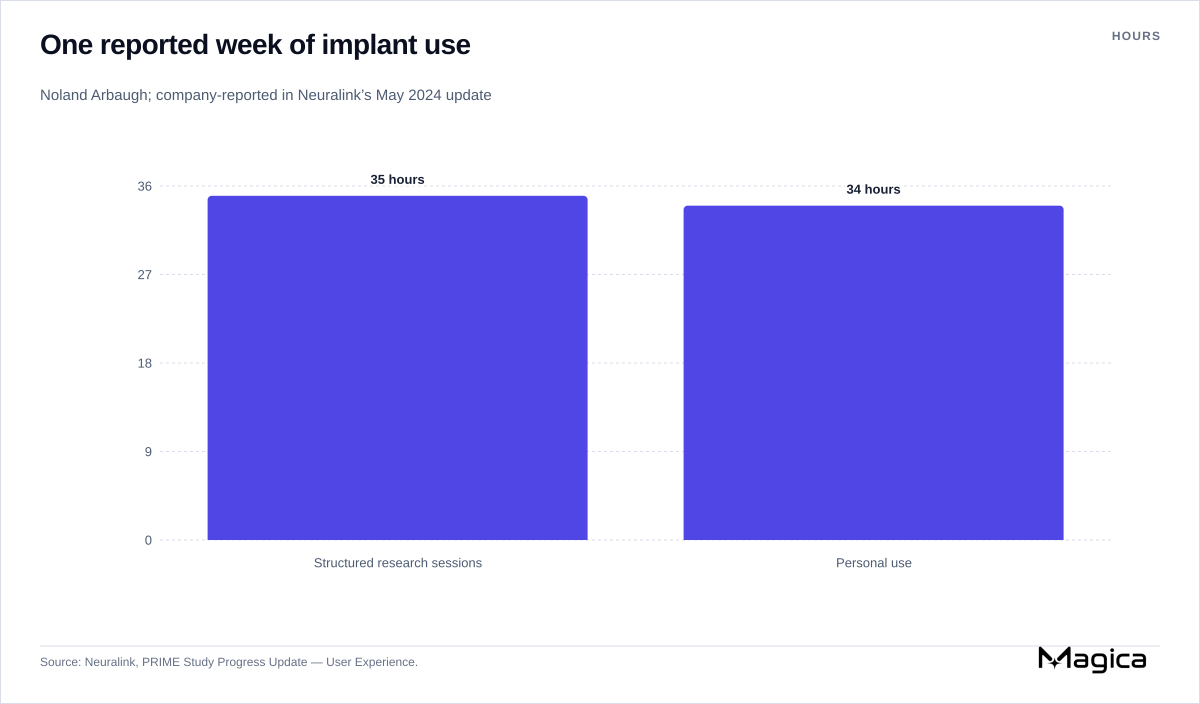
Company-reported implant use by Noland Arbaugh during one week: 35 hours in structured sessions and 34 hours of personal use. These figures do not measure GTA VI performance. Source: Neuralink study update.
In a statement reproduced in the coverage of the video, Neuralink said its devices are investigational and have not been approved by the US Food and Drug Administration or other regulators. The company also cautioned that the voluntary participants’ personal experiences may not reflect all participants or future outcomes. Trial participation therefore should not be confused with availability as a consumer gaming accessory.
The company's stated PRIME study aim includes assessing safety and usefulness in daily life, with benefit measured through independent use and quality of life. The new footage and accompanying reports do not supply input-error rates, response latency, the amount of assistance or calibration required, or sustained GTA VI performance across participants.
The next useful evidence would connect those measurements to the participant’s stated benefit: using digital devices with less discomfort and dependence on assistive equipment. The earlier usage figures show why that question can be assessed over daily life, alongside the trial’s safety evaluation.
SoftBank founder Masayoshi Son reportedly explored financing a $1 trillion acquisition of memory-chip maker SK hynix, but the company says the deal is no longer under active consideration. The target brings surging earnings, existing shareholders and customer commitments that complicate any simple equation between ownership and access to AI-memory supply.
Nvidia reported $115.8 billion in quarterly revenue, but its shares fell 14% Friday amid a wider technology selloff, a leadership transition and a reported accounting investigation. Strong cash generation offers a counterweight to concerns about the durability of AI spending.
The Nasdaq 100 fell 5.6% on November 20 and closed 19.8% below its record after an intraday bear-market breach. Nvidia’s revenue surge and Anthropic’s huge IPO did not halt the rout; infrastructure bills and resilience elsewhere in the market complicate the picture.
OpenAI reports sharply lower reasoning-extraction rates in internal GPT-6.2 tests and backs sanctions against illicit foreign distillation. Its own research and rival Anthropic’s experience show why protecting hidden reasoning leaves capability transfer and customer costs unresolved.
Alberta proposes 600-metre setbacks for large data centres and expanded utility oversight, but exemptions and rules still to be written will determine how much protection communities receive.
President Donald Trump backed Commerce Secretary Howard Lutnick as lawmakers scrutinize alleged delays in restricting a suspected route for AI chips to China. A new congressional inquiry also questions Nvidia’s influence on an existing investigation.

Amazon’s month-old Echo Time is $50 off for Black Friday. Its touchscreen, home hub and optional sleep-aware alarm cost $90 more than the reported Echo Spot price, while Alexa+ access and evidence of better waking remain key buying questions.
Merck will pair its experimental data with Isomorphic Labs’ AI to seek small-molecule cancer drug candidates. The deal follows Isomorphic’s $5 billion financing, but its payments, target and development timetable remain undisclosed.
Thinking Machines Lab released a roughly 20GB open-weights model that reuses its middle layers for reasoning. It brings the Inkling family to local hardware, with competitive coding results but workload-dependent costs and preliminary evidence on oversight.
Apple’s first HomePod mini update since 2020 adds Mac audio and four-speaker surround, but Siri AI remains unavailable, core home-hub features carry over, and reviews disagree on playback reliability.
Treasury Secretary Scott Bessent says an unnamed Anthropic founder will announce a large gift to children's investment accounts within weeks, but the amount, recipients and connection to existing philanthropic pledges remain undisclosed.
Google says air cooling will limit water use at its Visakhapatnam AI hub, but environmental proceedings and residents’ accounts raise broader questions about land, electricity, public incentives and the evidence behind promised benefits.
Nvidia slipped behind Alphabet to fourth in U.S. market value during November 20 trading. The reversal follows a steep selloff despite strong reported revenue growth, with a permanent CEO still to be chosen.
Google will close the Nest app on January 25, 2027 and retire Assistant on home speakers and displays in August. Device transfers are automatic, but continued voice access requires accepting Gemini; basic assistance remains free.

Amazon says Cairn agents exploited a MONAI Label zero-day to take over a university server. Other attacks failed, and maintainers list no patched package release.
Federal Reserve Governor Lisa D. Cook sees early AI pressure on coding, translation and young workers, but says a solid overall labor market and persistent inflation still call for tighter monetary policy.
President Donald Trump threatened a tax on U.S. companies building data centers abroad without specifying how it would work. The proposal raises questions for an AI export program that has received 78 applications and for domestic construction constrained by power and community opposition.
Donald Trump said only older chips should be sold to China while discussing a broader deal with Beijing. His remarks leave unresolved which products would qualify as Washington tightens access to American AI hardware and overseas manufacturing.
Treasury Secretary Scott Bessent expects no change to the US policy permitting limited H200 sales to China despite sparse orders. Nvidia’s earlier filing shows Chinese restrictions and tariff costs also obstruct sales, while the company warns that exclusion helps competitors.