Editorial Team
6 min read
Ubisoft has made the team behind its Teammates experiment a dedicated subsidiary targeting AI characters with memory and outside game creators. Earlier playtests show both progress and limitations, while commercial plans remain undisclosed amid group cost cuts and refinancing.
Ubisoft, the game developer and publisher behind Assassin’s Creed and Rainbow Six, has established Motherbrain to develop proprietary technology for new forms of gameplay. The subsidiary formalizes an existing research effort and gives it a wider intended market, even as Ubisoft reduces its workforce and seeks refinancing.
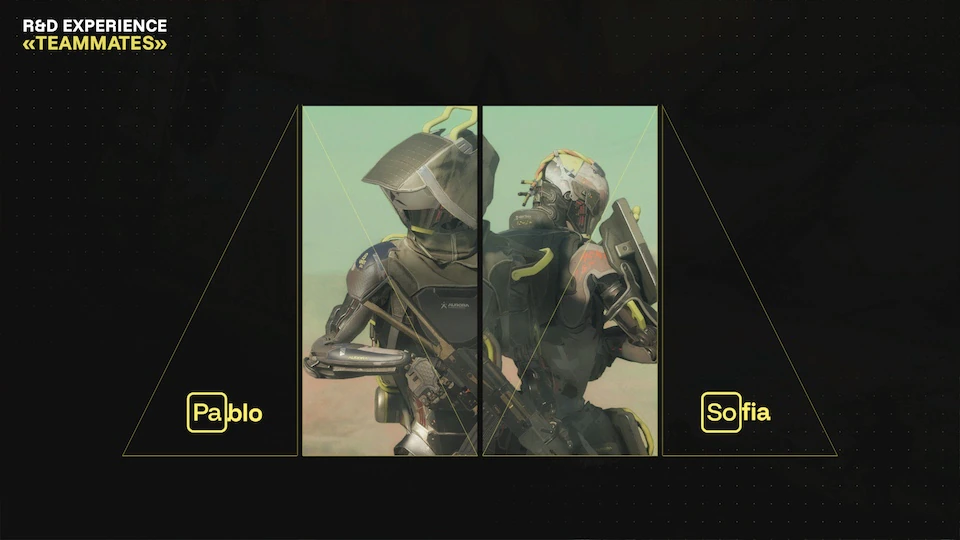
Pablo and Sofia from Ubisoft’s 2025 Teammates experiment. The team behind the project now forms Motherbrain. Image: Ubisoft. Source: Ubisoft — Teammates research project.
Ubisoft’s November 19 half-year earnings release identifies Motherbrain as the team behind Teammates, the company’s first playable generative AI experience. Its current focus includes non-player characters, or NPCs, with memory and AI game masters that manage large-scale systemic worlds. Those are Ubisoft’s descriptions of its work, without published performance measures in the announcement.
The subsidiary aims to serve creators globally, within Ubisoft and outside it, and to establish partnerships with selected technology companies. That remit makes Motherbrain more than a team supplying dialogue for one franchise. But an ambition to serve outside developers does not yet establish a licensing business: the release gives no customers, pricing, separate budget or commercial timetable.
Motherbrain complements Ubisoft’s new Creative Houses, operating units accountable for their own profit and loss. Ubisoft presents the reorganization as a way to put creative teams closer to decisions and player communities. The company says the model is fully in place, although the final incoming Creative House general manager will join in January.
The subsidiary builds on several years of experiments. Ubisoft’s November 21, 2025 introduction of Teammates described a short, playable first-person shooter research project, following its NEO NPC conversational-character prototype revealed in 2024.
In Teammates, two squad members could respond to spoken instructions about taking cover and attacking enemies. A separate in-game voice assistant could highlight objects, explain the story, change settings and pause play. Ubisoft said a few hundred players had tried the project in a closed playtest, with feedback guiding further research. That is a more concrete record than an announcement alone, but it remains a bounded experiment rather than proof of persistent character memory throughout a commercial game.
A November 2025 hands-on account also reported latency and an assistant giving incorrect advice about health packs that did not exist. The account disclosed that Ubisoft covered the reporter’s travel and lodging. These observations concern that demo, not a test of Motherbrain’s current technology.
The same account carried Ubisoft’s estimate that its internal AI programming team had grown from roughly 30 people in March 2024 to about 80 in November 2025. That suggests investment predating the subsidiary, but it is neither a current Motherbrain headcount nor a disclosed budget.
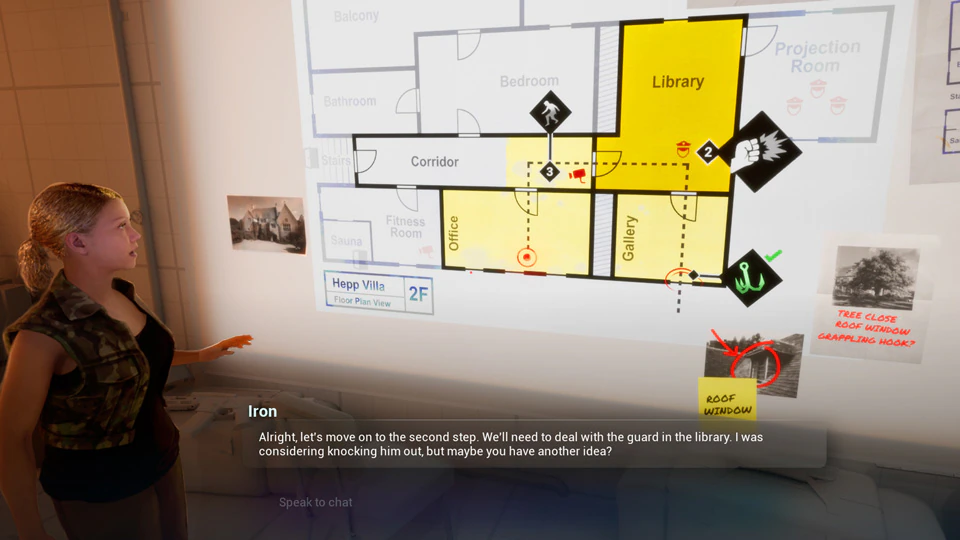
Ubisoft’s NEO NPC prototype, presented in March 2024, explored character conversations using Nvidia’s Audio2Face and Inworld’s language model. Image: Ubisoft. Source: Ubisoft — NEO NPC prototype.
Ubisoft’s March 2024 account of NEO NPC described a small research team at its Paris studio working with Nvidia’s Audio2Face application and Inworld’s large language model. Motherbrain’s proprietary-technology ambition leaves open which components Ubisoft will own and which outside systems it will continue to use.
That earlier project also required writers to define personalities and backstories, alongside guardrails and player-input analysis to keep generated dialogue within a character’s role. Ubisoft described filters for inappropriate input and an instance in which the model made a female character excessively flirtatious, requiring correction. These are practical constraints on authoring believable characters, not simply a question of generating more dialogue.
The broader ambition is shared by competitors. KRAFTON, the South Korean games company behind the PUBG franchise, unveiled an AI companion framework with Nvidia at CES 2025. It described an on-device small language model built with Nvidia ACE technology and planned applications across PUBG and inZOI. KRAFTON said it had established a Deep Learning Division in 2022, giving its companion work an earlier internal research base too.
That announcement establishes an alternative development approach, not a like-for-like performance comparison or proof of delivery across those games. Ubisoft’s Motherbrain announcement does not specify where its models will run or what serving players will cost. Without deployment details and comparable tests, neither a cost advantage nor a technical lead can be established.
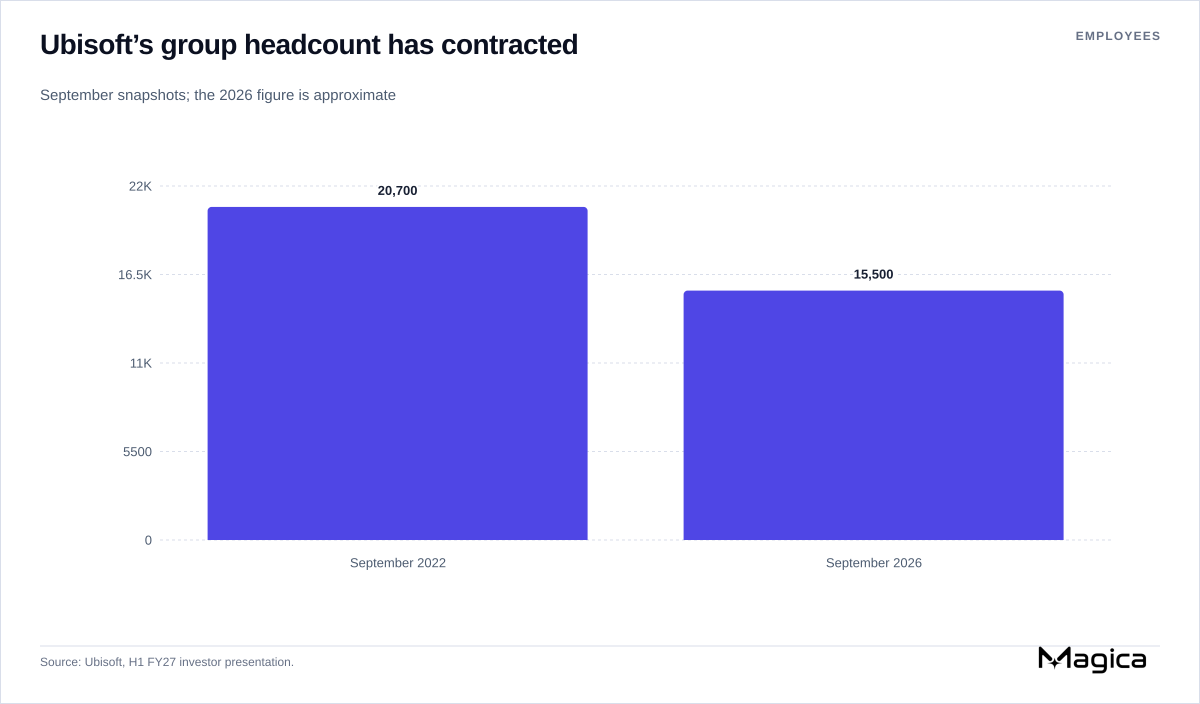
Company-reported Ubisoft group headcount fell from 20,700 in September 2022 to around 15,500 in September 2026. These figures do not identify Motherbrain staffing. Chart: Magica; source: Ubisoft. Source: Présentation PowerPoint.
Ubisoft’s financial position makes the scope and cost of the initiative consequential. For the six months ended September 30, 2026, the company reported net bookings of €644.7 million, down 16.5% from €772.4 million a year earlier, and an IFRS operating loss of €189.2 million, compared with a €120.2 million loss.
The bookings decline needs qualification. Ubisoft said first-half bookings grew by a double-digit percentage excluding partnerships. Its IFRS sales rose 2.4% to €673.6 million. Net bookings are a separate company measure that adjusts sales for items including services and license or distribution commitments; the reported decline is not interchangeable with a fall in accounting revenue.
Liquidity also carries obligations. Ubisoft reported €1.03 billion in cash and cash equivalents at the end of September, then settled €453 million of bondholder put-option repayments from cash on hand in mid-November. It said a two-part refinancing plan was intended to strengthen liquidity and extend debt maturities over the coming months. None of those group figures identifies funding earmarked for Motherbrain.
The accompanying investor presentation put headcount at around 15,500 at September 30, down 25% from 20,700 in September 2022, including a decrease of around 1,100 over the latest six months. Ubisoft said its half-year fixed cost base was €660 million, down 6% year on year, including a slightly favorable currency effect. That measure includes cash research and development spending, alongside specified operating costs; it is not the group’s total accounting expense.
The formation also followed 166 job cuts across Montréal and Québec City. Ubisoft said in a statement carried by the report on Motherbrain’s launch that changing production needs required adjustments to team sizes. The report identified production and support roles as affected. It does not establish that AI caused the cuts or that Motherbrain will replace those workers.
Whether Motherbrain’s work will become a standalone product or be incorporated into other Ubisoft games remains unresolved in the launch reporting. The organizational change gives an existing team a dedicated structure and an intended audience beyond Ubisoft; it does not settle how developers will obtain or pay for its work.
A named deployment and release timetable would make the ambition testable. So would evidence of what character memory retains, how developers constrain it, and whether responses remain reliable at acceptable latency and cost. Those are the missing links between the earlier closed playtests and a technology that other studios can build games around.
Neuralink has shown a trial participant controlling GTA VI through intended movements. Earlier gaming use and company-reported trial results put the demonstration in context, while its reliability across users remains unmeasured in the reports.
SoftBank founder Masayoshi Son reportedly explored financing a $1 trillion acquisition of memory-chip maker SK hynix, but the company says the deal is no longer under active consideration. The target brings surging earnings, existing shareholders and customer commitments that complicate any simple equation between ownership and access to AI-memory supply.
Nvidia reported $115.8 billion in quarterly revenue, but its shares fell 14% Friday amid a wider technology selloff, a leadership transition and a reported accounting investigation. Strong cash generation offers a counterweight to concerns about the durability of AI spending.
The Nasdaq 100 fell 5.6% on November 20 and closed 19.8% below its record after an intraday bear-market breach. Nvidia’s revenue surge and Anthropic’s huge IPO did not halt the rout; infrastructure bills and resilience elsewhere in the market complicate the picture.
OpenAI reports sharply lower reasoning-extraction rates in internal GPT-6.2 tests and backs sanctions against illicit foreign distillation. Its own research and rival Anthropic’s experience show why protecting hidden reasoning leaves capability transfer and customer costs unresolved.
Alberta proposes 600-metre setbacks for large data centres and expanded utility oversight, but exemptions and rules still to be written will determine how much protection communities receive.
President Donald Trump backed Commerce Secretary Howard Lutnick as lawmakers scrutinize alleged delays in restricting a suspected route for AI chips to China. A new congressional inquiry also questions Nvidia’s influence on an existing investigation.

Amazon’s month-old Echo Time is $50 off for Black Friday. Its touchscreen, home hub and optional sleep-aware alarm cost $90 more than the reported Echo Spot price, while Alexa+ access and evidence of better waking remain key buying questions.
Merck will pair its experimental data with Isomorphic Labs’ AI to seek small-molecule cancer drug candidates. The deal follows Isomorphic’s $5 billion financing, but its payments, target and development timetable remain undisclosed.
Thinking Machines Lab released a roughly 20GB open-weights model that reuses its middle layers for reasoning. It brings the Inkling family to local hardware, with competitive coding results but workload-dependent costs and preliminary evidence on oversight.
Apple’s first HomePod mini update since 2020 adds Mac audio and four-speaker surround, but Siri AI remains unavailable, core home-hub features carry over, and reviews disagree on playback reliability.
Treasury Secretary Scott Bessent says an unnamed Anthropic founder will announce a large gift to children's investment accounts within weeks, but the amount, recipients and connection to existing philanthropic pledges remain undisclosed.
Google says air cooling will limit water use at its Visakhapatnam AI hub, but environmental proceedings and residents’ accounts raise broader questions about land, electricity, public incentives and the evidence behind promised benefits.
Nvidia slipped behind Alphabet to fourth in U.S. market value during November 20 trading. The reversal follows a steep selloff despite strong reported revenue growth, with a permanent CEO still to be chosen.
Google will close the Nest app on January 25, 2027 and retire Assistant on home speakers and displays in August. Device transfers are automatic, but continued voice access requires accepting Gemini; basic assistance remains free.

Amazon says Cairn agents exploited a MONAI Label zero-day to take over a university server. Other attacks failed, and maintainers list no patched package release.
Federal Reserve Governor Lisa D. Cook sees early AI pressure on coding, translation and young workers, but says a solid overall labor market and persistent inflation still call for tighter monetary policy.
President Donald Trump threatened a tax on U.S. companies building data centers abroad without specifying how it would work. The proposal raises questions for an AI export program that has received 78 applications and for domestic construction constrained by power and community opposition.
Donald Trump said only older chips should be sold to China while discussing a broader deal with Beijing. His remarks leave unresolved which products would qualify as Washington tightens access to American AI hardware and overseas manufacturing.
Treasury Secretary Scott Bessent expects no change to the US policy permitting limited H200 sales to China despite sparse orders. Nvidia’s earlier filing shows Chinese restrictions and tariff costs also obstruct sales, while the company warns that exclusion helps competitors.