Editorial Team
8 min read
New hardware orders have increased Nscale's 2027 funding needs and limited its ability to defer spending. The British AI infrastructure provider is pursuing a New York listing targeting a $35 billion valuation while financing for its Anthropic contracts remains uncommitted.
Nscale has warned that it needs additional financing to meet its forecast obligations in 2027 after ordering more AI hardware, as it prepares for a planned New York flotation. The British AI infrastructure provider is pursuing a listing targeting a $35 billion valuation, according to the report.
The company supplies data centers and graphics processing unit capacity for AI workloads. Its prospectus traces its independence to a May 2024 spinout from Arkon Energy, which builds and operates data centers serving the Bitcoin network. Founder, chief executive and chair Joshua (Josh) Payne previously founded Arkon and served as its executive chairman. Nscale's strategy is to combine power, facilities, computing equipment and software under one platform, backed largely by multiyear customer contracts.
The immediate tension is between securing equipment and preserving cash. In its November 12 amended registration statement, Nscale says it placed orders to reduce price and supply-allocation risks and mitigate delay penalties under its agreements with Anthropic, the AI company behind the Claude assistant. Those orders have also made some spending unavoidable before the necessary financing is secured.
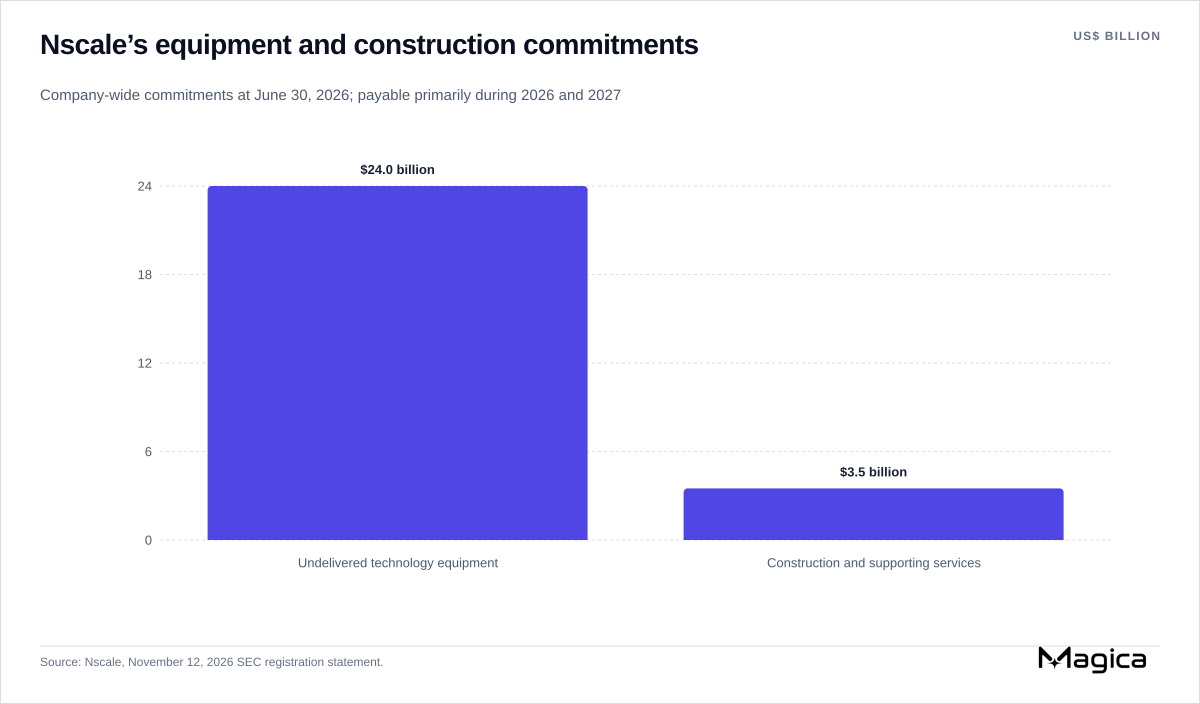
Company-reported commitments at June 30, 2026, payable primarily during 2026 and 2027. These amounts do not quantify the newly disclosed 2027 funding gap. Chart: Magica; data: Nscale. Source: SEC.
When Nscale first filed to go public in September, it said it had sufficient funds for at least the following 12 months, the report says. The amended filing now explicitly requires further financing for 2027, without specifying the size of the funding gap.
The distinction matters because management's assessment in its 2025 financial statements that substantial doubt about the company's ability to continue as a going concern had been alleviated relied partly on spending flexibility. It could defer, reduce or cancel planned capital expenditure to preserve liquidity.
Nscale says it subsequently made significant new equipment commitments and agreed initial equity financing for a portion of those purchases. That partial financing has not eliminated the additional 2027 requirement. Some new commitments cannot contractually be deferred, reduced or cancelled. The company says further financing transactions are necessary, while their timing, availability and terms remain outside its control.
That constraint also reflects the customer's protections. The Anthropic agreements impose stricter service commitments than Nscale's other customer contracts. Anthropic can terminate affected tranches if delivery delays exceed specified periods, and has termination rights for sustained failures to meet uptime thresholds. Certain industry-wide GPU supply delays are excused only if Nscale has placed binding supplier orders within a specified period. Ordering early therefore helps protect the contract while increasing Nscale's financial exposure.
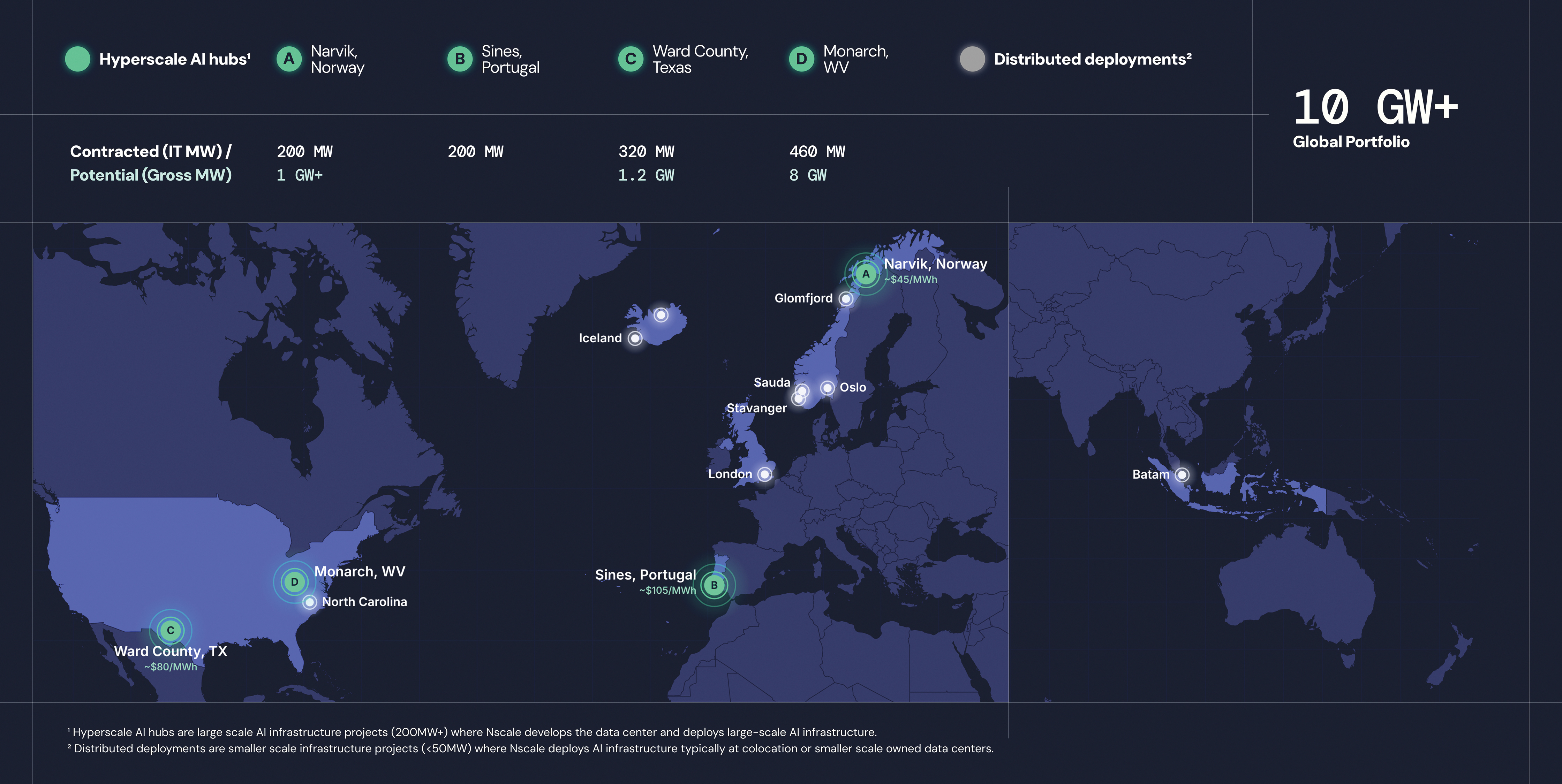
Nscale’s company-reported portfolio map locates Monarch in West Virginia alongside its other major hubs. Contracted IT capacity and potential gross power capacity are different measures. Graphic: Nscale. Source: SEC.
Nscale signed the Anthropic agreements on August 25. They provide for aggregate payments of up to approximately $44.6 billion for dedicated GPU infrastructure at the Monarch Compute Campus in Mason County, West Virginia. Services are divided into four tranches, with multiyear terms beginning when each tranche is accepted.
The filing estimates $10 billion to $10.5 billion of data-center and power expenditure for Monarch's first building, including roughly $1 billion already incurred by September 30. It separately estimates $21 billion to $22 billion for GPUs and other computing equipment at the campus.
Nscale says it has no binding commitments for any of the financing required to perform the Anthropic agreements. It nevertheless believes it can obtain the financing within the required period, citing discussions with market participants and its record of securing data-center and GPU funding. The agreements specify no minimum financing amount. A report citing people familiar with the matter describes a six-month window to secure funding for the facility and GPUs; the filing describes a specified period that can be extended by agreement.
The company's operating footprint shows how much expansion still lies ahead. At the prospectus date, Nscale reported approximately 50,000 active GPUs against 461,000 active and contracted GPUs combined. Its predominantly multiyear, take-or-pay business model offers contracted demand, but contract terms begin after successful delivery of the computing infrastructure.
Nscale argues that owning facilities in low-cost power markets will lower its computing costs. Much of that model is still being built: most active capacity currently uses colocation or leased deployments, while the substantial majority of contracted capacity is at wholly owned sites. Its filing identifies specialist GPU clouds including CoreWeave and Nebius, alongside established cloud platforms, as competitors. The cost advantage Nscale seeks depends partly on bringing its owned facilities into operation.
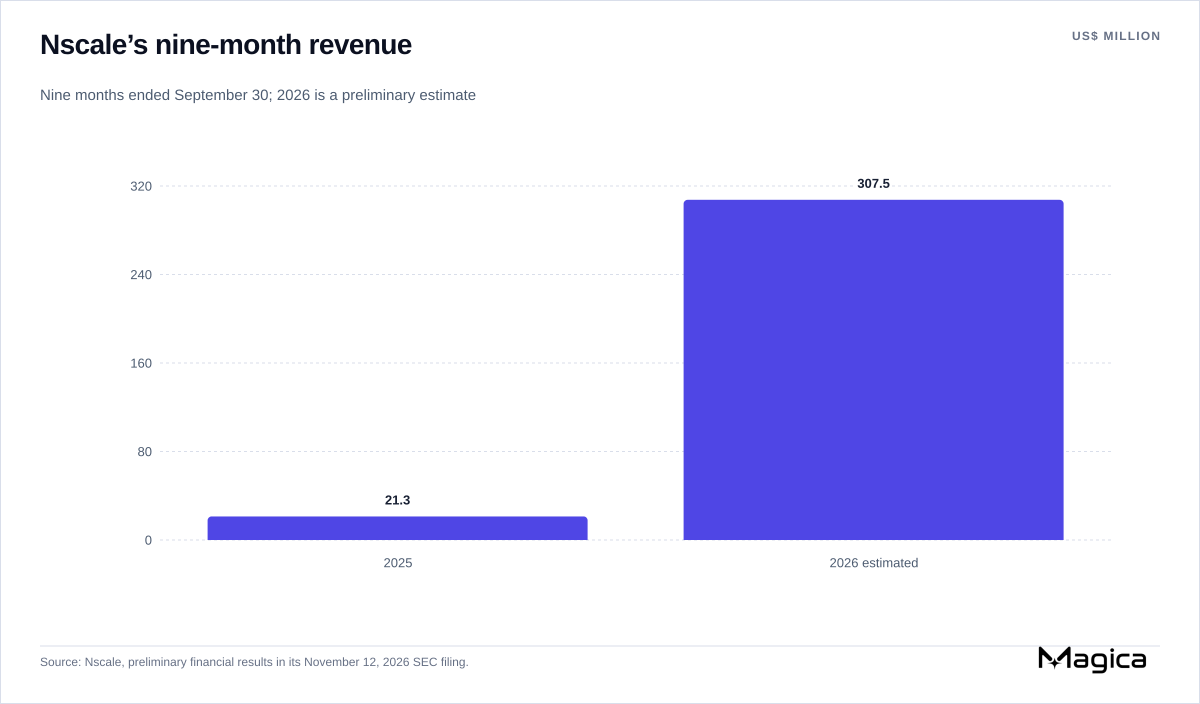
Company-reported revenue for the nine months ended September 30. The 2026 estimate is preliminary, subject to change and has not been independently reviewed or audited. Chart: Magica; data: Nscale. Source: SEC.
Nscale's preliminary, unaudited estimates put revenue for the nine months ended September 30, 2026 at $307.5 million, compared with $21.3 million a year earlier. It estimated an operating loss of $837.5 million and a net loss of $1.69 billion. The latter included $629.9 million of losses on fair-value adjustments, so the net-loss figure should not be read as a measure of cash consumed. The estimates remain subject to change and have not been reviewed or audited by the company's independent accounting firm.
Estimated cash and cash equivalents stood at $3.58 billion at September 30, against total debt of $5.52 billion. Separately, at June 30, Nscale had $24 billion of outstanding orders for undelivered technology equipment and $3.5 billion of construction and supporting-service commitments, payable primarily during 2026 and 2027. These figures cover different reporting dates and company-wide commitments; subtracting cash from them would not establish the new 2027 funding gap.
Microsoft statements of work originally provided for up to approximately $43.8 billion in payments through December 2033, excluding optional extensions. A $3.22 billion statement of work for Loughton, near London, was subsequently terminated after the power provider withdrew the scheduled connection date and allocation, Nscale's filing says. The account of the cancellation says grid access would not arrive until the 2030s. Nscale says its other Microsoft statements of work were unaffected, it is exploring alternative power sources for Loughton, and it still expects Microsoft to be a significant future customer.
That report also says Microsoft declined an option for a Texas site, where humanoid robotics company Figure subsequently contracted part of the capacity. Nscale's filing puts the Figure agreement's value at approximately $3.5 billion, with half payable in cash and half through Figure equity. The arrangement makes Nscale a shareholder as well as a supplier; only half the stated contract value is payable in cash.
Nscale's largest customer, unnamed in its concentration disclosure, accounted for 52% of revenue in the six months ended June 30, 2026. The company warns that delays or underperformance on concentrated contracts can trigger penalties and other customer remedies, creating liquidity pressure independently of fundraising.
Nscale plans to fund its requirements through debt, equity, strategic partnerships, customer prepayments and other capital raising. Its earlier fundraising offers evidence of access to capital: the filing says it has raised more than $3.3 billion through its series financings. A separate September subscription agreement covers $3.36 billion, comprising $2.36 billion of issued unsecured convertible loan notes, including investment from Nvidia, and a further $1 billion Nvidia investment expected to close around November 16. Nvidia is both an equipment supplier and a source of capital for a company buying its hardware. The anticipated investment does not change the disclosure that financing for the Anthropic agreements remains uncommitted.
The flotation also faces a weaker market for comparable AI infrastructure providers. The report on the IPO says shares in CoreWeave and Nebius fell close to 30% and 40%, respectively, over the preceding month amid investor concern about the debt-funded AI buildout.
The timetable has several pressure points. Anthropic exercised its right to negotiate additional capacity at Monarch's second building on September 29. The parties have 60 days, subject to mutual extension, to agree terms; otherwise neither retains obligations for that building and Nscale can seek another customer. Separately, September convertible notes carry annual interest that rises from 2% to 3% on June 30, 2027, and to 5.5% on December 30, 2027, as detailed in the filing and this analysis. The issued convertible notes automatically convert into shares when the offering completes.
The revised prospectus does not confirm an IPO postponement. The next evidence investors need is binding financing commitments, their cost and conditions, and whether they arrive before equipment payments and contractual delivery deadlines.
Treasury Secretary Scott Bessent said agencies had backed export restrictions on Nvidia customer Megaspeed for months. He challenged Commerce’s handling of the case and Nvidia’s safeguards, while Megaspeed denies illicit chip exports to China.
Applied Materials expects chipmaking equipment demand to rise more than 30% in 2027, while supplier capacity and factory readiness will determine how much demand becomes sales.
Shi Bingzhe and two companies face money laundering charges over 917 servers allegedly acquired from Aperia International. The case now covers five individuals and six companies, but the new charges do not establish the servers’ chip contents or ultimate destination.
Nothing’s December AI device has appeared with red and green lights and an apparent recording button. The clues suggest an audio tool, but existing AI recorders leave the company needing to explain its hardware, service costs and use of personal context.
Apify says an intruder accessed customer accounts and personal information or stored data. Customer notices describe credential rotations and two-factor resets, while the affected-account count and full data exposure remain unclear.
Chinese computing projects still specify Nvidia processors, but their reported values mix proposals and contracts. Conditional US licenses, Chinese restrictions, financing and customer demand complicate the path to usable capacity.
The former Huawei server business has passed Shenzhen's listing committee review for an 8 billion yuan IPO. Its growing market share and profits sit alongside negative operating cash flow and a sharp increase in short-term borrowing.
EU leaders gather for their first dedicated AI discussion, weighing investment, foreign dependencies and safety while Ukraine diplomacy competes for attention. The informal summit is a strategic discussion, with no political statement scheduled for adoption.
Commerce Secretary Howard Lutnick has agreed to voluntary Senate testimony as bipartisan scrutiny of Nvidia exports turns to government approvals and enforcement. A hearing date remains unconfirmed, and intelligence suspicions remain disputed.
The startup founded by Microsoft data-system veterans has raised $70 million across seed and Series A rounds. Its unified analytics platform targets unpredictable AI-agent workloads, but the claimed savings still need comparable performance evidence.
Samsung Electronics is reportedly in talks to buy Modine as it expands a cooling business already bolstered by FläktGroup. Modine brings fast-growing data center sales, but weaker margins and a Texas factory still ramping production complicate the potential deal.
Nvidia faced pressure to enlarge its financing backstop before Jensen Huang departed. The leadership change raises questions about support for AI customers, but interim CEO Colette Kress helped build that strategy and chip demand remains a counterweight.
Google launched Gemini 4 Hydrogen and automatic model switching in Antigravity, claiming near-Carbon task success with less quota and faster completion. Lower token rates support the efficiency pitch, but reasoning settings, mixed competitive results and inconsistent benchmark labels leave the cost of completed work to be tested.
Japan is considering safety and reporting duties backed by enforceable orders for advanced AI. The proposal would strengthen its nonbinding framework, but capability thresholds, covered businesses and penalties remain unresolved.
Google says its new fast AI model is reaching Search users worldwide, improving complex answers and source discovery. The rollout expands access to Gemini 4, but its effect on answer quality and website traffic remains unmeasured.
Four nonprofits are asking a California court to stop five AI developers from building or deploying more capable systems. The case seeks enforceable limits even as OpenAI has previously reported a training pause and is launching defensive AI tools.
Expo Simulators gives coding agents remote iOS and Android environments with recordings for reviewers. The launch extends Expo's cloud development services into verification, with per-minute charges and shared capacity limits.
Kleiner Perkins and Clearlake Capital led Mirendil’s $1 billion Series A. Its agent-led model-building experiment points to smaller research teams, but company benchmarks, substantial compute costs and a private beta qualify the promise of wider access.
Mount Thor raised $45 million in equity, alongside separate hardware financing, to expand Apple infrastructure for AI agents and model inference. Existing Mac clouds and workload-specific performance limits put its demand and cost claims to the test.
Salesforce Ventures led a Series C that values Q-CTRL above $1 billion. The funding backs GPS-free navigation and quantum computing software, while undisclosed revenue and contested performance benchmarks leave the commercial case open.