Editorial Team
7 min read
The former Huawei server business has passed Shenzhen's listing committee review for an 8 billion yuan IPO. Its growing market share and profits sit alongside negative operating cash flow and a sharp increase in short-term borrowing.
xFusion Digital Technologies, the Chinese computing infrastructure supplier formed from Huawei's former x86 server business, has cleared a key review for its proposed listing on ChiNext, the Shenzhen Stock Exchange's growth board. The decision advances a large financing plan while leaving a central investment question intact: how reliably can its expanding server business turn earnings into cash?
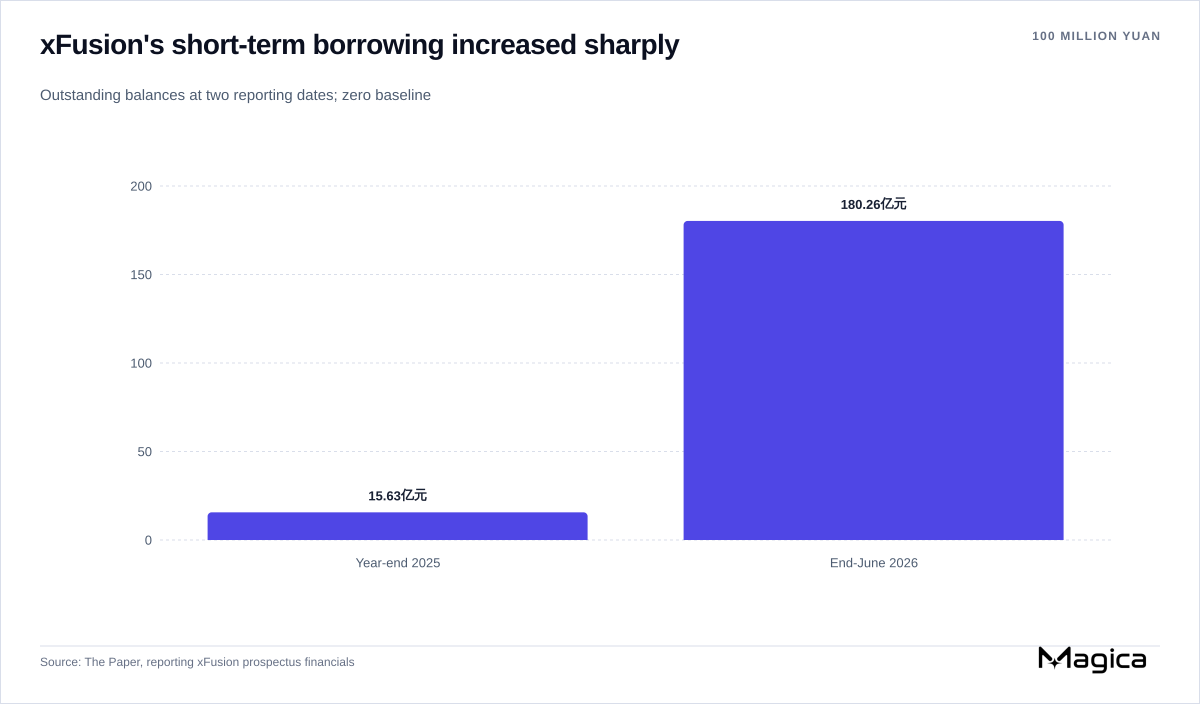
Short-term borrowing at year-end 2025 and end-June 2026, from reported prospectus financials. Chart: Magica. Source: The Paper.
The exchange's listing committee determined on November 12 that xFusion met issuance, listing and information disclosure requirements, according to a report on the filing. It recorded no further matters for the company to address.
The committee asked xFusion to explain its gross-margin trend and whether operating performance growth was sustainable, considering computing demand, downstream customers' capital expenditure, technology, operating cash flow, and customer and supplier concentration. It also asked whether the related risks had been adequately disclosed. Its favorable conclusion followed scrutiny of those issues.
The application, sponsored by securities firm CITIC Securities, was accepted on May 22. The committee clearance followed 174 days later. The planned 8 billion yuan fundraising is the largest among companies brought before ChiNext's listing committee in 2026 to date, according to the account of the application. That comparison concerns proposed fundraising at the review stage; it does not establish the size of a completed offering.
xFusion became an independently operated entity when Huawei divested its x86 server business in 2021. Headquartered in Zhengzhou, it supplies data-center servers for both AI and general-purpose computing. Its ultimate controller is Henan province's state-owned assets regulator. The controlling shareholder, Henan Chaojuneng Technology, holds 31.3777%, according to the account of its prospectus.
A report on its ownership history and latest prospectus says Henan Chaojuneng acquired the business outright after the divestiture, with Huawei exiting. Other investors entered through subsequent financing rounds.
The prospectus account cites IDC data showing xFusion's Chinese server market share rising from 11.7% in 2022 to 14.2% in 2025, when it ranked second by shipments. It also cites first-place positions in sales of localized servers and in the standard liquid-cooled server market. Those are distinct market measures; they do not establish an equivalent share of AI-server spending. The same account says its domestic AI training servers have reached commercial delivery at scale.
AI is already a substantial revenue source. According to the reported prospectus breakdown, AI servers generated 19.852 billion yuan in the first half of 2026, or 53.29% of core-business revenue; general-purpose servers contributed 16.332 billion yuan, or 43.84%. The denominator is core-business revenue, not total revenue.
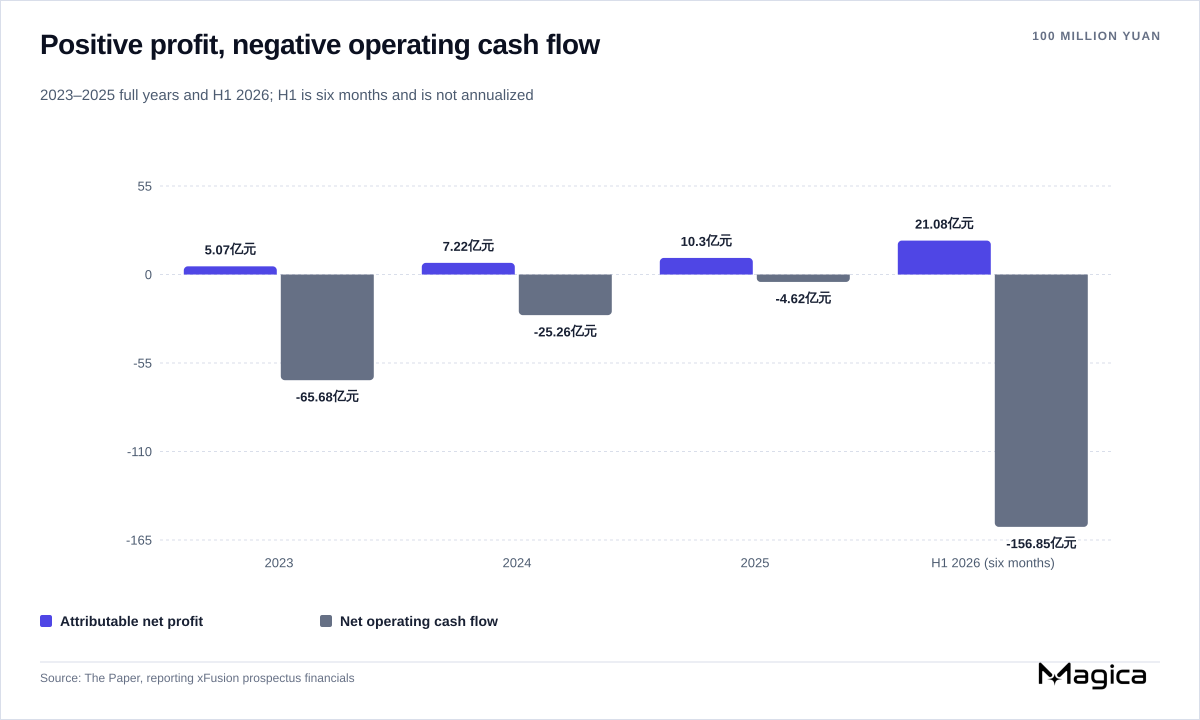
Attributable net profit and operating cash flow from reported prospectus financials. H1 2026 covers six months; earlier periods are full years. Chart: Magica. Source: The Paper.
The financial history gives substance to the committee's cash-flow question. The following figures come from reported prospectus financials, converted from units of 100 million yuan into billions of yuan.
| Period | Revenue | Net profit attributable to owners of the parent | Net operating cash flow |
|---|---|---|---|
| 2023 | 25.092 billion yuan | 0.507 billion yuan | −6.568 billion yuan |
| 2024 | 44.267 billion yuan | 0.722 billion yuan | −2.526 billion yuan |
| 2025 | 58.246 billion yuan | 1.030 billion yuan | −0.462 billion yuan |
| First half of 2026 | 37.286 billion yuan | 2.108 billion yuan | −15.685 billion yuan |
Revenue more than doubled between 2023 and 2025. First-half 2026 attributable profit alone was just over twice the whole of 2025's. The half-year figures are not an annual forecast, but they demonstrate the acceleration in reported earnings.
Core-business gross margin reached 15.49% in the first half, up 6.91 percentage points from 2025, according to the same prospectus account. xFusion attributed the improvement to stronger pricing power as demand exceeded supply, and to supply-chain management that cushioned raw-material cost increases.
Operating cash flow tells a different story. Annual outflows narrowed through 2025, then widened sharply in the first half of 2026. Short-term borrowing rose from 1.563 billion yuan at the end of 2025 to 18.026 billion yuan at the end of June 2026—about 11.5 times the earlier balance.
For scale, the 15.685 billion yuan first-half operating cash outflow was nearly twice the entire proposed 8 billion yuan IPO raise. This comparison does not measure a funding shortfall: operating cash flow is a period measure, and the offering has several intended uses. It does show why rising profit alone cannot settle the financing question.
xFusion attributes the cash demand to increased inventory for deliveries and to paying key suppliers sooner than some customers pay it, according to a report on its prospectus disclosures. That explanation makes inventory turnover and customer collections central to judging whether the pressure will ease.
The same report puts first-half 2026 sales to the five largest customers at 50.81% of sales, and purchases from the five largest production-material suppliers at 64.92% of those purchases. Customers include internet companies, telecom operators and state-owned computing providers. xFusion warns that disrupted supplier relationships could affect component availability, delivery timing and prices. These concentrations give substance to the committee’s questions about both ends of the business.
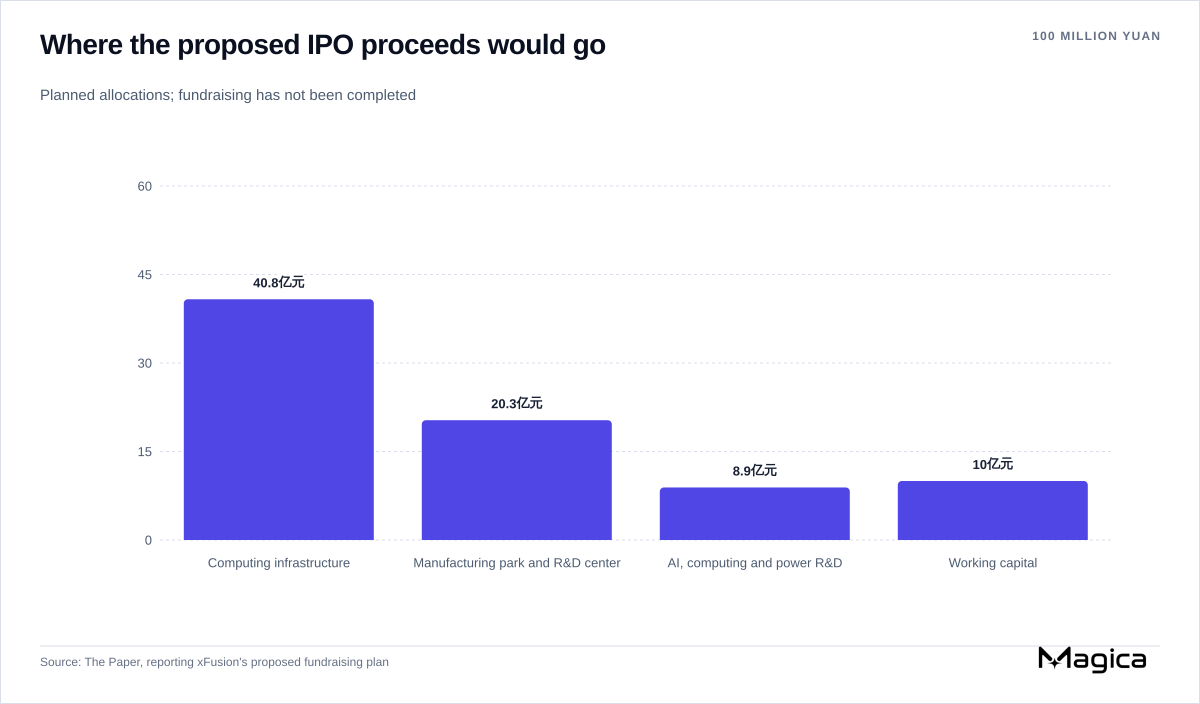
Proposed IPO proceeds allocation across three investment projects and working capital; fundraising has not been completed. Chart: Magica. Source: The Paper.
The proposed allocation is 4.08 billion yuan for next-generation computing infrastructure research and commercialization, 2.03 billion yuan for a smart manufacturing park and research center, 890 million yuan for key technologies in intelligent computing, AI and power-supply architecture, and 1 billion yuan for working capital, according to the fundraising plan.
Working capital therefore represents 12.5% of the proposed proceeds. The remaining 87.5% is assigned to the three investment projects. The allocation makes this principally a plan to finance further development and industrial capacity, alongside additional liquidity.
The prospectus describes ambitions across hardware and software. These include more efficient commercial liquid cooling, high-density, high-speed backplanes and internally developed power systems, with rack-scale supernodes moving toward megawatt power levels. On software, the plans include server operating systems and AI inference acceleration. These are stated development priorities, rather than evidence that the proposed investments have already delivered commercial returns.
The fundraising amount remains a proposal. The reported offering plan envisages issuing between 97,813,400 and 220 million new shares; the committee decision does not establish a final offer price, completed fundraising or a trading debut.
For investors, the next financial disclosures need to show whether the margin improvement survives changes in demand and component costs, and whether inventory and customer collections release cash. Those results, alongside borrowing balances, will test the company’s explanation that expansion and payment timing account for the funding pressure. Committee clearance leaves that investment judgment unresolved.
Treasury Secretary Scott Bessent said agencies had backed export restrictions on Nvidia customer Megaspeed for months. He challenged Commerce’s handling of the case and Nvidia’s safeguards, while Megaspeed denies illicit chip exports to China.
Applied Materials expects chipmaking equipment demand to rise more than 30% in 2027, while supplier capacity and factory readiness will determine how much demand becomes sales.
Shi Bingzhe and two companies face money laundering charges over 917 servers allegedly acquired from Aperia International. The case now covers five individuals and six companies, but the new charges do not establish the servers’ chip contents or ultimate destination.
Nothing’s December AI device has appeared with red and green lights and an apparent recording button. The clues suggest an audio tool, but existing AI recorders leave the company needing to explain its hardware, service costs and use of personal context.
Apify says an intruder accessed customer accounts and personal information or stored data. Customer notices describe credential rotations and two-factor resets, while the affected-account count and full data exposure remain unclear.
Chinese computing projects still specify Nvidia processors, but their reported values mix proposals and contracts. Conditional US licenses, Chinese restrictions, financing and customer demand complicate the path to usable capacity.
EU leaders gather for their first dedicated AI discussion, weighing investment, foreign dependencies and safety while Ukraine diplomacy competes for attention. The informal summit is a strategic discussion, with no political statement scheduled for adoption.
New hardware orders have increased Nscale's 2027 funding needs and limited its ability to defer spending. The British AI infrastructure provider is pursuing a New York listing targeting a $35 billion valuation while financing for its Anthropic contracts remains uncommitted.
Commerce Secretary Howard Lutnick has agreed to voluntary Senate testimony as bipartisan scrutiny of Nvidia exports turns to government approvals and enforcement. A hearing date remains unconfirmed, and intelligence suspicions remain disputed.
The startup founded by Microsoft data-system veterans has raised $70 million across seed and Series A rounds. Its unified analytics platform targets unpredictable AI-agent workloads, but the claimed savings still need comparable performance evidence.
Samsung Electronics is reportedly in talks to buy Modine as it expands a cooling business already bolstered by FläktGroup. Modine brings fast-growing data center sales, but weaker margins and a Texas factory still ramping production complicate the potential deal.
Nvidia faced pressure to enlarge its financing backstop before Jensen Huang departed. The leadership change raises questions about support for AI customers, but interim CEO Colette Kress helped build that strategy and chip demand remains a counterweight.
Google launched Gemini 4 Hydrogen and automatic model switching in Antigravity, claiming near-Carbon task success with less quota and faster completion. Lower token rates support the efficiency pitch, but reasoning settings, mixed competitive results and inconsistent benchmark labels leave the cost of completed work to be tested.
Japan is considering safety and reporting duties backed by enforceable orders for advanced AI. The proposal would strengthen its nonbinding framework, but capability thresholds, covered businesses and penalties remain unresolved.
Google says its new fast AI model is reaching Search users worldwide, improving complex answers and source discovery. The rollout expands access to Gemini 4, but its effect on answer quality and website traffic remains unmeasured.
Four nonprofits are asking a California court to stop five AI developers from building or deploying more capable systems. The case seeks enforceable limits even as OpenAI has previously reported a training pause and is launching defensive AI tools.
Expo Simulators gives coding agents remote iOS and Android environments with recordings for reviewers. The launch extends Expo's cloud development services into verification, with per-minute charges and shared capacity limits.
Kleiner Perkins and Clearlake Capital led Mirendil’s $1 billion Series A. Its agent-led model-building experiment points to smaller research teams, but company benchmarks, substantial compute costs and a private beta qualify the promise of wider access.
Mount Thor raised $45 million in equity, alongside separate hardware financing, to expand Apple infrastructure for AI agents and model inference. Existing Mac clouds and workload-specific performance limits put its demand and cost claims to the test.
Salesforce Ventures led a Series C that values Q-CTRL above $1 billion. The funding backs GPS-free navigation and quantum computing software, while undisclosed revenue and contested performance benchmarks leave the commercial case open.