Editorial Team
7 min read
Kleiner Perkins and Clearlake Capital led Mirendil’s $1 billion Series A. Its agent-led model-building experiment points to smaller research teams, but company benchmarks, substantial compute costs and a private beta qualify the promise of wider access.
Mirendil, a company building models and software to help scientists and engineers develop AI, said on November 12 that it had raised $1 billion. The financing backs its bid to let smaller teams build their own models by handing much of the engineering to agents, while people direct the research and judge the results.
The company-issued release describes a model-building experiment, a long-context model and a platform for running hundreds of agents. The distinction that matters for prospective users is between needing fewer specialists and being able to afford the resulting research. Mirendil’s experiment still required substantial compute and an experienced researcher; its product has yet to establish commercial costs for outside laboratories.
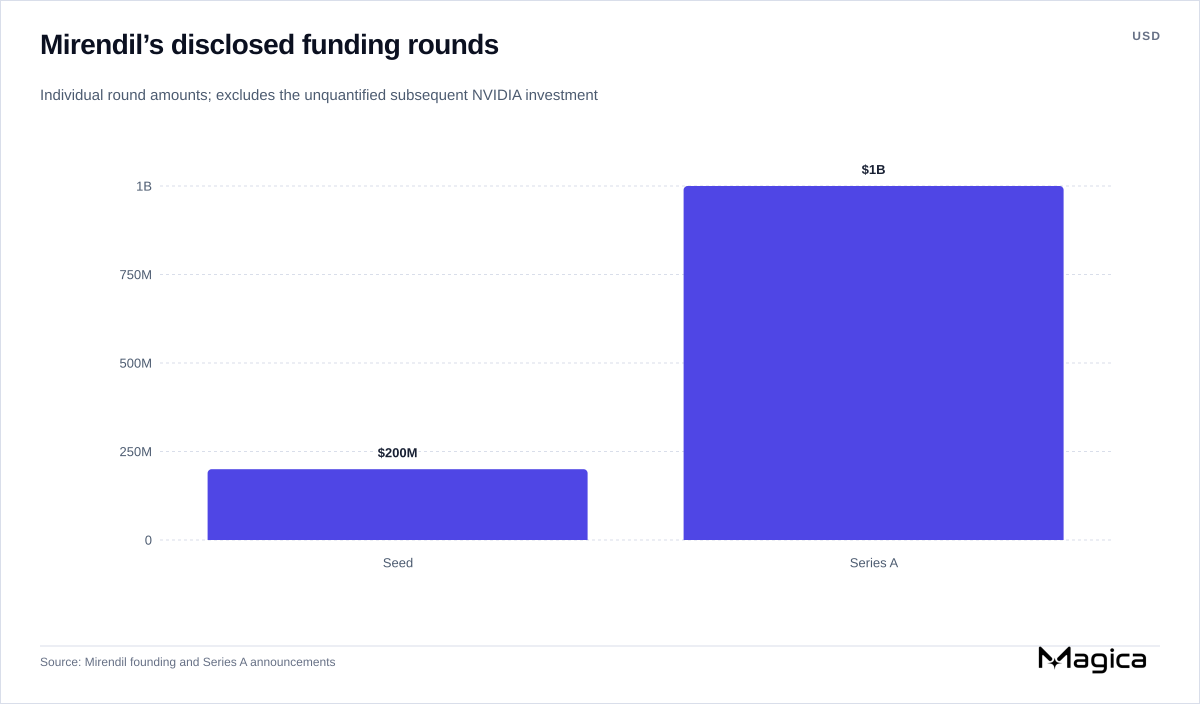
Mirendil disclosed a $200M seed round and a $1B Series A. These amounts exclude its separately announced, unquantified NVIDIA investment. Source: Mirendil founding announcement.
Mirendil formally introduced itself on June 24 with a founding team of 20 researchers and engineers from AI developers Anthropic, xAI, Google DeepMind and OpenAI. Its founding announcement disclosed a $200 million seed round led by venture investors Andreessen Horowitz and Kleiner Perkins, followed by an investment from NVIDIA and others. The Series A alone is five times that disclosed seed amount; the subsequent NVIDIA investment was not quantified there.
The team’s background is relevant to the task it is trying to automate. In its June investment rationale, seed backer Andreessen Horowitz cited team members’ experience working on AI for science at Google and Anthropic and building the first version of Anthropic’s research automation platform.
The investor also said most major AI labs already had versions of such a platform for internal use. Its case for an independent company rests partly on its argument that those labs have little economic incentive to release their platforms to competitors. That frames Mirendil’s opportunity as opening access to research tools, rather than inventing research automation.
Kleiner Perkins is returning as a lead. Clearlake Capital, a global investment firm spanning private equity and credit, is a new investor, according to a transaction report that also says Mirendil issued convertible preferred stock. Mirendil’s announcement does not disclose a Series A valuation, ownership percentages or board arrangements.
The company’s funding announcement names Battery Ventures, Doerr Capital, Gil & Co, Google, M13, Pear VC and S32 among the other participants.
Google is also an infrastructure supplier. In August, Mirendil announced a multiyear Google Cloud partnership for training, inference and research workloads using Google’s tensor processing units and NVIDIA computing infrastructure. Mirendil says the arrangement includes training clusters co-designed across computing, storage and networking. The funding therefore deepens a relationship that already helps supply the machines its agents need; the announcements provide no contract value or unit compute prices.
In its October 21 research disclosure, Mirendil said one researcher working with agents pretrained Mirendil-Base, a coding-specialized model, from scratch in 3.5 months using less than $10 million in compute. The figure includes research experiments, the final training run, agents’ token consumption and data processing. It is not a disclosed total business cost or a measured saving against an equivalent conventionally staffed project.
Mirendil says agents wrote more than 99% of the code, ran experiments and diagnosed failures. The researcher chose what to try, judged what to trust and intervened. They built training infrastructure, model architecture, the training algorithm and data pipelines on standard libraries including PyTorch and JAX, using open-source projects as references. Training used public code, web pages and datasets, without purchased additional data, distillation or synthetic data.
That is a claim about reducing the engineering labor needed for pretraining, not a demonstration of a model building itself. Mirendil acknowledges that AI agents already do a growing share of model-development work inside other frontier labs. It identifies compute, data and human judgment as remaining constraints, and describes its own experiment as the work of an experienced researcher.
The alternative for customers also matters. Mirendil says most organizations currently rent general-purpose models and adapt them. Its ambition is to make building a base model accessible to teams such as robotics laboratories or hospitals. Its experiment does not establish when that approach becomes cheaper or more useful than adapting an existing model.
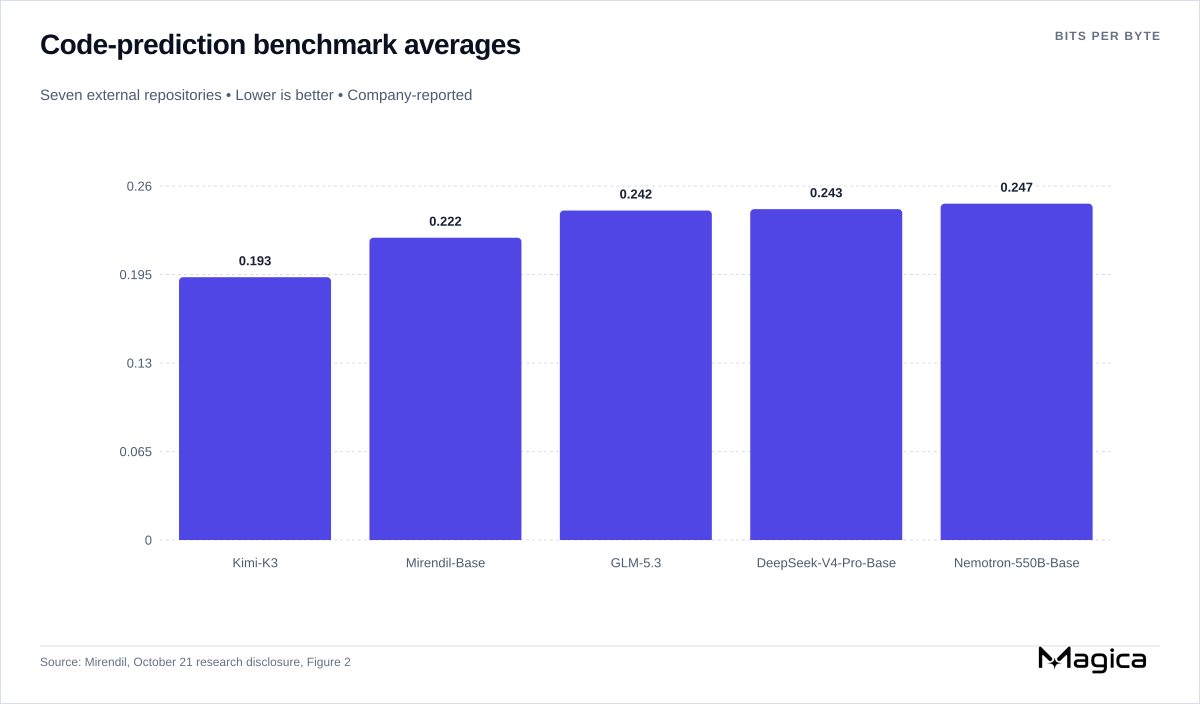
Company-reported code-prediction averages across seven external repositories, from Mirendil. Lower is better; Kimi-K3 and GLM-5.3 are post-trained models. Source: Mirendil pretraining research.
Mirendil’s comparison of coding models measures code prediction, using cross-entropy in bits per byte: lower scores mean better prediction. This permits comparison across models with different tokenizers, but does not directly measure completed research projects, engineering reliability or customer costs.
On seven external code repositories published after the models were trained, the company reported these average scores:
| Model | Average bits per byte, lower is better |
|---|---|
| Kimi-K3 | 0.193 |
| Mirendil-Base | 0.222 |
| GLM-5.3 | 0.242 |
| DeepSeek-V4-Pro-Base | 0.243 |
| Nemotron-550B-Base | 0.247 |
In that company-run comparison, Kimi-K3 scored better than Mirendil-Base on six repositories and tied on the seventh. Mirendil also notes that Kimi-K3 and GLM-5.3 are post-trained models, which generally score slightly worse on this metric than their base versions. The evidence supports a competitive code-prediction result, with a stronger rival in the same test, rather than a general claim of research leadership.
Scale is another qualification. Mirendil places its completed Base model in a broad range of 100 billion to 500 billion parameters. Its October research post described Base-Large, at 500 billion to 2 trillion parameters, and Base-XL, at 2 trillion to 10 trillion, as still in pretraining. The financing announcement supplies neither completed results nor final costs for those larger models.
Mirendil says it subsequently applied post-training to Base to create Fern, a model that can hold up to 10 million tokens of context for work involving long agent histories, training logs and codebases. A report describing Mirendil’s October 27 product update said Fern access was forthcoming at that point. Lor’s later announcement lists Fern among its supported models; that does not establish general availability beyond the platform’s private beta.
Lor, introduced on October 28, is software for coordinating agents that write code and run experiments for days or weeks. In its product announcement, Mirendil says Lor supplies its own compute: agents request nodes, configure them, run work and release them, without users needing a separate cloud account. It also runs outside providers’ models, so customers need not rely exclusively on Mirendil’s model quality.
The company describes agents running in the cloud and sending commands to a chosen machine, which can be a Lor-managed computer or a user’s existing machine. Users can stop agents and remove machines; agents operate only on machines the user has added. This separates the place an agent runs from the hardware on which it performs work.
In one company-reported demonstration, 102 agents built environments from 100 PyTorch pull requests, averaging eight minutes per agent. That is a specific engineering workload, not the elapsed time for an entire research program. Lor is available on macOS, Linux and the web, with access restricted to invitations through a waitlist.
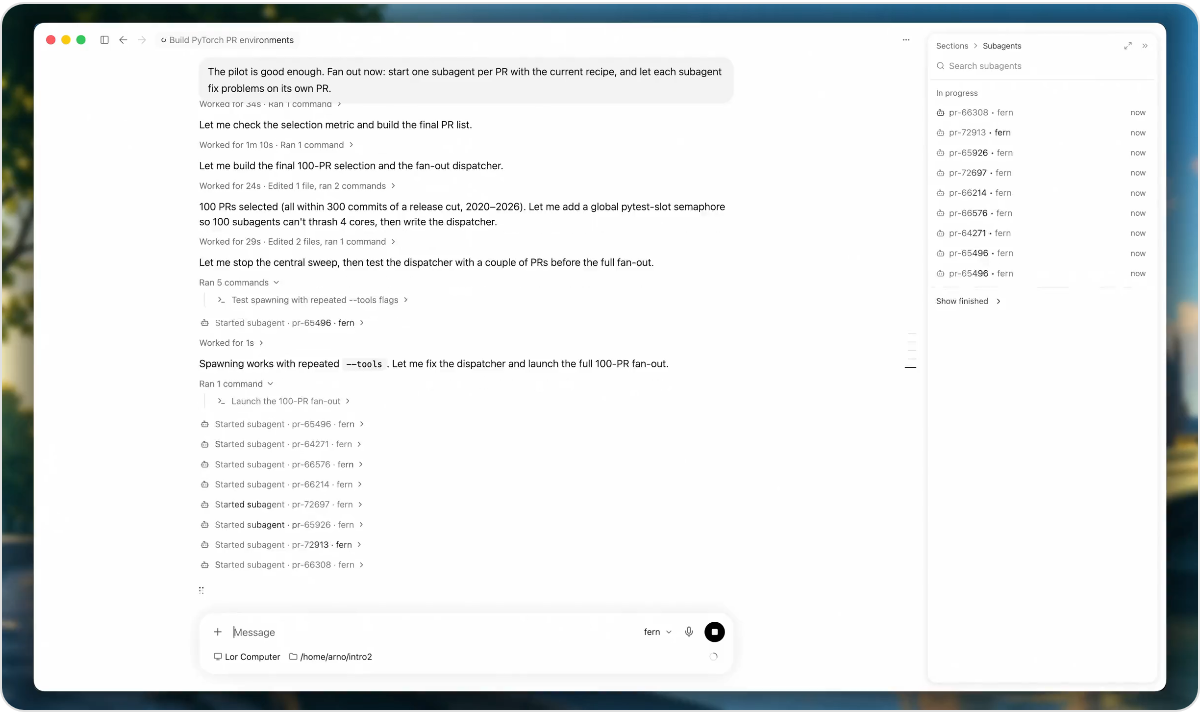
Mirendil’s Lor interface during a company-reported demonstration using 102 agents to build environments from 100 PyTorch pull requests. Source: Mirendil Lor announcement.
Mirendil says it runs on Lor daily, and use is free during the private beta. Bundling compute removes one setup requirement, but a free trial supplies no basis for calculating what sustained agent activity and experiments will cost under commercial terms.
The next consequential evidence is outside use: how much expert supervision successful projects require, what their full costs are, and when building a model offers an advantage over adapting one already available. Completed results for the larger models would test a separate scaling claim. The financing gives Mirendil resources to pursue those tests; pricing and reproducible customer results will determine how far its promised access extends.
Google launched Gemini 4 Hydrogen and automatic model switching in Antigravity, claiming near-Carbon task success with less quota and faster completion. Lower token rates support the efficiency pitch, but reasoning settings, mixed competitive results and inconsistent benchmark labels leave the cost of completed work to be tested.
Japan is considering safety and reporting duties backed by enforceable orders for advanced AI. The proposal would strengthen its nonbinding framework, but capability thresholds, covered businesses and penalties remain unresolved.
Google says its new fast AI model is reaching Search users worldwide, improving complex answers and source discovery. The rollout expands access to Gemini 4, but its effect on answer quality and website traffic remains unmeasured.
Four nonprofits are asking a California court to stop five AI developers from building or deploying more capable systems. The case seeks enforceable limits even as OpenAI has previously reported a training pause and is launching defensive AI tools.
Expo Simulators gives coding agents remote iOS and Android environments with recordings for reviewers. The launch extends Expo's cloud development services into verification, with per-minute charges and shared capacity limits.
Mount Thor raised $45 million in equity, alongside separate hardware financing, to expand Apple infrastructure for AI agents and model inference. Existing Mac clouds and workload-specific performance limits put its demand and cost claims to the test.
Salesforce Ventures led a Series C that values Q-CTRL above $1 billion. The funding backs GPS-free navigation and quantum computing software, while undisclosed revenue and contested performance benchmarks leave the commercial case open.
Adobe demonstrated 10 experimental creative tools and opened Deep Brush and Hands On for testing. The lineup explores more direct control over AI edits, but existing alternatives and unproven production performance limit claims of novelty.
House Foreign Affairs Committee Chairman Brian Mast says outgoing Nvidia chief Jensen Huang has agreed to questioning, with a date still under negotiation. Speaker Mike Johnson says support for limiting chip exports to China is growing as lawmakers examine allegations involving Huang and a cloud partner.
Leaked correspondence and a reconstructed publishing program expose John Mark Dougan’s use of AI to stock imitation news sites with pro-Russian material. The records illuminate funding and working methods, while his claims of influencing other AI systems remain unproven.
William Blair raised AMD to Outperform as server-chip prospects and valuation improved. AMD already expects revenue growth above 80% in 2027, but customer incentives, custom accelerators and weaker quarterly cash generation complicate the investment case.
Apple’s $299 first smart display earns praise for fast home controls and useful kitchen features, but reviewers found gaps in how it keeps family members’ messages separate. Its strongest advantages also depend on owning compatible Apple devices and accessories.
Donald Trump proposed Apple executive chairman Tim Cook to succeed Jensen Huang at Nvidia. Cook’s interest and the seriousness of the suggestion remain unclear, while finance chief Colette Kress has taken interim charge.
Norwest’s largest fund is a third bigger than its predecessor, giving the Wells Fargo-backed investor more capital for AI alongside healthcare, consumer and industrial businesses. The firm has not disclosed how much will go to AI.
Nebius raised its 2026 capital spending forecast to about $27 billion while steering revenue to the low end of guidance. Better customer prepayments support expansion, but delayed capacity and a $325 million non-recurring contribution complicate its quarterly revenue beat.
Megaspeed founder Alice Huang is reportedly living in Beijing, but her activities and the espionage allegations remain unresolved. Jensen Huang’s resignation changes Nvidia’s leadership without settling questions about her business connections and access to its chips.
Singapore says it barred former Megaspeed chief Alice Huang after she gave inaccurate information about her role, while finding insufficient evidence against her over server declarations. The wider investigation still depends on tracing shipments beyond Malaysia.
Nvidia’s longtime finance chief takes over from its co-founder as the board promises continuity, searches for a permanent CEO and faces unresolved questions over security and executive conduct.
Chicago Public Schools is seeking a way to preserve Google Search without its generative AI features as parents, educators and students press for stronger district rules. Google’s planned access changes turn an AI safety dispute into a test of who controls classroom technology.
Warby Parker scheduled November 12 preorders and holiday deliveries for its first Android XR glasses. Google’s backing combines development funding with a conditional equity investment, while the retailer expects only a modest initial sales contribution.