Editorial Team
6 min read
Nvidia faced pressure to enlarge its financing backstop before Jensen Huang departed. The leadership change raises questions about support for AI customers, but interim CEO Colette Kress helped build that strategy and chip demand remains a counterweight.
Nvidia’s effort to mobilize $500 billion for AI infrastructure faced demands for greater financial support before Jensen Huang, its co-founder and chief executive for 33 years, stepped down. After months without deals, some customers and Wall Street partners had pressed the leading AI chip supplier to enlarge its backstop, according to a report citing people familiar with private negotiations.
The transition puts a consequential choice before interim CEO Colette Kress, who has served as Nvidia’s chief financial officer since 2013 and helped design financing deals with major customers: how much additional risk should the chip supplier accept to help fund its buyers? Her involvement in that strategy complicates predictions of an abrupt retreat.
Huang transformed Nvidia from a maker of video game graphics chips into the leading supplier of graphics processing units, or GPUs, powering AI services. The company also became a financier of customers building infrastructure for those chips. His departure puts leadership and financial support under scrutiny, but does not establish that a functioning $500 billion investment pool has disappeared.
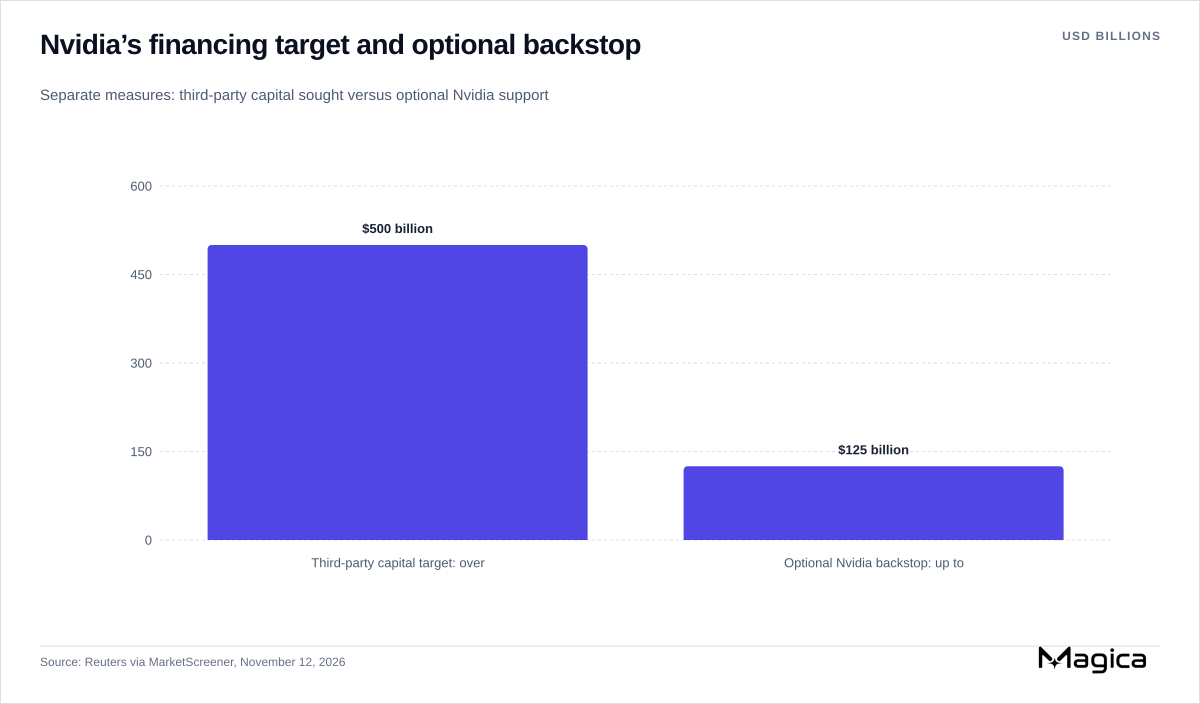
The platforms sought over $500 billion in third-party capital; Nvidia could optionally backstop up to $125 billion. Neither figure represents completed investments, and they should not be added together. Source: Reuters via MarketScreener.
Nvidia said in August that it had partnered with six major financial institutions, including asset managers Apollo, BlackRock and Blackstone, on compute financing platforms aimed at raising more than $500 billion in third-party capital for AI infrastructure. Huang said Nvidia had the option to backstop up to $125 billion, or 25% of potential deals, according to the .
Treasury Secretary Scott Bessent said agencies had backed export restrictions on Nvidia customer Megaspeed for months. He challenged Commerce’s handling of the case and Nvidia’s safeguards, while Megaspeed denies illicit chip exports to China.
Those figures describe different things: outside capital sought and optional Nvidia support. Neither measures money already invested through the platforms. The report about pressure for a larger backstop does not say how much additional support customers requested or whether Nvidia agreed.
The commercial tension is that Nvidia sells the chips while helping finance companies that buy them. Support can help projects attract lenders, but it also ties Nvidia to customers’ financial risks. Christopher Brown, senior vice president for investments at Synovus Securities, told the investor report that Nvidia’s credit support makes much of the debt financeable and that lenders would question its durability if the company’s leadership or regulatory standing were impaired.
The same report says Nvidia listed $164.5 billion in financial commitments in its most recent earnings report, including an obligation capped at $105 billion on a data center in Ohio for OpenAI, the developer of ChatGPT, and more than $50 billion in lease and other capacity guarantees. These are reported commitments, rather than cash already spent. The available reporting does not establish how they overlap with the financing platforms, so adding them to the optional $125 billion backstop would not produce a reliable total exposure.
Nvidia said Kress would become interim CEO while it searches for a permanent successor, according to the investor report. Huang’s November 12 departure followed board scrutiny of reported extramarital affairs, including a relationship with a woman alleged to be a Chinese spy.
Nvidia said over the preceding weekend that it was investigating whether Huang had been targeted by a foreign intelligence effort; China’s Foreign Ministry dismissed the spying allegations, according to a profile of Kress. Nvidia did not directly address the affairs in its Thursday announcement. The security allegations remain allegations.
Kress’s record extends beyond Nvidia. Its September 2013 CFO appointment announcement describes three years as finance chief of Cisco’s Business Technology and Operations Finance organization, following 13 years at Microsoft, including four as CFO of its Server and Tools division.
The profile identifies her as a key architect of financing deals with Nvidia customers including AI developer Anthropic and data-center operator CoreWeave. It also reports that, in her statement accepting the interim role, Kress committed to building on the foundation Huang created and continuing Nvidia’s work in accelerated computing and AI.
That is evidence of experience and an expressed intention to continue the business. It is not a commitment to enlarge guarantees or approve particular financing deals. Those choices remain open for Kress and the permanent successor.
The initial market response spread unevenly. Nvidia shares were down nearly 5% at 1600 GMT on Thursday, while Nvidia-backed CoreWeave fell more than 6%, the investor report said. South Korea’s Naver, another customer in which Nvidia had taken a $1 billion stake by financing a data-center expansion, also fell 6%.
Chipmaking rivals Broadcom and AMD rose. Chinese GPU makers Moore Threads, MetaX and Cambricon each jumped nearly 10% amid expectations that local suppliers could gain market share. These were trading reactions and expectations, rather than evidence of orders moving to competitors.
Investors quoted in the report also argued that Nvidia’s product quality was unlikely to change and demand would not quickly suffer. Anna Wu, founder of Floodlines Research, said demand for its advanced GPUs underpins the AI trade beyond any individual leader. That assessment limits the case for treating Huang’s exit as an immediate collapse in AI spending, even as customers face uncertainty about future financial support.
Nvidia’s earnings next week will give investors an opportunity to reassess the sales outlook developed under Huang and the company’s financing strategy. The useful distinction will be between existing obligations and a willingness to take additional risk to unlock new projects.
A separate test of investor appetite is approaching at Anthropic, the five-year-old AI developer behind the Claude chatbot and an Nvidia financing customer. It is seeking to raise upwards of $60 billion in an initial public offering slated for November 18, at a valuation that could exceed $1.4 trillion, according to a report on industry executives’ reactions. These are reported ambitions for an offering, not completed proceeds or an established public valuation. The investor report identifies Nvidia as an investor in the IPO.
The listing could indicate how readily public investors will fund AI businesses. It would not by itself establish whether Nvidia-backed infrastructure projects can attract capital on workable terms, or whether AI developers can become profitable.
For the stalled financing platforms, the decisive evidence will be completed transactions, the support Nvidia agrees to provide and the exposure it retains. Those terms will show whether third-party investors will commit capital—and how much risk Nvidia’s new leadership must accept to bring them in.
Applied Materials expects chipmaking equipment demand to rise more than 30% in 2027, while supplier capacity and factory readiness will determine how much demand becomes sales.
Shi Bingzhe and two companies face money laundering charges over 917 servers allegedly acquired from Aperia International. The case now covers five individuals and six companies, but the new charges do not establish the servers’ chip contents or ultimate destination.
Nothing’s December AI device has appeared with red and green lights and an apparent recording button. The clues suggest an audio tool, but existing AI recorders leave the company needing to explain its hardware, service costs and use of personal context.
Apify says an intruder accessed customer accounts and personal information or stored data. Customer notices describe credential rotations and two-factor resets, while the affected-account count and full data exposure remain unclear.
Chinese computing projects still specify Nvidia processors, but their reported values mix proposals and contracts. Conditional US licenses, Chinese restrictions, financing and customer demand complicate the path to usable capacity.
The former Huawei server business has passed Shenzhen's listing committee review for an 8 billion yuan IPO. Its growing market share and profits sit alongside negative operating cash flow and a sharp increase in short-term borrowing.
EU leaders gather for their first dedicated AI discussion, weighing investment, foreign dependencies and safety while Ukraine diplomacy competes for attention. The informal summit is a strategic discussion, with no political statement scheduled for adoption.
New hardware orders have increased Nscale's 2027 funding needs and limited its ability to defer spending. The British AI infrastructure provider is pursuing a New York listing targeting a $35 billion valuation while financing for its Anthropic contracts remains uncommitted.
Commerce Secretary Howard Lutnick has agreed to voluntary Senate testimony as bipartisan scrutiny of Nvidia exports turns to government approvals and enforcement. A hearing date remains unconfirmed, and intelligence suspicions remain disputed.
The startup founded by Microsoft data-system veterans has raised $70 million across seed and Series A rounds. Its unified analytics platform targets unpredictable AI-agent workloads, but the claimed savings still need comparable performance evidence.
Samsung Electronics is reportedly in talks to buy Modine as it expands a cooling business already bolstered by FläktGroup. Modine brings fast-growing data center sales, but weaker margins and a Texas factory still ramping production complicate the potential deal.
Google launched Gemini 4 Hydrogen and automatic model switching in Antigravity, claiming near-Carbon task success with less quota and faster completion. Lower token rates support the efficiency pitch, but reasoning settings, mixed competitive results and inconsistent benchmark labels leave the cost of completed work to be tested.
Japan is considering safety and reporting duties backed by enforceable orders for advanced AI. The proposal would strengthen its nonbinding framework, but capability thresholds, covered businesses and penalties remain unresolved.
Google says its new fast AI model is reaching Search users worldwide, improving complex answers and source discovery. The rollout expands access to Gemini 4, but its effect on answer quality and website traffic remains unmeasured.
Four nonprofits are asking a California court to stop five AI developers from building or deploying more capable systems. The case seeks enforceable limits even as OpenAI has previously reported a training pause and is launching defensive AI tools.
Expo Simulators gives coding agents remote iOS and Android environments with recordings for reviewers. The launch extends Expo's cloud development services into verification, with per-minute charges and shared capacity limits.
Kleiner Perkins and Clearlake Capital led Mirendil’s $1 billion Series A. Its agent-led model-building experiment points to smaller research teams, but company benchmarks, substantial compute costs and a private beta qualify the promise of wider access.
Mount Thor raised $45 million in equity, alongside separate hardware financing, to expand Apple infrastructure for AI agents and model inference. Existing Mac clouds and workload-specific performance limits put its demand and cost claims to the test.
Salesforce Ventures led a Series C that values Q-CTRL above $1 billion. The funding backs GPS-free navigation and quantum computing software, while undisclosed revenue and contested performance benchmarks leave the commercial case open.