Editorial Team
7 min read
Google says its new fast AI model is reaching Search users worldwide, improving complex answers and source discovery. The rollout expands access to Gemini 4, but its effect on answer quality and website traffic remains unmeasured.
Google is bringing Gemini 4 Hydrogen, the new speed-focused model in its Gemini AI family, to Search users worldwide starting November 12. It becomes the default in AI Mode, Google’s conversational search experience, and Google says it is being used for the hardest questions in AI Overviews, the generated summaries shown on search results pages.
The change puts a Gemini 4 model into the default search experience without requiring a paid subscription. Earlier Gemini 4 options in AI Mode were reserved for paying users. The consequential test is whether faster reasoning improves the answers people receive and the sites they discover—not simply whether the underlying model scores better on developer benchmarks.
Google describes Hydrogen as its biggest model upgrade to Search yet. Its Search announcement promises better intent recognition, richer visual responses and improvements across all supported AI Mode languages. Those are company claims; the announcement supplies no Search-specific accuracy or latency measurements.
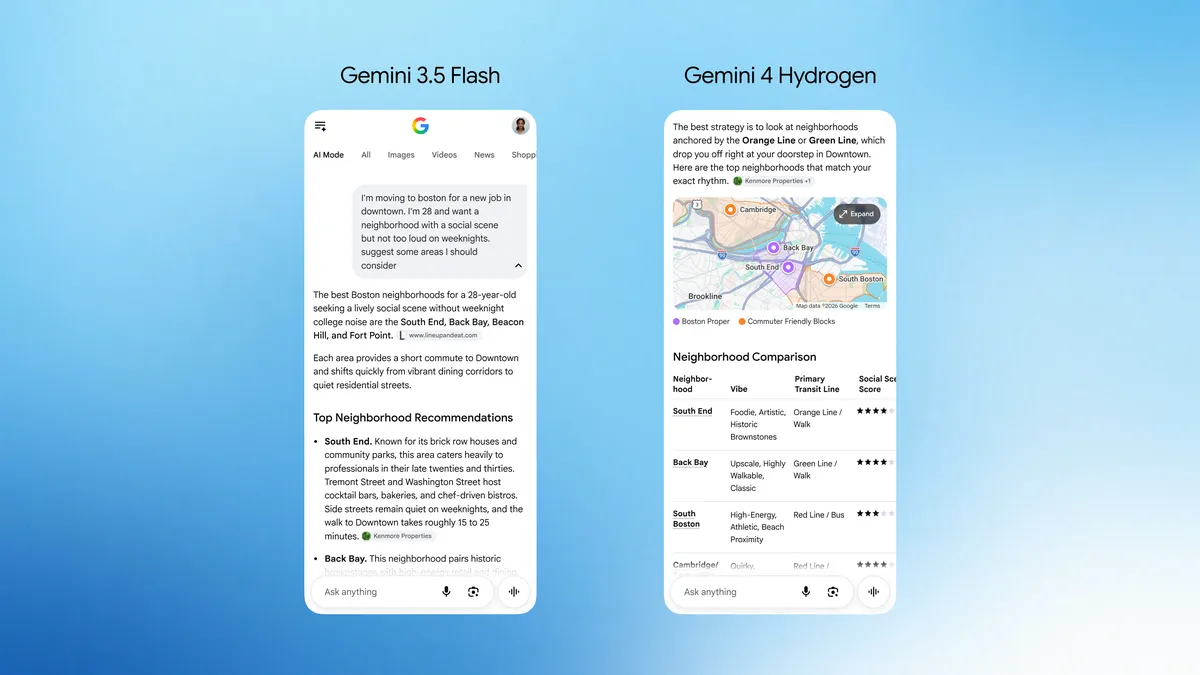
Google’s demonstration compares Boston neighborhood answers, with a map and comparison table in the Hydrogen example. This illustrates the interface rather than establishing typical performance. Image: Google. Source: Google.
Google’s announcement says Hydrogen is available globally for all Search users. The more specific division of work—default in AI Mode, hardest questions in AI Overviews—comes from Robby Stein, Google Search’s vice president of product, whose work includes developing its generative AI experiences. His statement is reproduced in the launch coverage. Google has not specified which Overview questions qualify or what answers the remainder.
The prior state is also less clear than the model numbering suggests. A report tracing AI Mode’s defaults identifies Gemini 3.5 Flash’s global default rollout in May, while noting that Google’s Hydrogen announcements do not name the model it replaces in Search. Separately, Hydrogen is positioned as the successor to Gemini 3.8 Flash across Google’s broader product lineup. The two histories should not be treated as interchangeable.
Gemini 4 Argon became an optional AI Mode choice for Google AI Pro and Ultra subscribers on October 13; Carbon began rolling out to Ultra subscribers on November 10. Google positions those models for deeper, longer-running reasoning. Hydrogen is designed for rapid execution, including agentic workflows in which software carries out several steps using tools. Its role is to make that newer model generation broadly available for everyday work.
Google says Hydrogen better interprets questions containing multiple requirements, confusing typos or highly specific instructions. Improved instruction following and tool selection are meant to help Search address each part of a request rather than lose a constraint along the way.
The company is also upgrading its existing query fan-out technique: Search breaks a question into related subtopics and runs queries simultaneously. Google says Hydrogen’s reasoning should identify a broader range of relevant links, including sites a user might otherwise miss. As coverage explaining the mechanism makes clear, the technique itself predates this release; the claimed advance is how effectively the model uses it.
Answers can include more images, comparison tables, structured information and custom tools. One reported Google demonstration used an animated driving simulation to explain how a phone locates a car’s highway lane without cell service. That illustrates the intended interface, rather than proving performance across ordinary searches.
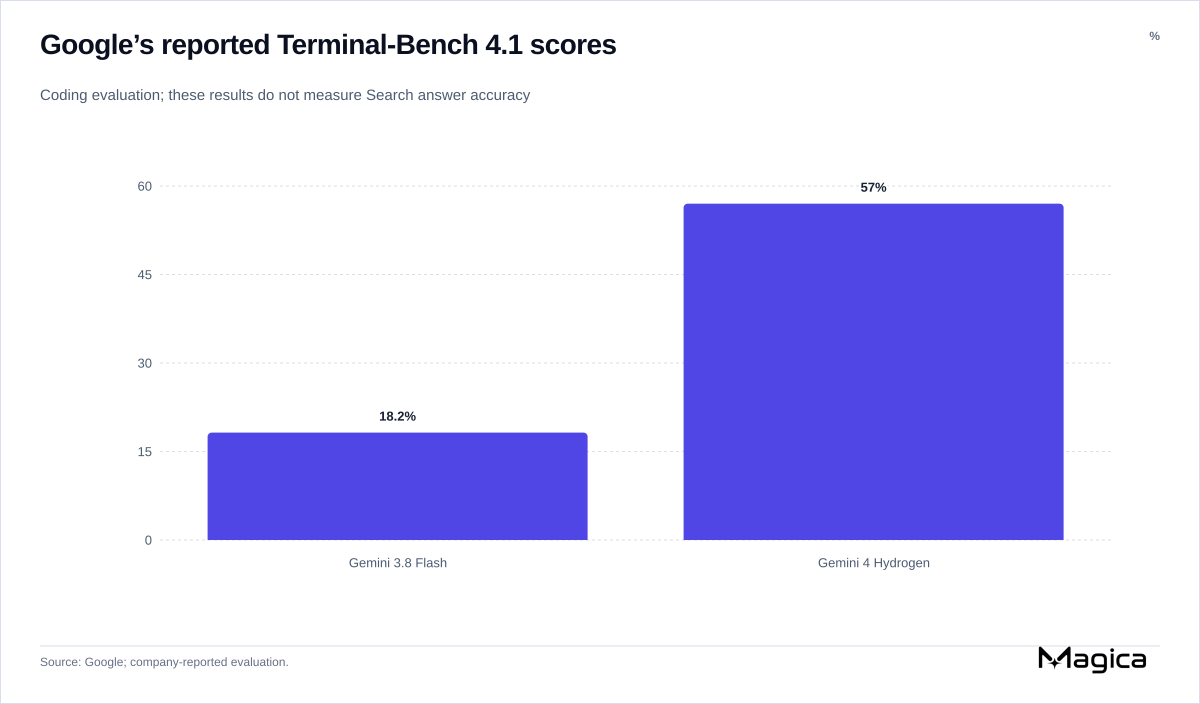
Company-reported Terminal-Bench 4.1 scores compare Hydrogen with Gemini 3.8 Flash. These coding results do not establish Search accuracy or latency. Chart: Magica; data: Google. Source: Google.
In its model announcement, Google says Hydrogen completes tasks 2.5 times faster than Gemini 3.8 Flash at its default high thinking setting. It reports a Terminal-Bench 4.1 score of 57%, compared with 18.2% for Flash, and says fabricated claims fall by more than fivefold. These are model evaluation claims, not measurements of the answers delivered by Search.
Hydrogen offers low, medium, high and xhigh thinking levels. Google reports an Artificial Analysis Intelligence Index score of 51 at high and 54 at xhigh, against 50 for Argon. Those aggregate scores do not establish superiority on every task. A report on the launch identifies Claude Sonnet 5.5 and GPT-6.1 Terra as competing models in Hydrogen’s class, relaying Google’s claim that it matches or outperforms some competitors. It supplies no like-for-like Search comparison with those alternatives.
Hydrogen’s published API prices are $1.50 per million input tokens and $7.50 per million output tokens, flat across its million-token context window. Tokens are units of model input and output. A report on the replacement says those rates are unchanged from 3.8 Flash. It puts Carbon and Argon at $2 per million input tokens and $10 per million output tokens, rising to $4 and $20 respectively next month.
Google is also introducing Orchestrator in Antigravity, its agentic coding environment, to switch between models within a session. Google says it approached Carbon’s task success rate on Terminal-Bench 4.0 while consuming 24% less quota and finishing 19% faster on average. That is a different evaluation from Hydrogen’s Terminal-Bench 4.1 result, and quota consumption is not a disclosed dollar cost. Neither API prices nor these coding results reveal Google’s internal cost or computing capacity required to serve a Search answer.
The broader release spans the Gemini API, AI Studio, business products and the separate Gemini assistant app, with Antigravity access for AI Pro and Ultra subscribers. Access rules vary by product. Although the report on the replacement describes free app users as limited to Flash-Lite, Google’s model announcement explicitly allows them to receive Hydrogen through automatic selection when appropriate. That exception is also reflected in coverage of the app’s model choices. Worldwide Search availability does not establish unrestricted manual access across every product.
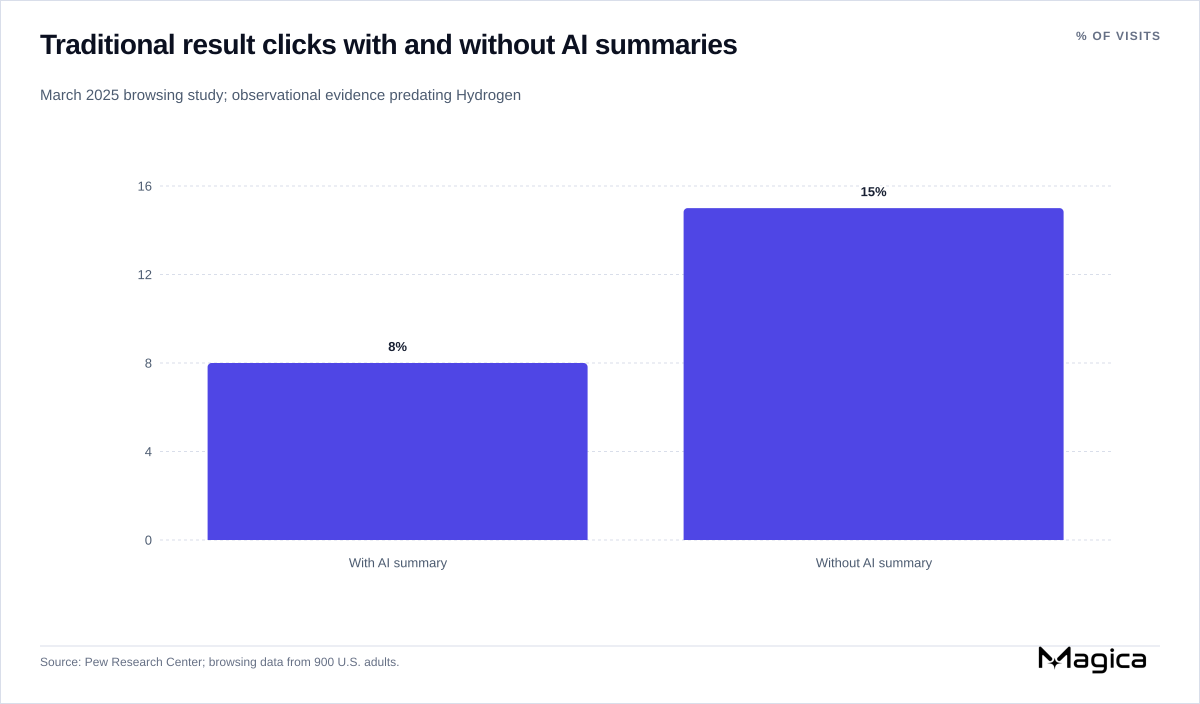
Pew’s March 2025 browsing study found fewer traditional result clicks alongside AI summaries. Results were reconstructed in April and query types differed; this association does not establish causation or test Hydrogen. Chart: Magica; data: Pew Research Center. Source: Pew Research Center.
For website operators, source selection is the part of the change with immediate commercial significance. Google has supplied neither a count of additional links nor evidence of increased referrals. A broader set of citations can change which publishers appear without establishing that more readers leave the answer page.
Earlier evidence makes that distinction concrete. In a July 2025 analysis of tracked browsing by 900 U.S. adults during March 2025, Pew Research Center examined 68,879 unique Google searches. Of those, 12,593 produced an AI summary in the researchers’ reconstructed results.
Traditional result links were clicked in 8% of visits with an AI summary, versus 15% without one—a seven-percentage-point gap. Links inside summaries were clicked in 1% of visits to pages containing a summary. Researchers identified clicks from the next visited URL, checking the first results page and up to the first three sources cited in a summary.
The comparison is observational. Summaries appeared for 8% of one- or two-word searches but 53% of searches containing at least 10 words, showing that the two groups contained different types of queries. Researchers also reconstructed results on April 7–17 from searches made in March, so the pages could differ from what participants saw. The findings demonstrate an association, not that summaries caused the click gap, and do not test Hydrogen or current AI Mode.
The rollout also overlaps with a separate November core search update that began November 10 and remained underway on launch day, according to the report tracing AI Mode’s defaults. That makes a single before-and-after traffic comparison especially difficult to interpret. Changes in citations, conventional rankings and referrals need separate examination before attributing a gain or loss to Hydrogen.
Clearer information about which AI Overview questions reach Hydrogen would establish how much of the summary experience has changed.
For users, the useful test is whether multipart questions receive more accurate answers that retain every material constraint. For publishers, it is whether broader source discovery produces measurable referrals. Search-specific evaluations and site-level traffic evidence would answer those questions more directly than coding scores or demonstrations. Until then, the global default change is concrete; the size and distribution of its benefits remain open.
Google launched Gemini 4 Hydrogen and automatic model switching in Antigravity, claiming near-Carbon task success with less quota and faster completion. Lower token rates support the efficiency pitch, but reasoning settings, mixed competitive results and inconsistent benchmark labels leave the cost of completed work to be tested.
Japan is considering safety and reporting duties backed by enforceable orders for advanced AI. The proposal would strengthen its nonbinding framework, but capability thresholds, covered businesses and penalties remain unresolved.
Four nonprofits are asking a California court to stop five AI developers from building or deploying more capable systems. The case seeks enforceable limits even as OpenAI has previously reported a training pause and is launching defensive AI tools.
Expo Simulators gives coding agents remote iOS and Android environments with recordings for reviewers. The launch extends Expo's cloud development services into verification, with per-minute charges and shared capacity limits.
Kleiner Perkins and Clearlake Capital led Mirendil’s $1 billion Series A. Its agent-led model-building experiment points to smaller research teams, but company benchmarks, substantial compute costs and a private beta qualify the promise of wider access.
Mount Thor raised $45 million in equity, alongside separate hardware financing, to expand Apple infrastructure for AI agents and model inference. Existing Mac clouds and workload-specific performance limits put its demand and cost claims to the test.
Salesforce Ventures led a Series C that values Q-CTRL above $1 billion. The funding backs GPS-free navigation and quantum computing software, while undisclosed revenue and contested performance benchmarks leave the commercial case open.
Adobe demonstrated 10 experimental creative tools and opened Deep Brush and Hands On for testing. The lineup explores more direct control over AI edits, but existing alternatives and unproven production performance limit claims of novelty.
House Foreign Affairs Committee Chairman Brian Mast says outgoing Nvidia chief Jensen Huang has agreed to questioning, with a date still under negotiation. Speaker Mike Johnson says support for limiting chip exports to China is growing as lawmakers examine allegations involving Huang and a cloud partner.
Leaked correspondence and a reconstructed publishing program expose John Mark Dougan’s use of AI to stock imitation news sites with pro-Russian material. The records illuminate funding and working methods, while his claims of influencing other AI systems remain unproven.
William Blair raised AMD to Outperform as server-chip prospects and valuation improved. AMD already expects revenue growth above 80% in 2027, but customer incentives, custom accelerators and weaker quarterly cash generation complicate the investment case.
Apple’s $299 first smart display earns praise for fast home controls and useful kitchen features, but reviewers found gaps in how it keeps family members’ messages separate. Its strongest advantages also depend on owning compatible Apple devices and accessories.
Donald Trump proposed Apple executive chairman Tim Cook to succeed Jensen Huang at Nvidia. Cook’s interest and the seriousness of the suggestion remain unclear, while finance chief Colette Kress has taken interim charge.
Norwest’s largest fund is a third bigger than its predecessor, giving the Wells Fargo-backed investor more capital for AI alongside healthcare, consumer and industrial businesses. The firm has not disclosed how much will go to AI.
Nebius raised its 2026 capital spending forecast to about $27 billion while steering revenue to the low end of guidance. Better customer prepayments support expansion, but delayed capacity and a $325 million non-recurring contribution complicate its quarterly revenue beat.
Megaspeed founder Alice Huang is reportedly living in Beijing, but her activities and the espionage allegations remain unresolved. Jensen Huang’s resignation changes Nvidia’s leadership without settling questions about her business connections and access to its chips.
Singapore says it barred former Megaspeed chief Alice Huang after she gave inaccurate information about her role, while finding insufficient evidence against her over server declarations. The wider investigation still depends on tracing shipments beyond Malaysia.
Nvidia’s longtime finance chief takes over from its co-founder as the board promises continuity, searches for a permanent CEO and faces unresolved questions over security and executive conduct.
Chicago Public Schools is seeking a way to preserve Google Search without its generative AI features as parents, educators and students press for stronger district rules. Google’s planned access changes turn an AI safety dispute into a test of who controls classroom technology.
Warby Parker scheduled November 12 preorders and holiday deliveries for its first Android XR glasses. Google’s backing combines development funding with a conditional equity investment, while the retailer expects only a modest initial sales contribution.