Editorial Team
6 min read
OpenAI has released its Agents API in public beta, offering the session, context-management and recovery layer it uses for Codex while letting developers choose where code runs. The practical trade-off is clear: customers can choose an execution environment, but OpenAI retains the session layer and the beta is not eligible for Zero Data Retention.
OpenAI has put the managed harness behind Codex into a public-beta API. In its launch announcement, the company says the service is meant for agents that work with files, run code, save intermediate results and continue over hours or days.
That is a meaningful product boundary. An agent is not merely a model request: someone has to preserve state, manage a finite context window, run tools, recover after interruption and expose work in progress to an application. OpenAI is offering to operate that control layer, while developers supply the model configuration, instructions, tools and domain workflow that make an agent useful.
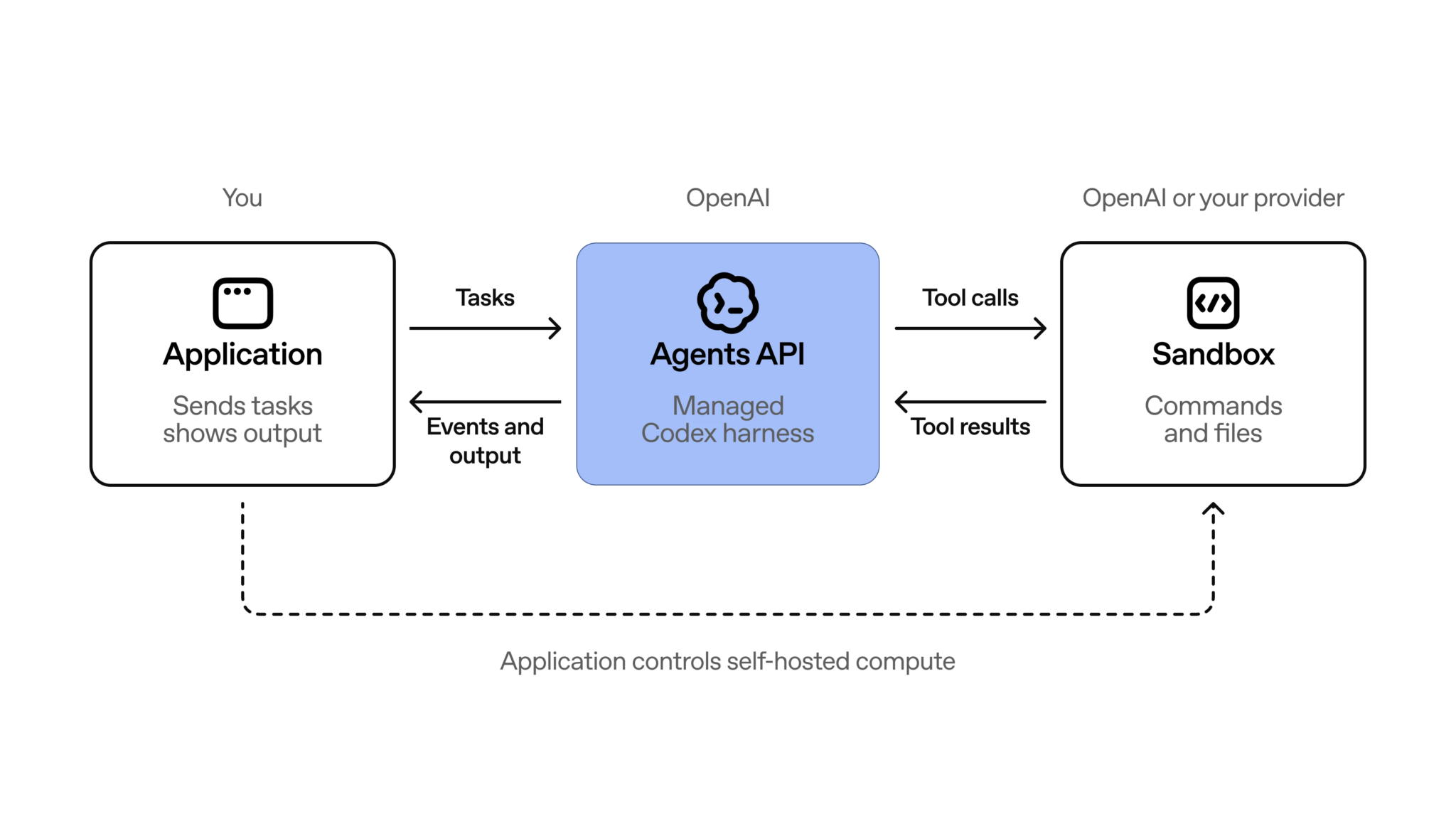
OpenAI’s diagram of an Agents API deployment in which the application controls self-hosted compute. Source: openai.com.
The API documentation defines an agent as a model, instructions, tools and MCP servers. An environment—where it can access files, load skills and execute commands—is optional; a session is the durable instance that receives tasks and returns events and output.
The beta manages sessions, orchestration, context compaction and recovery. An application can create a session, submit work, stream events or receive webhooks, then continue or steer that same session. The quickstart makes an operational caveat explicit: a completed turn does not prove that every tool call succeeded, and an idle event alone is not a success signal. Teams still need to inspect events and reported execution results.
The release builds on capabilities that were already arriving in the platform rather than replacing them wholesale. The changelog records server-side compaction, hosted shell and skills in the Responses API in February, followed by an Agents SDK update with sandbox agents and an open-source harness in May. The new element is a hosted session-and-orchestration product that groups that operational work behind one beta interface.
OpenAI says the harness itself is open source, so developers can inspect the logic that coordinates model calls, tools and context. But the company hosts and maintains that harness in the API. That makes the offer less a handover of Codex’s infrastructure than a managed implementation of it.
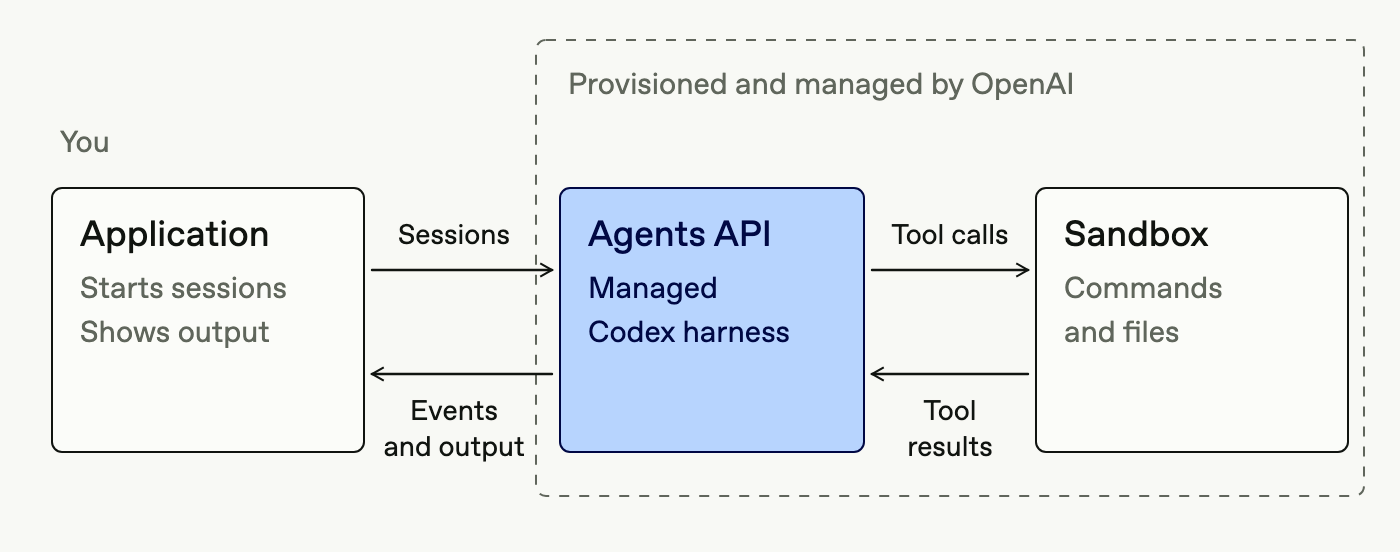
OpenAI’s documentation diagram of an OpenAI-hosted Agents API session and sandbox. Source: developers.openai.com.
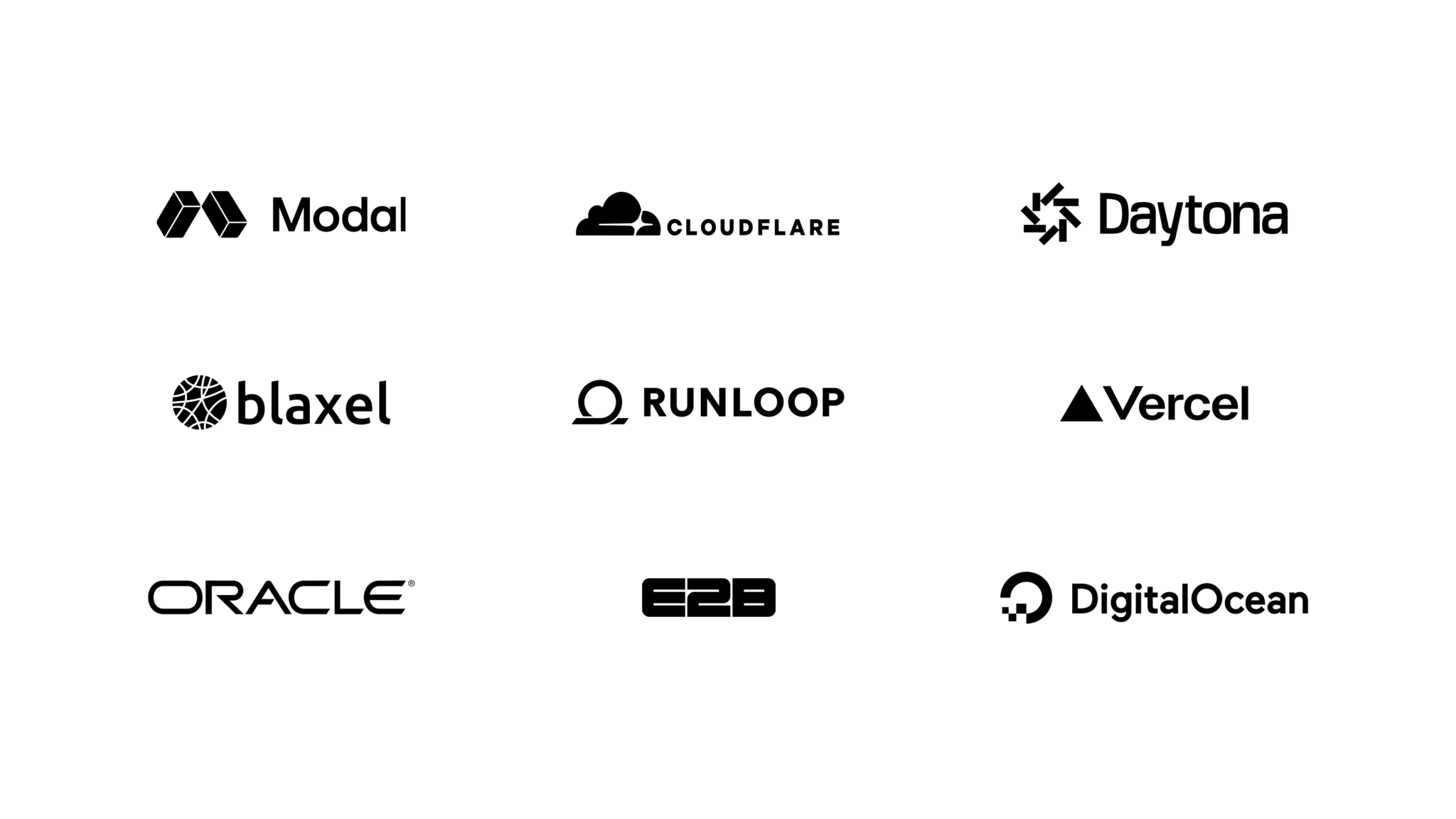
OpenAI lists nine sandbox partners for Agents API integrations: Modal, Cloudflare, Daytona, Blaxel, Runloop, Vercel, Oracle, E2B and DigitalOcean. Source: openai.com.
OpenAI lets customers select an OpenAI-hosted sandbox, a self-hosted environment, or an integration with a sandbox provider. Its announcement names providers including Cloudflare, Blaxel and E2B, alongside options intended for managed deployment or a customer VPC and differing compute, storage and secret-handling needs.
That flexibility is the principal limit on the launch’s centralization. It lets a customer keep execution close to its own tools and systems while OpenAI runs the generic session and orchestration layer. It does not turn the service into a self-hosted control plane. The API retains session state; it currently supports data residency only in the United States and does not support Zero Data Retention. Choosing a self-hosted sandbox does not make the API ZDR-eligible, according to the data-controls documentation.
For regulated or sensitive workflows, that distinction is a deployment constraint, not a footnote. The relevant question is not only where code executes, but also what task context, events and session state are sent to the managed API.
For teams choosing OpenAI-hosted execution, the sandbox guide supports packages, setup commands, input files, skills and plugins. It rejects runtime-reserved environment-variable names, including OPENAI_API_KEY.
Network access may be enabled, disabled or restricted to 1–100 exact host names. The documentation warns that redirects and subdomains need their own entries. A sandbox can be deleted after an hour without activity and keep-alives; files written to /workspace/outputs become immutable downloadable artifacts when a turn completes. Those details make network policy, dependencies, inputs and artifact handling part of the application’s security and reliability design.
The API can delegate independent work to subagents. Each receives its own context while a coordinating agent combines the results. The default ceiling is six concurrent subagents, excluding the coordinator, according to the multi-agent guide.
OpenAI’s guidance is narrower than a generic pitch for autonomous swarms: use subagents for independent tasks, such as reviewing separate documents or investigating different failure causes. Keep short or dependent work with the main agent, and coordinate agents that edit the same files. Subagents inherit configured MCP tools, credentials, permitted tools, web-search settings, command-line access and the shared environment filesystem; they do not support function tools.
That may simplify parallel research or investigation, but it does not remove the need for oversight. The event stream records delegation actions, yet a completed create or wait action does not establish that a subagent finished its assigned task. A production application needs its own success criteria and review of the combined result.
OpenAI says there is no additional Agents API fee. Model use is billed at the selected model’s API rates; OpenAI tools carry their standard rates; and OpenAI-hosted sandboxes use standard container rates. This is not a priced managed-service surcharge in the documentation, but neither is it a flat-cost substitute for bespoke orchestration.
The client surface is arriving with the launch. The Python SDK’s 3.13.0 release, published September 10, lists the Agents API. The documentation still requires the agents=v1 beta header for raw requests and uses beta.agents in SDK examples. That is evidence of availability, not evidence that every long-running workflow is ready for a production migration.
The beta’s test is whether the time saved by a managed harness exceeds the loss of control—or the additional governance work—created by keeping session state with OpenAI. A team should first map its task data, required residency and retention controls, execution environment, network policy, credentials, tool failure handling and expected model and container usage.
Only then does multi-agent orchestration become a useful comparison point. The next evidence to watch is whether production users can show reliable recovery, observable tool outcomes and acceptable workload economics under those constraints as OpenAI iterates toward general availability.
AI safety advocates gained experienced lawmakers and battleground seats in the midterms, but rival technology-backed groups also elected allies, leaving federal legislation far from assured.
A federal judge found Anthropic’s Claude Max usage advertising plausibly misleading because subscribers could read the multipliers as monthly promises. Contract and misrepresentation claims survive, but several other claims were dismissed with leave to amend.
Thailand’s proposed data-centre framework would scale requirements by power demand, screen sites for electricity and water access, and assess domestic benefits. It also covers existing facilities, while conflicting application and approval schedules remain unresolved.
PJM’s independent market monitor attributes about $11 per megawatt-hour of first-half 2026 wholesale costs to data-center demand in capacity auctions. Energy costs drove more of the overall increase, while construction barriers and an October regulatory rejection complicate the response.
DataVita now says its proposed Lanarkshire AI data centres will be fully grid served, with direct renewable connections only a future possibility. The change in public presentation raises questions about promised power costs and community benefits, although the DV4 planning application already assumed grid supply.
AMD chief Lisa Su calls the chipmaker a data-center-first company as server and AI sales surge. Gaming revenue fell 40%, but PC-chip sales grew, and her remarks leave the supply outlook for expensive Radeon cards unresolved.
A reported U.S. intelligence assessment links Megaspeed executive Alice Huang to China’s Ministry of State Security, raising questions about access to Nvidia’s leadership and chip-export policy. Whether the alleged operation succeeded remains unclear.
Ocient’s $100 million Series C backs tailored AI analytics on an established database platform, with national-security investors and deployment economics shaping its expansion.
Anthropic plans IPO marketing next week and a listing in the week of November 16, according to people familiar with the plans. Buyers are discussing valuations of $1.2 trillion–$1.3 trillion, with some weighing $1.1 trillion, as its filing reveals faster-growing compute costs and extensive infrastructure commitments.
India's IT lobby chief warns that AI could make technology jobs harder for graduates to secure. Hiring is below earlier peaks, but some firms favour AI-equipped beginners over costly experienced staff. The unresolved question is how junior workers will build expertise.
Internet scans and leaked databases expose the spread of ARTEX, a security-testing framework used in cyberattacks. Researchers documented largely autonomous compromises, but the records also show failed cashouts and uncertain counts of independent deployments.
Meta's strategy chief and former CFO is joining Fireworks AI ahead of a reported fundraising push targeting at least a $30 billion valuation. The inference company announced a $17.5 billion valuation in July, making the hire part of a much larger expansion than its older funding figures suggest.
Sand.ai says its $200 million Series A+ round lifts its valuation above $1 billion. Co-lead investor Wangsu plans inference and deployment cooperation, while its filing shows substantial losses behind the startup’s video AI ambitions.
An advocacy group estimates Interior Secretary Doug Burgum’s AI holdings at $18.1 million–$64.4 million as his department advances data centers on public land. His ethics agreement allows retained investments with recusals, while pending permits will determine both the application of those safeguards and the public’s return. Interior denies his decisions are driven by personal investments.
Microsoft is evaluating fewer neocloud partners while expanding its own infrastructure. Delivery-dependent contracts underpin supplier financing, while IREN reports rising revenue alongside a $6 billion funding target for its broader expansion.
Physical Superintelligence says its AI system found a proof of a conjecture limiting quantum query advantages on random inputs. Public proof files enable scrutiny, but do not establish the private system’s cost or repeatability.
OpenAI is expanding its relationship with Hacktron, whose researchers previously reported an attack chain into employee accounts, to test third-party connections with greater access to cybersecurity models.
Google has acquired Crusoe’s southeast Wyoming data center site, where it plans a long-term $17 billion investment. Crusoe describes completed pre-development work; independent reporting points to customer setbacks. Power delivery and carbon capture remain key tests.
The team behind document-parsing service SoMark has released OXR-1.0 code and weights. A benchmark retest supports a strong result, but speed and accuracy were measured separately, and users above funding or revenue thresholds need a commercial license.
OpenAI is reportedly developing a Business Hub with daily mention and click charts, product updates and business agents. The unannounced feature could give verified businesses direct visibility into ChatGPT responses, without revealing prompts or competitor rankings.