Editorial Team
9 min read
Pika’s six-step MiniMax H3 derivative opens video-and-audio generation to local use, while 4K finishing and optimized serving remain hosted at launch. Competing H3 derivatives, hardware costs and inherited license conditions complicate the choice.
Pika, the AI video developer, launched H3 Flex on October 29 with downloadable adapters and inference code for a faster version of MiniMax’s H3 video-and-audio model. Its release opens the generator to local use and customization, while high-resolution finishing, audio separation and optimized serving are hosted features at launch.
The commercial proposition is repeated revision: generate inexpensive drafts, choose a take and then pay to finish it. But neither fast H3 derivatives nor the division between downloadable generation and hosted services begins with Flex. Its value depends on how much its post-training improves usable results—and whether customers prefer Pika’s service to running a licensed model themselves.

Pika’s H3 Flex product page uses an overhead table-tennis scene in an empty pool as promotional imagery. Source: Pika. Source: Pika H3 Flex product page.
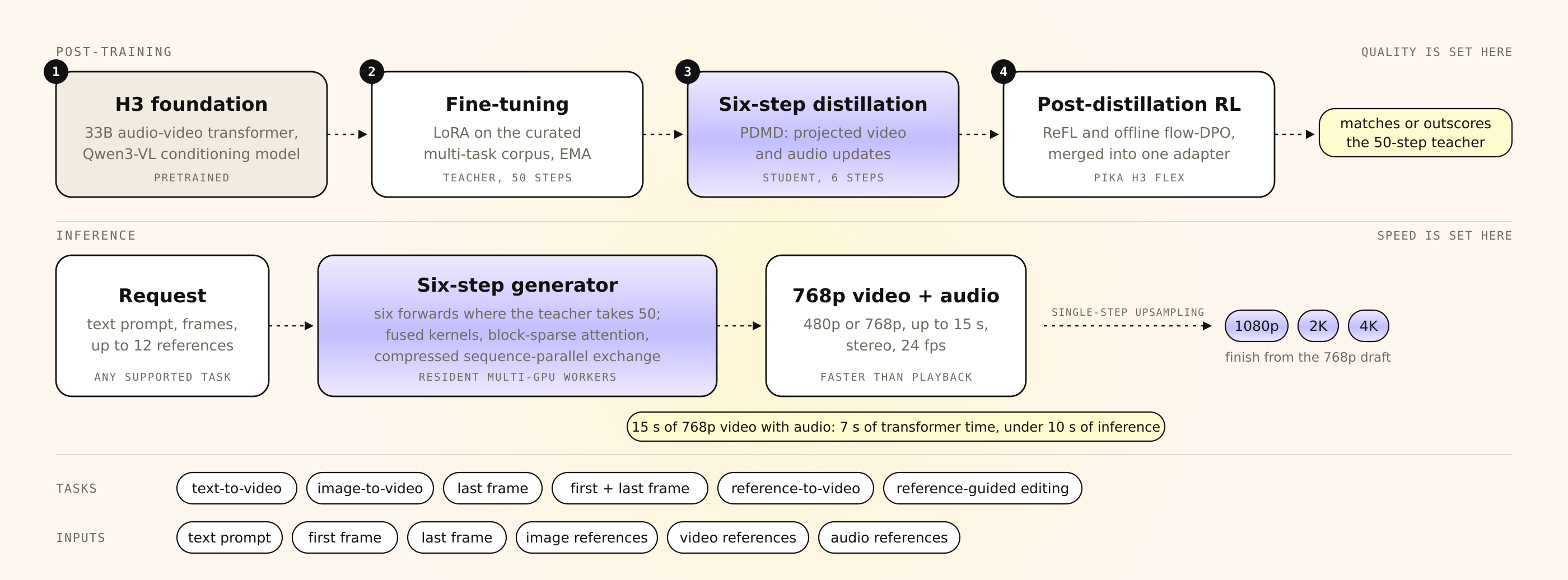
Pika Research’s pipeline diagram shows H3 Flex post-training, six-step generation, and separate upsampling. Source: Pika Research. Source: Pika Research.
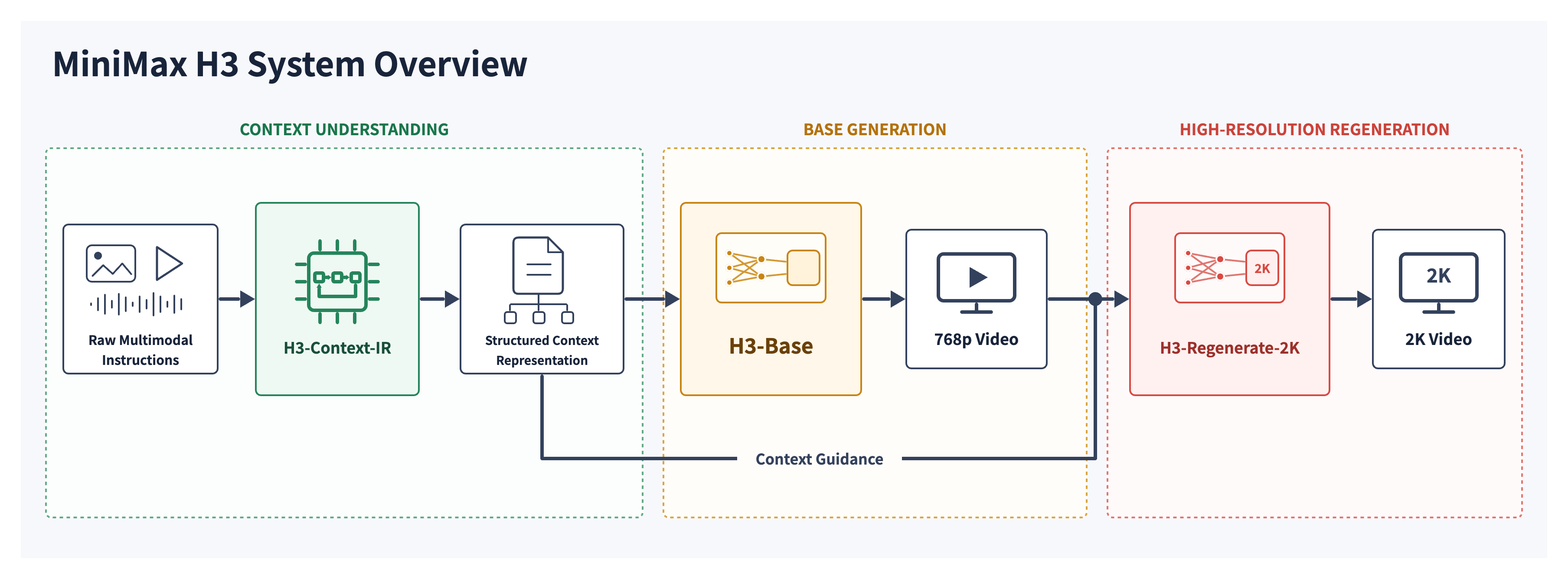
MiniMax’s official system overview shows the H3 foundation’s context-understanding, base-generation, and high-resolution-regeneration modules. Source: MiniMax. Source: MiniMax.
Founded in 2023, Pika already sells AI video tools, including Pikaffects, and operates a creation product and generative-media API platform. Its launch announcement places Flex within that broader business, targeting professional creators who repeatedly adjust shots.
Pika had substantial venture backing before this release. In a June 2024 financing report, the company said an $80 million Series B led by Spark Capital valued it at $470 million; its cumulative funding then stood at $135 million. Lightspeed participated after leading the previous Series A.
The foundation comes from MiniMax, a Shanghai-based AI developer founded in 2022 that listed in Hong Kong in January 2026. It introduced H3 on July 31, joining a video-generation market contested by ByteDance and Kuaishou. Its August open-weight announcement described a system accepting text, images, video and audio, with native stereo sound and clips up to 15 seconds. The same limits of 12 reference files already applied to H3.
MiniMax’s resolution claims need the same distinction as Pika’s. Its downloadable H3-Base generates at 768p; a separate H3-Regenerate-2K stage reprocesses that result with the original context. MiniMax’s initial release excluded both that 2K stage and its hosted system for interpreting and preparing inputs. Pika is therefore extending a model ecosystem that already combines open weights with hosted components.
According to Pika’s technical report, its team fine-tuned H3 on an internally curated audio-video dataset, distilled the resulting 50-step teacher to six generation steps, then applied reward feedback and preference optimization. Ordinary distribution-matching distillation was unstable in its experiments, the company says, so it used a projected variant.
The release contains two adapters—additional model weights that specialize the base system. One handles text and first/last-frame conditioning; the other handles image, video and audio references. The Diffusers library documentation confirms that the underlying MiniMax components remain unchanged and are loaded alongside the selected adapter.
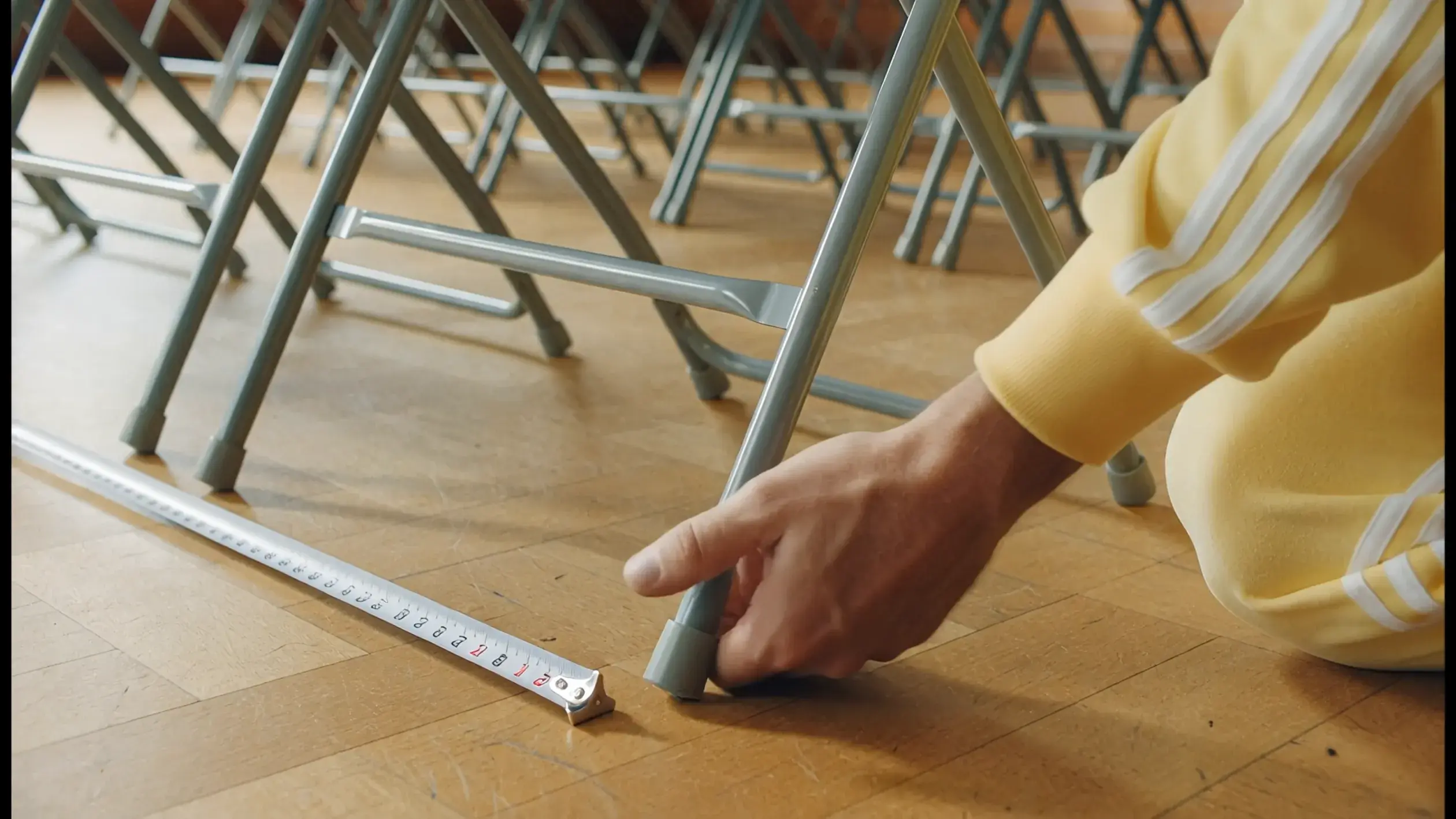
Pika’s H3 Flex product page illustrates a precision-editing workflow with a close-up measuring shot. Source: Pika H3 Flex product page. Source: Pika H3 Flex product page.
Flex’s model card specifies native 480p and 768p video with synchronized stereo audio. Users request 5–15 seconds; actual duration is rounded to the model’s supported frame counts at 24 frames per second.
Reference mode accepts up to 12 files, with individual ceilings of nine images, three videos and three standalone audio clips. At least one image or video is required. Each video or audio reference must last 2–15 seconds, and the combined duration of each type cannot exceed 15 seconds. These are input limits, not a guarantee that every combination fits local GPU memory.
The hosted finishing service upscales a selected draft to 1080p, 2K or 4K. A separate audio model divides the mixed soundtrack into dialogue, music, sound effects, Foley and ambience. The generator itself does not create five independent tracks: Pika recovers them through source separation. Prompt enhancement and the accelerated serving stack are also outside the downloadable package.
Pika says it will release the upsampler model, but gives no date in its technical report. The present hosted/local boundary could therefore change.
Local operation requires planning. The inference repository reports representative tests on one Nvidia H100 with 80GB of memory and downloads of roughly 210GB of base components plus 5.5GB of adapters for both tasks. One request runs on one GPU; the package cannot divide it across several GPUs. CPU offloading can reduce sampling memory use at the cost of substantial host memory and transfer time. Maximum reference counts remain unqualified on GPU.
Those requirements describe Pika’s released package, not every H3 implementation. MiniMax said H3 was designed to work with several Chinese-made chips, according to the report on its launch. That claim does not establish support in Pika’s Nvidia-oriented local package.
ComfyUI, the node-based generation interface, provides text, endpoint-frame and reference workflows; its three-template addition was merged on October 29. Its testing notes caution that camera directions and precise contact constraints can be unreliable. Pika also warns that its creative showcases are not release-validation renders and are not guaranteed to reproduce with the downloadable package.
The adapters inherit the MiniMax H3 Community License Agreement. Its standard grant excludes the European Union, United Kingdom, South Korea and United States, and its territorial use restrictions also cover outputs. Prospective deployers in those territories are directed to contact MiniMax for separate permission.
The agreement requires prior written authorization when the licensee’s commercial products and services generate more than $20 million in yearly revenue. Commercial interfaces using the model must prominently display MiniMax H3. It also prohibits using the model or its outputs to improve AI models outside the H3 family and requires providers to implement safeguards and a mechanism for reporting violations.
Pika’s inference code has an Apache-2.0 license, but that does not replace the model terms. Download access consequently does not mean unrestricted deployment. The launch materials do not establish what separate permissions individual hosted providers hold.
The same base already supports competing derivatives. The generative-media API provider fal released H3 Max on August 26, combining post-training with inference optimization. Its team said it had spent four years optimizing diffusion and generative-media workloads, and already claimed faster-than-real-time video generation.
Other options address local deployment. A survey of H3 derivatives describes OpenVDN’s VDN-H3, which modifies the model’s attention architecture, and FreeVideo, an implementation built on it that reportedly runs with as little as 8GB of GPU memory. That expands the alternatives for owners of smaller GPUs; it does not establish equivalent output quality or speed to Flex.
Pika’s headline seven-second figure is narrower than a customer’s waiting time. Its benchmark footnote says a 15-second 768p clip with audio can take as little as seven seconds of transformer computation. Conditioning inputs, decoding, finishing and service overhead are outside that measure.
The company’s latency evaluation reports about 1.8 times the speed of fal H3 Max on average across 768p text-, image- and 10-second reference-to-video comparisons. These comparisons measure transformer denoising. Pika says it matches H3 Max Turbo for text/image generation; Turbo has no reference-to-video endpoint in that comparison.
A separate Pika test isolates inference-engine improvements: with the same checkpoint and six-step schedule, reported full-inference latency for five-second 768p generation with audio fell from 3.409 to 2.129 seconds on eight B300 GPUs. That supports a benefit from serving optimizations, but is not a performance promise for the single-GPU download.
Quality rankings also depend on the task. Pika says Flex was the highest open-weight entry and seventh overall on DesignArena’s text-to-video preference leaderboard at launch. fal’s own launch materials claim a leading position on image-to-video boards. Different tasks and snapshots do not establish a single overall winner.
In Pika’s blind human comparisons of four models using the same prompts at 768p, Flex led on anatomy, complex composition and audio synchronization for text/image generation, and on style and camera work for reference generation. Other models were preferred for physics, multi-scene narrative, lighting and materials, and some action-heavy or control-video reference tasks. Its automated tests showed comparable cross-modal alignment, despite stronger scores on the five visual and audio quality measures.
The API catalog advertises text/image generation from $0.01 per second. The full price schedule identifies that as a 480p launch discount. Text, image and keyframe generation are billed per output-video second:
| Output | Regular price per second | Launch price per second |
|---|---|---|
| 480p | $0.02 | $0.01 |
| 768p | $0.04 | $0.02 |
| 1080p | $0.07 | $0.035 |
| 2K | $0.08 | $0.04 |
| 4K | $0.16 | $0.08 |
At regular rates, 15 billed output seconds cost $0.60 at 768p or $2.40 at 4K, before extras. Pika says finishing an existing draft costs only the difference, allowing users to discard unsuccessful drafts before paying for higher resolution.
Reference generation has a separate tariff: $0.12 per second regularly at 768p, or $0.06 at launch. Video-reference seconds are billed alongside output seconds; image and audio references add no input charge. Thus, at the regular rate, five seconds of video reference plus 15 billed output seconds costs $2.40, compared with $1.80 for the same billed output duration using only image references.
Audio separation adds $0.001 per second. Pika lists prompt rewriting as included free in its hosted Flex service; calling that service separately for a self-hosted model costs $0.02 per request.
Pika’s promotional dates conflict. Its press release promises 15 free daily generations for members and subscribers for two weeks after launch, while the product page lists October 29–November 5 for API Club members.
Flex is available through Pika’s API and downloadable release. Pika says it will reach its creation product on November 2; the promised upsampler release has no announced date.
The unresolved comparison is the total cost and elapsed time needed to obtain an acceptable finished shot across repeated attempts. The published benchmarks establish particular computation times and selected quality results. They do not show how often a production task needs regeneration or how reliably references survive successive revisions.
For teams choosing a deployment route, that means testing the same shots through the complete workflow, including input preparation, failed takes, finishing and audio editing. Local hardware costs and licensing eligibility belong in that decision alongside API charges. Those results will determine whether Flex’s faster generation translates into cheaper, more controllable production.
Palantir’s co-founder and CEO says he could back a Democrat in 2028, while excluding a Democratic Socialists of America member. His Democratic history complicates talk of a political conversion; the more immediate question is how his government software company will answer congressional scrutiny.
ByteDance’s video model is reaching creators through multiple platforms with 30-second 4K output. Posted prices and draft workflows show why the choice of distributor still matters.
Rox’s $1.3 billion valuation backs AI agents for large enterprise sales teams. Its growth and cost claims face a crowded market, while integration with existing systems leaves the case for replacing Salesforce unresolved.
Google’s Gemini Decision 1 scores predefined choices across text, images, audio, video and PDFs for $0.10 per million input tokens. Its shared-input billing targets recurring workflow costs, but cheaper decision models, rival caching and low-cost generative alternatives complicate the savings claim.
Treasury and other agencies reportedly want Singapore cloud provider Megaspeed on a U.S. trade blacklist. Commerce denies a reported cabinet confrontation over the delay, while Nvidia says it has blocked shipments since June 2025.
United is restricting unauthorized AI agents from searching, booking and managing travel through its platforms and intermediaries. The airline cites security and safety risks as it reserves control over future integrations.
A controlled study found that pharmaceutical ads shifted AI recommendations toward promoted drugs without reducing overall clinical accuracy. The results expose a gap in accuracy tests, but do not establish effects on prescriptions or patient outcomes.
Former AWS computing chief Dave Brown will succeed Santosh Janardhan in early 2027 as Meta weighs its next capacity budget after a quarter of negative free cash flow.
Google is rolling out its Gemini app on Apple CarPlay, bringing voice conversations linked to Gmail and Google Calendar. It joins existing in-car AI options, while some personalized features remain restricted by age and region.
Google Labs’ Tabletop lets groups generate and use shared itineraries, polls and other interactive tools. The US adult-only experiment builds on an idea already offered by shareable AI app builders, leaving its practical advantage to be tested.
Anthropic’s IPO has reportedly attracted orders multiple times the available shares. Its planned $3 billion–$3.5 billion Japanese allocation would exceed Japan’s reported domestic IPO proceeds so far this year, but indications of interest are not completed sales.
Google warned that charging for news links would force it to stop distributing Indonesian news, while Meta and TikTok challenged other parts of the copyright bill. Existing Indonesian payment mechanisms and overseas deals complicate the platforms’ warnings about the cost to publishers.
Utrecht is investigating restrictions on camera glasses in municipal buildings, with findings expected in early 2027. The city must establish whether a ban is lawful, enforceable and compatible with assistive uses.
Research commissioned by cloud-storage supplier Wasabi estimates £3.8 billion in annual UK infrastructure overspend attributable to hard-to-forecast provider charges, including £1.2 billion for AI. Businesses report hiring and investment trade-offs, but recovering that money and turning it into jobs remain conditional.
The USDT issuer’s 800-million-parameter BotPsy beats a larger Qwen model on five of six company-reported agent benchmarks. Its local-AI ambitions still face missing handset measurements and explicit limits on sensitive uses.
Google DeepMind’s AlphaGenome 2 improves cell-specific DNA predictions and accepts new single-cell data without fine-tuning. Company benchmarks show gains at high confidence, but limited recall, complementary tools and greater computational demands leave experimental validation essential.
Coinbase is rolling out server-enforced trading limits and portfolio-loss triggers for AI agents connected to customer accounts. Product-category permissions remain forthcoming, and pausing new trades does not establish a ceiling on losses.
JetBrains IDEs 2026.3 bundle Air for running coding agents and reviewing their changes, while the standalone Air app is in maintenance mode. Existing provider subscriptions remain usable, but billing, security controls and execution options vary by integration.

Amazon’s shares and convertible notes could be worth $271.8 billion at the top of Anthropic’s proposed IPO range. Existing accounting gains, a 12% ownership cap and Anthropic’s computing commitments shape what that paper value means.
Nvidia chief Jensen Huang argued in May 2025 that US chip restrictions were strengthening Chinese rivals. Filings show a substantial commercial stake, but lost sales and market share alone cannot establish whether the controls failed their security purpose.