Editorial Team
7 min read
Activists breached the Amsterdam construction site intended for Microsoft, joining opposition to data center expansion with allegations about surveillance. The developer plans more than €1 billion in investment, while government records acknowledge competition for scarce grid capacity.
Dozens of pro-Palestinian activists breached the fences of a data center construction site intended for Microsoft in Amsterdam on Friday, November 6. The occupation brought a campaign to stop construction inside a development whose builder has pledged more than €1 billion in investment.
The dispute joins objections to the electricity demands of new data centers with allegations about Microsoft’s military customers. The software and cloud services company is to use all the campus’s server capacity, according to the Dutch government’s parliamentary reply. But the available evidence does not establish what data this unfinished site will hold, or whether Friday’s occupation will change its construction schedule.
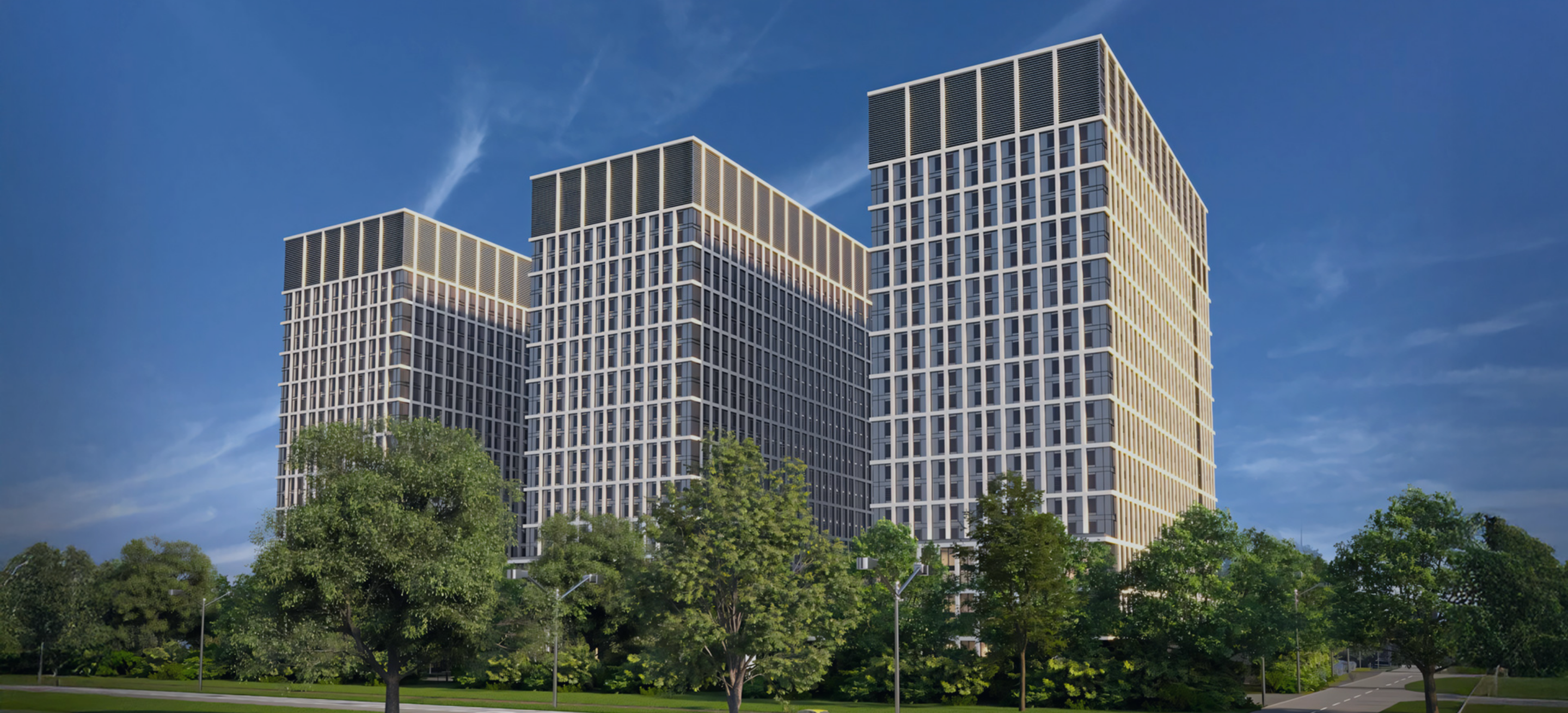
Company-reported design: Pure DC’s CGI rendering of the planned AMS01 campus in Amsterdam Westpoort. Image: Pure DC. Source: Pure DC.
Activists including members of the protest group Geef Tegengas entered the Sloterdijk site before a separate noon demonstration organized by Fossielvrij NL. Demonstrators climbed a construction crane and sat on the roof, according to the on-site account. Roughly 100 to 150 Fossielvrij NL demonstrators stood outside; it was unclear whether their planned protest would proceed.
Fossielvrij NL, a campaign group calling for a halt to new data centers, had announced its support for Geef Tegengas’s action. It argued that people should first have a democratic say over where AI is used, then assess how many data centers are needed. The two gatherings therefore shared a cause, although they were distinct groups in the on-site reporting.
An earlier dispatch identified Geef Tegengas as the organizer of an attempt by about 100 activists to reach the Plimsollweg building site and halt construction. Police surrounded them on Basisweg at about 11 a.m. and used batons to hold them back. Around 11:15 a.m., police announced that demonstrators’ belongings could be confiscated on the mayor’s authority; activists then tried to break through the police line.
The local live account recorded police using pepper spray and demonstrators entering the site from several directions. The attendance estimates describe different groups and stages, and cannot safely be added together.
Geef Tegengas had already occupied the site in June, according to earlier reporting. That campaign also drew Extinction Rebellion, which staged a nighttime action, the earlier dispatch said.
Pure Data Centres Group, or Pure DC, is the British developer and operator building the campus for cloud and AI computing. It had pursued similar large projects before this launch: a March 2025 regulatory announcement described it as owned by Oaktree and announced a joint venture to develop a 56 MW data center in London.
In its December 2025 Amsterdam announcement, Pure DC said it would invest more than €1 billion in the Westpoort campus, designated AMS01. That is a development commitment, rather than evidence that the entire sum has been spent. The company said the campus was fully leased, with permits and power secured and a private substation already live. It acquired the land on a long leasehold from the Port of Amsterdam.
Pure DC’s design calls for three 85-metre towers, each housing 26 MW of data halls. It projected more than 1,000 direct development jobs and about 80 permanent skilled jobs once complete. Those are company forecasts.
An April 2026 government reply to parliament, drawing on provincial information, put the electrical connection capacity at 33 MW per tower, or 99 MW in total. Connection capacity and the developer’s data-hall figures describe different measures; neither is observed annual electricity use.
The government calculated that continuous demand at 99 MW would require about 0.87 terawatt-hours a year. That is a full-load illustration, not a forecast of this campus’s consumption.
For national context, Statistics Netherlands’ provisional 2024 figures show electricity deliveries to Dutch data centers of about 5.1 TWh, or 4.6% of national electricity consumption. Deliveries rose 37% from 2021, slower than the 58% rise between 2018 and 2021. The statistics count connections where data center operation is the main activity, excluding in-house facilities at institutions such as hospitals and universities.
The government explicitly acknowledged that the Amsterdam project takes space and grid transport capacity and therefore affects other developments. It said the project had contracted capacity before congestion was declared and a queue established. The exact contract date was not public; the government inferred that the contracts dated from around the 2019 building application. Its explanation was an earlier contractual entitlement, rather than a specific government decision to put Microsoft ahead of housing.
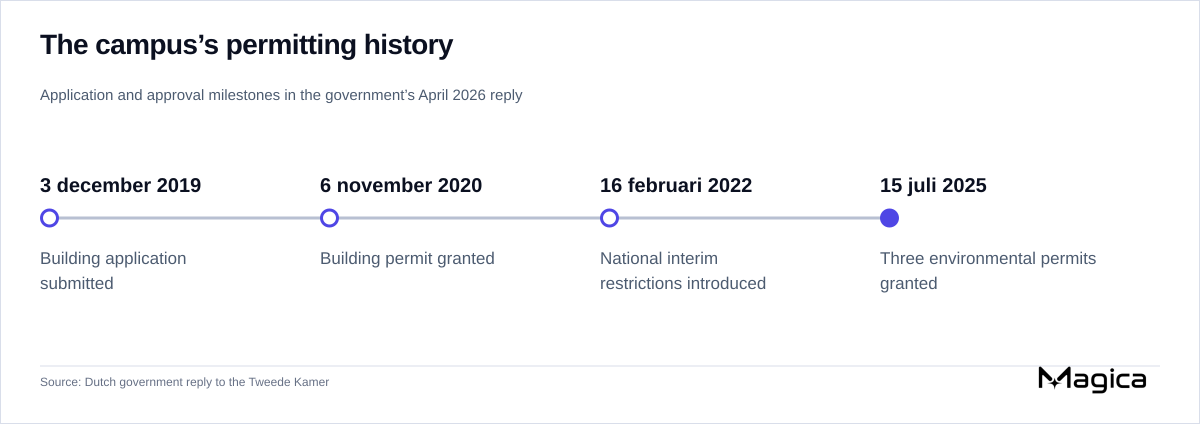
The building permit preceded national restrictions. An appeal against the environmental permits remained underway when the government replied to parliament in April 2026. Source: Dutch parliamentary record.
The permitting history is more specific than a claim that a large project simply bypassed a ban. The government said a building permit was granted on November 6, 2020, following a December 2019 application. Provincial environmental permits for the three towers followed in July 2025. As of the April reply, an appeal against those environmental permits was still underway.
National restrictions apply to data centers with more than 10 hectares of built floor area and connection capacity of at least 70 MW. The government put this project’s combined built floor area at 2.2 hectares, below the area threshold despite its electrical capacity.
Computable’s June report characterized the separate permits for three towers as a way of evading the national ban. The government’s earlier explanation directly disputes that mechanism: the combined area of all three towers was below the threshold, so splitting the buildings was not decisive. It said an equivalent new application would also fall outside the national rules.
That does not settle the policy question. The government shared concerns about grid pressure and said it would examine whether additional rules were needed for future cases. It placed responsibility for this project’s planning and permits with Amsterdam and the province of North Holland. It also defended investment in data centers as essential to digital infrastructure and competitiveness, while acknowledging a gap between industry demand and available space and energy.
The action group’s statement reproduced in the local live account accused Microsoft of enabling oppression through services for the Israeli military and US immigration agency ICE. Those are the campaign’s allegations, rather than evidence identifying this campus’s future workloads.
There is a documented history behind the surveillance concern. In a September 2025 statement, Microsoft said its ongoing review had found evidence supporting elements of reporting about Israeli military surveillance, including Israeli defense ministry consumption of Netherlands storage capacity on Azure, Microsoft’s cloud platform, and use of AI services.
Microsoft said it had disabled specified storage and AI services for a unit within Israel’s defense ministry, while continuing other cybersecurity work for Israel. The company said its review examined its own business records without accessing the customer’s content, and that its terms prohibited mass surveillance of civilians.
In April, the Dutch government said it did not know what data Microsoft planned to store at the Amsterdam campus. Customers were not required to report their intended data or uses of server capacity to Dutch authorities. Citing Microsoft’s service shutdown, the government considered the same surveillance use unlikely; that was its assessment, not a disclosure of the new site’s customers or workloads.
In its response to the on-site report, Microsoft said it respected peaceful expression but disapproved of unlawful actions or conduct endangering people’s safety. The available reporting at the November 6 research cutoff, 12:05 UTC, did not establish how long the occupation would last or whether construction would be delayed.
A lasting change would require evidence beyond entry to the site: a revised construction schedule, a developer decision or an intervention by the authorities responsible for its permits. The April record also leaves the later outcome of the environmental-permit appeal unresolved. The occupation is established; its effect on a permitted, contracted development remains to be demonstrated.
Chip shares recovered part of Thursday’s losses in early Friday trading. Fears about data-centre construction face a test against AI-chip supplier Nvidia’s strong reported sales, growth forecast and conditional infrastructure-financing plans.
SoftBank shares fell 10.8% as default-insurance costs reached a four-year high. Delayed listings and unfinished data centers complicate its AI investment outlook, while a $40 billion bridge facility has a March 2027 maturity and a repayment plan based on existing assets and other financing.
U.S. prosecutors allege a global fraud combined AI impersonation, sham confidential deals and cryptocurrency laundering. A blocked bank transfer shows why convincing an employee and moving the money are separate hurdles.
President Donald Trump pledged support for states embracing AI without announcing project commitments. Existing federal incentives and Virginia’s data center review show why the returns depend on tax concessions, construction and who pays for electricity infrastructure.
Tesla plans to wind down Cybertruck production at its Texas factory around mid-2027 to expand Cybercab output. Weak pickup sales frame the retreat, while battery constraints and rising investment complicate the robotaxi expansion. Final truck output and customer order handling remain unclear.
EU regulators preliminarily found TikTok failed to adequately assess and reduce risks from repetitive video recommendations. The case challenges engagement signals and ineffective user controls, including for legal content. TikTok disputes the findings.
Airbnb plans to start rolling out an AI travel agent in the first half of 2027. Its wider ambition to bring partner bookings into its app could bring more revenue and support obligations, while Expedia’s abandoned Romie assistant shows the execution risk.
South Korea halted KOSPI share trading after a plunge of more than 8%, while Japan’s Nikkei touched 20% below its June peak. Investors fear a slowdown in AI infrastructure spending, but the market losses do not yet establish cuts to construction or supplier orders.
Kalepa’s $75 million Series B will fund more insurance workflows, a planned London office and a doubling of staff in 2027. The company says it has been cash flow positive for over two years; its next test is extending automation while preserving insurer control over consequential decisions.
The Cambridge startup has secured backing described as eight figures in capital and compute, including UK government support. Its wager is that cheaper, accurate quantum calculations can supply better AI training data; full performance results remain forthcoming.
Japan’s Nikkei fell 7.09% in Friday morning trading, with AI, chip and data center-related shares hit hard after Wall Street losses. Reports linked the rout to fears of U.S. regulation following Democratic election victories, without identifying an enacted restriction or a cut in AI spending.
Potential investors are pressing Anthropic for a lower valuation as a technology selloff threatens its November IPO timetable. Rapid revenue growth and substantial cash complicate a financing debate driven by losses and long-term infrastructure commitments.
Visa's new benchmark finds that AI shopping models often miss customer requirements and struggle to repeat successful decisions. The tests cover product discovery, leaving checkout and payment reliability for future rounds.
Agility Robotics began trading after its Churchill Capital Corp XI merger, bringing a commercially deployed humanoid robot maker to U.S. public markets. Its next test is turning conditional Digit 5 orders into deliveries and sustainable economics.
Goldman Sachs sees temporary halts potentially affecting about 45% of planned US data center expansion after Democratic election victories. In Texas, where approvals were already paused, the next fight is over how long restrictions last and what developers must pay for.
Core Scientific’s third-quarter colocation revenue rose 57.6% to $215.4 million. Its expansion beyond CoreWeave could diversify sales from 2027, but the next projects require additional financing rather than the same customer funding that supported its existing conversions.
Meta is rolling out voice conversations and animated avatars for Muse in the US. The update adds personality to a cloud-based task agent whose costs, permissions and reliability matter more than its expressions.
Anthropic is rolling out Personal Finance to paid Claude users in the US, using Plaid to read bank data. Its pitch rests on ad-free answers and privacy controls, while its own documentation warns that balances and budgets can be incomplete.
OpenAI president Greg Brockman predicts significant medical advances within 12 to 18 months and raises the possibility of death becoming a choice. OpenAI’s cell research and a separate early drug trial show narrower progress, with financial ties, safety questions and clinical testing still central to judging the promise.
Citrini Research is recasting its AI investments around relative value as it warns that financing and construction constraints threaten returns. Its reported Oracle–Nebius trade faces a crucial counterargument: Nebius has substantial customer commitments, although delivery remains conditional.