Editorial Team
6 min read
Meta is rolling out voice conversations and animated avatars for Muse in the US. The update adds personality to a cloud-based task agent whose costs, permissions and reliability matter more than its expressions.
Meta, the company behind Facebook, began rolling out real-time voice conversations and expressive avatars for Muse, its personal AI agent, on November 5. Users can speak to the service and watch a character react while listening and talking, or choose voice alone.
The update adds an interface to a product that asks for access to more than conversation. Muse launched on September 8 with connections to email, calendars and payments, designed to keep working after users leave the app. A more personable agent still needs to earn permission to act—and demonstrate that it can finish the work.
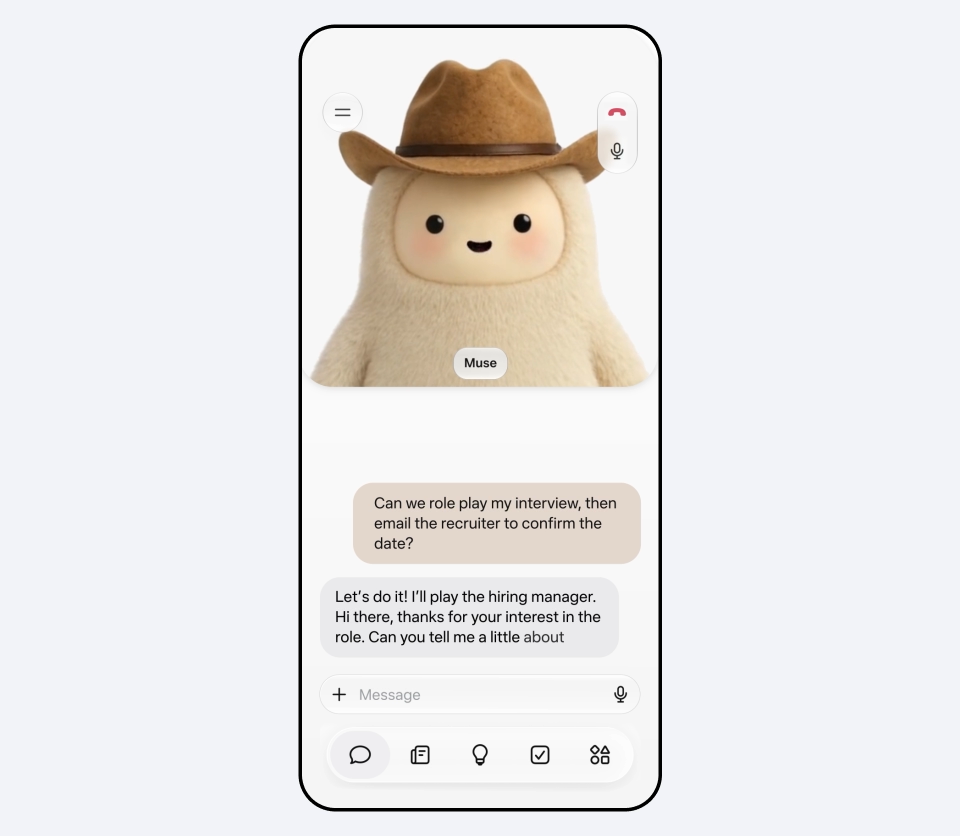
Meta’s demonstration pairs Muse’s avatar with an interview-practice conversation. Image: Meta. Source: Meta.
Meta says in its announcement that the feature, previewed at its Connect developer conference, is rolling out on mobile, web and Mac, starting in the US. The phone icon at the top right starts a conversation. Users can display the avatar beside their chat, expand it to full screen or leave it off.
Meta offers hundreds of voices with changeable styles and says users can interrupt the agent. Its examples include trip planning, interview practice and rehearsing a presentation while keeping hands free. These are suggested uses, rather than published measures of success.
A report on the rollout describes the default animated character, nicknamed Jolly, and customizable alternatives resembling people, animals or other characters. The report says Meta believes humanlike qualities can help consumers feel more connected to their agent. Meta’s research team , and cautions that its technical demonstrations include avatars unavailable in the app.
The Cambridge startup has secured backing described as eight figures in capital and compute, including UK government support. Its wager is that cheaper, accurate quantum calculations can supply better AI training data; full performance results remain forthcoming.
Voice itself is already offered by competing AI services. Nor is delegating tasks exclusive to Muse: reporting at its launch identified Gemini Spark and Claude Cowork as other services that start tasks on consumers’ behalf. Muse’s animated presence is one part of a broader contest over useful agents.
At launch, Meta said Muse could send emails, book travel, fill out forms and make purchases. Users choose which services to connect individually; where a service lacks an API, a software interface for connecting applications, Muse can use a browser instead.
That work runs in a dedicated virtual machine—a separate computing environment—in Meta’s cloud, with a browser visible to the user. A separate system called Sentinel controls access to the internet and connected services, deciding whether a proposed action proceeds, is blocked or needs user approval, according to the launch account. Meta says permissions can distinguish reading from writing and be limited by task, service, transaction or time. Meta says sensitive actions require approval, while previously authorized, lower-risk tasks can proceed.
The distinction matters: conversational warmth does not establish authority to spend money or change information. External services also retain control. The same account noted that restaurant-booking service Resy had said it would delete accounts using automated agents.
Meta’s privacy record makes its assurances consequential. The launch reporting recalled Facebook’s $5 billion settlement with the US Federal Trade Commission in 2019 over privacy violations. It also noted that Muse’s debut followed Meta’s August agreement to an $18 billion multistate settlement over social-media consumer harms. For Muse, Meta says conversations and data are kept out of its advertising systems, and that the agent cannot see users’ passwords or payment methods. That promise is separate from model data use: the launch account says queries to Meta models can be used by the company by default, with an option to turn that off. A confidential workspace that Meta itself could not see inside was still a planned release at launch, targeted before year-end.
Meta’s technical account describes Muse Realtime Voice and Muse Realtime Avatar as a streaming system: shared speech tokens drive both audio and generated video, keeping lips and expressions synchronized.
The company reports about 870 milliseconds from the end of a user’s turn to the first byte of synchronized voice and video, at 25 frames per second. It reports capacity for 12 concurrent video-generation sessions on a single GB200 hardware unit. These company figures concern responsiveness and video capacity, not the time or cost to complete a user’s task.
In comparisons with commercial avatar systems, Meta reports overall preference for Muse of 78% against Runway Characters and 88% against HeyGen LiveAvatar. Raters used each product’s native live calls for two- to three-minute conversations with matched avatar identities. This tests conversational presentation; the post gives no rater count, and the mannerism comparison with Runway was not statistically distinguishable from parity.
Independent observations are narrower. In a brief iOS test, the agent generally replied quickly but sometimes paused to look up or check information. Animation matched its speech well, although the tester found a customized human likeness uncanny. One short test cannot establish reliability across users or tasks.
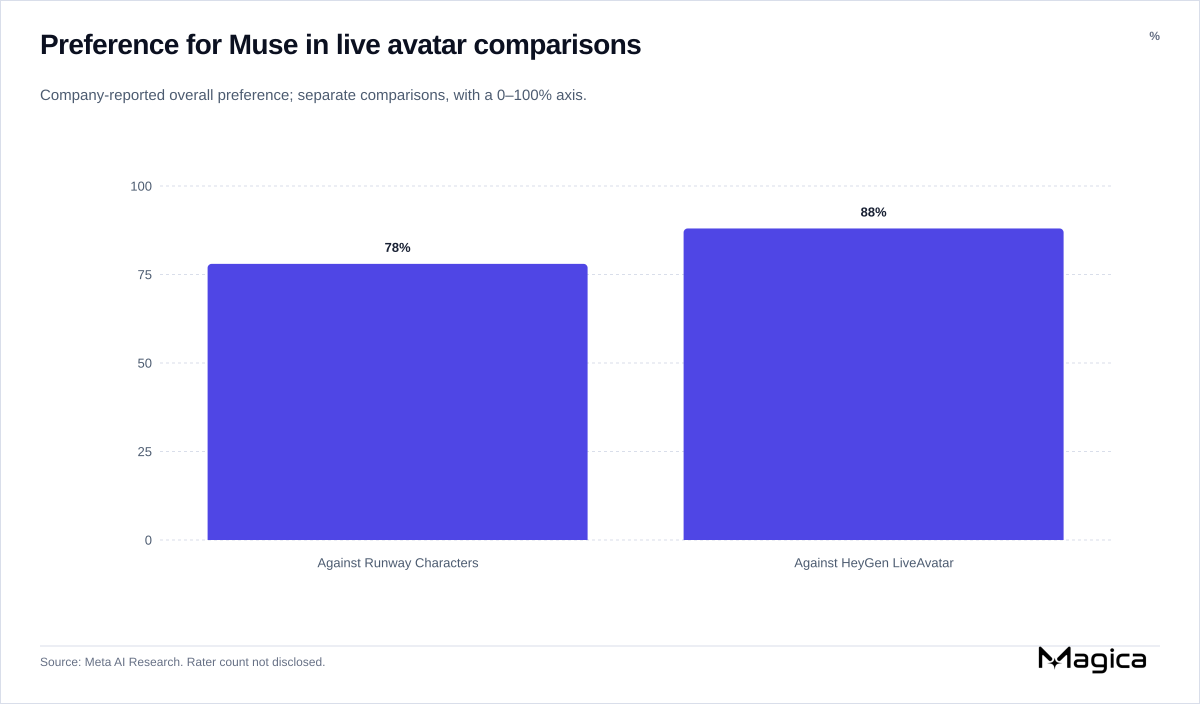
Company-reported preference for Muse in separate live-avatar comparisons. These ratings assess conversational presentation, not task completion. Source: Meta AI Research. Source: Meta AI Research.
Muse launched with a free tier and Power and Maximum subscriptions costing $20 and $100 a month, respectively, for more usage. A payment card was required to get started. Meta said a meter would track remaining usage and users would be warned when free usage ran out. Meta said most users should fit within the free tier and that paid plans helped cover compute costs. At launch there was no advertising within Muse, while commerce opportunities were being explored. The voice announcement does not specify separate pricing, allowances or serving costs for the new feature, so the video-capacity figures cannot establish its unit economics.
Meta says voice conversations will come soon to its AI glasses and Muse Charm, a planned wearable with a small screen for the avatar. The rollout reporting says the device is expected before year-end; those extensions are still forthcoming.
The evidence needed next is task-level: how often spoken requests produce the intended result, under what permissions, and at what usage cost. Expressive conversation and favorable avatar ratings answer a different question from whether users should entrust more of their work and personal information to Muse.
Japan’s Nikkei fell 7.09% in Friday morning trading, with AI, chip and data center-related shares hit hard after Wall Street losses. Reports linked the rout to fears of U.S. regulation following Democratic election victories, without identifying an enacted restriction or a cut in AI spending.
Potential investors are pressing Anthropic for a lower valuation as a technology selloff threatens its November IPO timetable. Rapid revenue growth and substantial cash complicate a financing debate driven by losses and long-term infrastructure commitments.
Visa's new benchmark finds that AI shopping models often miss customer requirements and struggle to repeat successful decisions. The tests cover product discovery, leaving checkout and payment reliability for future rounds.
Agility Robotics began trading after its Churchill Capital Corp XI merger, bringing a commercially deployed humanoid robot maker to U.S. public markets. Its next test is turning conditional Digit 5 orders into deliveries and sustainable economics.
Goldman Sachs sees temporary halts potentially affecting about 45% of planned US data center expansion after Democratic election victories. In Texas, where approvals were already paused, the next fight is over how long restrictions last and what developers must pay for.
Core Scientific’s third-quarter colocation revenue rose 57.6% to $215.4 million. Its expansion beyond CoreWeave could diversify sales from 2027, but the next projects require additional financing rather than the same customer funding that supported its existing conversions.
Anthropic is rolling out Personal Finance to paid Claude users in the US, using Plaid to read bank data. Its pitch rests on ad-free answers and privacy controls, while its own documentation warns that balances and budgets can be incomplete.
OpenAI president Greg Brockman predicts significant medical advances within 12 to 18 months and raises the possibility of death becoming a choice. OpenAI’s cell research and a separate early drug trial show narrower progress, with financial ties, safety questions and clinical testing still central to judging the promise.
Citrini Research is recasting its AI investments around relative value as it warns that financing and construction constraints threaten returns. Its reported Oracle–Nebius trade faces a crucial counterargument: Nebius has substantial customer commitments, although delivery remains conditional.
Shield AI has agreed to acquire Echodyne for up to $5.3 billion, backed by a $2.5 billion financing package. The radar maker brings a profitable, defense-heavy business and commercial customers, with a promise to keep supplying outside system builders.
Gemini Omni 1.2 Flash lowers Google's quoted 720p generation price to $0.07 per second and extends native clips from 10 to 15 seconds. Editing limits and early commercial tests show why cheaper output does not guarantee the same savings on finished videos.
Mercedes-Benz plans to add Liquid AI’s on-device models to its North American voice assistant. The deal combines local processing with existing cloud AI, while customer availability, measured performance and contract economics remain unconfirmed.
Mistral is expanding Studio with managed agents, apps and workflow tools, extending its existing enterprise platform. Its private-deployment pitch sits alongside cloud-hosted app services and vendor-stored agent sessions, making the chosen configuration central to customer control.
Meta president Dina Powell McCormick expects tougher conditions for new US data centers after Democratic election victories, but says states still want investment. The test is whether electricity commitments, local jobs and tax benefits can secure community support.
OpenAI is releasing GPT-6 Cyber to selected verified defenders with stronger monitoring. Its Linux research shows the scale and cost of automated exploitation, while mixed benchmark results and unfinished patching limit what the launch proves about safer software.
Black Hills plans $1.8 billion of gas generation under agreements to serve Google’s proposed $17 billion Cheyenne campus through 2048. Google has advanced equipment funding, but delivery, fuel-cell conditions and local impacts remain unresolved.
Dropbox agreed to buy Tigris for about $350 million in cash and unveiled DBX Agent Cloud, starting with standalone object storage. The expansion accompanies AI actions for existing file customers, while pricing and evidence of competitive performance and productivity gains remain absent from the announcement.
ElevenMusic creators can now publish directly to SoundCloud, with a three-month Pro offer for Artist Pro subscribers. The integration shortens distribution while preserving disclosure and rights requirements.
A researcher demonstrated how a browser extension could use Claude Dispatch to execute code through a connected desktop agent. Anthropic reportedly acknowledged the flaw in May and proposed retiring Dispatch, but existing users still have access, leaving questions about authorization across devices.