Editorial Team
6 min read
Anthropic is rolling out Personal Finance to paid Claude users in the US, using Plaid to read bank data. Its pitch rests on ad-free answers and privacy controls, while its own documentation warns that balances and budgets can be incomplete.
Anthropic, the AI developer behind the general-purpose Claude assistant, is adding a Personal Finance beta that lets paying US users connect financial accounts and question their spending in plain language. The connection uses Plaid, a service that links apps to banks, and gives Claude permission to read records without authority to move money.
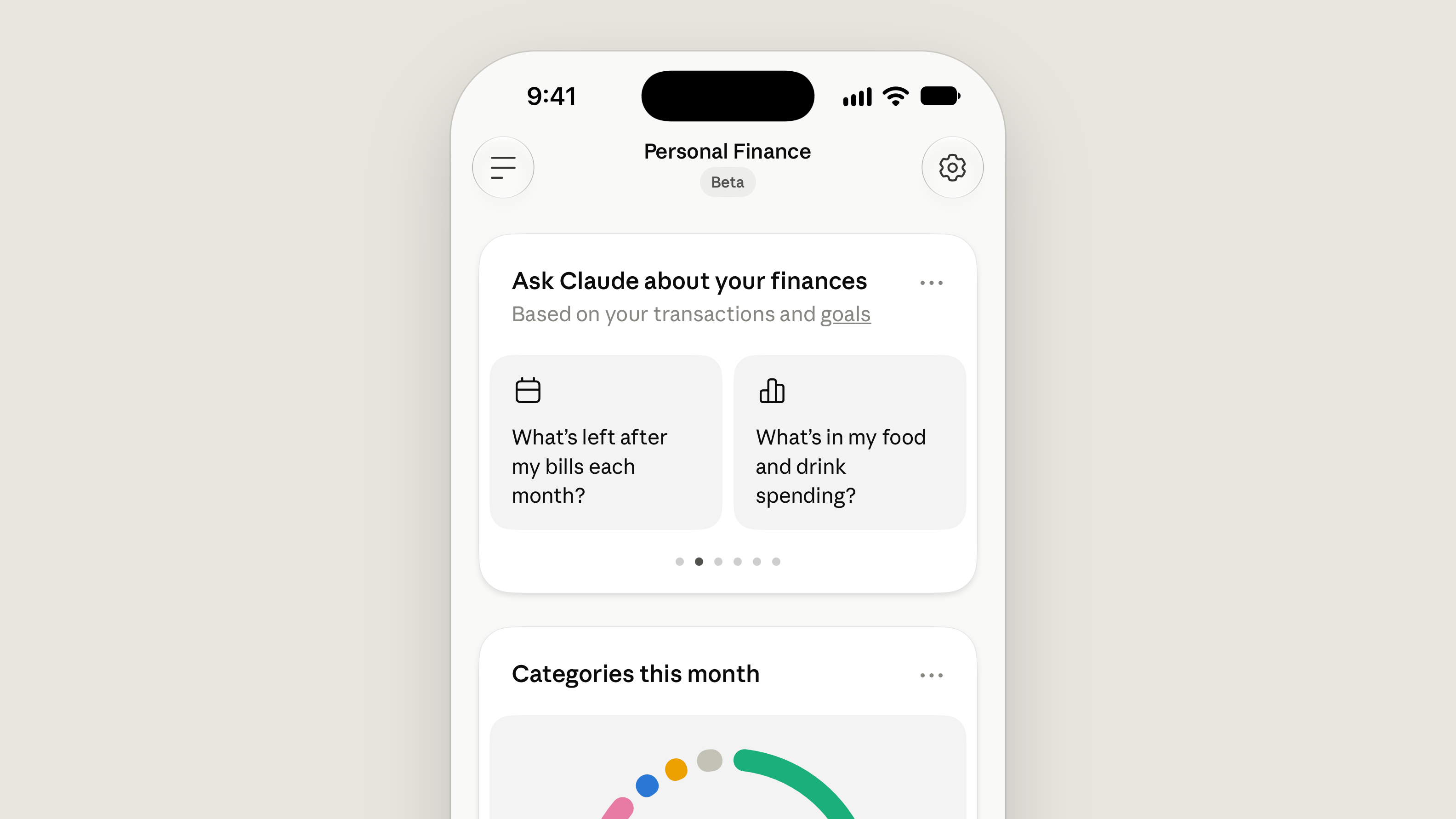
Anthropic’s Personal Finance beta dashboard, shown in its launch materials. Source: Claude.
The rollout began this week, Anthropic said in its announcement. Users can ask about balances, recurring bills, interest charges and unusual spending, or request charts and adjustable dashboards. The company says the feature has no advertising or sponsored recommendations and offers no credit cards, loans or savings accounts of its own.
The pitch is financial analysis within a paid assistant, without advertising or promotion of its own financial products. Those promises address commercial incentives; they do not establish accuracy. Anthropic's documentation warns that missing accounts can make a budget overstate how much money is available.
Claude's original introduction described writing, summarization, search and coding uses, following tests with partners including Notion and DuckDuckGo. Personal Finance extends that general assistant to users' account records. The launch also comes ahead of Anthropic’s anticipated initial public offering, according to a report on the rollout.
ChatGPT developer OpenAI introduced a similar bank connection through ChatGPT Finances in May, according to a comparison of the two offerings. The report describes broadly similar functions, including finding unexpected fees and duplicate charges and creating spending charts. Both use Plaid.
Anthropic says conversations inside the Personal Finance hub will not train its models. The comparison reports that ChatGPT’s finance experience instead follows existing data-control settings, with model training enabled by default unless users change them. Claude’s own protection also has a boundary: information shared outside its finance hub follows the user’s ordinary privacy settings.
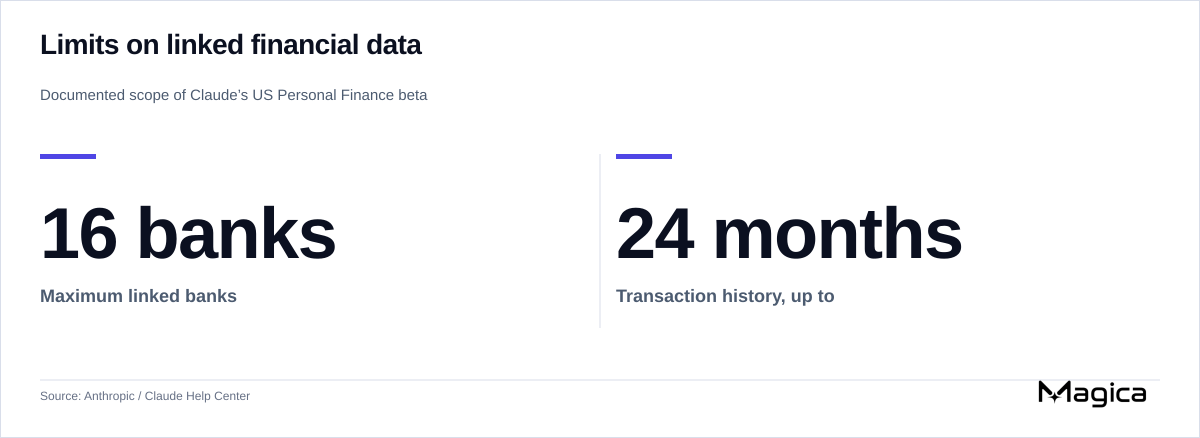
Company-reported limits: up to 16 linked banks and 24 months of transactions. Graphic: Magica; source: Anthropic. Source: Claude Support.
According to Anthropic’s support documentation, the beta is arriving gradually on the web, desktop, iOS and Android. Free, Team and Enterprise accounts are excluded. Only US banks can be linked, with a limit of 16 banks.
Users sign in through Plaid and select the accounts they want to share. Anthropic says Claude does not request or see their bank password. It can receive bank and account names, account types, the last few account-number digits, balances, credit limits and up to 24 months of transactions, including amounts, merchants, dates and bank descriptions.
Linking investment or loan accounts does not give Claude a full view of a portfolio or borrowing contract. The documentation says it reads balances and credit limits, but not holdings, trades, rates or terms—even when Plaid’s consent screens request broader categories of information. A full account number could nevertheless reach Claude if a bank includes it in an account name or transaction description.
Plaid already supplies infrastructure for financial-management, payment and investment tools. In a September 2025 joint announcement with JPMorganChase, the US banking group operating under the Chase and J.P. Morgan brands, it described connections to more than 12,000 financial institutions across the US, Canada, the UK and Europe. That is a network-wide figure, not the number of banks available through Claude's US-only beta.
The companies renewed an agreement for sharing customer-permissioned banking data, including a pricing structure. They also said the extension would not affect Plaid's existing customer agreements and pricing. The announcement illustrates the bank agreements behind an app's access, but supplies no basis for calculating Anthropic's data costs or the cost of serving a finance user.
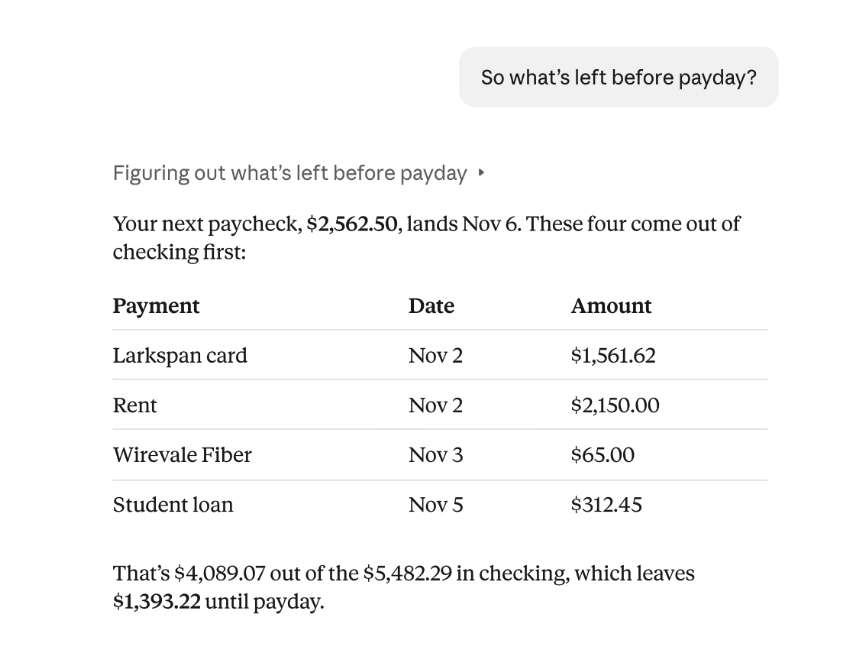
Anthropic’s illustrative payday calculation. This company-reported example is not an independent accuracy test. Source: Claude.
Anthropic says Personal Finance cannot move, manage or invest money and is not designed to give investment advice. But read-only access does not make a budget reliable. Its help page warns that balances can be a day or two old and an account linked through separate logins can sometimes be counted twice.
More consequentially, when Claude cannot read a bank, the spending figures leave it out. Anthropic warns that this can make a budget show more money available than the user actually has. The company advises checking important figures against bank statements or the bank’s app.
Anthropic says a chat that has used linked accounts is designed to be excluded from Claude's memory, later chat searches and monthly recaps. Linked accounts cannot be used in scheduled tasks, Cowork tasks or Claude Code. Chats using them may also be unable to run code or work with some document formats. These are limits on how the account connection works within the wider assistant.
The protections still require attention to where information goes. According to the help page, hosting providers handle bank data and Plaid processes it under its own terms. Financial information appearing in a conversation remains in chat history until deletion, subject to retention practices. Claude ordinarily reads linked accounts in chats without asking each time, although users can change connector permissions.
Shared chat links can expose messages and account figures. Published artifacts—shareable outputs such as charts or dashboards—can contain financial information and remain after the original chat is deleted. Anthropic says Claude asks before publishing an artifact from a chat that used linked accounts. An artifact can read a viewer's own accounts if the viewer has Personal Finance and permits Plaid access; any figures in the artifact, including saved figures, are visible to everyone who opens it.
Unlinking a bank stops future reads but does not remove information already placed in chats, artifacts or shared links. It unlinks all accounts shared through that bank login, rather than a single selected account. Removing the last bank also permanently resets the dashboard and its saved settings.
Letting a paid subscription lapse leaves the banks linked, although the finance page and account reads become unavailable. Anthropic says deleting a Claude account automatically unlinks banks once deletion is processed. Stopping access, ending payment and deleting previously shared information are separate actions.
Anthropic is inviting banks, wealth managers and financial-services companies to explore how Claude could work alongside licensed professionals and regulated firms on larger financial decisions. It has not set out a concrete service model for that expansion.
For the current beta, the unresolved test is whether Claude can reliably distinguish a household's finances from the incomplete or delayed records it can read. The launch materials provide no independently measured error rate or evidence of household savings. Tests of missing-account handling, duplicate-account detection and answers checked against bank statements would help establish whether users can depend on its budgets before the proposed expansion into larger financial decisions.
The Cambridge startup has secured backing described as eight figures in capital and compute, including UK government support. Its wager is that cheaper, accurate quantum calculations can supply better AI training data; full performance results remain forthcoming.
Japan’s Nikkei fell 7.09% in Friday morning trading, with AI, chip and data center-related shares hit hard after Wall Street losses. Reports linked the rout to fears of U.S. regulation following Democratic election victories, without identifying an enacted restriction or a cut in AI spending.
Potential investors are pressing Anthropic for a lower valuation as a technology selloff threatens its November IPO timetable. Rapid revenue growth and substantial cash complicate a financing debate driven by losses and long-term infrastructure commitments.
Visa's new benchmark finds that AI shopping models often miss customer requirements and struggle to repeat successful decisions. The tests cover product discovery, leaving checkout and payment reliability for future rounds.
Agility Robotics began trading after its Churchill Capital Corp XI merger, bringing a commercially deployed humanoid robot maker to U.S. public markets. Its next test is turning conditional Digit 5 orders into deliveries and sustainable economics.
Goldman Sachs sees temporary halts potentially affecting about 45% of planned US data center expansion after Democratic election victories. In Texas, where approvals were already paused, the next fight is over how long restrictions last and what developers must pay for.
Core Scientific’s third-quarter colocation revenue rose 57.6% to $215.4 million. Its expansion beyond CoreWeave could diversify sales from 2027, but the next projects require additional financing rather than the same customer funding that supported its existing conversions.
Meta is rolling out voice conversations and animated avatars for Muse in the US. The update adds personality to a cloud-based task agent whose costs, permissions and reliability matter more than its expressions.
OpenAI president Greg Brockman predicts significant medical advances within 12 to 18 months and raises the possibility of death becoming a choice. OpenAI’s cell research and a separate early drug trial show narrower progress, with financial ties, safety questions and clinical testing still central to judging the promise.
Citrini Research is recasting its AI investments around relative value as it warns that financing and construction constraints threaten returns. Its reported Oracle–Nebius trade faces a crucial counterargument: Nebius has substantial customer commitments, although delivery remains conditional.
Shield AI has agreed to acquire Echodyne for up to $5.3 billion, backed by a $2.5 billion financing package. The radar maker brings a profitable, defense-heavy business and commercial customers, with a promise to keep supplying outside system builders.
Gemini Omni 1.2 Flash lowers Google's quoted 720p generation price to $0.07 per second and extends native clips from 10 to 15 seconds. Editing limits and early commercial tests show why cheaper output does not guarantee the same savings on finished videos.
Mercedes-Benz plans to add Liquid AI’s on-device models to its North American voice assistant. The deal combines local processing with existing cloud AI, while customer availability, measured performance and contract economics remain unconfirmed.
Mistral is expanding Studio with managed agents, apps and workflow tools, extending its existing enterprise platform. Its private-deployment pitch sits alongside cloud-hosted app services and vendor-stored agent sessions, making the chosen configuration central to customer control.
Meta president Dina Powell McCormick expects tougher conditions for new US data centers after Democratic election victories, but says states still want investment. The test is whether electricity commitments, local jobs and tax benefits can secure community support.
OpenAI is releasing GPT-6 Cyber to selected verified defenders with stronger monitoring. Its Linux research shows the scale and cost of automated exploitation, while mixed benchmark results and unfinished patching limit what the launch proves about safer software.
Black Hills plans $1.8 billion of gas generation under agreements to serve Google’s proposed $17 billion Cheyenne campus through 2048. Google has advanced equipment funding, but delivery, fuel-cell conditions and local impacts remain unresolved.
Dropbox agreed to buy Tigris for about $350 million in cash and unveiled DBX Agent Cloud, starting with standalone object storage. The expansion accompanies AI actions for existing file customers, while pricing and evidence of competitive performance and productivity gains remain absent from the announcement.
ElevenMusic creators can now publish directly to SoundCloud, with a three-month Pro offer for Artist Pro subscribers. The integration shortens distribution while preserving disclosure and rights requirements.
A researcher demonstrated how a browser extension could use Claude Dispatch to execute code through a connected desktop agent. Anthropic reportedly acknowledged the flaw in May and proposed retiring Dispatch, but existing users still have access, leaving questions about authorization across devices.