Editorial Team
8 min read
Agility Robotics began trading after its Churchill Capital Corp XI merger, bringing a commercially deployed humanoid robot maker to U.S. public markets. Its next test is turning conditional Digit 5 orders into deliveries and sustainable economics.
Agility Robotics, the Salem, Oregon-based maker of the two-legged industrial robot Digit, began trading on Nasdaq on November 5 after merging with Churchill Capital Corp XI, a listed acquisition vehicle. The transaction and related financings raised approximately $465 million before expenses to expand a business that already has paying customers but is still developing its next robot and manufacturing scale.
Agility’s announcement graphic for its November 5 Nasdaq debut as AGLT. Image: Agility Robotics. Source: Agility Robotics.
Digit is designed to move materials and perform repetitive physical tasks in warehouses and factories built for people. Agility’s listing announcement describes the company as the first U.S. publicly listed pure-play humanoid robotics business with active commercial deployments. Its shares trade as AGLT and warrants as AGLTW.
The scale of the financing contrasts with the operating business. A review of Agility’s securities disclosures reports $1.8 million in 2025 revenue and a $140 million operating loss. Agility’s disclosures anticipate continuing operating and net losses. The new capital funds an expansion from that base; it does not establish sustainable economics.
The claim to be first is geographically limited. A report on the debut notes that Chinese robot maker Unitree listed in Shanghai in August. Agility’s U.S. listing nevertheless offers a window into a sector whose startup competitors largely remain private.
Churchill XI was a special purpose acquisition company, formed to merge with an operating business. The transaction closed November 4. A pre-closing company announcement filed with the SEC broke the approximately $465 million gross financing into about $164 million from Churchill’s trust account, a roughly $201 million private investment in public equity committed at $10 per share, and $100 million in equity funding already received after the merger announcement. The headline total therefore includes earlier funding and precedes transaction expenses.
Foxconn, Apple’s main iPhone assembly partner, led the private investment. Other backers include Nvidia, Amazon and SoftBank Vision Fund 2, according to the report on the debut. Those investors give Agility links to large technology and manufacturing businesses, while its funding needs remain tied to commercial execution.
Existing Agility shareholders rolled all their equity into the combined company, according to the closing announcement. Their shares and those of Churchill’s sponsor face a 180-day sales lockup, with possible early release tied to stock-price performance. That preserves their financial exposure, although it does not guarantee commercial results.
Agility says in its listing announcement that Digit has accumulated more than 65,000 operating hours and is working with customers including contract logistics provider GXO, automotive supplier Schaeffler and Toyota Motor Manufacturing Canada. The debut report describes about 400 employees, nine customers that have used Agility’s humanoids and commitments covering 12 customer facilities. These measures do not establish how many robots are working continuously or profitably.
Agility chief executive Peggy Johnson previously ran augmented-reality company Magic Leap, where Agility’s appointment announcement credits her with shifting the business from consumers toward enterprise customers. She argues in the debut report that Agility should be judged like other automation providers, including on throughput and accuracy—measures that make the usefulness of deployments more consequential than their novelty.
The commercial history predates the listing. GXO’s June 2024 multi-year subscription agreement followed a pilot in late 2023. At a SPANX warehouse, Digit moved totes from other robots onto conveyors, managed through Agility Arc, Agility’s cloud software for deploying and managing robot fleets. The robot complemented existing automation in a specific workflow; that deployment did not demonstrate unrestricted general-purpose autonomy.
In its listing announcement, Agility says Digit has moved more than 100,000 totes at GXO’s Georgia operation and that the partnership will expand to two additional U.S. facilities in early 2027. Agricultural machinery manufacturer AGCO has agreed to a manufacturing pilot beginning in 2027. Agility also identifies three unnamed manufacturing customers in paid application programs and more than 30 prospective customers. Paid programs, pilots and sales discussions represent different stages of adoption from repeat commercial deployments.
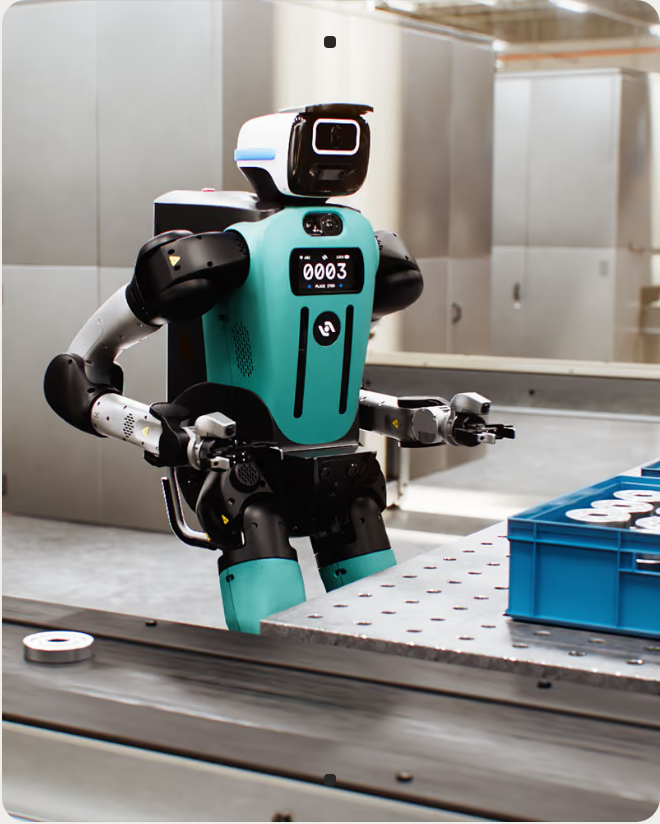
Digit 5 in official product imagery supplied by Agility Robotics. Source: Agility Robotics.
The next-generation Digit 5, unveiled in September, is intended to broaden the work available to the platform. Agility targets repetitive lifting of up to 50 pounds, interchangeable end effectors—the tools at the ends of its arms—and closer operation alongside people. Earlier Digit versions worked behind physical safety barriers, limiting the jobs they could take on.
Agility’s listing announcement ties those ambitions to outside suppliers. It plans to standardize onboard computing on Nvidia IGX Thor and expand its use of Nvidia Halos safety technology; FORT Robotics supports industrial safety-system development. Nyobolt supplies battery technology intended to support nine-minute charging stops and more than 20 productive hours per 24-hour day. These are company targets, including technologies still to be integrated and validated, rather than demonstrated performance across customers.
The disclosure review describes nine minutes of charging for 90 minutes of runtime. It also reports Agility’s claim that its agreement with Nyobolt gives it exclusive use of the battery chemistry in humanoid robots. That is a specific claimed advantage in a component partnership, rather than proof that the complete robot will meet its productivity targets.
Safety is a commercial constraint as well as a technical one. The debut report notes that legged robots can be less predictable and pose greater risks to people than similar wheeled devices. Agility must validate the closer working arrangements on which its broader task range depends.
The review of Agility’s securities disclosures describes two illustrative customer arrangements for Digit 5, expected to reach customers in 2027:
| Customer arrangement | Initial payment per robot | Recurring software and maintenance |
|---|---|---|
| Subscription | About $25,000 for delivery and deployment | $8,500 monthly |
| Hardware purchase | $200,000 for hardware plus $20,000 for delivery and deployment | $36,000 annually |
At those illustrative rates, subscription charges total $127,000 in the first 12 months, including deployment, versus $256,000 for purchasing with the first year’s software and maintenance. Over five years, the corresponding totals would be $535,000 and $400,000, calculated by adding deployment and hardware charges, where applicable, to 60 monthly or five annual fees. That assumes unchanged rates and five years of use; it does not establish actual contract terms, measured savings or equivalent output to human labor.
Agility compared roughly $100,000 in annual subscription costs with $200,000 in annual labor costs in an investor presentation, according to the disclosure review. That is the company’s sales comparison. Customer value also depends on useful output, availability, accuracy, supervision and the workflow being automated; the fee schedule alone does not establish the claimed labor substitution.
The company’s own economics also depend on scale. The disclosure review says Agility estimates an initial Digit 5 bill of materials of $150,000, falling to $75,000 at annual production of 1,000 robots and eventually $30,000 at 10,000 robots. It estimates a five-year operating life and annual software and maintenance costs of $15,000 per robot, plus $15,000 for initial deployment. A bill of materials is only one component of the business’s costs, and the lower figures are projections tied to higher output.
Agility’s RoboFab plant is designed for up to 10,000 robots annually. Designed capacity is not achieved production. Nor do the orders yet amount to recognized revenue: the company says its more than $300 million in committed multi-year Digit 5 orders remain subject to milestones, product features and specifications. The disclosure review describes one $300 million order covering 1,000 robots over a three-year subscription contract, highlighting the importance of delivering against a large individual commitment.
Agility also warns in its listing announcement that the available capital could be insufficient to execute its plans and that it may need further financing. Its production-cost targets and order book therefore need to be judged alongside its continuing losses.
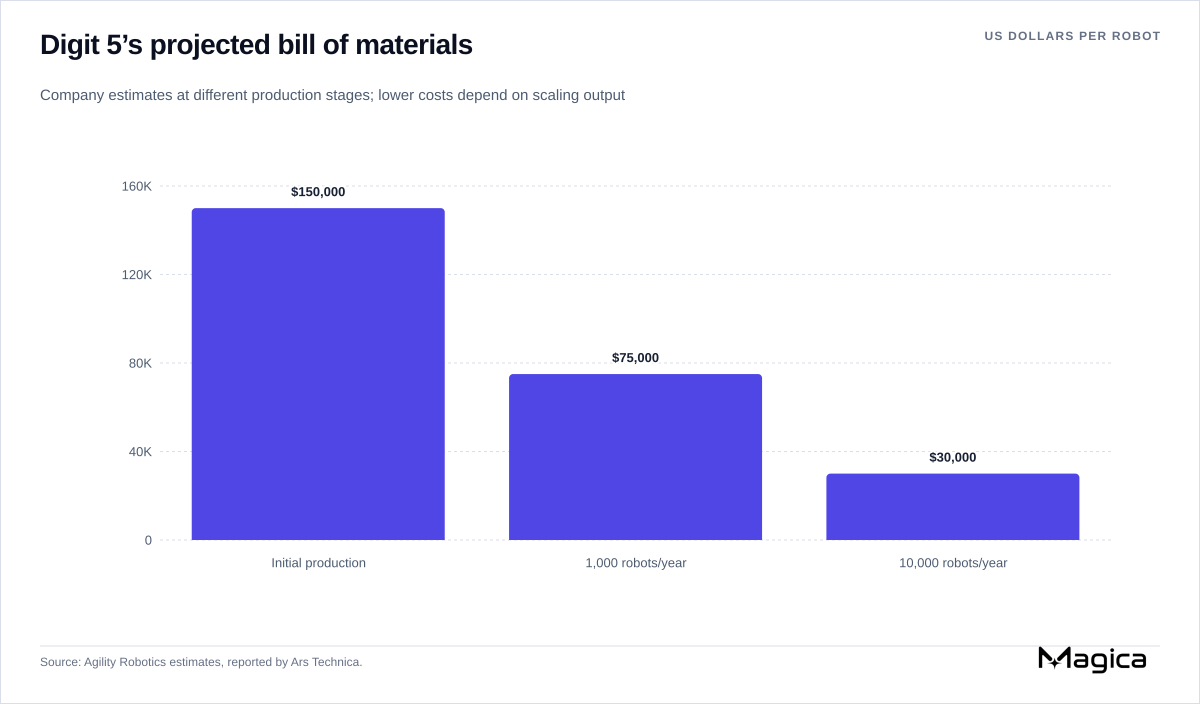
Company-reported bill-of-materials estimates decline with higher annual production. These are projections and cover only part of total costs. Source: Ars Technica.
Agility’s listing announcement projects early customer access to Digit 5 in the first half of 2027 and targets general availability by year-end. It plans to use the proceeds to fulfill orders, expand deployments and scale production, supported by RoboFab and a planned Pittsburgh expansion for software, AI and customer support. Manufacturing capacity must be matched by the ability to install, integrate and maintain robots at customer sites.
The competitive test extends beyond other humanoids. The disclosure review highlights Agility’s acknowledgment in its filings that conventional industrial robots have decades of commercial experience, while humanoids remain unproven at scale. Those filings also identify well-funded humanoid competitors including Boston Dynamics, Tesla, Apptronik and Figure AI, some with greater manufacturing resources and customer relationships.
The next useful evidence is customer access on schedule, fulfillment of the conditions attached to large orders, and sustained throughput and accuracy in paid operations. Production volumes and realized manufacturing and service costs will show whether the illustrative economics survive deployment. The listing supplies capital and public disclosures; 2027 deliveries must show how much of that model Agility can execute.
The Cambridge startup has secured backing described as eight figures in capital and compute, including UK government support. Its wager is that cheaper, accurate quantum calculations can supply better AI training data; full performance results remain forthcoming.
Japan’s Nikkei fell 7.09% in Friday morning trading, with AI, chip and data center-related shares hit hard after Wall Street losses. Reports linked the rout to fears of U.S. regulation following Democratic election victories, without identifying an enacted restriction or a cut in AI spending.
Potential investors are pressing Anthropic for a lower valuation as a technology selloff threatens its November IPO timetable. Rapid revenue growth and substantial cash complicate a financing debate driven by losses and long-term infrastructure commitments.
Visa's new benchmark finds that AI shopping models often miss customer requirements and struggle to repeat successful decisions. The tests cover product discovery, leaving checkout and payment reliability for future rounds.
Goldman Sachs sees temporary halts potentially affecting about 45% of planned US data center expansion after Democratic election victories. In Texas, where approvals were already paused, the next fight is over how long restrictions last and what developers must pay for.
Core Scientific’s third-quarter colocation revenue rose 57.6% to $215.4 million. Its expansion beyond CoreWeave could diversify sales from 2027, but the next projects require additional financing rather than the same customer funding that supported its existing conversions.
Meta is rolling out voice conversations and animated avatars for Muse in the US. The update adds personality to a cloud-based task agent whose costs, permissions and reliability matter more than its expressions.
Anthropic is rolling out Personal Finance to paid Claude users in the US, using Plaid to read bank data. Its pitch rests on ad-free answers and privacy controls, while its own documentation warns that balances and budgets can be incomplete.
OpenAI president Greg Brockman predicts significant medical advances within 12 to 18 months and raises the possibility of death becoming a choice. OpenAI’s cell research and a separate early drug trial show narrower progress, with financial ties, safety questions and clinical testing still central to judging the promise.
Citrini Research is recasting its AI investments around relative value as it warns that financing and construction constraints threaten returns. Its reported Oracle–Nebius trade faces a crucial counterargument: Nebius has substantial customer commitments, although delivery remains conditional.
Shield AI has agreed to acquire Echodyne for up to $5.3 billion, backed by a $2.5 billion financing package. The radar maker brings a profitable, defense-heavy business and commercial customers, with a promise to keep supplying outside system builders.
Gemini Omni 1.2 Flash lowers Google's quoted 720p generation price to $0.07 per second and extends native clips from 10 to 15 seconds. Editing limits and early commercial tests show why cheaper output does not guarantee the same savings on finished videos.
Mercedes-Benz plans to add Liquid AI’s on-device models to its North American voice assistant. The deal combines local processing with existing cloud AI, while customer availability, measured performance and contract economics remain unconfirmed.
Mistral is expanding Studio with managed agents, apps and workflow tools, extending its existing enterprise platform. Its private-deployment pitch sits alongside cloud-hosted app services and vendor-stored agent sessions, making the chosen configuration central to customer control.
Meta president Dina Powell McCormick expects tougher conditions for new US data centers after Democratic election victories, but says states still want investment. The test is whether electricity commitments, local jobs and tax benefits can secure community support.
OpenAI is releasing GPT-6 Cyber to selected verified defenders with stronger monitoring. Its Linux research shows the scale and cost of automated exploitation, while mixed benchmark results and unfinished patching limit what the launch proves about safer software.
Black Hills plans $1.8 billion of gas generation under agreements to serve Google’s proposed $17 billion Cheyenne campus through 2048. Google has advanced equipment funding, but delivery, fuel-cell conditions and local impacts remain unresolved.
Dropbox agreed to buy Tigris for about $350 million in cash and unveiled DBX Agent Cloud, starting with standalone object storage. The expansion accompanies AI actions for existing file customers, while pricing and evidence of competitive performance and productivity gains remain absent from the announcement.
ElevenMusic creators can now publish directly to SoundCloud, with a three-month Pro offer for Artist Pro subscribers. The integration shortens distribution while preserving disclosure and rights requirements.
A researcher demonstrated how a browser extension could use Claude Dispatch to execute code through a connected desktop agent. Anthropic reportedly acknowledged the flaw in May and proposed retiring Dispatch, but existing users still have access, leaving questions about authorization across devices.