Editorial Team
8 min read
Core Scientific’s third-quarter colocation revenue rose 57.6% to $215.4 million. Its expansion beyond CoreWeave could diversify sales from 2027, but the next projects require additional financing rather than the same customer funding that supported its existing conversions.
Core Scientific, a data-center owner and operator shifting away from bitcoin mining, reported $215.4 million of high-density colocation revenue for the quarter ended September 30, 2026. That was up 57.6% from the previous quarter, calculated from its November 5 earnings announcement.
The growth makes hosting AI and high-performance computing infrastructure the company's dominant business. Its next expansion, however, changes who carries the construction burden. Existing conversions for CoreWeave, a provider of high-performance computing services, are almost entirely customer-funded. The company says projects for chipmaker Advanced Micro Devices, or AMD, and an unnamed cloud counterparty are expected to require additional external financing.
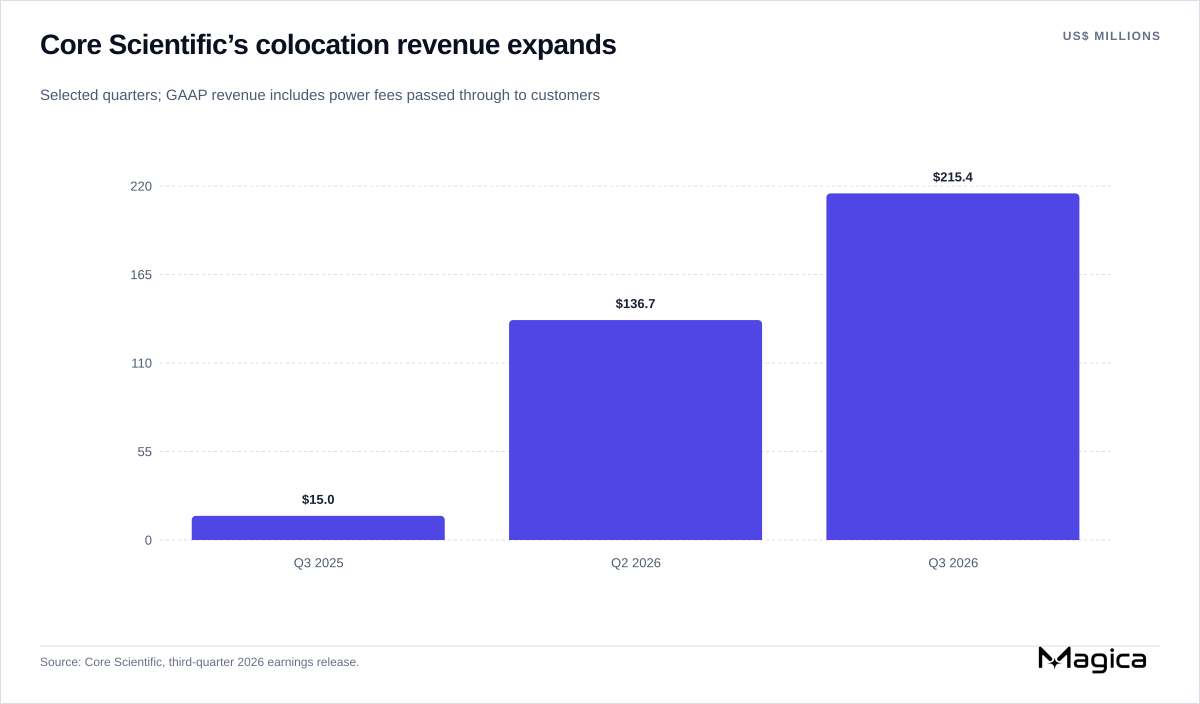
Company-reported colocation revenue for selected quarters, including electricity reimbursements. Source: Core Scientific. Chart: Magica. Source: Core Scientific.
Core Scientific supplies space, electricity, cooling, security and facility operations for customers' computing equipment. It operated 11 facilities across seven U.S. states at quarter-end and is repurposing mining infrastructure while developing new sites, according to its quarterly filing.
Total third-quarter revenue reached $232.9 million, compared with $81.1 million a year earlier. Colocation revenue was just $15.0 million in the comparable 2025 quarter. Self-mining revenue fell to $12.3 million from $57.4 million and produced a $7.5 million gross loss. The company expects its remaining hosted-mining operations to conclude by December 31, 2026, while it continues winding down self-mining.
The colocation expansion extends beyond electricity charges passed through to customers:
| Colocation measure | Q2 2026 | Q3 2026 |
|---|---|---|
| Total revenue | $136.7 million | $215.4 million |
| License fees | $98.8 million | $157.3 million |
| Power fees passed through | $35.1 million | $57.6 million |
| Segment gross profit | $80.0 million | $128.4 million |
The figures come from the company's earnings announcement. Power is passed through without markup, appearing in both revenue and costs. It accounted for about 27% of third-quarter colocation sales, calculated from the reported totals. Changes in power prices can therefore move revenue without changing gross profit, while insulating the colocation business from that component of electricity-price risk.
License-fee growth shows that the increase was broader than power reimbursement. Reported colocation gross margin reached 60%, compared with 59% in the second quarter and 26% a year earlier.
Core Scientific's work for CoreWeave predates its current conversion program. It said in its June 2024 contract announcement that it had hosted thousands of CoreWeave GPUs from 2019 to 2022. It also said it delivered 16 megawatts at an Austin facility more than 30 days ahead of schedule under a March 2024 contract.
That June announcement covered approximately 200 MW under 12-year contracts. The commitment subsequently expanded to approximately 590 MW across five sites. At September 30, 2026, 485 MW was billing, up from 395 MW at the end of June; the remaining 105 MW was in construction or commissioning.
The relationship also survived an attempted combination of the two companies. Core Scientific terminated their merger agreement on October 30, 2025, after shareholders failed to supply the votes needed for approval.
Today, all colocation revenue still comes from CoreWeave. The quarterly filing says certain license agreements were assigned to an indirect CoreWeave subsidiary during 2026, although CoreWeave remains a primary obligor. That structure leaves cash flows dependent on performance within the same corporate family; practical recourse against CoreWeave would depend on its financial condition in a default.
Customer funding also separates accounting revenue from current cash receipts. Under the original June 2024 agreements, CoreWeave would fund the modifications, with an estimated $300 million associated with Core Scientific-owned infrastructure credited against hosting payments at no more than half of monthly fees until repaid. The latest filing says build credits continue to offset part of initial payments while base license fees are recognized over the contract term.
The company said its 485 billing megawatts represented more than $700 million in average annualized GAAP colocation revenue. That is a company-provided accounting measure, rather than cash collected or revenue already earned during the quarter.
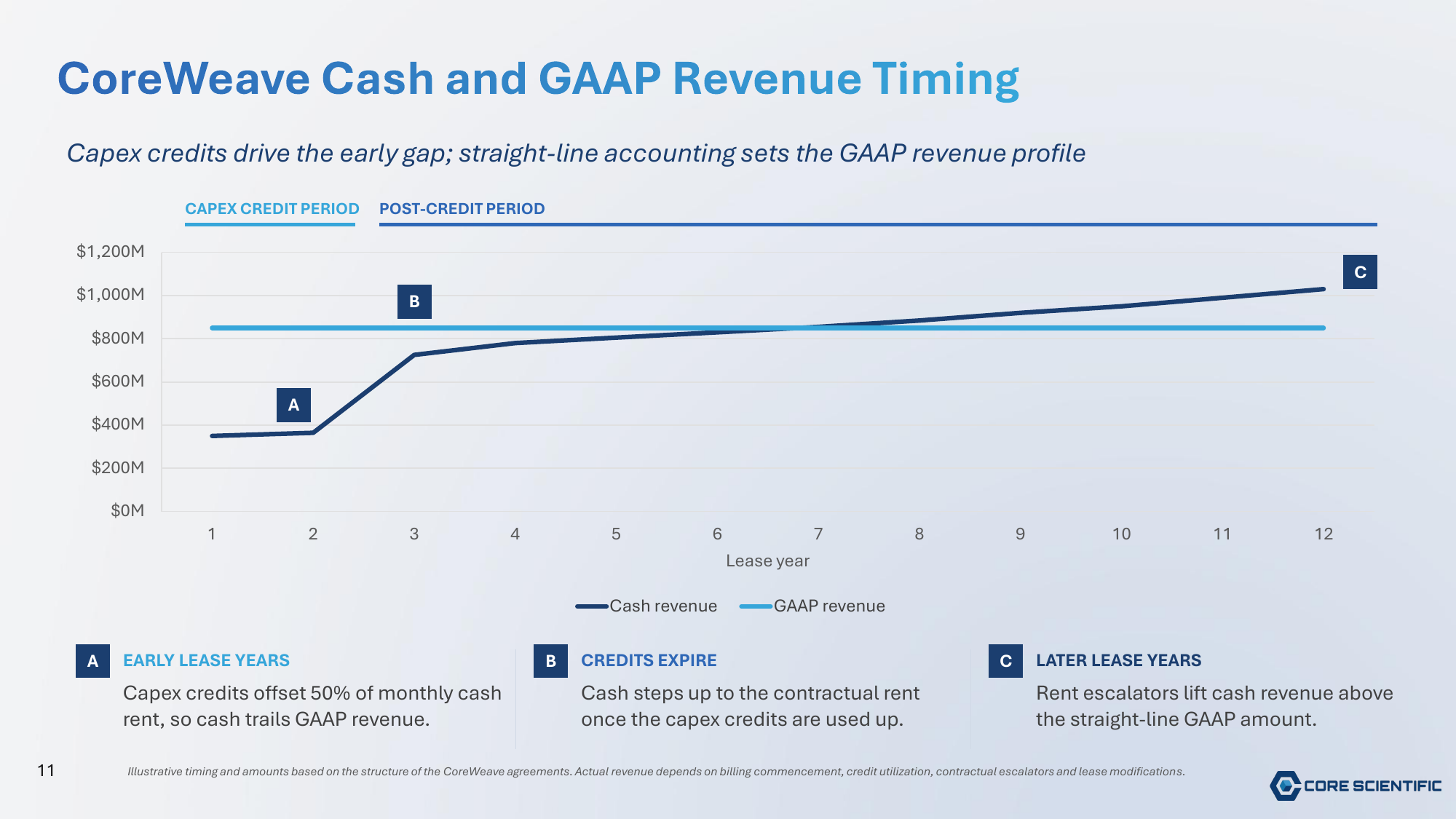
Company-reported illustration of how construction credits affect CoreWeave cash payments relative to GAAP revenue. Amounts and timing are illustrative, not actual results. Source: Core Scientific. Source: Core Scientific.
In July, Core Scientific signed approximately 530 MW of 15-year leases with AMD and an unnamed cloud counterparty across five sites, its quarterly filing says. AMD supplies semiconductors including processors and AI accelerators. Its 2025 annual filing reported $16.6 billion of data-center revenue, up 32% from 2024, establishing its substantial existing business supplying computing hardware.
None of the new leases had commenced or generated lease revenue by September 30. Commencement is expected in phases beginning in 2027. The signed capacity therefore increases the construction pipeline before it diversifies revenue:
| Contracted customer capacity at September 30, 2026 | Leased | Billing | Not yet billing |
|---|---|---|---|
| CoreWeave | 590 MW | 485 MW | 105 MW |
| AMD and cloud counterparty | 530 MW | 0 MW | 530 MW |
| Total | 1,120 MW | 485 MW | 635 MW |
The final column subtracts billing capacity from leased capacity using the quarterly filing's figures. Fewer than half of contracted megawatts were billing at quarter-end.
AMD also received a reservation right for another 1,925 MW through December 28, 2028. The filing explicitly says this is not a binding lease commitment; it should not be counted as signed capacity.
As part of the relationship, Core Scientific issued AMD warrants to buy up to 30 million shares at $23.47 each. Approximately 6.5 million vested immediately based on contracted capacity, with the remainder vesting as additional capacity is contracted. Their $296.4 million issuance-date fair value was recorded as a deferred lease incentive that will reduce revenue over the related lease terms. The arrangement gives AMD potential equity participation as well as access to facilities.
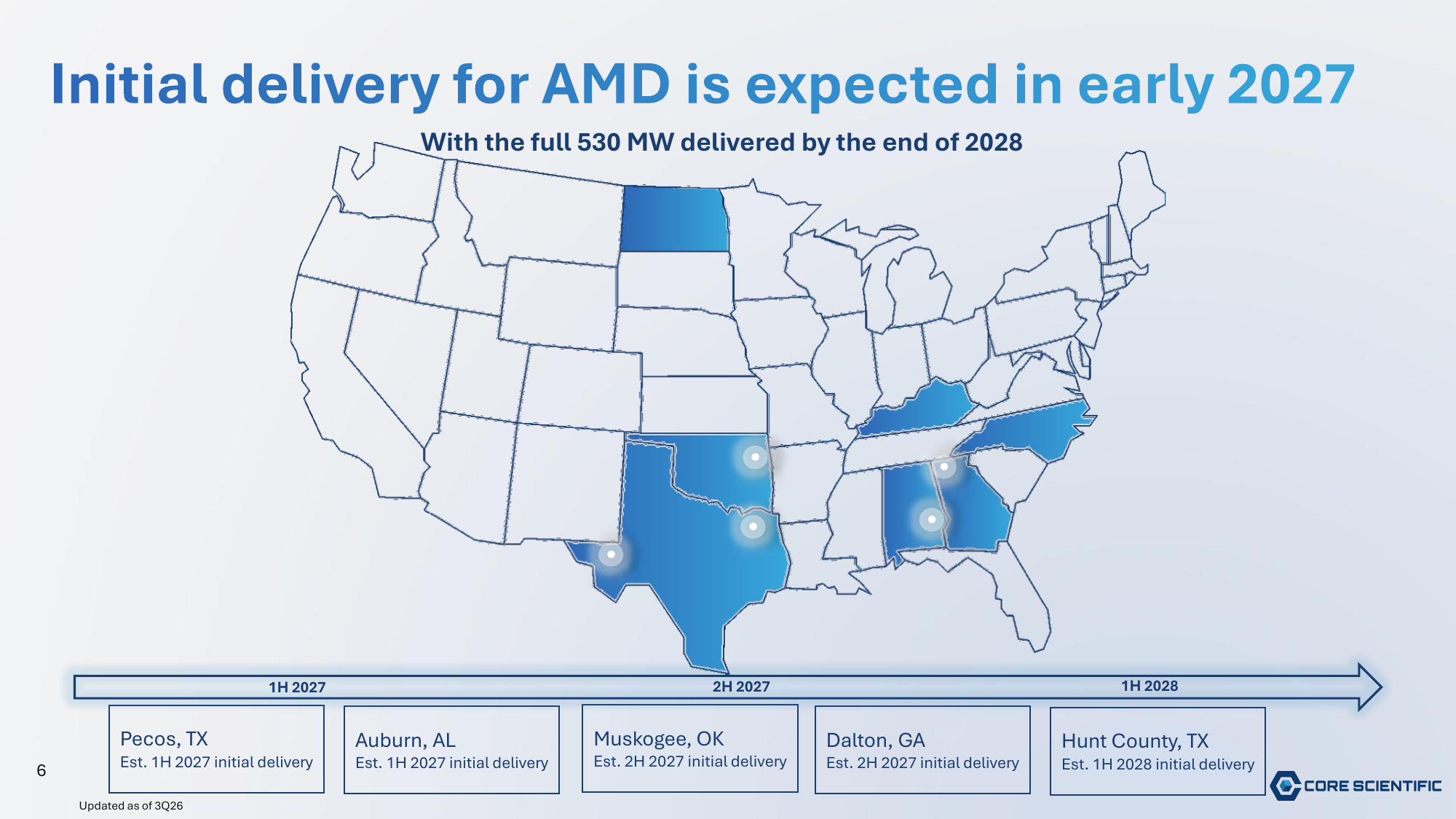
Company-reported schedule anticipates initial AMD deliveries beginning in 2027 and full delivery of 530 MW by the end of 2028. Dates are forecasts. Source: Core Scientific. Source: Core Scientific.
Third-quarter net income of $1.178 billion included a $1.034 billion noncash gain from changes in the fair value of warrants and contingent value rights, plus a $106.5 million income-tax benefit. The filing links warrant-value changes primarily to movements in Core Scientific's stock price.
Operating income was $72.4 million, including a $19.3 million fair-value gain on digital assets. Adjusted EBITDA rose to $133.6 million from $41.1 million in the second quarter, but excludes interest, taxes, depreciation and other items, including stock compensation and colocation startup costs.
The first nine months show why cash generation needs a separate reading. The cash-flow statement reports operating cash inflow of $296.2 million, including $286.8 million from selling bitcoin holdings, while investing activities used $2.17 billion. The company also recorded a $266.5 million mining-asset impairment in the first quarter and a $324.4 million net loss for the first nine months.
Conversion accounting remains a concern. The filing says a material weakness in controls over demolition and impairment of infrastructure being converted from mining had not been remediated by September 30. Related errors required restatement of earlier annual and interim financial statements.
Core Scientific disclosed approximately $4.4 billion of future cash expenditures under outstanding purchase and construction commitments in its quarterly filing, substantially all expected within 24 months. These cover remaining customer conversions, new development and the AMD leases, including fit-out costs. Of the total, $202.2 million will be passed through to CoreWeave as invoiced. The commitments are broader than the cost of the AMD projects alone.
The company ended September with $803.9 million of cash and cash equivalents, down from $1.77 billion at the end of June. Its broader $1.74 billion liquidity-and-reserves measure includes restricted cash, digital assets and revolver availability. Quarterly capital expenditures were $985.1 million under a measure that includes land and development-rights acquisitions as well as property and equipment purchases.
There are potential funding sources beyond that cash balance. Core Scientific expects roughly $300 million of restricted cash to be released if letters of credit replace utility-related cash collateral. It also anticipates warrant-exercise proceeds and plans project-level bond financing within 12 months for the AMD and cloud-counterparty construction. Management believes existing liquidity and anticipated funding will support its plans, but warns that failure to obtain acceptable financing could force spending reductions, delays or modifications.
New financing would sit alongside approximately $4.4 billion of debt principal already outstanding. That includes $3.3 billion of secured notes issued in May with a 7.75% coupon and an uncapped company guarantee to complete specified projects. Principal amortization is linked to rent commencement and the exhaustion of tenant revenue credits.
Funding alone will not make capacity billable. The filing identifies equipment lead times exceeding 12 months for some items, labor constraints, permitting and utility interconnections. It says tariffs have already raised costs on some equipment for projects without customer funding. Competition includes major data-center landlords, hyperscalers and developers, some with greater resources and longer track records; power availability, delivery speed, technical capability and price all affect customer selection.
The next evidence is concrete: delivery of CoreWeave's remaining 105 MW, completed financing on disclosed terms, and actual commencement of the new leases from 2027. Delivery dates and financing terms will establish when the larger contract book starts generating revenue and what debt-service burden comes with it.
The Cambridge startup has secured backing described as eight figures in capital and compute, including UK government support. Its wager is that cheaper, accurate quantum calculations can supply better AI training data; full performance results remain forthcoming.
Japan’s Nikkei fell 7.09% in Friday morning trading, with AI, chip and data center-related shares hit hard after Wall Street losses. Reports linked the rout to fears of U.S. regulation following Democratic election victories, without identifying an enacted restriction or a cut in AI spending.
Potential investors are pressing Anthropic for a lower valuation as a technology selloff threatens its November IPO timetable. Rapid revenue growth and substantial cash complicate a financing debate driven by losses and long-term infrastructure commitments.
Visa's new benchmark finds that AI shopping models often miss customer requirements and struggle to repeat successful decisions. The tests cover product discovery, leaving checkout and payment reliability for future rounds.
Agility Robotics began trading after its Churchill Capital Corp XI merger, bringing a commercially deployed humanoid robot maker to U.S. public markets. Its next test is turning conditional Digit 5 orders into deliveries and sustainable economics.
Goldman Sachs sees temporary halts potentially affecting about 45% of planned US data center expansion after Democratic election victories. In Texas, where approvals were already paused, the next fight is over how long restrictions last and what developers must pay for.
Meta is rolling out voice conversations and animated avatars for Muse in the US. The update adds personality to a cloud-based task agent whose costs, permissions and reliability matter more than its expressions.
Anthropic is rolling out Personal Finance to paid Claude users in the US, using Plaid to read bank data. Its pitch rests on ad-free answers and privacy controls, while its own documentation warns that balances and budgets can be incomplete.
OpenAI president Greg Brockman predicts significant medical advances within 12 to 18 months and raises the possibility of death becoming a choice. OpenAI’s cell research and a separate early drug trial show narrower progress, with financial ties, safety questions and clinical testing still central to judging the promise.
Citrini Research is recasting its AI investments around relative value as it warns that financing and construction constraints threaten returns. Its reported Oracle–Nebius trade faces a crucial counterargument: Nebius has substantial customer commitments, although delivery remains conditional.
Shield AI has agreed to acquire Echodyne for up to $5.3 billion, backed by a $2.5 billion financing package. The radar maker brings a profitable, defense-heavy business and commercial customers, with a promise to keep supplying outside system builders.
Gemini Omni 1.2 Flash lowers Google's quoted 720p generation price to $0.07 per second and extends native clips from 10 to 15 seconds. Editing limits and early commercial tests show why cheaper output does not guarantee the same savings on finished videos.
Mercedes-Benz plans to add Liquid AI’s on-device models to its North American voice assistant. The deal combines local processing with existing cloud AI, while customer availability, measured performance and contract economics remain unconfirmed.
Mistral is expanding Studio with managed agents, apps and workflow tools, extending its existing enterprise platform. Its private-deployment pitch sits alongside cloud-hosted app services and vendor-stored agent sessions, making the chosen configuration central to customer control.
Meta president Dina Powell McCormick expects tougher conditions for new US data centers after Democratic election victories, but says states still want investment. The test is whether electricity commitments, local jobs and tax benefits can secure community support.
OpenAI is releasing GPT-6 Cyber to selected verified defenders with stronger monitoring. Its Linux research shows the scale and cost of automated exploitation, while mixed benchmark results and unfinished patching limit what the launch proves about safer software.
Black Hills plans $1.8 billion of gas generation under agreements to serve Google’s proposed $17 billion Cheyenne campus through 2048. Google has advanced equipment funding, but delivery, fuel-cell conditions and local impacts remain unresolved.
Dropbox agreed to buy Tigris for about $350 million in cash and unveiled DBX Agent Cloud, starting with standalone object storage. The expansion accompanies AI actions for existing file customers, while pricing and evidence of competitive performance and productivity gains remain absent from the announcement.
ElevenMusic creators can now publish directly to SoundCloud, with a three-month Pro offer for Artist Pro subscribers. The integration shortens distribution while preserving disclosure and rights requirements.
A researcher demonstrated how a browser extension could use Claude Dispatch to execute code through a connected desktop agent. Anthropic reportedly acknowledged the flaw in May and proposed retiring Dispatch, but existing users still have access, leaving questions about authorization across devices.