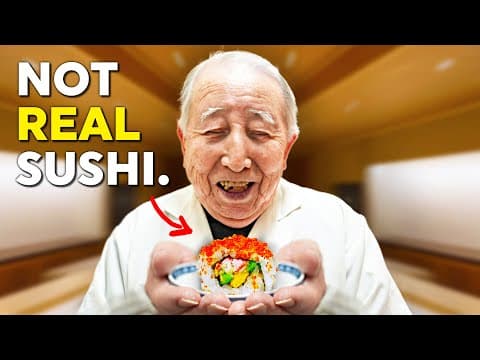
In a fascinating cultural exchange, a 90-year-old traditional Japanese sushi chef samples various American sushi rolls, providing insights into the differences between authentic Japanese sushi and its American adaptations, including his ratings and reactions to each type.
In a unique cultural exploration, a 90-year-old sushi chef from Japan experiences American sushi for the first time. This encounter highlights the significant differences between traditional Japanese sushi and its American counterparts, which have evolved to cater to different tastes and preferences.
Sushi has its roots in Japan, dating back to the 14th century, where it originally meant "sour rice." The traditional sushi we know today is quite different from its early forms. Fast forward to modern times, the first American sushi, known as the California roll, was invented in Little Tokyo, Los Angeles, by Ichiro Masuda. This adaptation features two main differences: imitation crab meat instead of raw fish, and the seaweed (nori) wrapped inside the roll rather than outside, catering to American palates that are less accustomed to raw seafood.
Today, American sushi is dominated by various rolls such as the Philadelphia roll, the dynamite roll, and the dragon roll. However, these creations do not exist in Japan, where sushi is typically a simple combination of fish and rice. This raises an intriguing question: how do Japanese people perceive American sushi?
To find out, the chef, known as Suzuki Kunio, is presented with several American sushi rolls. Before diving into the tasting, the team sources American-style sushi from a restaurant in Tokyo called California Roll, which is tucked away in a basement of an office building. The restaurant specializes in American sushi, and the chef is eager to learn why the owner chose to open such a restaurant in Japan.
The restaurant owner shares his initial shock at the differences in sushi styles. Despite his background as a sushi chef, he has grown to appreciate the unique flavors of American sushi, even if they differ significantly from traditional sushi.
As Suzuki Kunio begins tasting the rolls, he shares his thoughts:
The first roll is the California roll, which contains imitation crab, cucumber, and avocado. Kunio notes the sweetness and finds it acceptable, rating it a 6 or 7 out of 10. He expresses that if half of the people enjoy it, it has passed the test.
Next is the Philadelphia roll, which includes salmon, cucumber, avocado, cream cheese, and sesame. Kunio is puzzled by the inclusion of cream cheese, stating that it does not belong in sushi. He rates this roll a 5 out of 10, emphasizing that salmon should stand alone without additional ingredients.
The tempura roll, featuring shrimp and avocado, garnished with sesame and eel sauce, impresses him the most. He finds it delicious and rates it highly, noting its memorable taste.
The spicy salmon roll, which includes spicy salmon sauce, sesame oil, cucumber, and spicy mayo, receives a lukewarm reception. Kunio expresses his disapproval of mayonnaise in sushi, rating it a 6 out of 10.
The dragon roll, containing imitation crab, cucumber, avocado, and eel sauce, is well-received. Kunio finds it tasty and believes he could recreate it, although he prefers not to serve such rolls in his restaurant.
Finally, the bomb roll, which includes imitation crab, cucumber, avocado, scallops, spicy mayo, and eel sauce, is rated a 7 out of 10. Kunio appreciates the variety of ingredients but still prefers traditional sushi.
Overall, Kunio finds American sushi to be quite enjoyable, rating it positively despite its differences from traditional Japanese sushi. He notes that authentic Japanese sushi is simpler, focusing on the natural flavors of fish and rice without the embellishments found in American versions.
In a world where culinary traditions often blend and evolve, this tasting session serves as a reminder of the rich cultural exchanges that shape our food experiences. Kunio's insights not only highlight the differences between American and Japanese sushi but also reflect the adaptability and creativity of culinary practices across cultures.