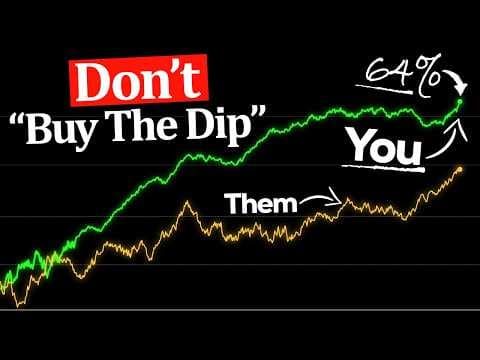
An analysis of 10 years of data on 1,000 stocks reveals that buying individual stock dips of 20% does not yield better returns than buying stocks at highs. However, buying stocks during market-wide dips, when both the stock and the market fall significantly, results in substantially higher median returns. This insight highlights the importance of fundamentals over price movements and supports Warren Buffett's advice to be greedy when others are fearful.
"Buy the dip" is one of the most commonly repeated investing slogans. But is it really true that purchasing stocks when their prices drop improves your returns? To answer this, an analysis was conducted on 10 years of data across 1,000 of the USA's top stocks by market capitalization, examining thousands of individual dip events.
A stock market crash is generally considered a decline of more than 20%. Applying this logic to individual stocks, a "dip" was defined as a stock dropping 20% in price within a 12-month period.
The study measured what happened if you bought every single one of these dips:
This suggests that buying the dip on individual stocks does not necessarily lead to better returns.
What if instead of buying dips, you bought stocks that had gained 20% within the last 12 months — essentially buying stocks at their highs?
This shows that buying a stock because its price has dropped is no more beneficial than buying because its price has risen.
The phrase "buy the dip" can be dangerous and misleading because a price drop alone tells you very little about future performance. Often, dips are justified by deteriorating fundamentals. The price movement itself, whether up or down, rarely predicts what happens next.
As legendary investor Philip Fisher said, the true test of whether a stock is cheap or expensive is not its current price relative to past prices, but whether the company's fundamentals are significantly more or less favorable than the market's current appraisal.
The key question is whether buying dips works when the dip is part of a wider market decline. For example, when both an individual stock drops 20% and the S&P 500 falls at least 10%, representing a market-wide dip.
These returns are significantly higher than buying dips in isolation.
This supports Warren Buffett's famous advice to "be fearful when others are greedy, and greedy when others are fearful." When fear drives prices down across the market, not fundamentals, it creates real opportunities.
A price drop alone tells you nothing about value. When a single stock falls while the market is stable, it usually reflects worsening fundamentals. But when the entire market falls, great companies get dragged down alongside weaker ones, creating opportunities.
Currently, every industry in the US stock market is in fear or extreme fear, with the S&P 500 down over 9% from its January high. Many fantastic companies have fundamentals that are unchanged or improved but are trading at unreasonably low prices.
Nvidia recently dropped over 20% from its October peak. Despite criticism of being overvalued, Nvidia trades at a price-to-earnings (PE) ratio of around 35, which is reasonable given its earnings and revenue growth exceeding 60% over the past year and expected growth near 40% annually. This results in a low price/earnings-to-growth (PEG) ratio of about 0.91, indicating undervaluation.
Other companies like Microsoft, Meta, and Micron are also trading at attractive valuations.
Buying dips on individual stocks without considering fundamentals is not a reliable strategy. However, buying during market-wide dips, when fear drives prices down indiscriminately, can lead to significantly higher returns.
Investors should focus on fundamentals rather than price movements alone and consider market sentiment to identify genuine opportunities.
This approach aligns with the wisdom of value investing pioneers and remains highly relevant in today's market environment.