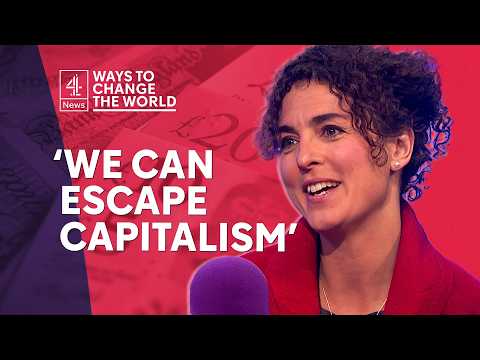
Economist Clara Mattei argues that capitalism is a constructed system enforced through austerity and economic coercion, not a natural order. She explains how capitalism relies on wage labor and private investment, perpetuates inequality, and is maintained by political choices masked as economic necessity. Mattei advocates for mental liberation from capitalist narratives, participatory democracy, and building local alternatives to create a more just and humane society.
Capitalism is often perceived as the natural and inevitable economic system, rooted in human nature's desire to accumulate wealth and exercise freedom. However, economist Clara Mattei challenges this notion, arguing that capitalism is not spontaneous but a system enforced through violence, austerity, and political decisions. In this comprehensive discussion, Mattei explores the foundations of capitalism, its systemic inequalities, the role of austerity, and the possibilities for building alternatives.
Mattei defines capitalism as a system based on two fundamental pillars:
The entire system is driven by the pursuit of profit, meaning that goods and services exist primarily because they generate financial returns, not necessarily to meet human needs.
Contrary to popular belief, capitalism requires constant enforcement by the state to maintain market dependence. This enforcement includes austerity policies that cut social services, militarization, and surveillance to keep the majority subordinated to the market. People are often left with no alternative but to accept low-wage, insecure jobs.
Mattei highlights the extreme inequality under capitalism, noting that 12 people own more wealth than the bottom 4 billion globally. In countries like the UK and the US, poverty and wealth accumulation coexist starkly, with billionaires' fortunes growing exponentially while millions suffer from poverty and food insecurity.
She also emphasizes the structural underdevelopment of the Global South, which is exploited through debt, resource extraction, and capital flows to the Global North. This unequal development is not accidental but a feature of the capitalist system.
Austerity is often portrayed as a necessary economic fix, but Mattei argues it is a political choice essential to preserving capitalism. Economic models blame workers for inflation and justify policies that increase unemployment to weaken workers' bargaining power. This unemployment is crucial for capitalism to function, as it keeps labor costs low and profits high.
The dominant economic narrative suggests that those at the bottom deserve their fate due to individual failings, while the wealthy are rational actors benefiting society. Mattei calls this a myth that obscures systemic exploitation and fosters division among the oppressed.
Mattei critiques the economics discipline for being ahistorical and classist, rarely exposing students to alternative frameworks like Marxian political economy. Marx's analysis reveals capitalism as a social relation marked by anti-democratic production processes, not merely individual choices.
Mattei advocates for mental liberation from capitalist ideology and building alternatives starting at the local level. She founded the Forum for Real Economic Emancipation in Tulsa, which promotes public education, assemblies, and participatory budgeting—a democratic process where citizens decide how public funds are spent.
Participatory democracy contrasts with liberal democracy's oligarchic nature by empowering people to have a say in material conditions, such as food sovereignty and housing.
Class is defined by one's relation to production—whether income comes from labor or capital—not merely by wealth. The so-called middle class is shrinking, and many who identify as middle class are workers vulnerable to economic insecurity.
Mattei dispels myths about Marxism advocating for abolishing private property. Instead, she supports ensuring everyone has access to housing and exploring collective ownership models that are more empowering and less individualistic.
Capitalism is globally imposed through militarism and political interventions, not a natural convergence of systems. Resistance involves connecting struggles worldwide, recognizing that the fight against profit-driven exploitation is a fight for humanity.
Revolution is often misunderstood as violent upheaval, but Mattei reclaims it as social transformation and change. The resistance to change by elites often leads to conflict, but revolution is necessary for human prosperity.
If Mattei could change the world instantly, she would prioritize ending physical violence and ensuring everyone has access to food. These basic needs transcend political divides and require collective action beyond profit motives.
Change begins locally through building alternative institutions and pressuring governments to prioritize needs over profits. Participatory budgeting and assemblies can increase agency and challenge austerity policies.
Clara Mattei's analysis reveals capitalism as a constructed and enforced system that perpetuates inequality and suffering. By understanding its foundations and rejecting the dominant narratives, people can reclaim agency through education, participatory democracy, and building alternatives. The path to a more just and humane society lies in collective action and social transformation.
This comprehensive exploration of capitalism challenges us to rethink economic systems and consider how we can collectively build a future that prioritizes human needs over profit.