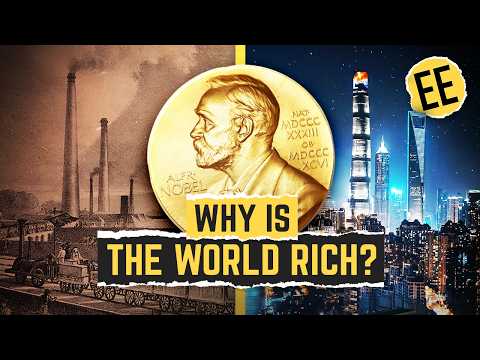
The 2025 Nobel Prize in Economics was awarded to Joel Mokyr, Philip Aghion, and Peter Howitt for their groundbreaking work on innovation-driven economic growth. Their research explains how technological progress since the Industrial Revolution has fueled sustained economic growth, the importance of combining theoretical and practical knowledge, and the role of creative destruction in fostering innovation. Their insights are highly relevant to today's challenges, including AI and market dynamics.
The 2025 Nobel Prize in Economic Sciences, officially known as the Spherigus Riksbank Prize in Economic Sciences in Memory of Alfred Nobel, was awarded to three distinguished economists: Joel Mokyr, Philip Aghion, and Peter Howitt. Half of the prize money, approximately 1.1 million USD, was awarded to Joel Mokyr, while the other half was shared between Philip Aghion and Peter Howitt. Their combined work has significantly advanced our understanding of how innovation drives economic growth.
While the monetary award is substantial, the true value of the Nobel Prize lies in the recognition of a lifetime of impactful work. These economists have demonstrated that the sustained economic growth and prosperity experienced over the last two centuries are primarily driven by technological innovation. Since the Industrial Revolution, new technologies have enabled more advanced products and production methods, leading to higher economic output, increased wealth, and improved living standards for billions worldwide.
At first glance, the idea that technological innovation fuels economic growth might seem obvious. However, the laureates' work goes deeper by identifying that the continuous, compounding nature of technological progress is actually an anomaly rather than the norm. They analytically unpacked the conditions necessary to sustain this process over time.
Their research is particularly relevant today, as the global economy faces challenges such as the disruptive potential of artificial intelligence (AI) and the stifling of innovation by dominant companies with little competition. Understanding their work helps explain how the world has become hundreds of times wealthier in just a few generations and highlights the threats to continued progress.
Starting around 1760, the Industrial Revolution transformed the world, making it vastly wealthier in a historically short period. Not only did average wealth increase, but technological advances in mechanized farming, soil science, and water management supported larger populations. This wealth also enabled consumption of goods and services previously unimaginable, such as modern medicine and conveniences.
Contrary to popular belief, technological innovations were not rare before the Industrial Revolution. Innovations such as the printing press, advanced navigation, new tools, clockwork, farming techniques, and medical advancements occurred frequently. However, these did not translate into sustained economic growth.
Joel Mokyr, an economic historian and half of this year’s laureates, found that while pre-industrial empires were inventive, they did not become measurably wealthier. The key reason was that people often discovered what worked but did not understand why it worked. Mokyr described this as a world of "engineering without mechanics" and "iron making without metallurgy." Without understanding the underlying principles, consistent improvements were limited, leading to plateaus in progress.
For example, pre-industrial blacksmiths could forge metals effectively but lacked knowledge of molecular changes, limiting their ability to develop new steel alloys. This lack of scientific understanding also made investing in new ideas risky, as innovations seemed as unlikely as turning lead into gold.
Mokyr challenged the assumption that the Industrial Revolution was simply the result of reaching a critical mass of innovation or the invention of the steam engine. Instead, he argued that societal changes played a crucial role, particularly the increased interaction between people with theoretical knowledge and those with practical skills.
During the Enlightenment in the 1700s, Europe saw a blending of theory and practice for the first time. In the UK, apprentice tradesmen learned both theory and practice, passing this knowledge to new generations. This fusion of understanding was essential to the rapid technological progress that followed.
The other half of the Nobel Prize was awarded to Philip Aghion and Peter Howitt for their work on the concept of creative destruction and its role in economic growth. While macroeconomic progress over the last 200 years appears smooth, it is driven by constant cycles of innovation replacing outdated technologies.
For example, water wheels and horses gave way to steam engines, which were replaced by internal combustion engines, and now electrification challenges their dominance. For innovation to thrive, economies must allow outdated industries to fail.
Aghion and Howitt developed a mathematical framework to measure how innovation translates into economic growth. They proposed that economic growth depends on the scale of innovations multiplied by the frequency of new innovations.
Their research highlights the importance of balancing market competition. If competition is too fierce, with companies constantly copying and undercutting each other, there is little incentive to innovate. Conversely, if a company holds a monopoly or competitors collude, innovation stagnates because new technologies threaten established dominance.
The optimal environment encourages some market dominance through intellectual property protections, providing profit motives for innovation, while preventing excessive dominance through antitrust measures and limiting the duration of IP protections.
Historically, pre-industrial nobility often resisted new technologies that threatened their status quo. In modern times, companies like Nvidia exemplify the balance of innovation and market dominance. Nvidia invested billions over many years to develop CUDA, a proprietary platform that has become the industry standard for AI computing. Their market dominance incentivizes long-term investments in innovation.
The laureates’ work is highly relevant to the current AI revolution. AI represents another technological innovation with the potential to fuel economic growth. Optimistically, AI could make theoretical knowledge more accessible to workers, accelerating advancements.
However, there are concerns that AI could disrupt labor markets by replacing workers, analogous to how steam engines replaced water wheels. The laureates emphasize the importance of robust social protections for those displaced by creative destruction.
Countries like Denmark and the Netherlands provide examples of flexible labor markets combined with generous welfare and retraining programs. Such policies reduce the risks of disruption, encourage risk-taking, and build popular support for innovation.
The laureates’ work also underscores the critical role of intellectual property rights in fostering innovation. AI challenges traditional notions of IP, especially regarding the use of existing intellectual creations in training data.
If creators cannot profit from their innovations because their work is freely used without compensation, innovation will decline, harming economic progress and society. Thus, effective regulation of IP in the AI era is essential.
There were allegations of leaks regarding the Peace Prize winners, leading to large bets before the official announcements. This incident reflects poorly on the awards committee and society’s tendency to treat such events as gambling opportunities.
The Nobel Prize traditionally honors up to three individuals per category, which is increasingly difficult to reconcile with modern scientific research that often involves large collaborative teams. While this is less problematic in economics, it poses challenges in fields like physics and chemistry.
Additionally, the Nobel Prize is not awarded posthumously, which complicates recognition in a field where progress builds on the work of many predecessors.
Economics was not one of the original Nobel categories, and the prize’s scope has expanded over time. For example, last year’s physics prize was awarded for work in machine learning and neural networks, areas traditionally considered computer science.
These developments highlight the evolving nature of science and the limitations of the Nobel Prize in fully capturing modern interdisciplinary research.
The 2025 Nobel Prize in Economics honors the profound contributions of Joel Mokyr, Philip Aghion, and Peter Howitt in explaining how innovation drives sustained economic growth. Their work sheds light on the historical roots of technological progress, the importance of combining theory and practice, and the delicate balance of market forces that foster innovation.
Their insights are particularly timely as the world navigates the challenges and opportunities presented by AI and other emerging technologies. Understanding and applying their findings can help policymakers create environments that encourage innovation while protecting those affected by economic transitions.
While the Nobel Prize has its limitations, it remains a prestigious recognition of groundbreaking work that shapes our understanding of the world and guides future progress.