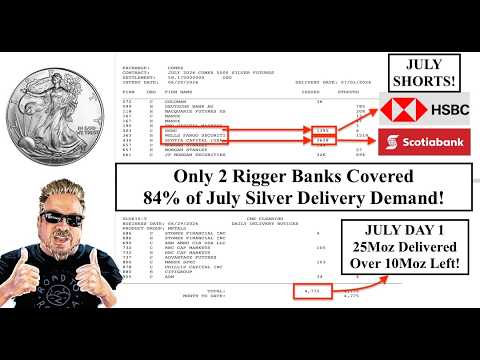
COMEX silver deliveries plunged from 1,181 contracts on Monday to just 3 on Tuesday, signaling a potential supply issue in the silver market. Meanwhile, platinum deliveries surged to 398 contracts, surpassing silver's total. This divergence suggests stress in silver's physical market despite price corrections. Gold's recent price volatility is also analyzed, highlighting a disconnect between paper prices and physical demand.
An analysis of the recent CME delivery reports for COMEX silver and platinum reveals a striking anomaly. On March 31, 2026, silver deliveries collapsed dramatically from 1,181 contracts on Monday to just 3 contracts on Tuesday. In contrast, platinum deliveries surged to 398 contracts on the same day. This discrepancy raises questions about the state of the silver market and the availability of physical silver for delivery.
On Monday, the first day of the delivery period, 1,181 contracts issued delivery notices, indicating aggressive demand from buyers who had been waiting. However, on Tuesday, only 3 contracts issued delivery notices, totaling 15,000 ounces. The institutions involved included Scotia Capital, Buffet Securities, and ADM.
This sharp drop from nearly 6 million ounces to 15,000 ounces in one day is unprecedented and suggests either a demand frontloading or a supply constraint.
Platinum deliveries on Tuesday were robust, with McCory alone issuing 390 contracts. Major institutional players such as Goldman Sachs, JP Morgan, City Bank, BNP, ABN Amro, Wells Fargo, Scotia, RBC, and Marx were active in the platinum market.
Notably, platinum's month-to-date delivery total has surpassed silver's, despite platinum having a much smaller market capitalization and less retail investor attention.
The first explanation is that buyers who had been waiting at the gate aggressively frontloaded their demand on Monday. This pattern has been consistent over recent months, with buyers preferring to take delivery immediately rather than spreading demand over the delivery period. Thus, Tuesday's low delivery count could simply mean the demand queue was emptied on Monday.
The second, less comforting explanation is that the short side of the silver market encountered a problem with the availability of unencumbered, properly warranted silver to issue delivery notices against new requests. The free float of registered silver that is not already committed or encumbered may have effectively dried up after Monday's draw. This would indicate a supply problem rather than a demand issue.
The platinum data exacerbates concerns about silver. Platinum, with a smaller market and less institutional focus, managed 398 delivery contracts on Tuesday, while silver managed only three. The institutional participants active in platinum are the same that trade silver, yet silver deliveries have collapsed.
Gold deliveries in April are also running at 11 times the pace of silver deliveries, indicating that gold and platinum markets are functioning normally while silver is not.
Gold recently touched $4,100 per ounce amid widespread skepticism about its safe-haven status due to geopolitical tensions such as the Iran war. Despite this, gold has rebounded strongly to near $4,700 and is pushing toward $5,000 within nine days.
Gold entered 2026 with a 95.6% gain in a single year, hitting an all-time intraday high of $5,626 on January 29. The Iran war caused a rapid correction due to overcrowded trades and changing rate expectations, with gold dropping 14.6% in March, its worst month since October 2008.
However, institutional forecasters like Goldman Sachs, JP Morgan, and Deutsche Bank maintain high year-end targets for gold, indicating confidence in its structural fundamentals such as dollarization, central bank accumulation, and expanding fiscal deficits.
Silver experienced a 50% correction from its all-time high of $121.67 to $61 per ounce over eight weeks, coinciding with the Iran war and a strong dollar move. Despite this price drop, the COMEX registered silver pile continued to drain, indicating persistent physical demand.
This suggests that buyers pulling metal out of COMEX are not speculators reacting to price but industrial users, strategic buyers, and institutional accumulators who need the metal regardless of price.
The registered silver pile has been declining roughly 13% per month, while the eligible pile (silver in approved vaults but not warranted for delivery) has remained largely static. When registered silver leaves, it is not converting to eligible but leaving the system entirely.
Eligible metal holders are not converting their metal to registered status even at prices that should make conversion attractive. This could be due to expectations of higher prices or informal commitments elsewhere.
The key question is: Where is the free float of deliverable silver? The delivery report showing only three contracts on Tuesday suggests the free float may have effectively gone to zero.
The gold and silver markets illustrate a divergence between paper prices and physical demand. While gold had its worst month since 2008 and was declared a failed safe haven by some, physical gold deliveries remain strong.
In silver, the paper price dropped 50%, but physical vault drain continued unabated. This gap indicates that physical buyers and paper traders operate in different realities.
The silver market is showing signs of stress that could indicate a physical supply shortage beneath the surface of the paper market. The coming days' delivery reports will be critical to watch for confirmation.
This situation demands close attention from investors and market participants as it may signal significant shifts in the precious metals markets.
What do you think? Is the silver market bullish or confused? Share your thoughts and stay tuned for updates.
This analysis was provided by John AG from Currency Archive.