This blog post delves into the integration of Daoist elements in Chinese poetry, highlighting key poets and their works that reflect Daoist philosophies, particularly during periods of political turmoil. It discusses the significance of poetry in traditional Chinese culture and how it serves as a medium for expressing deeper truths and connections to nature.
In this exploration of Daoism, we shift our focus from the religious aspects to its literary manifestations, particularly in poetry. Poetry has long been regarded as the highest form of literature in traditional Chinese culture, and its significance is underscored by its inclusion in the five Classics of Confucianism. This post will examine how Daoist elements permeate Chinese poetry, especially during tumultuous historical periods.
Poetry in ancient China was not merely an art form; it was a reflection of the poet's aspirations and truths. According to a highly influential preface to the Classic of Poetry, poetry crystallizes the author's truth, making it a vital skill for educated men, particularly those aspiring for government positions. The ability to compose poetry was seen as a window into one's soul, distinguishing the worthy candidates from the rest.
Daoism, often characterized by its vague praise of nature and a laissez-faire attitude, has been both embraced and critiqued in the context of Chinese poetry. Scholars have noted that while some poetry may superficially appear Daoist, deeper textual references and connections to Daoist philosophy are often present. It is essential to recognize that Confucianism and Daoism can coexist within the same literary work, reflecting a complementary relationship rather than a strict opposition.
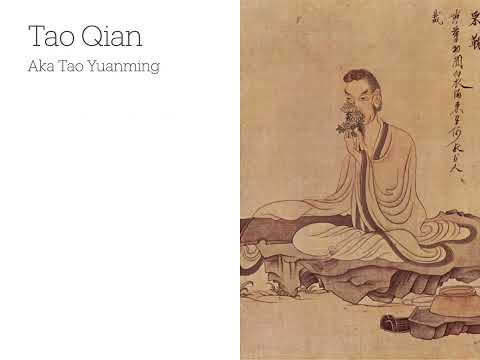
The political fragmentation following the fall of the Han Dynasty in the third century created a fertile ground for the emergence of Daoist themes in poetry. In times of chaos, poets sought solace in nature and reclusion, reflecting a desire for peace amidst turmoil. This dynamic is particularly evident in the works of the poet Tao Yuanming (also known as Tao Qian), who lived from 365 to 427 AD.
Tao Yuanming, often referred to as the "gentleman recluse," is celebrated for his poetry that emphasizes nature and a retreat from political life. After a brief career in government, he chose to live a simple life on a farm. His poetry frequently alludes to Daoist texts, particularly the Dao De Jing and the Zhuangzi. One of his most famous poems illustrates his connection to nature:
"I built my Hut in the human world yet hear no clamor of horse and carriage. You ask how could this be so? When the heart is far away, the place becomes remote. Plucking chrysanthemums by the Eastern hedge, I catch sight of the Southern mountain in the distance. The Mountain Air becomes lovely at sunset as flying birds return together in flocks. In these things there is true meaning; I'd like to explain but I've forgotten words."
This poem encapsulates the essence of Daoist thought, emphasizing the importance of meaning beyond words and the profound connection to nature.
The Tang Dynasty (618-907 AD) is often regarded as the pinnacle of Chinese poetry, marked by the emergence of several key poets. Among them, Li Bai and Du Fu stand out, each representing different philosophical perspectives. Li Bai, known for his romantic and Daoist themes, contrasts sharply with Du Fu, who embodies Confucian ideals.
Li Bai, who lived from 701 to 762 AD, is celebrated as a Daoist romantic poet. His poetry often reflects a deep appreciation for nature and the joys of life. Unlike Du Fu, Li Bai did not pursue an official career, allowing him the freedom to explore Daoist themes in his work. One of his most famous poems, "Drinking Alone Under the Moon," captures the essence of solitude and companionship with nature:
"Among the flowers, a single jug of wine, I drink alone, no one close to me. I raise my cup, invite the bright moon; facing my shadow, together we make three. The moon doesn't know how to drink, and my shadow can only follow my body. But for a time, I make moon and shadow my companions. Taking one's pleasure must last until spring. I sing; the moon wavers back and forth, I dance; my shadow flickers and scatters. When I'm sober, we take pleasure together; when I'm drunk, we each go our own ways. I make an oath to journey forever free of feelings, making an appointment with them to meet in the Milky Way afar."
This poem reflects Li Bai's Daoist sensibilities, emphasizing the transient nature of life and the joy found in solitude and nature.
The exploration of Daoist elements in Chinese poetry reveals a rich tapestry of thought and expression that transcends mere aesthetics. Poets like Tao Yuanming and Li Bai not only celebrated nature but also embodied the philosophical underpinnings of Daoism, offering insights into the human experience amidst the chaos of their times. Through their works, we gain a deeper understanding of how poetry served as a medium for expressing profound truths and the enduring connection between humanity and the natural world.