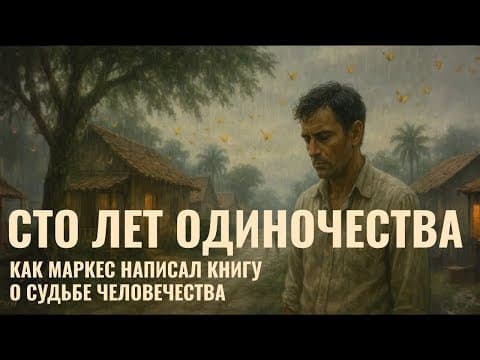
This blog post delves into Gabriel Garcia Marquez's One Hundred Years of Solitude, exploring its themes of memory, solitude, and magical realism, while reflecting on the author's childhood influences and the intricate narrative structure that intertwines the lives of the Buendía family with the broader history of Latin America.
Welcome to the Quiet Pages channel, where we discuss books and the people who have left a mark on history. In this post, we will touch upon the mystery of One Hundred Years of Solitude, a novel where memory becomes eternity, and wonder lives in every word. We will trace how Gabriel Garcia Marquez's childhood gave birth to the world of Macondo, where everything repeats and time closes in a circle. We will discuss magical realism, the solitude that became the fate of humanity, the women who hold life together, and the ending that transforms the book into a revelation about memory, love, and the meaning of existence.
When Gabriel Garcia Marquez recalled his childhood, he always began not with himself but with the house where he grew up. He stated that everything he wrote in life was born in that old house of his grandparents in the small town of Aracataca in northern Colombia. The walls held the scent of roasted coffee, the wooden floors creaked in the corridors, and the air was thick with heat and whispers. Each day passed between church bells, the screech of parrots, and the stories of elders about wonders, spirits, and strange coincidences. It was there that the child first understood that the world does not end with what can be seen with the eyes.
In this house lived a large family, and everything seemed to exist simultaneously: the past, the present, and what had yet to happen. His grandfather, Colonel Nicolás Márquez, was a man he loved and feared at the same time. The old soldier, with his thick mustache and medals from the civil war, recounted battles with such detail that it felt as if they had happened yesterday. Sometimes, showing an old saber, he would say, "I fought for freedom with this saber." The boy listened, feeling that before him stood not just a relative but a man carrying the history of an entire country, where the memory of wars lived longer than peace.
The Colonel taught him to honor justice and not to fear authority. When police appeared on the streets, he would quietly tell his grandson, "Do not fear them, son; we gave them the weapons." These words, spoken by a man who had experienced defeat, stayed with Marquez forever, as a memory of a generation that wanted to change the world but found itself trapped in its repetition.
In his old age, the writer would say that the image of Colonel Aureliano Buendía, the hero of One Hundred Years of Solitude, grew from the figure of this grandfather, a blend of pride, weariness, and an unending sense of solitude experienced by a man who had seen too much.
If the grandfather embodied reason and honor, his grandmother, Tranquilina Iguarán, was the voice of another half of the world, where wonders and death lived alongside the everyday. She told stories of ancestors, of ghosts that came at night, of women who flew to the sky, and of children born with tails. Yet she spoke so calmly, as if recounting the news. Little Gabriel listened to her and understood that for her, the supernatural was not a miracle but a part of life. Later, he would say that he inherited his way of writing about the incredible from her, with the same confidence that others describe rain or breakfast.
He recalled how his grandmother would bring clay vessels filled with water into the kitchen, warning that they should not be left open at night, for the souls of the dead might enter them. Or how, during a storm, she would cover a mirror with a sheet, explaining that during lightning, one could see death in it. The boy did not know whether to believe this, but he felt that behind these words lay not fear but an ancient caution before forces that humans cannot comprehend. This belief in mystery would become the heart of his future literature.
When he was about eight years old, his parents took him away from his grandparents' house. He did not know he was leaving Aracataca forever. The train slowly departed from the station, where palm trees dozed, and a hot mist hung over the rooftops. The boy gazed out the window until the town dissolved into sand. Later, he would confess that everything he wrote in life was an attempt to return to that city that vanished behind the train window. Macondo is Aracataca seen through the smoke of time.
Years later, while living in Mexico and working as a journalist, memories of his childhood suddenly awakened within him. He would say that he had long tried to write books in a voice that was not his own, following the rules of European realism, where wonders seemed foreign. Then one day, he realized he had to write just as his grandmother told stories. Thus, his style was born, along with his universe.
The world in which he grew up was full of contradictions. Uncertainty, madness, tenderness, rough life, and the quiet poetry of things. In Aracataca, the heat did not subside even at night. People slept in hammocks, doors were never locked, and everything that happened was part of one common dream. In the mornings, the elderly sat on porches, reminiscing about those who had died thirty years ago as if they still lived next door. At noon, women watered the yards to cool the dust for at least a moment. Sometimes the town would pause not because tasks were finished but because life itself seemed to take a break. This slow, hot, forgetful existence became the breath of his future novel.
From such days arose a sense of time that does not flow but circles back to itself. It was there in his childhood that Marquez first felt that the past never leaves, that everything returns not as memories but as continuations. He remembered the people he already considered heroes of his life: the blind street musician who played the same melody every morning because he believed that music kept houses from collapsing, and the old neighbor who claimed to hear the voices of the dead and spoke to them every evening while setting a bowl of soup on the table. These figures would later come alive in Macondo, where the dead converse with the living, and time knows no difference between past and present.
When Marquez began writing One Hundred Years of Solitude, he was not searching for a plot. He was seeking that feeling from which everything began, that atmosphere where wonder and memory are inseparable. He said he wanted to return to the house of his childhood while the light was still on. And when he recalled the first scene of a boy being taken by his father to see ice, he realized he had found the path to the source. This episode was a direct memory of his own father, who once took him to a neighboring town to see a refrigerator, the first in those parts. The boy was astonished. The cold was as much a miracle as magic. From this feeling, the first line of the novel was born, where memory connects with wonder, and life with the prediction of death.
Thus, childhood became not just a source of inspiration but the very form of his thinking. It united two worlds: the real and the magical, the honor of his grandfather and the mythology of his grandmother, history and fairy tale. From this fusion arose a language in which anything is possible, where spirits can return, love lasts for decades, and time moves in circles. For Marquez, the memory of childhood was not nostalgia but a way to understand life. He said that a person lives as long as they are remembered, and thus literature is also a way to be alive.
When Marquez first heard the term magical realism, he did not see it as a definition of his style. He said he invented nothing new; he simply wrote as people in his country had always spoken about incredible things with faces devoid of surprise. For him, the marvelous was not a genre but the breath of reality, especially in Latin America, where tragedies and revelations lived side by side. The belief in wonder was the only way to preserve dignity in the face of chaos.
In the 1950s, Marquez worked as a journalist. He wrote reports on shipwrecks, dictatorships, refugees, poverty, and the strange yet resilient hope of people who still believed in words. In one of his essays, he recounted the story of a sailor who miraculously survived a storm and drifted for ten days at sea. This text, written with documentary precision, already contained what would later become the essence of his prose: a careful, almost prayerful attitude toward human fate, where reality itself produces miracles if one looks closely enough.
However, during those years, he still did not know how to connect the world of fact with the world of feeling. He read Kafka, discovering transformation, and recalled telling friends that he now understood: "One can write about the incredible without explaining it." When he closed the book, the thought settled in his mind that his grandmother did the same. She told the impossible with complete calmness, as if reporting on ordinary matters. Then he realized that the marvelous does not need justification; it needs to be accepted.
He lived in Mexico when inspiration struck him. It was the late sixties, a time of poverty and doubt. One day, while driving south, he suddenly felt ready to tell the story of his childhood, the very one he had carried within him since youth but had not dared to begin. He stopped the car, returned home, and locked himself in a room for over a year. His wife sold furniture and dishes to buy paper, and he wrote: "Thus was born the novel where wonder was part of reality, and reality was part of wonder."
Marquez said that in his country, no one is surprised when the dead come back to life or when an angel appears in the sky. When someone disappears, people say they have gone to the wind. When a child is born with a tail, it is not seen as a deformity but as a sign of ancient kinship with the animal world. These myths, superstitions, and premonitions lived not in books but in conversations in kitchens, markets, and under banana trees. Therefore, when he transferred them to the pages of the novel, they did not appear as fiction. They were the very fabric of life.
In Macondo, there was no boundary between the living and the dead. When Rebeca died, the earth did not swallow her; it simply accepted her into its memory. When Remedios the Beauty ascended to the sky, no one was frightened. The women merely looked up and covered the sheets so the sun would not scorch the fabric. When yellow rain of butterflies fell from the sky, the townspeople did not seek explanations. They knew that everything in the world has its meaning, even if it is hidden. This view of life was not a fabrication but the essence of Latin America, a continent that had endured colonies, wars, coups, and miracles of survival, living in tension between dreams and suffering.
Marquez understood that the only language capable of describing this world was one where magic and truth intertwine, where wonder does not disrupt reality but reveals its depth. He said that wonder for him always began with feeling. When a person looks at the ordinary and suddenly realizes that something greater is hidden behind it. When a mother, having lost a child, still sets a plate for him at dinner, when a town forgets the date but remembers the smell of rain. When, after many years of war, someone opens an old album and recognizes themselves in the faces of strangers. This is magical realism—not an embellishment but a way of seeing the world without dividing it into the possible and the impossible.
Once, while conversing with fellow writers, he stated that his books are a chronicle of life on a continent where every morning can begin with a miraculous event, and no one would be surprised. He cited an example from the news: in one Colombian village, a boy was born with a birthmark in the shape of a heart on his chest, and the entire community decided it was a sign of impending peace. Marquez said that for Europe, this is absurd, but for us, it is simply life.
In the novel, he took this to the extreme. Time became closed. The dead spoke with the living, fates repeated, but everything happened with the naturalness of a dream. And therein lies the strength of his style. He does not compel the reader to believe in miracles. He makes them feel their necessity. For a person living in a world of suffering, wonder is not an escape but a form of hope.
Thus, a language was born in which wonder lives—not a language of magic but a language of memory. In it, everything forgotten returns. Everything impossible becomes part of the everyday. And when we read his lines about flying girls, about rain that lasts four years, about an old man who rises again for love, we understand that it is not about miracles but about life as it is—endless, unfathomable, and yet real.
Marquez managed to express this simply: "I only wrote what I saw around me." But in this around, entire centuries of human lives fit. And thus, magical realism became not a direction in literature but a way of being memory, where reality breathes alongside wonder.
When Marquez spoke about One Hundred Years of Solitude, he confessed that the word solitude was born before the story. It was in his life, in the life of his homeland, in the very air breathed by generations. He felt that Latin America lived as a forgotten continent, detached from time, speaking to itself, not hearing anyone beyond its own borders. Thus, solitude became not only the theme of the novel but also a state of the world in which he lived.
In the house of the Buendías, solitude was an inheritance. It was not passed down by blood but lived in each generation as something invisible, from which it was impossible to escape. José Arcadio Buendía, the founder of Macondo, dreamed of creating a place where no one would suffer from memories. He left his hometown with his wife to start life anew. But the further he moved from the past, the stronger the past returned to him. His solitude was the solitude of reason, a man who believes he can comprehend everything but loses connection with others. He locked himself away, conversed with spirits, built impossible machines, and one day finally went mad, tied to a tree in the yard. This scene is one of the saddest in the novel. The old man, once dreaming of a world where there would be room for all, spends his days in solitude, listening to life flow around him. His madness is not punishment but the last form of wisdom.
Marquez wrote that solitude is the moment when a person realizes that the truth exists, but there is no one to say it to. Colonel Aureliano, the son of the founder, experiences another form of solitude—the solitude of power and war. He raises a rebellion, fights for