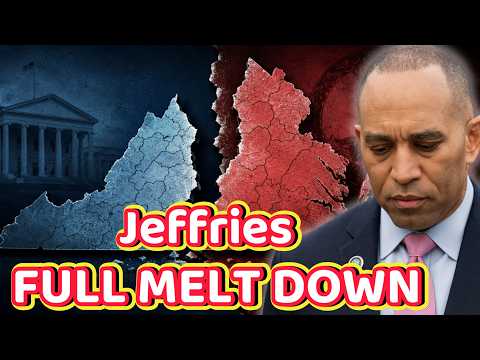
House Minority Leader Hakeem Jeffries invested nearly $40 million in a Virginia redistricting effort aimed at countering Republican-led maps. However, the Virginia Supreme Court struck down the new Democrat-friendly map on procedural grounds, nullifying the vote. This ruling maintains the old congressional lines for 2026, marking a significant setback for Democrats and a win for Republicans.
In a dramatic turn of events, House Minority Leader Hakeem Jeffries reportedly spent nearly $40 million in an effort to redraw Virginia's congressional districts in a way favorable to Democrats. This initiative was part of a broader strategy to combat Republican-led redistricting efforts nationwide, including those in Texas and Florida. However, the Virginia Supreme Court recently struck down the new redistricting plan, citing constitutional violations related to the legislative process used to approve the map.
Hakeem Jeffries has been vocal about the redistricting fight, describing it as "maximum warfare everywhere, all the time." His rhetoric reflects the intensity of the political battle over congressional maps, which can significantly influence election outcomes. Jeffries' investment of nearly $40 million underscores the high stakes involved.
Despite the substantial financial backing and tough talk, the Virginia Supreme Court ruled against the new map, effectively nullifying the recent vote that approved it.
The Virginia Supreme Court's decision was based not on the content of the new congressional map but on the procedural manner in which it was created. The court found that the special legislative session called to approve the map violated Article 7, Section 1 of the Virginia Constitution.
A key excerpt from the ruling states:
"On March 6th, 2026, the General Assembly of Virginia submitted to Virginia voters a proposed constitutional amendment that authorizes partisan gerrymandering of congressional districts in the Commonwealth. We hold that the legislative process employed to advance this proposal violated article 7 section 1 of the constitution of Virginia. This constitutional violation incurably taints the resulting referendum vote and nullifies its legal efficacy."
The issue centered on the authority of state legislators to call the special session, which the court deemed improper. As a result, the new map was invalidated on procedural grounds.
With the new map struck down, Virginia will revert to using the previous congressional district lines for the 2026 midterm elections. This outcome is considered a setback for Democrats, who had hoped the new map would secure additional seats. Conversely, it is viewed as a political win for Republicans.
The ruling is final, given it comes from the state supreme court. While the legislature might attempt to redraw the map through a properly convened session, the current decision means the new map will not be in effect for the upcoming elections.
Following the initial approval of the redistricting plan, Jeffries was confident and even issued warnings to Republicans in other states, such as Florida, about the consequences of their redistricting strategies. He used strong language, indicating a readiness for political confrontation.
However, the court's decision likely represents a significant blow to Jeffries and his allies. The investment of nearly $40 million did not yield the intended results, and the procedural invalidation of the map may be seen as a humiliation or at least a frustrating setback.
Jeffries has characterized the ongoing battles over redistricting as "redistricting warfare," emphasizing the combative nature of these political struggles. Participants in these efforts are metaphorically considered warriors in this fight for political advantage.
The Virginia case highlights the complexities and legal challenges involved in redistricting, where procedural technicalities can override the will of voters who approved changes at the ballot box.
The Virginia Supreme Court's decision raises questions about the balance between procedural legality and democratic will. While the voters approved the new map, the court's ruling nullified it due to how the legislative session was called.
This has sparked debate about whether such technicalities should override voter decisions and what this means for future redistricting efforts.
The Virginia redistricting saga illustrates the high-stakes nature of political map drawing and the significant resources invested by political leaders like Hakeem Jeffries. Despite the financial and rhetorical commitment, the procedural ruling by the Virginia Supreme Court has maintained the status quo, delivering a setback to Democrats and a victory to Republicans ahead of the 2026 elections.
The outcome serves as a reminder of the importance of adhering to constitutional procedures in legislative actions and the unpredictable nature of political battles.
What are your thoughts on the Virginia Supreme Court's decision to overturn the will of the voters on procedural grounds? Do you believe this ruling upholds the rule of law or undermines democratic choice? Share your opinions and join the conversation on this critical political issue.








