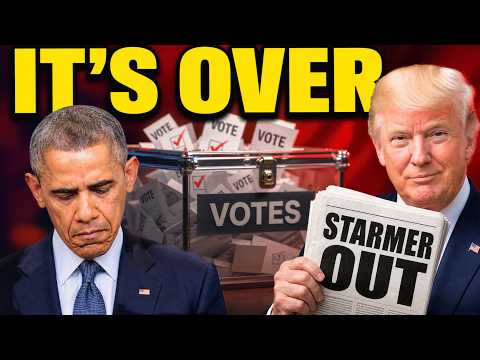
This article explores the recent political challenges faced by Barack Obama and his allies, including the British Labour Party's losses under Starmer, the Virginia Supreme Court's rejection of a Democratic gerrymander, and the rise of authentic outsider candidates in the US. It highlights the shift away from manufactured politics towards genuine grassroots movements ahead of the 2026 midterms.
Barack Obama, once a dominant figure in shaping Democratic strategies both in the United States and abroad, has recently faced significant political blows that have shaken his influence and the future prospects of his party. This article delves into three major events that have wiped the smile off Obama's face, revealing the growing challenges to his political legacy.
Across the Atlantic, the British Labour Party, often seen as the ideological brainchild of the US Democrats, suffered a devastating defeat in local elections. The party lost approximately 1,800 local races, control of the Welsh Parliament, and further control in Scotland. Wales's leader, Eluned Morgan, who lost her seat, acknowledged the need for Labour to reconnect with its working-class roots—a mission the party has largely abandoned.
Obama had personally mentored Labour leader Keir Starmer, attempting to craft him into a political personality and even taking credit for Starmer's 2024 victory. However, Starmer's tenure has been marked by continuation of London's controversial green energy policies, open-border immigration stances—including protection of criminal gangs—and a permanent war posture against Russia and Ukraine. His administration raised taxes, cut welfare, and jailed anti-immigrant protesters for their speech.
Starmer's opposition to Trump's policies, especially regarding peace efforts between Russia and Ukraine and the Iran nuclear issue, further alienated voters. The resulting energy disruptions and economic hardships, exacerbated by the UK's net zero energy policy, contributed to Labour's downfall. Nigel Farage's Reform Party surged, gaining control of many local councils by campaigning against open borders and net zero policies.
Obama's ongoing meetings with Canadian and European globalists indicate attempts to salvage the situation and strategize new fronts in the political war against the US.
Back in the United States, the Democratic Party suffered a major legal defeat when the Virginia Supreme Court, in a narrow 4-3 decision, invalidated a congressional redistricting referendum pushed through by Democrats. This referendum aimed to create the most aggressive partisan gerrymander in the country, transforming a 6-5 Democratic map into a 10-1 Democratic advantage.
The court ruled that Democrats bypassed the bipartisan redistricting commission approved by voters in 2020, fast-tracked an illegal amendment, and used misleading language to secure passage. The referendum was funded with over $5 million in taxpayer money and nearly $100 million from outside groups.
The court's decision means Virginia will conduct its 2026 midterms under the existing districts, effectively resetting the political map and undermining Obama's plans to secure Democratic majorities through 2030.
This ruling, coupled with the Supreme Court's April 29 decision in Louisiana v. Kellas outlawing race-based jurymandering nationwide, signals a seismic shift in redistricting politics. It challenges Democratic strategies in states like California and Texas, where maps were explicitly drawn based on race.
Amidst these political upheavals, authentic outsider candidates are gaining traction by connecting with voters on a personal and emotional level.
Vice President JD Vance delivered a heartfelt speech to Iowa Republicans at a steel grill factory, recounting the decline of manufacturing in his hometown and the political void that Donald Trump and Zack Nun filled. Vance spoke candidly about the sacrifices made by military families, emphasizing the need to honor those sacrifices by making the country worthy of them.
His speech touched on national prosecutions of Democratic entitlement fraud, foreign ownership of farmland, and support for farmers, resonating deeply with his audience and embodying the authenticity lacking in manufactured political messaging.
In Los Angeles, outsider candidate Spencer Pratt, who lost his home in the Pacific Palisades fire, has launched a relentless campaign highlighting the failures of California's Democratic leadership. With the help of filmmaker Charles Kuran, Pratt produced AI-generated ads that vividly portray the state's struggles with homelessness, drug addiction, and public safety.
These short, impactful videos have gone viral, propelling Pratt into a competitive position against incumbent Mayor Karen Bass. Pratt's campaign demonstrates the power of authentic messaging amplified by modern technology to challenge entrenched political machines.
The political landscape is undergoing a profound transformation. Obama's handpicked leaders and strategies are facing rejection both in the UK and the US. The British Labour Party's losses, the Virginia Supreme Court's rejection of gerrymandered maps, and the rise of authentic outsider candidates like JD Vance and Spencer Pratt illustrate a growing demand for genuine representation.
Manufactured politicians are losing ground to truth-tellers who speak directly to the people's realities. This shift signals a critical moment in the ongoing battle between globalist political elites and sovereign national movements.
As the 2026 midterms approach, the stakes have never been higher. The political map has shifted, and the people are waking up to the need for authentic leadership that honors their sacrifices and addresses their concerns.
The battle for America's future is underway, and the outcome will shape the nation's trajectory for decades to come.








