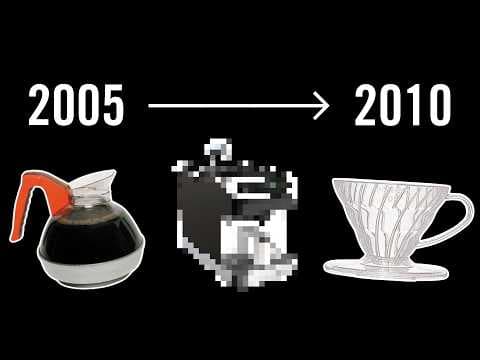
The story of how Starbucks, through its acquisition of the Clover brewer, inadvertently led to the rise of the Hario V60 as a staple in specialty coffee culture, highlighting the evolution of coffee brewing methods and consumer preferences.
Today, we delve into the surprising journey of the Hario V60, a coffee brewer that has become a household name in both homes and cafés worldwide. While Starbucks never officially used or promoted the V60, it played a pivotal role in making it an iconic symbol of the Specialty Coffee movement. This blog post explores the intricate connections between Starbucks, the Clover brewer, and the eventual rise of the V60.
To understand the V60's popularity, we must first look at the Clover 1S, a revolutionary coffee brewer created by the Coffee Equipment Company. The Clover made its debut at Coffee Fest in Seattle in 2005, where it generated significant buzz among coffee enthusiasts. The Clover was designed to enhance the brewing process, allowing for a more refined cup of coffee, which was a stark contrast to the traditional methods used at the time.
The Clover was developed by three Stanford graduates—Zander Nosler, Randy Hulett, and Jorah Wyer—who aimed to bring technological innovation to drip coffee. Initially, they created an office coffee machine called the Magnolia, but during development, they experimented with a new brewing chamber, leading to the creation of the Clover. This machine combined immersion and percolation, allowing users to control brew volume, steep time, and temperature, resulting in a superior cup of coffee.
The Clover quickly gained popularity among coffee professionals. It allowed cafés to offer a variety of high-quality coffees, which was previously difficult due to the limitations of traditional brewing methods. Despite its high price tag of around $9,000, the Clover became a sought-after machine, generating excitement at trade shows and among coffee aficionados.
In 2007, Starbucks faced significant challenges, including a decline in stock prices and increased competition from both specialty coffee shops and fast-food chains. Howard Schultz, the company's founder, returned as CEO to revitalize the brand. During a pivotal shareholders meeting in 2008, Schultz announced the acquisition of the Coffee Equipment Company and the Clover, a move that would have far-reaching implications for the coffee industry.
The acquisition was met with mixed reactions. While some viewed it as a strategic move to enhance Starbucks' coffee offerings, others in the specialty coffee community saw it as a threat. Notably, Duane Sorenson, founder of Stumptown Coffee, removed all Clovers from his shops in protest. The acquisition symbolized a clash between the mainstream coffee giant and the burgeoning specialty coffee movement.
As the specialty coffee industry grappled with the implications of Starbucks' acquisition, many cafés sought alternatives to the Clover. This led to the discovery of the Hario V60, a simple and affordable pour-over brewer that allowed baristas to craft high-quality coffee without the complexities of the Clover.
Hario, a Japanese company known for its glassware, launched the V60 in 2005. Initially, it struggled to gain traction outside Japan. However, as the specialty coffee movement grew, the V60 found its place in cafés and homes alike. Its affordability and ease of use made it an attractive option for coffee enthusiasts who wanted to replicate café-quality brews at home.
The V60's rise can be attributed to its accessibility. With a price point that allowed home brewers to invest in quality equipment, it quickly became a staple in coffee shops. By 2023, Hario had sold over 20 million units of the V60, solidifying its status as one of the most popular coffee brewers in the world.
The story of how Starbucks inadvertently popularised the V60 is a fascinating example of how market dynamics can shift in unexpected ways. The Clover brewer sparked a renewed interest in manual brewing methods, paving the way for the V60 to thrive. This narrative not only highlights the evolution of coffee brewing but also underscores the interconnectedness of the coffee industry. The V60 has become an icon of Specialty Coffee, changing how coffee is brewed and enjoyed around the world.