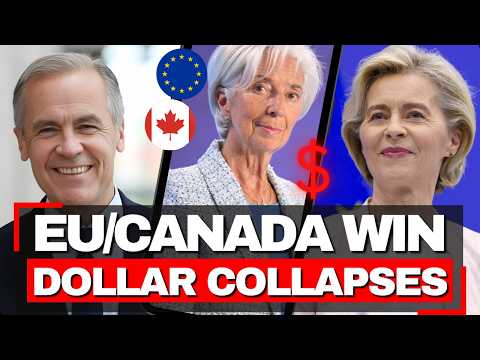
The Iran war disrupted Qatar's LNG capacity, causing European gas prices to double and forcing the ECB to consider interest rate hikes to combat inflation. Meanwhile, the US Federal Reserve is trapped between slowing growth and rising inflation, unable to hike rates. This divergence is causing capital to flow from the dollar to the euro, strengthening Europe and Canada financially while weakening the US dollar and economy.
The ongoing conflict involving Iran has unexpectedly reshaped the global economic landscape, particularly impacting currency dynamics between Europe, Canada, and the United States. This article explores how the Iran war has inadvertently positioned Europe and Canada to gain financial strength while the US dollar faces significant challenges.
Iran's military actions have knocked out 17% of Qatar's liquefied natural gas (LNG) capacity, amounting to 12.8 million tons per year for an estimated 3 to 5 years. This loss translates to approximately $20 billion in annual revenue for Qatar. The immediate consequence was a doubling of European gas prices overnight, which has had a profound effect on inflation and monetary policy in Europe.
In response to the surge in energy prices, the European Central Bank (ECB) has signaled a potential hike in interest rates to combat inflation. Although the ECB held rates steady at 2% on March 19th, it raised inflation projections for 2026 from 1.9% to 2.6%. ECB President Christine Lagarde highlighted the war's significant uncertainty and its material impact on near-term inflation.
The ECB is well-positioned to handle this shock and has warned of upside risks to inflation. Market analysts, including JP Morgan, Barclays, and Morgan Stanley, have revised forecasts anticipating multiple rate hikes in 2026, with futures markets pricing in a high probability of increases by mid-year.
Contrasting with Europe, the US Federal Reserve finds itself trapped. The US economy is slowing, and a recession would be catastrophic given the $39 trillion national debt. The Fed cannot easily hike rates without risking economic collapse, nor can it cut rates due to rising inflation driven by $112 per barrel oil prices and increased war spending.
This paralysis limits the Fed's ability to respond effectively to inflationary pressures, weakening the US dollar's appeal to investors.
When the ECB raises rates while the Fed remains constrained, European bonds offer higher returns than US Treasuries. Investors naturally seek higher yields, causing capital to flow from dollars to euros. This process, known as dedollarization, strengthens the euro and weakens the dollar.
A stronger euro makes European imports cheaper and helps control inflation, while a weaker dollar increases the cost of US imports, exacerbating inflation. This self-reinforcing cycle challenges the dollar's status as the world's reserve currency.
Canada stands to benefit significantly from the disruption in Qatar's LNG supply. With a capacity of 14 million tons per year at full production and plans to expand to over 30 million tons by 2028-2029, Canada is ramping up LNG exports at premium prices.
Canadian LNG's proximity to Asian markets offers a strategic advantage, reducing shipping times compared to US Gulf ports. This positions Canada to earn tens of billions annually from LNG exports amid tight global supply.
Germany's announcement of a 1 trillion euro infrastructure and defense spending program marks a shift away from fiscal austerity, boosting growth and investment attractiveness in Europe. European government bond yields are stabilizing despite increased issuance, indicating strong demand.
Meanwhile, the US is depleting strategic petroleum reserves to keep oil prices down, easing Iran sanctions to prevent price spikes, and facing a bond market under stress with rising yields.
The Iran war, initially intended to weaken Iran and secure American dominance in the Middle East, has inadvertently empowered Europe and Canada financially. Europe gains energy diversification and a stronger currency through potential rate hikes, Canada profits from premium LNG exports, and the US faces stagflation, rising debt, and capital flight.
The fundamental mechanics are straightforward: when one central bank raises rates and another does not, investors chase higher yields. If European bonds yield 3% and US Treasuries yield 2.5%, capital flows to Europe, strengthening the euro and weakening the dollar.
A stronger euro improves Europe's purchasing power, while a weaker dollar diminishes the value of US savings and investments. This dynamic threatens the dollar's reserve currency status, especially as real returns in Europe become more attractive.
The Iran war has acted as a catalyst accelerating existing structural problems in the petrodollar system. Europe and Canada are positioned to win the currency war through tight monetary policy and strategic resource exports, while the US struggles with economic constraints and a weakening dollar.
This shift has profound implications for global finance, trade, and geopolitical power balances. While central banks could alter course and geopolitical events may evolve, the current pattern indicates a significant realignment favoring Europe and Canada.
Understanding these developments is crucial for investors, policymakers, and anyone interested in the future of the global economy.
This analysis is based on data patterns and geopolitical-economic insights and does not constitute financial advice. Market conditions and policies may change rapidly.