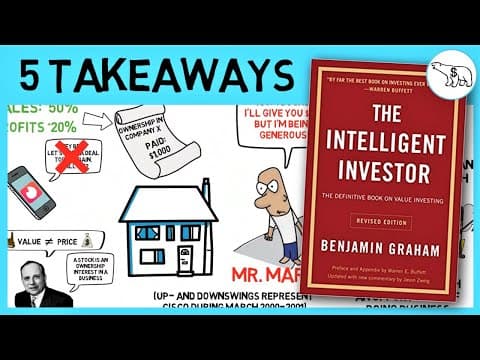
Benjamin Graham's The Intelligent Investor emphasizes a rational approach to investing, focusing on emotional control, understanding market fluctuations, and the importance of a margin of safety. It distinguishes between defensive and enterprising investors, providing strategies for both to achieve financial success.
Successful investing does not require a high IQ, insider information, or luck. Instead, it necessitates a sound intellectual framework for decision-making and the ability to manage emotions. In "The Intelligent Investor", Benjamin Graham provides this framework, which has proven to be one of the most successful investing strategies over the past century. Notably, Warren Buffett, one of Graham's most famous disciples, regards this book as the best on investing ever written. Here are the key takeaways from Graham's work.
Imagine you own a part of a business worth $1,000. Every day, a volatile character named Mr. Market comes to you with an opinion on how much your share is worth, offering to buy or sell based on his fluctuating views. Historically, Mr. Market's valuations can be wildly inaccurate. For example, in March 2000, he valued your share at $2,600, only to drop it to $500 a year later, despite the company's profits increasing.
Graham emphasizes that a stock is not merely a price tag but an ownership interest in a business. Since Mr. Market can be irrational, the true value of a business often diverges from its market price. Investors should only buy stocks they are comfortable holding long-term, regardless of Mr. Market's daily fluctuations. If Mr. Market offers a price that seems excessively high, sell; if he offers a bargain, buy. In today's world, where information is constantly at our fingertips, it's crucial to remember that just because Mr. Market is more present, it doesn't mean we need to engage with him more frequently.
Graham categorizes investors into two types: defensive (or passive) and enterprising (or active). Most individuals are better suited for the defensive strategy due to limited time for investing.
For those satisfied with average market returns, these strategies are sufficient. However, for those seeking higher returns, further considerations are necessary.
Becoming an enterprising investor requires more effort, patience, and discipline than simply following the market. It involves a deeper analysis of potential investments and a willingness to learn.
Every investment carries the risk of being wrong, but this risk can be minimized by ensuring a margin of safety. This means buying stocks at a price significantly lower than their calculated value. For instance, if a stock is worth $31, it should be purchased at $30 or less to provide a buffer against potential miscalculations.
Graham provides a formula for estimating a company's value:
Value = Current Earnings x 8.5 + 2 x Expected Annual Growth Rate
This formula helps investors identify stocks that can be bought with a margin of safety.
Traditional academic theory suggests that higher potential returns come with higher risks. However, Graham argues that price and value often diverge, meaning that the expected return is more about the investor's effort in finding undervalued assets than the inherent risk of the investment itself.
For example, buying a dollar's worth of value for 40 cents presents a lower risk than buying it for 60 cents, despite the higher potential reward. This principle underscores the importance of understanding the true value of investments rather than relying solely on market trends.
In summary, the five key takeaways from Benjamin Graham's "The Intelligent Investor" are:
Graham's insights remain relevant today, encouraging investors to adopt a rational and disciplined approach to investing. What are your thoughts on Graham's advice? Do you find them applicable in today's market?