This blog post explores the intricate process of canned sweet corn production, from harvesting in the fields to the final packaging in factories, highlighting the technology and methods used to ensure quality and freshness.
Corn is one of the most widely consumed grains on the planet, sustaining billions of people around the globe every year. Over a billion tons of corn are harvested from sprawling fields, leading to countless delicious dishes. But have you ever wondered how those sweet golden kernels packed neatly into small cans at the supermarket are made? Today, we uncover the production process behind 160,000 tons of canned corn every year at one of the most advanced factories in the world.
The journey of sweet golden kernels begins in vast corn fields, particularly in the United States, where a region known as the Corn Belt, primarily located in Iowa, is dedicated to cultivating this valuable crop. Corn thrives in sunny and moist conditions, with a growth cycle lasting between 3 to 4 months. During this time, the plants grow from tiny seeds into tall mature stalks reaching heights of 4 to 9 feet.
Interestingly, a single corn plant contains both male and female flowers. The male flowers, located at the top of the plant, produce pollen, while the female flowers, nestled at the leaf axles, wait for pollination to develop into plump ears of corn. Each ear holds hundreds of neatly arranged kernels packed with nutritional value.
To ensure the highest quality canned corn, the harvest process is meticulously planned. Farmers must choose the perfect time to harvest when the kernels are at their peak—plump, sweet, and tender but not overly mature to avoid toughness and loss of flavor. The harvest season for canned corn typically runs from mid-August to mid-October. Notably, to preserve the corn's freshness, the entire process from harvesting to canning must be completed within 12 hours.
Farmers rely on specialized harvesters equipped with sharp cutting blades and automated ear separation systems. These harvesters efficiently clear vast corn fields, with an impressive capacity of up to 150 tons per day. After harvesting, the corn is immediately loaded onto specialized trucks and transported to the processing plant.
Upon arrival at the state-of-the-art processing plant, trucks unload massive piles of corn onto an enormous outdoor conveyor system. The plant is equipped with large conveyor belts and a specialized bulldozer that flattens and pushes the corn efficiently onto the conveyor, ensuring a smooth flow of raw materials.
The corn then travels to the sorting area, where experienced quality inspectors meticulously examine each ear of corn, discarding those that are damaged, infested, or fail to meet size and ripeness standards. This rigorous sorting process ensures that only the highest quality corn proceeds to the next stage of production.
After passing quality checks, the selected ears of corn are prepared for their new look by removing the outer husks and silks. This step occurs in the husking area, where high-speed rotating rollers strip away the husks and silks without damaging the kernels. The removed husks are shredded and repurposed as livestock feed or organic fertilizer, contributing to sustainable agricultural practices.
Next, the corn undergoes a thorough cleaning process in agitation tanks containing surfactants that effectively remove dirt, sand, leaves, insects, and other impurities. After cleaning, the ears of corn move on to the kernel removal area, where sharp blades efficiently strip the kernels from the cob with remarkable accuracy. This system can process over 7,000 ears of corn per hour, ensuring a steady supply of high-quality kernels.
Once separated from the cob, the golden corn kernels flow along the conveyor system to a second cleaning stage, where they pass through a vibrating system that eliminates any remaining debris or impurities. The kernels then proceed to the blanching process, where they are briefly immersed in boiling water to deactivate natural enzymes that could affect their color, flavor, and texture during storage.
The blanching process lasts 4 to 5 minutes at temperatures between 158 to 167°F. After blanching, the kernels are cooled down using a specialized cooling machine that employs a vibrating mechanism and high-power fans to rapidly reduce the temperature without the risk of water absorption.
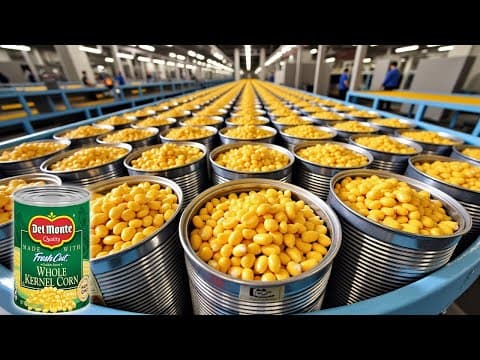
As the corn kernels are cooled, a different area of the factory prepares the tin cans. These cans, made of stainless steel and coated with an inner layer of tin, are handled by robotic arms and undergo a thorough cleaning and sterilization process using hot steam to eliminate bacteria and pathogens.
The liquid in a can of corn is not just plain water; it is a specially formulated solution made from purified water mixed with sugar, salt, and acidity regulators. This mixture stabilizes the pH level, prevents bacterial growth, and enhances the corn's flavor and shelf life.
In the filling area, advanced machines ensure each can is filled to a predetermined level with kernels, leaving a specific amount of headspace to allow for expansion during heat processing. Once filled, the cans are sealed tightly with lids using automated sealing machines, preserving the corn's freshness.
After sealing, the cans undergo a sterilization process in high-temperature baths reaching up to 480°F for 4 to 6 minutes. This step destroys any remaining microorganisms and enzymes, ensuring the corn stays fresh for an extended shelf life of 2 to 5 years.
Samples of the canned corn are taken to the laboratory for thorough testing on nutritional content, kernel structure, freshness, and microbiological safety. This final quality control step guarantees that every can of corn delivered to consumers is of the highest quality.
Once the canned corn has completed its transformation journey, robotic arms efficiently place the cans onto conveyor belts for labeling. The labels include essential product details such as ingredients, nutritional values, production date, expiration date, and lot number, demonstrating the manufacturer's commitment to quality.
Finally, trucks transport the canned corn to stores and supermarkets across the country, delivering a delicious, nutritious, and convenient food option to consumers everywhere.
The production of canned sweet corn is a fascinating process that combines agriculture, technology, and quality control to deliver a product enjoyed by millions. Have you ever tried canned corn? What’s your favorite way to prepare it?