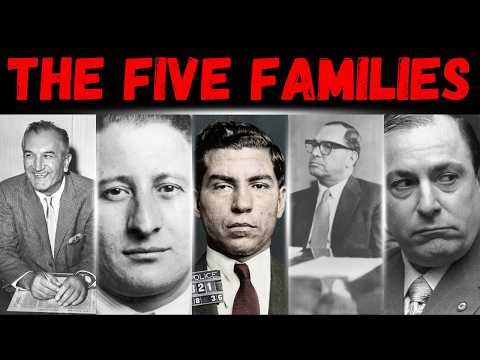
This blog post explores the history of the New York Mafia's Five Families, detailing their rise during Prohibition, internal conflicts, and the lasting impact of their organized crime structure on the city. It covers key figures, wars, and the evolution of power within the families, illustrating how they shaped the underworld and continue to influence New York today.
The story of the New York Mafia's Five Families begins in the shadows of old New York, a city rich with money, liquor, and men willing to do anything for both. By 1931, five powerful crews had carved out territories in the boroughs, establishing an underworld government that would shape the next half-century from the alleys to the boardrooms. Their names—Genevese, Gambino, Lucchese, Bonanno, and Colombo—became legendary. This post delves into how they rose from prohibition rackets and street wars to dominate America's largest city, how they survived betrayals, investigations, and bloodshed, and how their influence still lingers in the quiet corners of New York today.
During the years of Prohibition, New York's streets buzzed with illicit money. By the early 1930s, the city's underworld had become a pressure cooker, with every crew vying for a larger piece of the pie. The violence that ensued transformed back rooms and sidewalks into battlegrounds, culminating in the Castellammarese War—a bloody feud between factions led by Salvatore Maranzano and Joe Masseria.
The war reached its peak as Maranzano, a Sicilian traditionalist, and Masseria, an older boss losing his grip, fought for control. Their crews stalked each other through Manhattan and Brooklyn, leading to a staggering body count that strained even seasoned detectives. When the smoke cleared in 1931, Maranzano emerged as the last man standing. He quickly reshaped the scattered Italian-American gangs into a more organized structure, drawing lines across the city and grouping the outfits into five organizations named after their leaders: Maranzano, Profaci, Mangano, Luciano, and Galliano.
However, in the shadows stood Charles "Lucky" Luciano, who envisioned a different future for organized crime—one based on cooperation rather than constant warfare. After Maranzano's assassination later that year, Luciano took control and established the Commission, a governing body that brought together the bosses of the five New York families, along with leaders from the Chicago Outfit and the Buffalo Mafia. This underworld boardroom allowed for the management of disputes and territory, preventing the organization from tearing itself apart.
From the 1930s through the 1980s, the Five Families operated like a parallel government in New York City. Their influence was felt across various sectors, from trucking and construction to gambling and narcotics. Politicians were aware of their presence, union leaders answered to them, and business owners paid them to avoid trouble. Despite their power, the families maintained a structure that remained largely invisible to the public.
This changed in 1963 when Joseph Valachi, a soldier in the Genovese family, testified before a U.S. Senate panel, revealing the existence of the Five Families, the Commission, and their internal rules. His testimony sent shockwaves across the country, but even with the truth exposed, the families continued to operate. Federal pressure mounted, and younger generations began to turn away from the life, yet the families never fully disappeared.
The power of the Five Families has thinned over the years, but the structure Luciano built in 1931 continues to cast a long shadow over New York, upheld by men who remember what their predecessors created and what it meant to control a city from within.
The story of the Genevese family traces back to the Mel Gang, founded by Jeppe Mel in the early 1890s. Mel's crew dominated East Harlem and merged with Ignazio Lupo's operation, which thrived on counterfeiting and extortion. The family faced resistance from the Brooklyn Camorra, leading to the Mafia-Camorra War. After Prohibition, Joe Masseria emerged as the new boss, expanding the operation until he was ultimately killed by Luciano's men.
The Gambino family's roots also lie in the same neighborhoods. Ignazio Lupo's crew evolved into the Mangano family under Vincent Mangano, but it was Albert Anastasia, the underboss, who cast the longest shadow. Anastasia's violent methods drew attention, leading to his assassination in a barber shop in 1957, paving the way for Carlo Gambino to take control.
The Lucchese family began as an offshoot of the Mel Gang, with Gaetano "Tommy" Rina at the helm. Rina's refusal to share bootlegging profits with Masseria led to his assassination, and the family was reorganized under the Commission. Tommy Lucchese's leadership was marked by a low-profile approach, maintaining connections with politicians and avoiding street violence.
The Bonanno family, initially led by Salvatore Maranzano, saw Joseph Bonanno rise to power after Maranzano's death. Bonanno's leadership was characterized by strong ties to Sicily and a close-knit inner circle. However, internal conflicts, particularly the Banana War, led to Bonanno's retirement and the family's decline.
The Colombo family was the last to form, with Joe Profaci at the helm. Internal strife emerged with the rise of Joseph "Crazy Joe" Gallo, leading to a brief civil war. Carmine Persico eventually took control, but his long imprisonment led to a fragmented leadership structure.
The Five Families of the New York Mafia have a storied history filled with power struggles, betrayals, and a legacy that continues to influence the city's underworld. While their power has diminished, the structures and relationships established during their peak remain relevant today, reminding us of the complex interplay between crime and society in New York City.