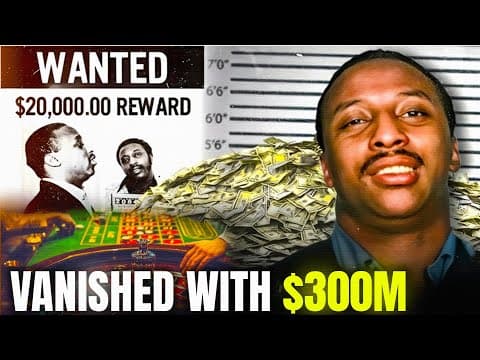
Frank Peewee Matthews, born in 1944, rose from humble beginnings in North Carolina to become a powerful drug kingpin in New York City, defying the mafia and building a $300 million empire. His story is one of ambition, power, and a mysterious disappearance that left many questions unanswered.
In the shadows of Brooklyn streets, one man dared to do the unthinkable: defy a mafia, outsmart the feds, and build an empire so massive that even John Gotti had to respect his name. Frank Peewee Matthews wasn't Italian, nor was he connected by blood; he wasn't supposed to win. Yet, he rewrote the rules, becoming America's first true black drug kingpin, earning a fortune, commanding soldiers, and terrifying rivals. This is the untold story of Black Caesar, the man who rose from stealing chickens in North Carolina to running a $300 million empire in New York City and then vanished into thin air.
Frank Larry Matthews was born on February 13, 1944, in Durham, North Carolina. A small boy with a big vision, he earned the nickname "Pee-Wee" due to his scrawny frame. However, behind that nickname was a future kingpin already forming. Life hit him hard when his mother died in 1948. At just four years old, Peewee was raised by his aunt, Marcela Steel, whose husband was a Durham City police officer. Ironically, even growing up under the same roof as the law, Peewee had no interest in a straight path.
By junior high, school was behind him; he dropped out after one year, already fixated on a different future. His inspiration came from a local singer named Clyde McFaten, who left Durham for New York and returned in a shiny Cadillac with pockets full of cash. That image burned into young Frank's mind. By the seventh grade, he had already written an essay predicting his life: his plan was simple—get rich, then retire in South America. The vision of an empire was already on paper long before the streets knew his name.
At just 14, Peewee organized his own neighborhood crew, sending kids as young as eight on chicken raiding missions. When a farmer caught on and confronted him, Pee-Wee didn't back down; he picked up a brick and cracked the man's skull. This incident marked his first taste of the system. Arrested for assault and theft in 1960, Peewee spent time in the Raleigh State Reformatory for boys. However, punishment didn't change him; it only sharpened his hunger.
At 17, Frank left country life behind and headed north, first stopping in Philadelphia. There, he learned the numbers game, working as a writer and quickly realizing he could pull six figures a year just from policy rackets. Philly wasn't just about numbers; it was also about networking. Pee-wee linked with heavy hitters connected to the black mafia, such as John Pops Darby and Tyrone Fat Tai Palmer. With his childhood friend Cadillac Tommy Fington by his side, Frank was learning how the underworld moved.
By 1963, the law was closing in, prompting Peewee to slide out and make his way to Brooklyn, New York. He set up shop as a barber, but the barber chair wasn't his dream; it was merely a front. Inside that little shop on Tomkins Avenue, Pee-Wee was quietly building power. Soon, the shop doubled as his headquarters, a place where hustlers came not just for haircuts but for deals, protection, and business.
In the underworld, word travels fast. By 1965, Frank was known as an enforcer with iron fists. At 5'9" and nearly 200 lbs, he was no longer Pee-Wee. People said he hit like a young Mike Tyson—compact, powerful, and unpredictable. The Italians noticed him, as the numbers game was controlled by the Italian mafia. Pee-wee initially worked under them, collecting, enforcing, and keeping black hustlers in line. An old mobster later recalled, "Tough kid, charismatic. He got his people to do things his way, which really was our way."
However, Peewee wasn't built to take orders. He studied the Italians, learned their structure, and began carving his own lane. By the late 1960s, he was looking beyond numbers; he wanted dope money. The problem was that to touch heroin in New York, he had to go through the mob. Pee-Wee tried the diplomatic route, sitting down with connected Italians like Louis Cerillo, hoping to secure a steady supply, but the mob shut him down.
That's when Frank Matthews made his boldest decision yet: if the Italians wouldn't supply him, he would find his own plug. He did so through Spanish Raymond Marquez and Cuban dealer Rolando Gonzalez, who handed Peewee his first real brick—pure, uncut, and better than anything the mob was pushing. Frank flipped it, doubled his money, and never looked back.
Frank turned his numbers network into a drug distribution army, selling heroin and cocaine through bodegas, pool halls, and clubs. Within weeks, he controlled entire neighborhoods. His prices were better, his products stronger, and his loyalty sharper. By 1970, Frank Matthews had pulled off the impossible: he had broken the mob's grip on the heroin trade, importing directly from South America and cutting out the Italians entirely. The streets crowned him Black Caesar.
The mafia wasn't happy. Wise guys claimed he didn't know his place, but Peewee wasn't scared. When a mobster threatened him, Frank snapped back, "Touch one of mine, and I'll send my men to Little Italy and shoot every last one of you." The Italians tested him and quickly backed off; Pee-wee had more firepower, more soldiers, and a greater willingness to pull the trigger. Even John Gotti respected him, seeing in Peewee a kindred flamboyant spirit.
But Frank didn't just flex with violence; he flexed with style. He bought a mansion across from Paul Castellano, the Gambino underboss. While Italians whispered about killing him, Frank spun donuts on a racist neighbor's lawn just to prove he wasn't backing down. Pee-wee wasn't a pawn anymore; he was playing king, building an empire.
At his peak, Frank Matthews was pulling in over $600,000 a day, running a drug pipeline that stretched across more than 21 states. He had New York, Philly, Boston, Baltimore, DC, Chicago, St. Louis, and even Miami under his control. The Feds later estimated his fortune at over $300 million, which in today's money amounts to billions.
What made him different was his strategy. Instead of waging wars, he made alliances. Local hustlers weren't enemies; they were partners. This approach kept the streets quiet and the profits flowing. When Peewee spoke, the entire coast listened. Once in 1972, he shut down heroin distribution for weeks, causing panic in the ghettos. Even the mob didn't dare move product without his green light.
The black scarf-faced Pee-Wee lived like royalty. He built a mansion in Staten Island with gold-plated fixtures and marble floors. He drove a new car almost every week, rocked mink coats, and showered women with cash. He was feared in the streets but also loved. Every year, he gave away a Cadillac on Bedford Avenue, no strings attached. To the people, he was a legend; to the feds, he was public enemy number one. To the mob, he was the nightmare they could never control.
By the early 1970s, Frank Matthews had achieved what no one before him could: he became the first true kingpin of America's drug empire. He outsmarted the mafia, outran the cops, and built a fortune so massive it shook the entire underworld. But just as the DEA closed in, just as indictments stacked in the noose tight, Frank Matthews pulled his greatest move yet. One day, he simply disappeared. No body, no arrest, no goodbye. The man they call Black Caesar vanished with millions in cash.
To this day, nobody knows where he went. Did he retire in South America just like he predicted in seventh grade? Or did the mob finally get their revenge? That is the mystery of Frank Peewee Matthews.