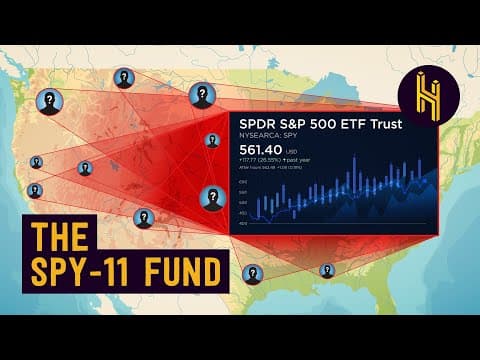
The SPDR S&P 500 Trust ETF, worth $500 billion, is tied to the lives of 11 Millennials whose existence determines the fund's longevity. This blog explores the origins of this unique financial structure and its implications for investors.
The SPDR S&P 500 Trust ETF, commonly referred to as SPY, is a significant player in the financial markets, valued at approximately $500 billion, which represents about 1% of the entire U.S. stock market. This ETF is one of the most widely traded assets globally, and many investors, including those with jobs, likely have a stake in it. However, there is an intriguing twist: the future of SPY is tied to the lives of 11 random Millennials.
To understand this peculiar connection, we must travel back to October 19, 1987, a date marked by a significant stock market crash. The reasons behind this crash are debated, ranging from the introduction of computerized trading systems to geopolitical events. Regardless of the cause, the aftermath left the stock market in turmoil, prompting the SEC to analyze the situation.
During their investigation, the SEC noted a critical gap in the market: while investors could trade various stocks, there was no way to invest directly in the stock market itself. The S&P 500 index, which tracks the performance of 500 of the largest companies, was merely an equation and not an investable asset. This realization led the SEC to encourage the creation of a financial product that could mimic the behavior of the entire stock market.
In response to the SEC's call, the American Stock Exchange (not to be confused with the New York Stock Exchange) began developing a solution. They aimed to create a trust that would hold stocks from all 500 companies in the S&P 500, allowing investors to buy and trade shares of this trust. After considerable effort, they successfully established a structure that would track the S&P 500's value closely.
However, a significant legal hurdle emerged: the trust needed an expiration date. Due to the rule against perpetuities, which prevents trusts from existing indefinitely, the creators had to ensure that the trust would not outlive its founders. In New York, trusts must expire 21 years after the death of any named individuals involved in their creation.
To circumvent this limitation, the American Stock Exchange decided to tie the trust's existence to the lives of several individuals. They sought out 11 babies, children, and grandchildren of people associated with the exchange, betting that their lives would extend the trust's duration for at least a century. This decision inadvertently linked the future of a $500 billion asset to the well-being of these 11 Millennials.
While not much is known about these individuals, a few have been identified over the years. For instance, one named Paul works as a bartender in Philadelphia, while another, Elizabeth, is an engineer based in Atlanta. Emily, a salesperson from New York, and Ranne, who resides in Birmingham, Alabama, are also among those whose lives are now intertwined with the fate of SPY.
The connection between SPY and these Millennials raises several questions about the stability and longevity of this investment vehicle. If any of the 11 were to pass away, the trust would face a countdown to its expiration. While theoretically, a new version of the ETF could be created to shift assets and continue operations, this plan relies on the assumption that the deaths of these individuals will occur in a predictable manner over the coming years.
The relationship between the SPDR S&P 500 Trust ETF and the lives of 11 Millennials is a fascinating example of how financial products can be influenced by unexpected factors. As investors, it is essential to be aware of the underlying structures of the assets we hold, as they can have surprising implications for our investments. While the situation may seem alarming, it serves as a reminder of the complexities of the financial world and the interconnectedness of our economy.
In a world where data privacy is increasingly at risk, it is also crucial to consider how personal information is handled. As we navigate these financial landscapes, being informed and cautious about our data is just as important as understanding our investments.