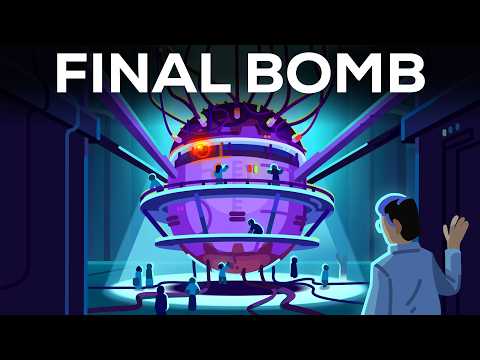
Project Sundial, a top-secret initiative from the 1950s, aimed to create a nuclear bomb with the power to destroy all of humanity. Conceived by scientist Edward Teller, this weapon represented the peak of nuclear madness, with implications that still resonate today as the world faces a new arms race.
In the 1950s, the United States embarked on a top-secret initiative known as Project Sundial, much of which remains classified to this day. The audacious goal of this project was to develop a single nuclear bomb so powerful that it could obliterate all of human civilization. Conceived by the brilliant yet controversial scientist Edward Teller, Sundial was designed to have an energy equivalent to 10 billion tons of TNT—an unimaginable force that dwarfed the destructive power of all bombs used during World War II.
To understand the madness of Project Sundial, we must first consider the historical context. If you were 40 years old in 1945, you were born in 1905, a time when monarchs ruled much of the world, only 3% of homes in the U.S. had electricity, and cities were dominated by horse-drawn carriages. The world was on the brink of monumental change. By 1945, the devastation of two world wars had resulted in the deaths of 24 million soldiers and 50 million civilians. The advent of television, microwaves, jet planes, and, crucially, nuclear bombs transformed society overnight.
The introduction of nuclear weapons shattered the illusion of safety, instilling a pervasive sense of terror. Nations without nuclear capabilities faced the grim reality that they could be easily overrun by those who possessed them. In 1946, the U.S. proposed the Baruch Plan, which aimed to eliminate atomic bombs and establish international oversight to prevent their proliferation. However, the military advantage offered by nuclear weapons proved too enticing to relinquish.
The landscape shifted dramatically when the Soviet Union detonated its first atomic bomb in 1949, catching the world off guard. This event ignited a nuclear arms race, with the number of nuclear weapons skyrocketing from just 9 in 1946 to 300 by 1950, and an astonishing 20,000 by 1960. The arms race became a cycle of escalation, with each superpower striving to outdo the other in destructive capability.
Among the key figures in this nuclear escalation was Edward Teller, a Hungarian theoretical physicist who played a pivotal role in the development of the hydrogen bomb. Teller believed that the existing nuclear arsenal was insufficient for national security and lobbied for the creation of even larger bombs. His relentless pursuit of more powerful weapons was fueled by the fear of Soviet advancements.
In 1952, Teller's vision materialized with the successful testing of the hydrogen bomb, a weapon so powerful that it required a standard atomic bomb to trigger it. The first test obliterated a Pacific island, and subsequent tests produced bombs 1,000 times more powerful than the Hiroshima bomb. The world recoiled in horror as the reality of total annihilation became palpable.
Teller's ambitions did not stop with the hydrogen bomb. He envisioned a weapon that would render all others obsolete—a bomb so devastating that it would deter any potential conflict. This led to the inception of Project Sundial, a weapon designed to be a "backyard bomb" capable of destroying the world. The specifics of Sundial remain largely classified, but it was estimated to weigh at least 2,000 tons and possess the explosive power of 10 billion tons of TNT.
The implications of such a weapon were staggering. If detonated, Sundial would create a fireball up to 50 kilometers in diameter, incinerating everything within a 400-kilometer radius. The resulting blast wave would trigger a magnitude 9 earthquake, and the fallout would lead to a catastrophic nuclear winter, decimating crops and contaminating water sources worldwide.
Fortunately, Project Sundial was never realized. The scientific community reacted with horror, and even military officials deemed the project too extreme. The concept of a single weapon capable of global destruction raised profound ethical questions. Would humanity be willing to press the button in response to a distant threat? The very idea of a doomsday bomb was fraught with peril.
While Sundial itself was never built, the world still faces the consequences of nuclear proliferation. At the height of the Cold War, there were over 70,000 nuclear weapons globally. Today, approximately 12,000 remain, enough to threaten human civilization. The difference between Sundial and the current arsenal is minimal; instead of a single doomsday bomb, humanity has created a doomsday machine.
As we navigate the complexities of modern geopolitics, the specter of a new nuclear arms race looms large. The U.S. is projected to spend a trillion dollars on nuclear modernization, while China is expanding its arsenal. The existential threat posed by these weapons remains ever-present, and the question arises: do we truly want to be prepared to annihilate ourselves at a moment's notice?
The story of Project Sundial serves as a chilling reminder of the potential for human ingenuity to create tools of unimaginable destruction. Science itself is neither good nor bad; it is our responsibility to channel our curiosity and exploration toward positive outcomes. As we reflect on our past, we must consider the future we want to build—a future where the horrors of nuclear weapons are relegated to history, rather than a looming threat over our existence.