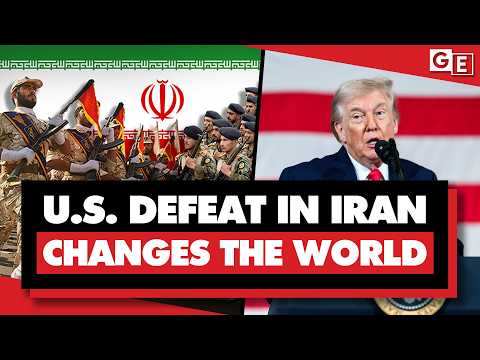
The United States is losing the war against Iran, a fact now reluctantly acknowledged even by neoconservative hawks who once advocated for it. This defeat will have profound geopolitical consequences, strengthening Iran, China, Russia, and the global south, while diminishing US global influence. The conflict highlights the limits of US imperial power and signals a shift toward a multipolar world order.
It is increasingly evident worldwide that the United States is losing the war against Iran—a war that the US itself initiated. This reality is being discussed not only internationally but also within Washington DC. Even neoconservative war hawks, who were architects of the Iraq war and other conflicts in Libya and Syria and long advocated for war on Iran, are now reluctantly admitting that the US is losing this conflict. This loss is expected to have massive geopolitical repercussions, weakening the US empire and strengthening Iran, China, Russia, and the global south.
Independent anti-war voices have long argued that the US is losing this war, but what is remarkable is that even the war proponents in Washington are now acknowledging it. One prominent figure is Robert Kagan, a notorious neoconservative and one of the original advocates for the 2003 Iraq invasion. Kagan recently wrote an article in The Atlantic titled "Checkmate in Iran," where he admits the US is losing and that this defeat will have a greater geopolitical impact than the US losses in Vietnam and Afghanistan.
Kagan argues that Iran's control over the Strait of Hormuz—a critical oil transit choke point—makes it a key regional and global player. The roles of China and Russia as Iran's allies are strengthened, while the US's role is substantially diminished. He describes America as "unreliable and incapable of finishing what it started."
The admission by hawks like Kagan stems from the political realities in the US. President Trump is extremely unpopular, partly due to this war, inflation, the cost of living crisis, and corruption. Polls show that at least 60% of Americans oppose the war on Iran, with some polls indicating even higher opposition.
The US and Israel launched the war of aggression on February 28. Within a month, international media like the British newspaper The Independent acknowledged Iran as the clear winner. US corporate media outlets, including The Wall Street Journal and The New York Times, have reported that the war is not going well for the US.
US intelligence reveals that Iran retains most of its missile capabilities and operational access to 30 of its 33 missile sites along the Strait of Hormuz. Iran initially closed the Strait in response to the US-Israeli aggression but has allowed passage for ships from friendly countries like China, Russia, and India. In response, Trump declared a US naval blockade of the Strait, but US intelligence admits Iran can withstand this blockade for many months, giving Iran significant leverage.
The war has triggered the largest oil crisis in history, causing a global economic and food crisis due to fertilizer shortages. US intelligence officials have also leaked that Iran has successfully defended itself and heavily damaged most US military bases in West Asia.
Neoconservatism, which advocates for the US as a global policeman spreading liberal democracy through regime change and war, has been a dominant force in US foreign policy. The movement was influential in the 1990s and 2000s, with many members holding top government positions during the George W. Bush administration. Key figures include Dick Cheney, Paul Wolfowitz, John Bolton, and Robert Kagan himself.
The ideology promotes US imperial dominance and supports military alliances like NATO to maintain global control. However, the neoconservative movement began to split in 2016 with Donald Trump's rise. Some neocons supported Trump, while others backed Hillary Clinton, a right-wing pro-war Democrat.
Victoria Nuland, Kagan's wife and a prominent neoconservative, played a significant role in US foreign policy across multiple administrations. She was instrumental in the 2014 Ukraine coup, openly supporting protests that overthrew the democratically elected government and installed a pro-US regime.
Kagan's article in The Atlantic is a rare honest admission from a leading neoconservative hawk. He states that defeats in the confrontation with Iran cannot be repaired or ignored, and there will be no return to the status quo. Iran's control of the Strait of Hormuz and its alliances with China and Russia strengthen its position, while the US's role diminishes.
He acknowledges that despite 37 days of US and Israeli attacks killing much of Iran's leadership, the Iranian government remains intact and unyielding. Iran's ability to retaliate against neighboring Gulf states and damage vital oil and gas infrastructure poses a prolonged economic crisis and global catastrophe.
Kagan concludes that the only way for the US to win would be a massive ground invasion and occupation of Iran, similar to Iraq, which ultimately failed. He suggests that walking away might seem the least bad option and that defeat for the US is not only possible but likely.
Other neocons, like Bill Kristol, co-founder of the Project for the New American Century alongside Kagan, are also distancing themselves from Trump and the war. Kristol supports some neoconservative Democrats and has launched a media outlet, The Bulwark, run by "never Trump" Republicans who oppose Trump despite their conservative views.
Their opposition is not due to a newfound commitment to peace but political opportunism, as they recognize Trump's unpopularity and the war's backlash.
Polls from NPR, PBS News, Marist, and the British agency YouGov show that a majority of Americans oppose the war and doubt US success. Only about one-third support the war, and a plurality believes the US will not win.
The US war on Iran, initiated under Trump, has become a quagmire with no clear path to victory. Iran's resilience and strategic advantages have shifted the balance of power in the region and globally. The conflict accelerates the decline of US imperial dominance and the rise of a multipolar world order where China, Russia, and the global south hold greater influence.
This geopolitical earthquake will have cascading effects for years to come, reshaping global politics far beyond West Asia and the Persian Gulf.
For those interested in deeper analysis of this conflict and other geopolitical issues, following independent and critical sources is essential to understand the evolving global landscape.








