Editorial Team
8 min read
Alibaba says Qwen4-Max reduces average task costs by 62% on its workplace benchmark. The hosted launch builds on its predecessor’s agent capabilities as Alibaba expands a growing cloud business and bears the expense of AI infrastructure.
Alibaba, the Chinese e-commerce and cloud-computing group that develops the Qwen AI model family, announced Qwen4-Max on November 15 with a claim of cheaper professional work. It is selling access to the new flagship while withholding downloadable model weights—a consequential choice for a family whose reach has been built partly through open releases.
In its launch announcement, Alibaba says average cost per task on Work360, a workplace benchmark it developed, fell from $4.43 for its August predecessor, Qwen3.8-Max, to $1.67. The reported overall score rose from 47.74 to 52.69. These are results from Alibaba’s evaluation, not demonstrated savings across customers’ workloads.
The commercial question is whether more economical agents—systems that plan work, call tools and revise results—can bring more paying use to Alibaba’s cloud. The company already sells computing infrastructure and model access, and is investing in chips and data centres. Lower task costs would matter beyond a leaderboard if customers can obtain acceptable deliverables with less spending and human correction.
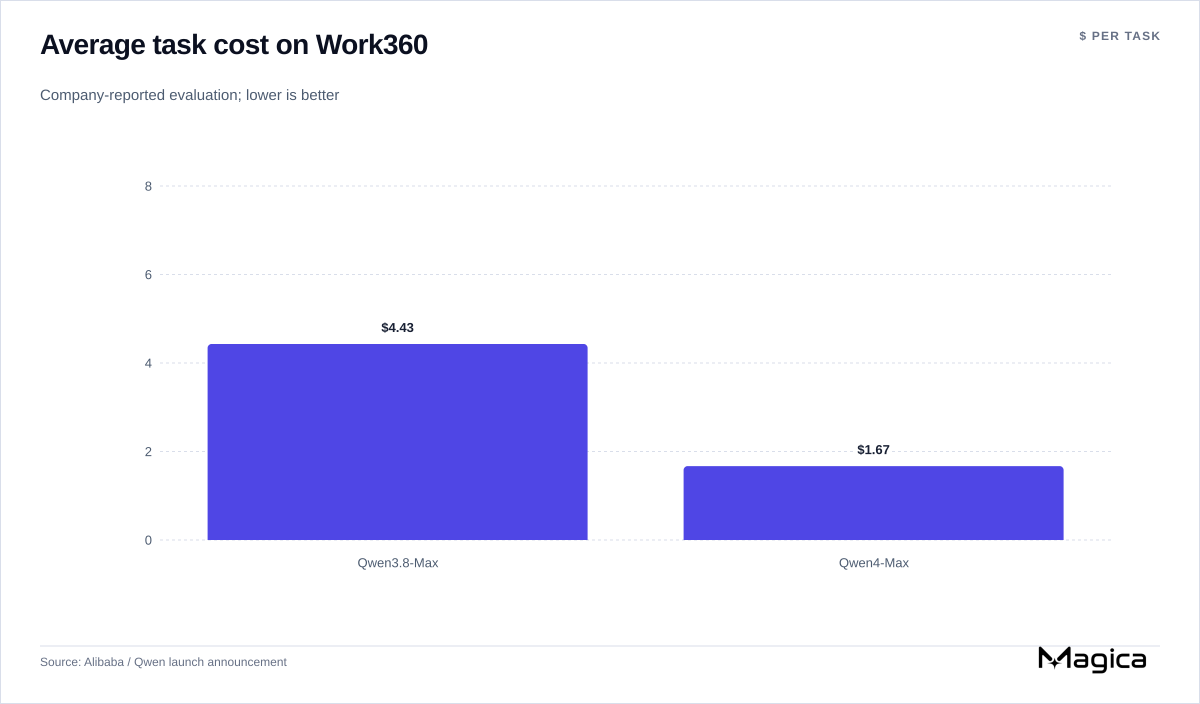
Company-reported average Work360 task costs fell from $4.43 to $1.67. The comparison combines token-use and pricing changes; customer savings may differ. Source: Qwen.
Qwen4-Max uses a new sparse mixture-of-experts architecture, which activates only part of the model for each token, or unit of text processing. Alibaba describes a 2.4-trillion-parameter backbone with 71 billion parameters activated per token, plus 328 billion N-gram Embedding parameters. It also provides native vision and a one-million-token context window, the capacity available for processing material within a request.
The August 3 launch description for Qwen3.8-Max already offered text, image and video input, a million-token context window, planning, tool use and verification. Its predecessor architecture had 2.4 trillion total parameters and 95 billion active parameters. That announcement even described a coding demonstration lasting approximately 16 days. Long-running work itself is therefore an established Qwen pitch; the new proposition is better execution with fewer resources.
Alibaba says Qwen4-Max reduced token use against Qwen3.8-Max by approximately 24% at Xhigh effort and 35% at High effort on Work360. On Terminal-Bench 4.0, it reports reductions of approximately 48% and 49%, respectively. These settings and tests matter: none of the figures establishes a universal reduction for every task.
The company also says it lowered API prices, especially for cached inputs. Its reported 62% reduction in average Work360 task cost accompanies both lower token use and lower prices; it is not a 62% cut to every API rate. The announcement does not supply a rate table with which to reconstruct the full task-cost comparison.
Competing developers offer alternatives. Alibaba says its coding benchmark results outperform Anthropic’s Claude Fable 5.1 and Moonshot’s Kimi K3.1 Pro, according to the launch coverage. Those are company comparisons, not proof of superiority across professional work. The coverage also identifies recent Tencent Hunyuan 4 and Kimi K3.1 Pro releases, and DeepSeek among China’s challengers to US developers.
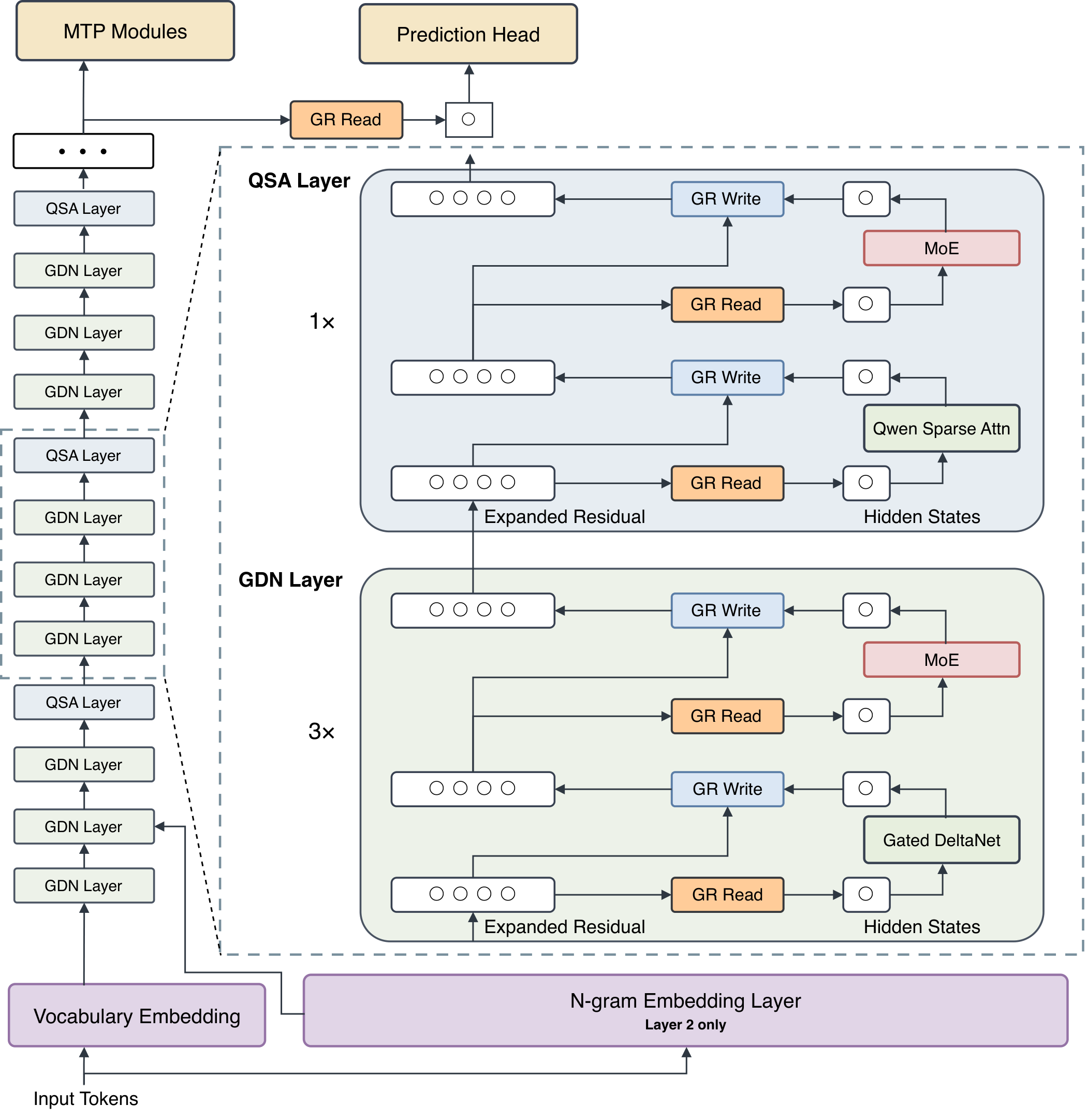
Alibaba/Qwen’s Qwen4-Max architecture diagram shows Gated DeltaNet layers, sparse attention, gated residual connections and N-gram embeddings. Source: Qwen.
The launch coverage describes Qwen as the world’s most-downloaded open-weight model family, but says Qwen4-Max is not open weight. Users cannot download and customize this flagship. Alibaba’s Qwen4 announcement instead promises smaller models for open-source release, without giving a date.
That differs from the predecessor’s August commitment to release the first open-weight Max-class Qwen model the following week. The August source establishes that promise; it does not establish whether those weights subsequently shipped.
Qwen4-Max is available through QwenCloud, Alibaba’s hosted model platform, using an API or Token Plan. Alibaba also lists QwenWork, Qoder and QwenStudio as access points. Its Token Plan documentation confirms Personal and Team edition support. Separately, it records a November 11–25 preview promotion, with credit consumption as low as 20% of the standard rate and a further nighttime discount. Those temporary credits are distinct from the launch’s API price claim.
Distribution is not exclusive to Alibaba’s models: the same documentation lists DeepSeek-V4.1-Flash as a supported option. It also records staged availability for connecting QwenWork to Token Plan, so a model’s listing should not be confused with every integration being generally available.
For customers, the choice involves deployment control as well as price. Hosted access puts use through the provider’s services; downloadable weights would allow customers to operate and adapt a model themselves. The new flagship does not offer that second route.
Alibaba’s May financial-results filing shows the business behind this strategy. For the quarter ended March 31, 2026, Cloud Intelligence Group revenue reached RMB41.626 billion, up 38% year over year. The filing separately reported RMB8.971 billion in AI-related product revenue for the quarter. The cloud segment’s adjusted EBITA, a non-GAAP earnings measure, increased 57% to RMB3.796 billion. Alibaba attributed the earnings improvement to revenue growth and operating efficiency, partly offset by investment in customer growth and technology.
The investment burden extends across the group. For the fiscal year ended March 31, 2026, capital expenditure rose to RMB126.063 billion from RMB85.972 billion in the preceding fiscal year—about 47%, calculated from the filing’s totals. That spending includes cloud and e-commerce computing equipment and data centres, logistics infrastructure and corporate facilities; it is not a disclosed Qwen budget.
Group free cash flow, Alibaba’s non-GAAP liquidity measure, swung from an inflow of RMB73.870 billion to an outflow of RMB46.609 billion over those fiscal years. Alibaba mainly attributed the deterioration to quick-commerce investment and higher cloud infrastructure expenditure. It nevertheless reported RMB520.824 billion in unrestricted cash and other liquid investments at March 31. These earlier figures establish financial capacity and competing demands on cash, not the return on November’s model launch.
Alibaba has also tapped debt markets: the filing records a September 2025 issuance of approximately US$3.2 billion in zero-coupon convertible senior notes due in 2032. It said proceeds were intended for general corporate purposes, with a focus on cloud infrastructure and international commerce. That financing predates Qwen4-Max and is not identified as funding for this launch.
Infrastructure expansion remains part of the strategy. The launch coverage says Alibaba is building across models and chips and has set a target of 20 gigawatts of global data-centre capacity by 2032. That is a target, not capacity already delivered. The May filing also describes T-Head, Alibaba’s chip-design subsidiary, and its own inference chips as parts of its cloud technology stack.
Qwen4-Max is itself being used in Alibaba Cloud resource scheduling, the company says. Its launch announcement reports an average 10.42% reduction in model-call scheduling costs for data annotation against a reference baseline. That is a specific internal optimization claim, not a reduction in Alibaba’s overall infrastructure bill.
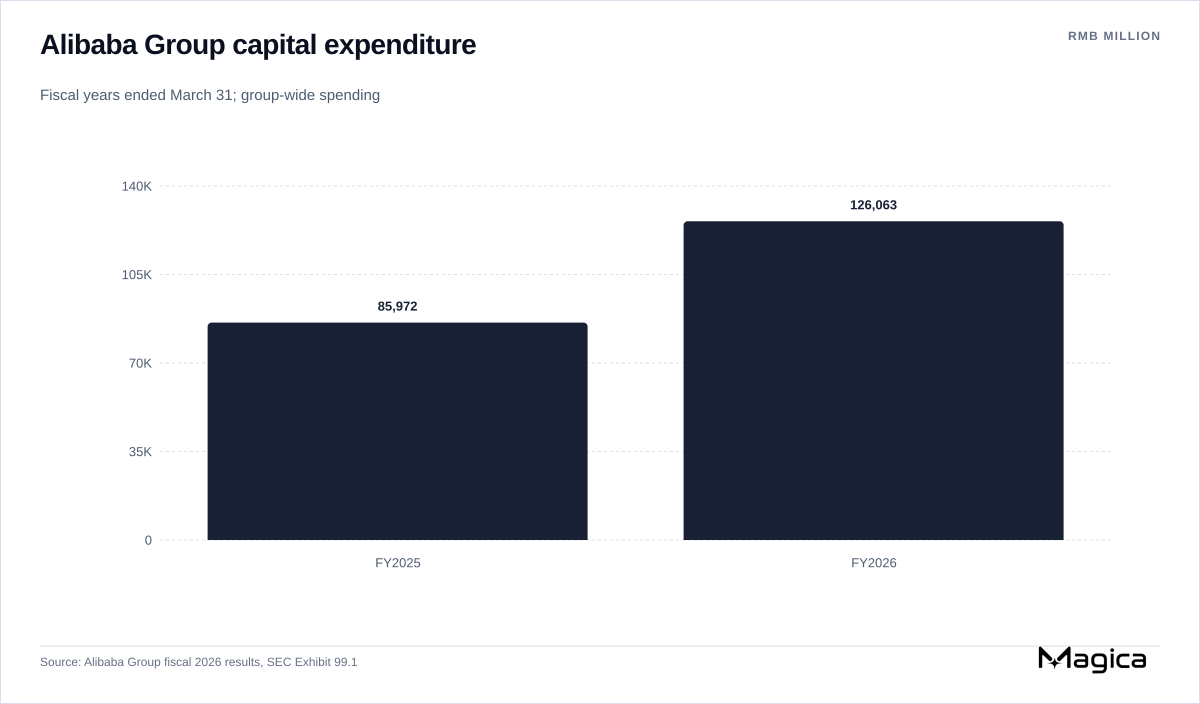
Alibaba’s group-wide capital expenditure rose in fiscal 2026. These totals include cloud, e-commerce, logistics and corporate facilities, predate the launch and are not a disclosed Qwen budget. Source: Alibaba Group financial results.
Alibaba’s Live Delivery feature gives users early versions of an agent’s work and lets them redirect subsequent iterations. The company says it is open-sourcing the associated plugin. It also describes developing the model together with its agent software and products, including Qoder. That makes the surrounding tools part of the delivery claim, rather than attributing every outcome to the underlying model alone.
Its examples span game creation, financial research, legal due diligence, clinical support and manufacturing. In a manufacturing showcase, Alibaba says manual programming effort for a single workpiece fell from approximately 475 minutes to 24 minutes. That is a selected demonstration, not an average across factories. The professional examples emphasize traceable evidence and deliverables, but do not establish general reliability in those occupations.
The scientific demonstrations also reached different stages. Alibaba says a coolant-design experiment produced a physical sample through automated laboratory synthesis and testing. A drug-discovery candidate, by contrast, was assessed computationally and still warrants wet-lab validation. Neither should be presented as a broadly proven autonomous scientific service.
On safety, Alibaba says it added code-security checks alongside functionality checks in software-engineering training tasks. In its Last Secure Code Bench evaluation, the function-level pass rate for both functionality and security rose from 22.0% to 31.8% against Qwen3.8-Max. The share generated securely at all three tested levels—function, file and repository—rose from 8% to 14.7%. Both are improvements, but most outputs still failed to satisfy the respective combined criteria; the figures are not general vulnerability rates for all generated software.
Alibaba also says internal experts observed no capabilities posing large-scale cybersecurity risks and found no significant uplift in users’ capabilities involving hazardous materials. A report on the release relays those company findings and places the disclosures amid growing concern about misuse and loss-of-control risks. It does not supply independent confirmation of the internal safety conclusions. Alibaba itself says professional judgment and human oversight remain essential in high-impact decisions.
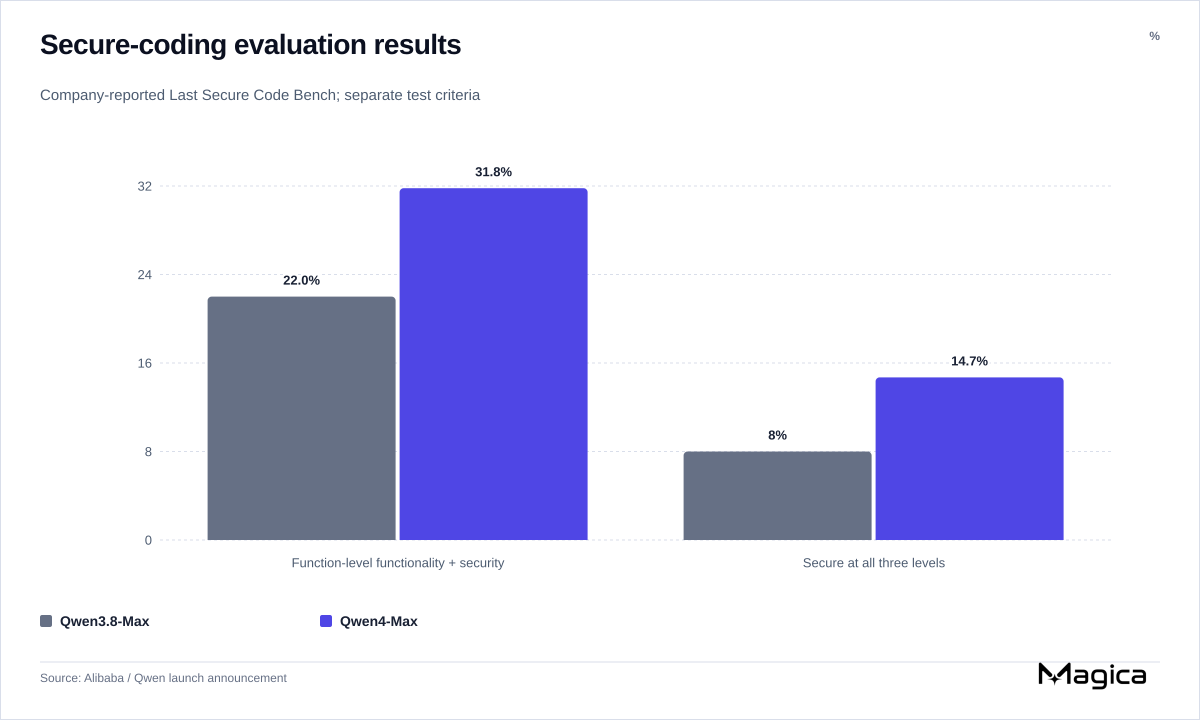
Company-reported Last Secure Code Bench results improved under both criteria. These benchmark-specific measures are not general vulnerability rates for generated software. Source: Qwen.
Customers evaluating Qwen4-Max need comparable workloads, tool access, effort settings and standards for acceptable output. The useful comparison includes failed runs and the human review needed to repair them, alongside API charges. Alibaba’s Work360 results provide a specific claim to test, while the demonstrations show tasks to investigate rather than guaranteed outcomes.
Users who need to run models themselves must also assess whether the promised smaller Qwen4 releases meet their needs; the launch does not offer downloadable flagship weights. For Alibaba, the unresolved commercial test is whether cheaper usable work expands paid cloud demand enough to justify the infrastructure and product investment behind it. The launch benchmarks alone cannot answer that question.
The FBI warns that ARTEX can accelerate intrusions, with some reaching privileged access in under three hours. Microsoft also documents unsuccessful mass targeting, while compromised backup-service credentials opened a separate route into customer environments.
Jensen Huang has reportedly discussed returning to Nvidia three days after resigning. Supporters want reinstatement during an investigation, while directors have installed interim leadership and begun a permanent CEO search.
House China committee chairman John Moolenaar demanded answers from Commerce Secretary Howard Lutnick over delayed restrictions on Nvidia customer Megaspeed. The dispute concerns enforcement, overseas access to advanced chips and commercial influence as President Donald Trump prepares to visit China.
Apple reportedly still aims to unveil iPhone-linked glasses at WWDC 2027 and ship before year-end. Siri control of existing apps is the software bet, but delays cloud the schedule and Meta already has an established eyewear lineup.
Treasury Secretary Scott Bessent urged Nvidia to recruit an outside CEO and explain within 10 days whether suspect chip sales inflated earnings. The board is considering internal and external candidates, while export enforcement also faces scrutiny.
Congressional scrutiny and company investigations are testing what Nvidia knew about Megaspeed, a Singapore cloud operator whose Malaysian subsidiary bought nearly $2 billion of its technology. Megaspeed denies wrongdoing; the available reporting has not conclusively traced suspected chip diversion to China.
Commerce Secretary Howard Lutnick is backing narrower restrictions on Chinese access to overseas AI computing, according to a report examining his former firm’s financing relationships. Bitdeer filings establish Cantor’s role and the scale of its client’s planned expansion, but do not establish improper influence on policy.
Microsoft said services were fully restored on Saturday after a global Microsoft 365 outage disrupted email, healthcare communications and public services. It blamed an earlier network capacity upgrade exposed by a later change, with a full technical review still to come.
Cursor says a key exposed by Fireworks led an attacker to unredacted credentials in historical coding-agent records and then its extension cache. Up to 5,000 users potentially received malicious Claude Code builds. Cursor has moved inference off Fireworks; successful endpoint compromises remain uncounted.
Police are investigating a top tax-accountant exam scorer's admission of AI-assisted cheating, while the government reviews national qualification tests held in 2026 and prepares stronger controls.
An early tally puts Japanese listed companies’ first-half net profit growth at 43.2%, led by manufacturers. Filings show AI component demand alongside currency benefits and non-AI earnings gains, while procurement delays and canceled infrastructure reservations expose the costs of expansion.
TSMC plans to back promising chip startups through a new investment arm, alongside separate commitments to OpenAI and Anthropic. The strategy reaches toward future customers and the AI developers shaping chip demand, but the investment rights remain unclear.
Nidus has raised $30 million across pre-seed and seed rounds to automate wire processing in existing U.S. defense factories. Its founders bring manufacturing and government-deployment experience, but customer access and proprietary data still need to translate into measurable production gains.
Nebuly is funding US and European expansion for its AI business-value platform. Adjustable assumptions and private deployment are part of its pitch, but rivals offer similar measurement tools and verified customer returns remain undisclosed.
Han Won-seok says he used a miniature camera, generative AI and a smartphone in tax accountant and CPA exams. His confession puts scrutiny on exam security after proctors reported no suspicious behavior.
Veteran songwriting team Glorywave used Suno to turn human-written lyrics into Meomuru’s chart-topping ballad. Recording revenue is settled separately, but songwriting royalties remain unavailable through Korea’s collecting association as rules for human contributions to AI-assisted music remain unresolved.
Chinese AI developers and optical suppliers fell as investors feared tougher US chip restrictions after Jensen Huang’s departure from Nvidia. Domestic chipmakers rallied, exposing a divide between companies that need advanced processors and those hoping to replace them.
Reports linked to AI and child sexual exploitation rose from about 4,700 in 2023 to more than 400,000 in 2025, Childlight finds. The increase exposes growing threats and weaknesses in reporting systems, but does not measure unique victims or confirmed AI-generated images.
Megaspeed says Alice Huang left on August 30, 2025, and has retained outside lawyers for an internal compliance investigation. Singapore’s inquiry began months before that departure; authorities later found insufficient evidence that Huang had committed a crime, while the investigation into the company continues.
HP’s US listing puts a $132,000 starting price on its ZGX Fury shared AI system. Its 748 GB of coherent memory supports a local-computing pitch, but competing GB300 machines, dedicated power requirements and workload-specific operating costs shape the buying decision.