Editorial Team
7 min read
An early tally puts Japanese listed companies’ first-half net profit growth at 43.2%, led by manufacturers. Filings show AI component demand alongside currency benefits and non-AI earnings gains, while procurement delays and canceled infrastructure reservations expose the costs of expansion.
AI infrastructure suppliers are helping lift Japanese corporate profits for April–September 2026, with manufacturers leading a sharp increase in an early earnings tally. But company filings show why the aggregate gain cannot be treated as a measure of AI’s contribution: exchange rates and other businesses also boosted results, while expanding infrastructure brings costs as well as orders.
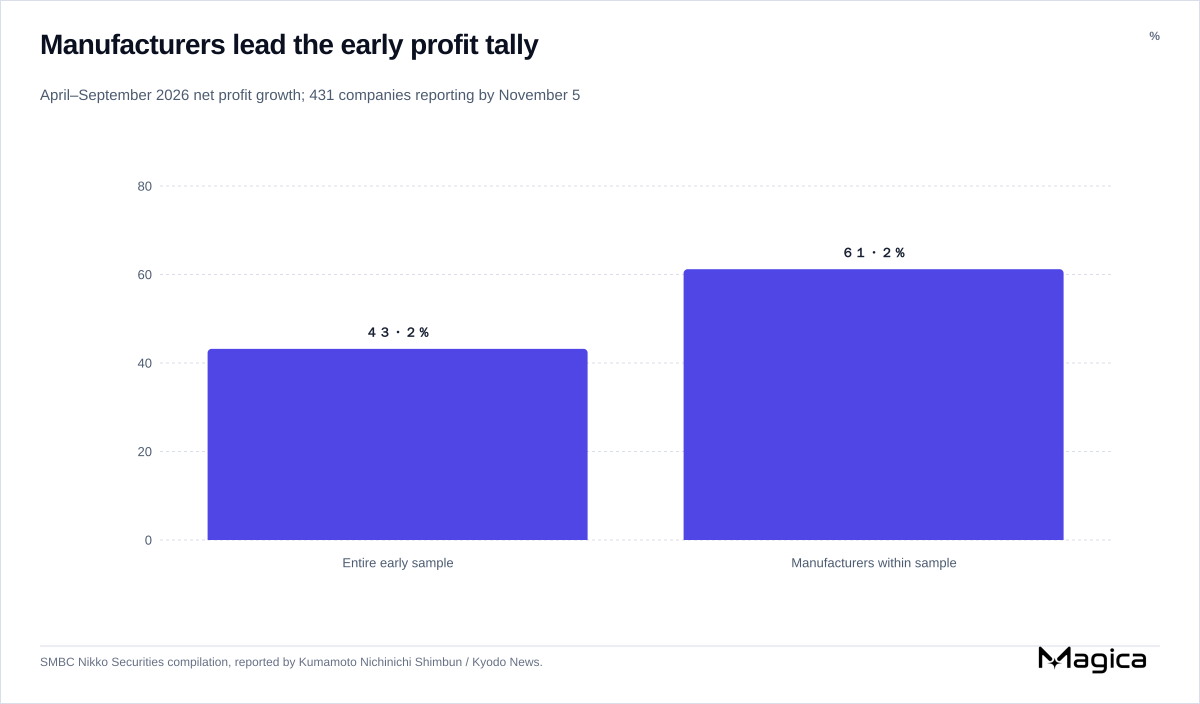
Manufacturers’ profit growth exceeded the early sample’s overall rate. Manufacturers are included in the sample, which covered about 40% of the eventual company count. Source: Kumamoto Nichinichi Shimbun.
Securities firm SMBC Nikko Securities’ compilation of 431 companies showed combined September interim net profit of ¥19.7451 trillion, up 43.2% from a year earlier, according to a report published November 6. The report said interim profits were on course for a record level and full-year earnings were also expected to reach a record in the year ending March 2027.
The sample consisted mainly of March-year-end companies on the Tokyo Stock Exchange’s top-tier Prime Market that had announced results by November 5. It represented about 40% of the companies in the eventual tally. The growth rate therefore describes that reporting sample, rather than a completed census of Japanese listed businesses.
Manufacturers’ net profit rose 61.2% to ¥12.805 trillion. Electrical equipment companies, a category including semiconductor maker Kioxia Holdings, doubled their combined profit to ¥6.139 trillion as data-center construction expanded. Dividing that sector total by the sample’s overall profit gives it about 31% of the sample’s total net profit.
The tally does not isolate the share of profit caused by AI demand or measure productivity gains from companies adopting AI. The underlying filings provide a more specific picture of where demand is reaching revenue and where other factors matter.
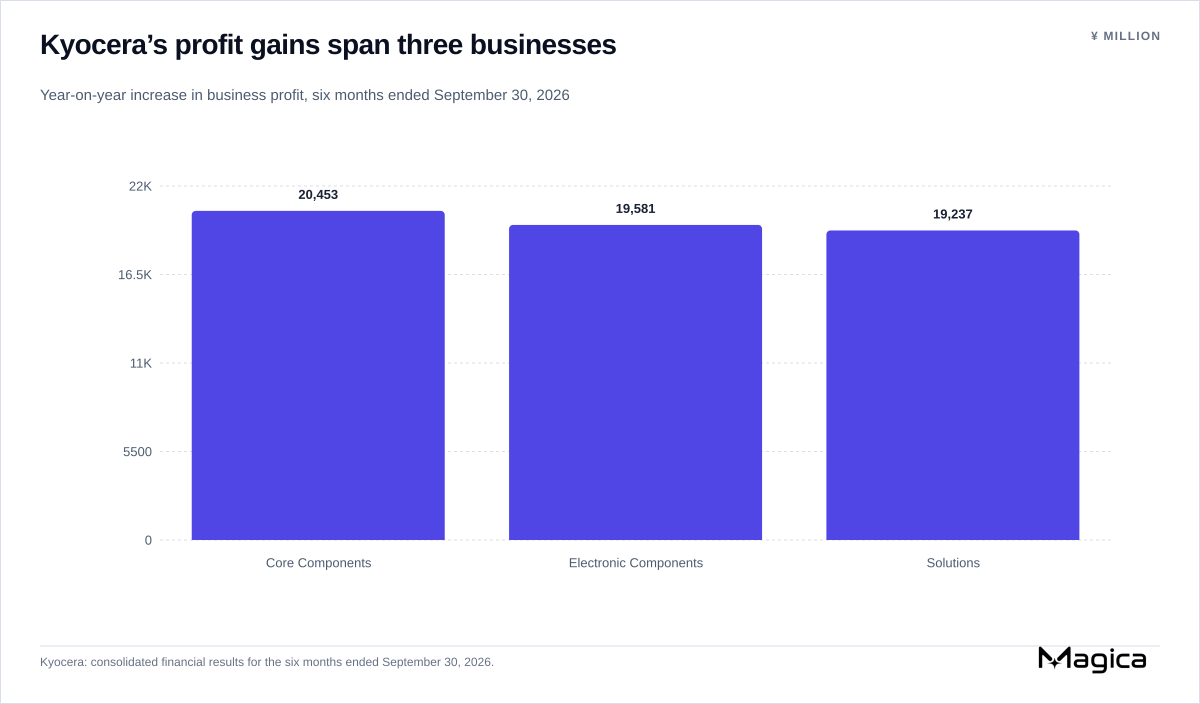
Kyocera’s company-reported business profit increases were similar across its three reporting businesses; these figures do not isolate AI’s contribution. Source: Kyocera.
Kyocera, a diversified manufacturer whose businesses include semiconductor packages, fine ceramics and electronic components, reported revenue of ¥1.078 trillion, up 8.8%, and profit attributable to owners of ¥73.43 billion, up 32.2%, in its six-month financial results.
The company attributed higher component sales primarily to products for AI data centers, including semiconductor packages and capacitors. Its Core Components business increased sales by 19.7% and improved its business profit margin from 9.8% to 13.7%, evidence that a more profitable product mix accompanied the sales growth.
Yet exchange rates also helped. Kyocera estimated that yen depreciation increased translated revenue by approximately ¥63 billion and pretax profit by approximately ¥12 billion compared with the previous first half. The latter is equivalent to nearly half its ¥25.07 billion year-on-year pretax profit increase; it is a company estimate of the currency effect, not a measure of AI’s contribution.
Growth also extended beyond AI components. The Solutions business, which includes document equipment, industrial tools and telecommunications, increased business profit by ¥19.237 billion to ¥56.999 billion. That increase was almost as large as Core Components’ ¥20.453 billion gain. Electronic Components profit additionally benefited from real-estate sales and the absence of a prior-year business-transfer loss.
Those benefits coexisted with approximately ¥37.1 billion of one-time costs, principally an impairment in its gallium-nitride devices business and an energy-related provision. Kyocera raised its full-year revenue forecast but left its profit forecasts unchanged. Improved business profitability and an expected approximately ¥15 billion gain from the October transfer of its chemical business were expected to offset the first-half one-time costs. Strong AI demand did not translate automatically into higher company-wide profit guidance.
SoftBank Corp., the mobile communications and enterprise-services operator, provides a service-side example. It said in its earnings briefing summary that first-half Cloud & AI revenue rose 37%, driven by AI computing infrastructure and other services. It retrospectively adjusted the prior-year figures after changing its enterprise revenue categories, making the reported comparison consistent with the new breakdown. The broader Enterprise segment increased revenue by 12% and segment income by 20%.
That category’s growth should not be mistaken for company-wide profit growth. SoftBank Corp.’s first-half operating income rose 2% to ¥642.1 billion; excluding specified prior-year one-time gains, it said the increase was 13%. Net income attributable to owners rose 5% to ¥364.5 billion. Its higher full-year forecasts reflected both business performance and a gain on selling preferred equity interests in SB Energy.
The technology investor SoftBank Group presents a different infrastructure exposure. A November 11 report described a $3.7 billion earnings hit from canceling gas-turbine reservations for AI data centers. It relayed SoftBank’s explanation to investors that it had placed the orders to secure power-generation equipment ahead of anticipated shortages. The company denied defaulting on its orders. Securing scarce equipment can therefore create financial exposure even before it produces revenue.
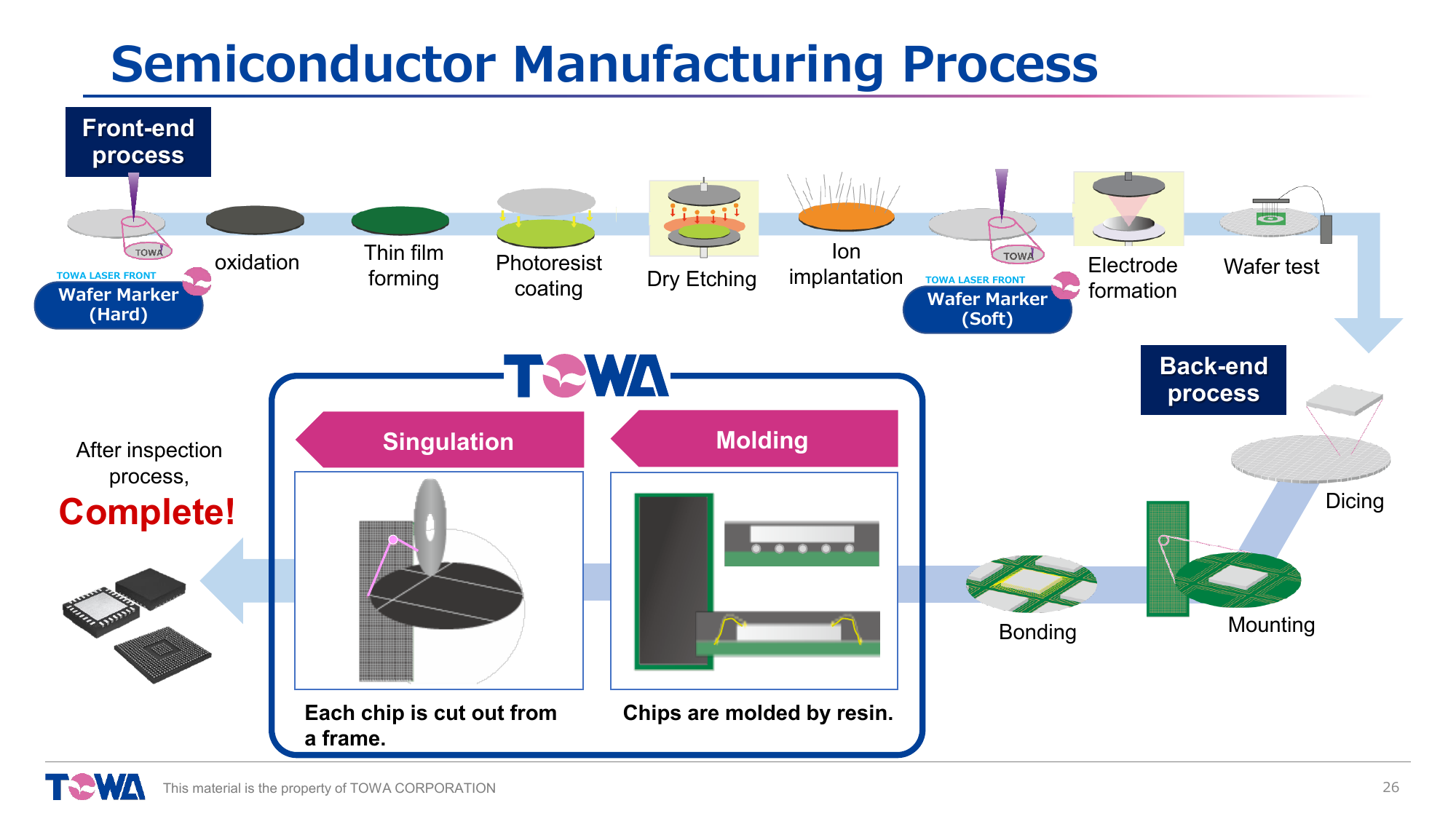
TOWA’s company-reported manufacturing overview highlights molding and singulation within semiconductor assembly. Source: May 2026 business-results presentation. Source: TOWA FY2025 business results.
TOWA, a Kyoto-based supplier of semiconductor assembly equipment, makes machinery and precision molds that encapsulate chips in resin. Its semiconductor business accounted for 74% of sales in the year ended March 2026, according to its May business-results presentation. It is thus more directly exposed to chip-production investment than a diversified manufacturer such as Kyocera.
TOWA’s first-half earnings presentation and questions put orders at a record ¥54.78 billion, about 2.2 times the previous year, against sales of ¥33.71 billion, about 1.4 times the previous year. Operating profit increased from ¥2.49 billion to ¥5.68 billion.
Management linked demand to generative AI, memory and power-management applications in data-center servers. It also identified investment in China’s in-house semiconductor manufacturing, showing that the order expansion has more than one driver. September-end backlog reached ¥51.83 billion.
For high-bandwidth memory, or HBM, which stacks multiple chip layers, management said earlier orders had been held back by insufficient chip supply and a lack of customers’ assembly space. More chips and newly built assembly factories were now bringing orders for TOWA’s back-end equipment. Demand for AI alone had not been enough to trigger those purchases.
There is precedent for strong demand failing to deliver equivalent profit growth. In the year ended March 2026, TOWA reported strong AI and data-center business but a 22.1% decline in annual operating profit. Its May presentation attributed lower profit despite increased sales to product mix and additional costs associated with initial deliveries.
Technology choices remain another qualification. Asked about hybrid bonding as an alternative to the existing molding-based HBM assembly process, management said customers’ immediate production needs continued to support equipment demand. It described hybrid bonding equipment as more expensive and technically challenging, while acknowledging that narrowing gaps further in the existing process would raise material costs and worsen yields. These are the supplier’s assessments of competing processes and customer choices.
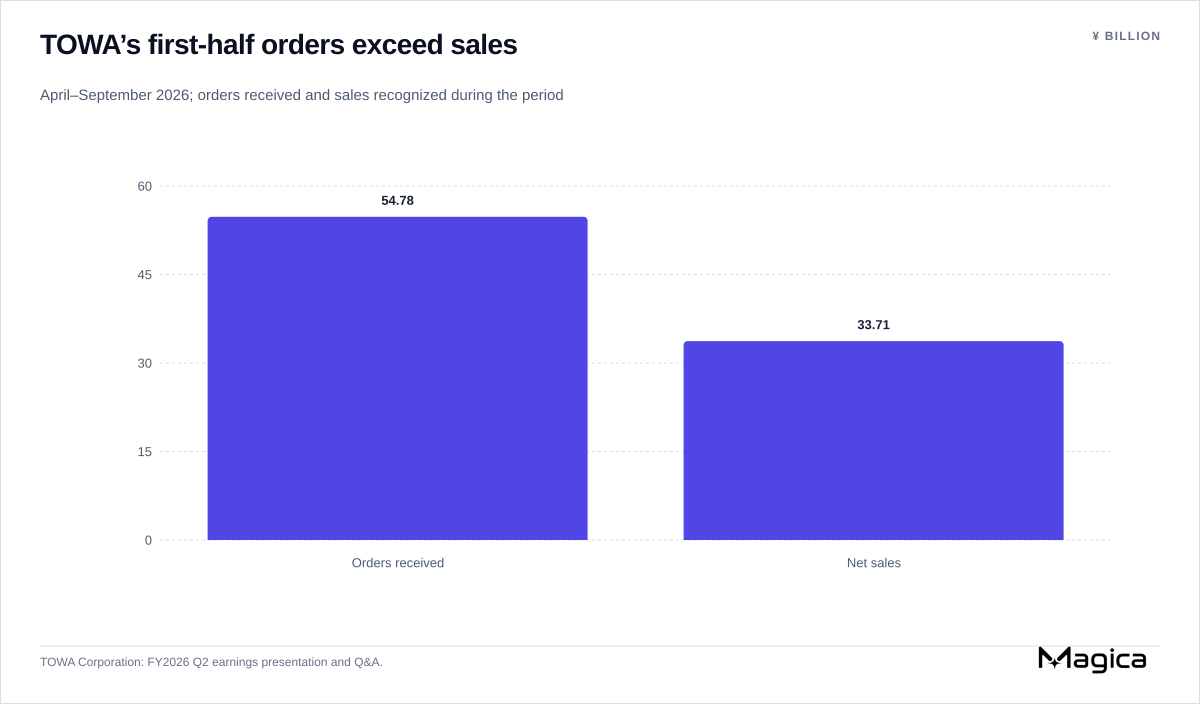
TOWA’s company-reported first-half orders exceeded sales. Orders received during a period need not become sales in that same period. Source: TOWA Corporation.
TOWA raised its full-year sales forecast to ¥71 billion and operating profit forecast to ¥13.15 billion. Its second-half plan calls for a 20% operating margin, above the first half’s 16.9%. Achieving that improvement requires delivery of the backlog as well as the expected benefits from sales volume, product mix and lower development costs.
Management said internal production and partner manufacturers could support about ¥100 billion of sales in the next fiscal year, but identified purchased components, including motors and sensors, as the immediate constraint. That capacity statement is not a sales forecast: without the parts, equipment cannot be built. Equipment lead times that had previously been around six months had exceeded a year, while some purchased items also had lead times longer than a year.
TOWA is arranging parts earlier, broadening its supplier base and reallocating production across its group. It said demand was making sales-price negotiations easier, helping it absorb component cost increases, but it had not separately quantified those increases in its forecast.
For the wider earnings story, the remaining company announcements will establish whether the early sample’s gains hold across the final tally. For suppliers already reporting strong demand, the immediate evidence to watch is more concrete: whether components arrive, backlogs become revenue and margins meet the forecasts attached to those orders.
Police are investigating a top tax-accountant exam scorer's admission of AI-assisted cheating, while the government reviews national qualification tests held in 2026 and prepares stronger controls.
TSMC plans to back promising chip startups through a new investment arm, alongside separate commitments to OpenAI and Anthropic. The strategy reaches toward future customers and the AI developers shaping chip demand, but the investment rights remain unclear.
Nidus has raised $30 million across pre-seed and seed rounds to automate wire processing in existing U.S. defense factories. Its founders bring manufacturing and government-deployment experience, but customer access and proprietary data still need to translate into measurable production gains.
Nebuly is funding US and European expansion for its AI business-value platform. Adjustable assumptions and private deployment are part of its pitch, but rivals offer similar measurement tools and verified customer returns remain undisclosed.
Han Won-seok says he used a miniature camera, generative AI and a smartphone in tax accountant and CPA exams. His confession puts scrutiny on exam security after proctors reported no suspicious behavior.
Thousands protested against proposed AI data centres in Scotland as ministers prepare new planning guidance, putting public participation and the scale of electricity demand at the centre of the dispute.
Uber is notifying drivers after a breach at AI infrastructure provider Fireworks exposed personal and driver’s license information. Three reported state counts add up to about 7,870 people. Fireworks has since disclosed wider data exposure, but the precise connection used to reach Uber’s records remains unexplained.
Jensen Huang’s reported resignation puts Nvidia’s financing and advocacy for American open models under scrutiny. Researcher Nathan Lambert warns of a loss of support, while Nvidia’s commercial incentives and continuing model work complicate that forecast.
Altimeter and Atreides want Nvidia's board to leave Jensen Huang's return open while it investigates recent events. Their letter backs interim leadership and acknowledges that directors can ultimately reject his reinstatement.
Elon Musk says Nvidia risks losing supply arrangements made personally by former CEO Jensen Huang. No affected supplier is named. Nvidia’s filing documents both $95.2 billion in commitments and limits to the protection those arrangements provide.
The former Anthropic and OpenAI researcher says a pretraining-efficiency slide helped drive his resignation, turning an investor selling point into an argument for a development pause.
Anthropic’s IPO has reportedly attracted orders for six times the available shares at proposed terms targeting a roughly $1.4 trillion valuation. The sale would add to substantial existing cash reserves as the Claude developer balances costly capacity shortages against long-term computing commitments.
Jason Clinton is urging network isolation as AI accelerates vulnerability discovery. The PHP emergency illustrates the immediate repair problem, while Anthropic's own security work shows that finding flaws does not automatically reduce risk.
Former Nvidia CEO Jensen Huang portrayed his relationship with a customer’s executive as routine business, according to reviewed messages and unnamed sources. A board inquiry faces questions about his disclosures amid separate concerns over chip exports and alleged spying.
Apple has detailed how Secure Exclaves isolate background camera and microphone processing from the main operating system and verify visible indicators before releasing full sensor data. The design aims to keep raw ambient sensing data beyond the main operating system’s reach, but its formal verification remains incomplete.
Charta Health is expanding its insurer tools with a $55 million Series B. Its promise of billing accuracy across payers and providers faces a harder test: showing that better coding reduces disputes rather than simply changes payments.
Operand has raised $31 million across seed and Series A funding for AI due diligence software aimed at private equity firms. Its pitch is to reconstruct businesses from public records and internet traces, but evidence of accuracy and deal-level economics remains limited.
Caitlin Kalinowski resigned over the deliberation and oversight behind OpenAI’s Pentagon agreement. The company says its safeguards prohibit domestic surveillance and autonomous weapons, leaving a dispute over how those limits were established and will be enforced.
The startup formerly known as QuilrAI pairs enterprise AI agents with Guardian agents and charges by agents under management. Its expansion pitch faces established alternatives and unanswered questions about security performance and cost.
Luminal’s Standard Capital-led Series A backs software for running AI models more efficiently on existing GPUs and alternative chips. Its reported processing volume leaves revenue and comparable customer savings unresolved.