Editorial Team
7 min read
Cursor says a key exposed by Fireworks led an attacker to unredacted credentials in historical coding-agent records and then its extension cache. Up to 5,000 users potentially received malicious Claude Code builds. Cursor has moved inference off Fireworks; successful endpoint compromises remain uncounted.
Cursor says an attacker used credentials left in its historical coding-agent records to reach internal services and distribute malicious Claude Code extensions on October 29. In its November 13 incident update, the AI code-editor company traced the initial access to a key exposed by its training and inference provider, Fireworks.
The consequential failure was the presence of usable secrets in archived records, which opened a path through several layers of infrastructure. A key granting read-only access to archived data led to credentials inside that data, then to internal services, and finally to a credential capable of altering software delivered to users. Moving inference providers addresses one dependency; Cursor’s account also exposes failures in its own data handling and distribution controls.
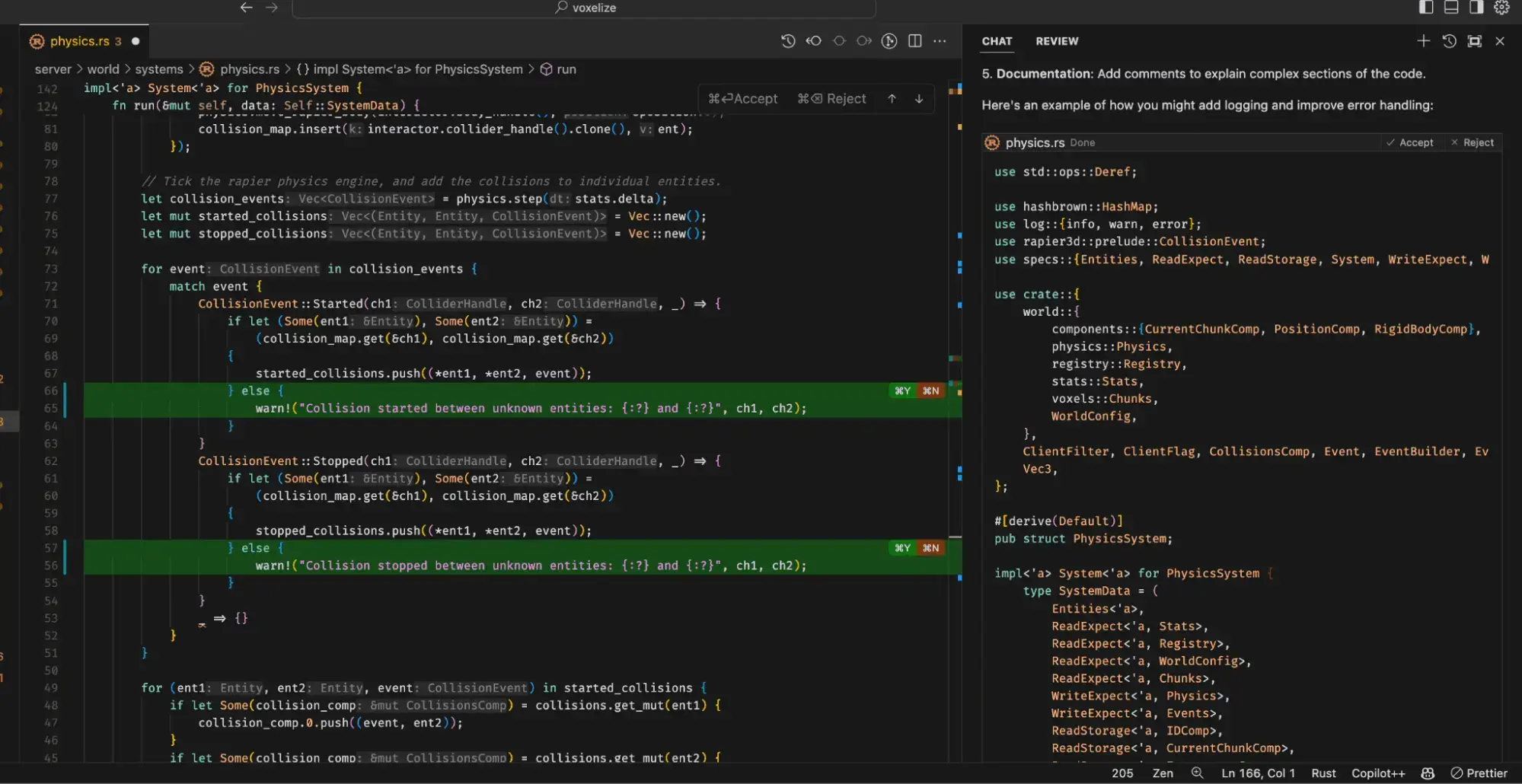
Cursor’s code-editing interface in Fireworks AI’s June 2024 case study about their Fast Apply collaboration. Source: Fireworks AI Cursor case study.
Cursor is an AI-powered code editor built on Microsoft’s open-source Visual Studio Code, used to write, modify and debug software with AI assistance, as described in the incident report. Its corporate entity, Anysphere, was acquired by SpaceX, the rocket, satellite-connectivity and AI infrastructure company, on August 14, 2026, according to an October securities filing.
Fireworks supplied infrastructure for model training and inference—the running of models to generate responses. The relationship had a performance rationale: in a June 2024 case study, Fireworks promoted Cursor’s Fast Apply code-editing feature reaching about 1,000 tokens per second on a fine-tuned Llama-3-70b model using speculative decoding. Fireworks said this was roughly 13 times the speed of ordinary Llama-3-70b inference and nine times Cursor’s previous GPT-4 speculative-edits deployment. Speculative decoding checks predicted output to accelerate generation. These vendor-reported comparisons concerned a specific editing workload in 2024, rather than all Cursor requests or current providers. Cursor’s incident update does not identify its replacement inference provider or disclose migration costs or performance.
According to Cursor’s incident update, an attacker obtained a key Cursor had issued to Fireworks and that Fireworks exposed. It allowed copying from a shared storage bucket containing limited coding-agent traces—records of agent sessions—mostly from 2025. These were records from sessions outside Privacy Mode that Cursor was permitted to use for model training.
Some traces contained credentials that had not been redacted. Those secrets opened selected software-as-a-service tools used by Cursor. The attacker accessed archived non-production source repositories, some containing business contacts; limited support data and emails; usage metrics and contact details; conversation summaries; and credentials customers had sent to support.
On October 29, the attacker used a credential stolen from exposed internal data to place unauthorized Claude Code copies directly in the cache serving Cursor’s VS Code extension marketplace, Cursor said. Claude Code is Anthropic’s coding assistant; the tampered packages impersonated its legitimate editor extension.
Cursor says Anthropic did not publish the malicious copies and its product was not vulnerable. It also says Open VSX, the upstream marketplace source, never hosted the malware. That locates the distribution failure in Cursor’s cache rather than in the original publisher or upstream registry.
The affected versions were Anthropic.claude-code 2.1.312 and 2.1.313. They were available for approximately 11 hours. Cursor removed them, took the extension marketplace offline and worked with the cloud provider hosting the attacker’s server to take it down.
A technical account describes injected JavaScript that collected system information, installed an attacker-controlled SSH key and attempted to establish persistent remote access. Researchers found coding errors that likely prevented the backdoor working on many Windows and macOS systems without SSH already enabled.
A separate analysis says the code ran when the extension loaded, without requiring a Claude conversation. It says the initial upload included environment-variable names rather than values. That report attributes to Cursor the finding that coding errors and missing administrator rights blocked remote login on most hosts, while other malicious changes and host-data collection remained possible. Failed remote login therefore does not establish that a machine was unaffected.
Cursor’s figures describe separate stages of the attack and should not be combined into a single victim count:
| Measure | Cursor’s disclosed scope | What it establishes |
|---|---|---|
| Historical coding-agent traces | Fewer than 0.05% of users | Exposure of records from sessions outside Privacy Mode |
| API credentials | Less than 0.01% of customers | Exposure of credentials in those records |
| Malicious extension distribution | At most 5,000 users requesting specific cached versions on October 29 | Potential receipt of a malicious build, not confirmed remote access |
The update supplies no absolute population totals for converting the percentages into user counts. Those percentages also cannot establish how many developers received malware: the stolen credentials enabled a later, separate distribution step. Nor does the potential distribution figure establish how many machines were successfully backdoored.
Cursor says Privacy Mode prompts and code, customer code repositories, active inference requests, production systems, and official application releases were unaffected. Historical trace exposure was confined to storage used for offline analysis. Its release code was held in a separate hosting system the attacker did not access, and no release-signing keys were exposed. Cursor also says it verified that other extensions were authentic. It says Cloud Agents for customer teams, Grok Bot, other SpaceX SI products and plugins downloaded from the separate Cursor Marketplace were unaffected.
Fireworks’ own November 9 security update expanded its earlier account beyond stored secrets to account and billing information, and, for a limited set of accounts, datasets and incomplete models. It also described an October 23 incident at a cloud provider that enabled access to Fireworks development machines the following day. Those wider findings do not establish that Cursor lost every category of data Fireworks listed, or that this cloud-provider incident was the precise route by which Cursor’s key was exposed. Fireworks said payment-card numbers were not stored and were not affected.
Fireworks said it had detected no impact to Inference, Training SDK or Nexus, services it described as having zero data retention by default. It reported no further detected successful access to its customer platform since October 25, while cautioning that its investigation remained open.
Working with Palo Alto Networks’ Unit 42 forensic team, Fireworks tightened credentials, network access, storage controls and logging. It disabled self-service dataset uploads and downloads for Batch Inference and dataset-based training during the investigation; its zero-retention Training SDK remained available.
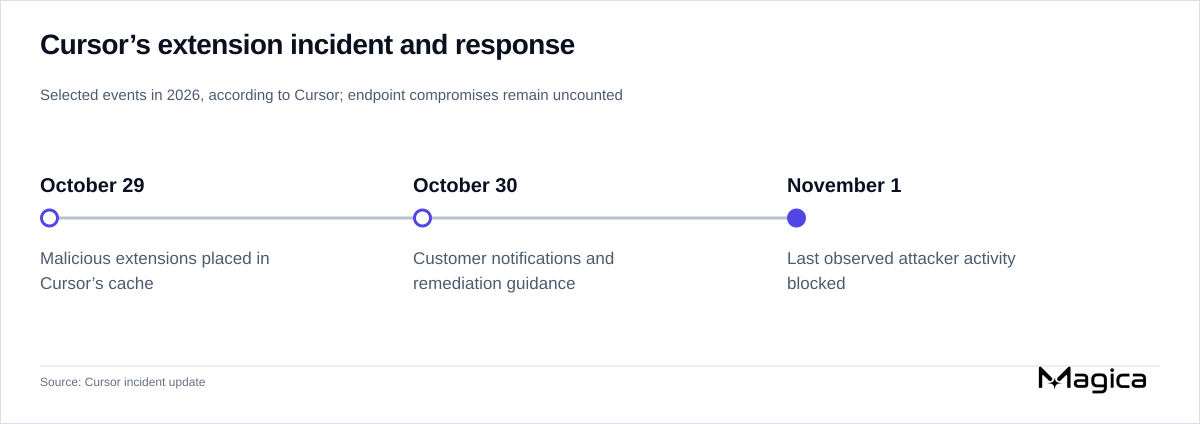
Company-reported chronology from Cursor. The distribution and response dates do not establish how many endpoints were successfully compromised. Source: Cursor.
Cursor says it has deactivated the vendor key, ended access to shared datasets and moved all inference traffic off Fireworks as a precaution. It has also rotated exposed credentials and, precautionarily, credentials across internal systems; rebuilt the extension marketplace; expanded secret scanning and network restrictions; redeployed production infrastructure; and engaged external forensic experts. Some services were temporarily disabled during the response and subsequently restored.
The company says it believes the incident is contained. The last attacker activity it observed, on November 1, was blocked. That is a statement about its investigation, not proof that every potentially affected endpoint is clean.
Cursor says it began notifying affected users and team administrators on October 30, supplied lists of exposed keys requiring rotation, and asked their issuers to revoke them. Customers who installed the affected extension versions should follow the remediation steps referenced in its incident update: Cursor explicitly warns that uninstalling alone may not be enough. The unresolved question is how many potentially exposed machines suffered successful access or retained malicious changes after the packages were removed. Answering it requires endpoint findings beyond the disclosed delivery estimate; changing inference providers alone cannot resolve it.
Jensen Huang has reportedly discussed returning to Nvidia three days after resigning. Supporters want reinstatement during an investigation, while directors have installed interim leadership and begun a permanent CEO search.
House China committee chairman John Moolenaar demanded answers from Commerce Secretary Howard Lutnick over delayed restrictions on Nvidia customer Megaspeed. The dispute concerns enforcement, overseas access to advanced chips and commercial influence as President Donald Trump prepares to visit China.
Apple reportedly still aims to unveil iPhone-linked glasses at WWDC 2027 and ship before year-end. Siri control of existing apps is the software bet, but delays cloud the schedule and Meta already has an established eyewear lineup.
Treasury Secretary Scott Bessent urged Nvidia to recruit an outside CEO and explain within 10 days whether suspect chip sales inflated earnings. The board is considering internal and external candidates, while export enforcement also faces scrutiny.
Congressional scrutiny and company investigations are testing what Nvidia knew about Megaspeed, a Singapore cloud operator whose Malaysian subsidiary bought nearly $2 billion of its technology. Megaspeed denies wrongdoing; the available reporting has not conclusively traced suspected chip diversion to China.
Commerce Secretary Howard Lutnick is backing narrower restrictions on Chinese access to overseas AI computing, according to a report examining his former firm’s financing relationships. Bitdeer filings establish Cantor’s role and the scale of its client’s planned expansion, but do not establish improper influence on policy.
Microsoft said services were fully restored on Saturday after a global Microsoft 365 outage disrupted email, healthcare communications and public services. It blamed an earlier network capacity upgrade exposed by a later change, with a full technical review still to come.
Police are investigating a top tax-accountant exam scorer's admission of AI-assisted cheating, while the government reviews national qualification tests held in 2026 and prepares stronger controls.
An early tally puts Japanese listed companies’ first-half net profit growth at 43.2%, led by manufacturers. Filings show AI component demand alongside currency benefits and non-AI earnings gains, while procurement delays and canceled infrastructure reservations expose the costs of expansion.
TSMC plans to back promising chip startups through a new investment arm, alongside separate commitments to OpenAI and Anthropic. The strategy reaches toward future customers and the AI developers shaping chip demand, but the investment rights remain unclear.
Nidus has raised $30 million across pre-seed and seed rounds to automate wire processing in existing U.S. defense factories. Its founders bring manufacturing and government-deployment experience, but customer access and proprietary data still need to translate into measurable production gains.
Nebuly is funding US and European expansion for its AI business-value platform. Adjustable assumptions and private deployment are part of its pitch, but rivals offer similar measurement tools and verified customer returns remain undisclosed.
Han Won-seok says he used a miniature camera, generative AI and a smartphone in tax accountant and CPA exams. His confession puts scrutiny on exam security after proctors reported no suspicious behavior.
Thousands protested against proposed AI data centres in Scotland as ministers prepare new planning guidance, putting public participation and the scale of electricity demand at the centre of the dispute.
Uber is notifying drivers after a breach at AI infrastructure provider Fireworks exposed personal and driver’s license information. Three reported state counts add up to about 7,870 people. Fireworks has since disclosed wider data exposure, but the precise connection used to reach Uber’s records remains unexplained.
Jensen Huang’s reported resignation puts Nvidia’s financing and advocacy for American open models under scrutiny. Researcher Nathan Lambert warns of a loss of support, while Nvidia’s commercial incentives and continuing model work complicate that forecast.
Altimeter and Atreides want Nvidia's board to leave Jensen Huang's return open while it investigates recent events. Their letter backs interim leadership and acknowledges that directors can ultimately reject his reinstatement.
Elon Musk says Nvidia risks losing supply arrangements made personally by former CEO Jensen Huang. No affected supplier is named. Nvidia’s filing documents both $95.2 billion in commitments and limits to the protection those arrangements provide.
The former Anthropic and OpenAI researcher says a pretraining-efficiency slide helped drive his resignation, turning an investor selling point into an argument for a development pause.
Anthropic’s IPO has reportedly attracted orders for six times the available shares at proposed terms targeting a roughly $1.4 trillion valuation. The sale would add to substantial existing cash reserves as the Claude developer balances costly capacity shortages against long-term computing commitments.