Editorial Team
5 min read
Chinese AI developers and optical suppliers fell as investors feared tougher US chip restrictions after Jensen Huang’s departure from Nvidia. Domestic chipmakers rallied, exposing a divide between companies that need advanced processors and those hoping to replace them.
Chinese AI companies sold off on Friday, November 13, as investors feared that the resignation of Jensen Huang, Nvidia’s co-founder and now former chief executive, would make advanced US processors harder to obtain. Nvidia makes graphics processing units used to develop AI models. Z.ai and MiniMax, Chinese developers of large language models, fell 10% and 8% respectively in Hong Kong, according to a market report.
The divide ran through the AI supply chain. Companies that use Nvidia processors to develop models lost value, while Chinese chip designers gained on expectations that restrictions would redirect demand toward them. The practical question behind that reaction is how quickly domestic hardware can meet Chinese AI businesses’ computing needs.
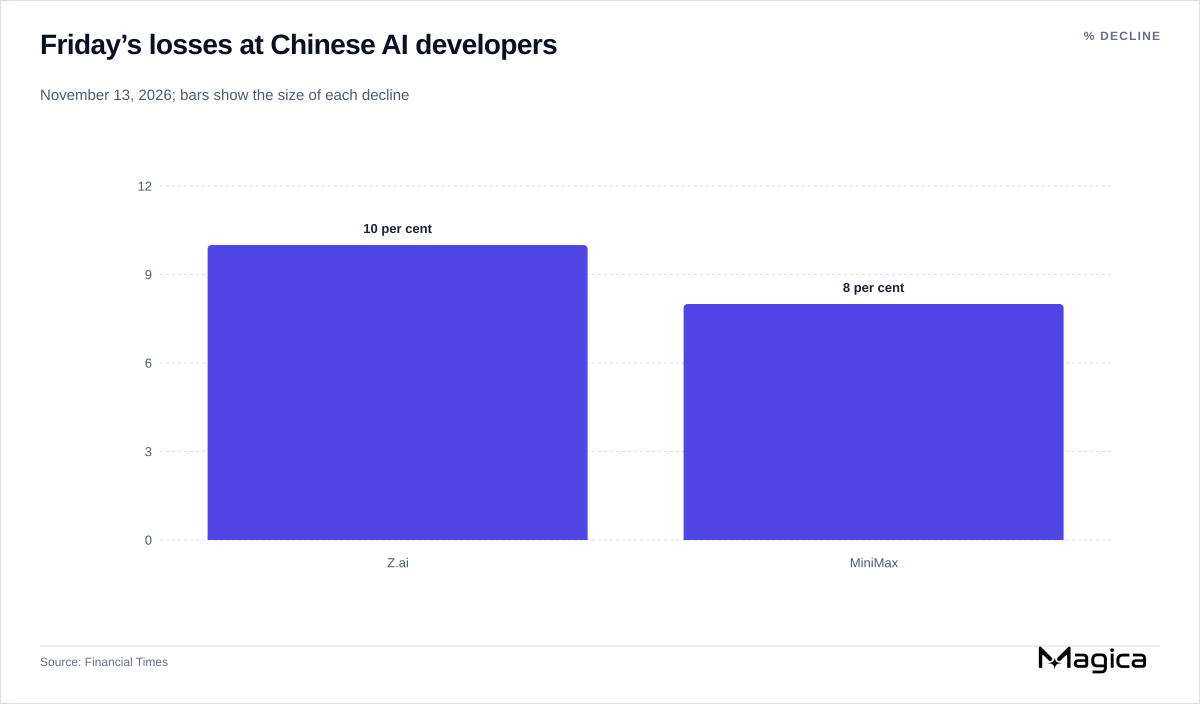
Z.ai and MiniMax fell 10 percent and 8 percent respectively in Hong Kong on November 13. Both bars represent losses. Source: Financial Times.
Huang co-founded Nvidia in 1993. Nvidia said Colette Kress, its chief financial officer and executive vice president since 2013, would become interim CEO, according to an account of the leadership transition.
Huang resigned on Thursday, November 12, after revelations of extramarital affairs, including a relationship with an alleged Chinese spy, the market report said. Beijing denies the espionage allegation, according to the account of the leadership transition. Huang had advocated continued chip sales to China, arguing that they benefited the US by keeping China dependent on American technology. His departure removes that advocate from Nvidia’s top job; it does not itself change export rules.
Despite restrictions on its most advanced chips, Chinese technology companies still depend on some Nvidia processors. Kenny Ng, a strategist at Everbright Securities International, warned that Huang’s departure could bring tighter US policy and regulatory controls, affecting businesses with high computing requirements.
Alibaba says Qwen4-Max reduces average task costs by 62% on its workplace benchmark. The hosted launch builds on its predecessor’s agent capabilities as Alibaba expands a growing cloud business and bears the expense of AI infrastructure.
The losses reached much larger companies. Alibaba and Tencent, Chinese technology groups that use Nvidia chips to train AI models, lost a combined $75 billion in market value during the week as their shares fell 14% and 8% respectively, the same market report said. Z.ai lost nearly a fifth of its market value over two days; MiniMax lost 15% over that period. These are different measurement windows, and the weekly losses should not all be attributed to Thursday’s resignation.
Hong Kong’s broader Hang Seng Tech Index fell 3% on Friday, taking its weekly decline to nearly 6.5%, according to a separate market account.
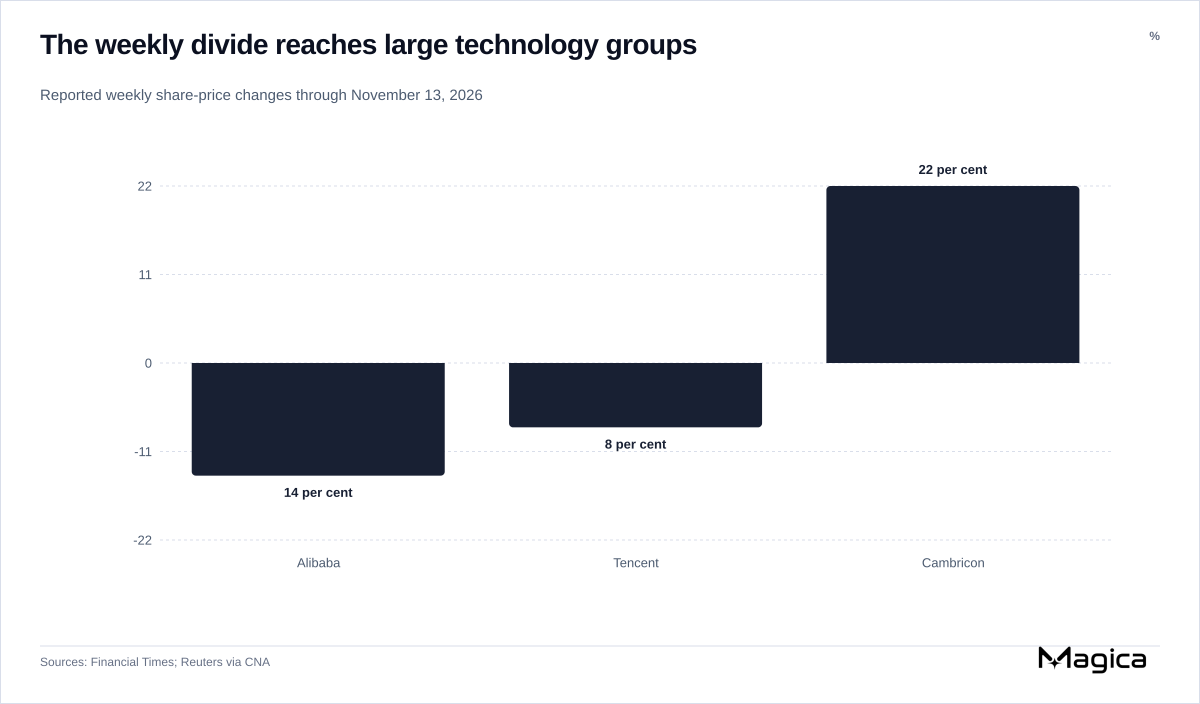
Alibaba and Tencent fell over the week as Cambricon rallied. This measurement window includes trading before Huang’s resignation. Source: Financial Times.
Cambricon Technologies, a Chinese AI chip designer, rose 0.6% on Friday and finished the week up 22%. Shenzhen Intellifusion Technologies, another AI chipmaker, gained 6% that day, the market account showed.
Beijing’s existing investment in domestic semiconductor capabilities gives that trade a policy foundation. National and local governments have invested heavily in semiconductor companies, with the domestic push spanning graphics processors and the equipment used to manufacture chips, according to the report on the sell-off. But a larger potential market for Chinese chips does not establish that those chips can immediately substitute for restricted imports.
A report examining the split traced US controls on advanced AI chip exports to 2022 and identified Nvidia’s advantage in computing performance and its software ecosystem as obstacles to full replacement in the short term. Further supply restrictions could disrupt both model development and the expansion of AI services.
Alex Yao, co-head of Asia technology, media and telecommunications at JPMorgan, similarly said most Chinese AI laboratories still relied on Nvidia’s solution. His longer-term assessment was less pessimistic: over three to five years, he expected China’s efforts to develop its own ecosystem to make chip access less of a bottleneck, according to the market account. That is an analyst’s expectation, rather than demonstrated replacement capacity.
Chinese hardware suppliers also faced concern about losing American customers. Zhongji Innolight and Eoptolink, makers of optical equipment needed for data-centre chips, each fell more than 8% on Friday, according to the market report.
The US was already working on a measure to bar imports of new Chinese optical transceivers on national-security grounds, the separate account said. For these suppliers, the concern is access to buyers; for model developers, it is access to processors. A domestic chip rally therefore offers little reassurance about the whole Chinese AI industry’s exposure.
US House Speaker Mike Johnson said on Thursday that consensus was growing in Congress on limiting chip exports to China, according to the account of the policy response. Gavekal Dragonomics expected tighter export controls by year-end. That forecast should be distinguished from an enacted restriction.
Physical shipments are only one route under scrutiny. The report examining proposed controls described congressional proposals covering oversight of AI chip exports, semiconductor location tracking and Chinese companies’ remote access to US-made chips through overseas data centres. Wu Zhou, a fund manager at Shenzhen Deyuan Investment, separately expected restrictions could reach computing power rented through offshore clouds, the market account said.
The report on proposed controls, citing Reuters reporting based on industry sources, said a major Chinese cloud provider was discussing long-term access to Nvidia computing capacity overseas. Other companies had asked about reserving AI servers, and smaller laboratories were exploring Southeast Asian cloud providers. These were reported inquiries and discussions, rather than confirmed capacity agreements.
China’s foreign ministry warned against using Huang’s relationship with an alleged spy as a pretext for tighter technology-export restrictions, the report said. The decisions that matter next are which access routes Washington restricts and when those rules take effect. Evidence that domestic processors can sustain developers’ workloads would be needed to show whether the chipmakers’ gains translate into relief for their customers.
The FBI warns that ARTEX can accelerate intrusions, with some reaching privileged access in under three hours. Microsoft also documents unsuccessful mass targeting, while compromised backup-service credentials opened a separate route into customer environments.
Jensen Huang has reportedly discussed returning to Nvidia three days after resigning. Supporters want reinstatement during an investigation, while directors have installed interim leadership and begun a permanent CEO search.
House China committee chairman John Moolenaar demanded answers from Commerce Secretary Howard Lutnick over delayed restrictions on Nvidia customer Megaspeed. The dispute concerns enforcement, overseas access to advanced chips and commercial influence as President Donald Trump prepares to visit China.
Apple reportedly still aims to unveil iPhone-linked glasses at WWDC 2027 and ship before year-end. Siri control of existing apps is the software bet, but delays cloud the schedule and Meta already has an established eyewear lineup.
Treasury Secretary Scott Bessent urged Nvidia to recruit an outside CEO and explain within 10 days whether suspect chip sales inflated earnings. The board is considering internal and external candidates, while export enforcement also faces scrutiny.
Congressional scrutiny and company investigations are testing what Nvidia knew about Megaspeed, a Singapore cloud operator whose Malaysian subsidiary bought nearly $2 billion of its technology. Megaspeed denies wrongdoing; the available reporting has not conclusively traced suspected chip diversion to China.
Commerce Secretary Howard Lutnick is backing narrower restrictions on Chinese access to overseas AI computing, according to a report examining his former firm’s financing relationships. Bitdeer filings establish Cantor’s role and the scale of its client’s planned expansion, but do not establish improper influence on policy.
Microsoft said services were fully restored on Saturday after a global Microsoft 365 outage disrupted email, healthcare communications and public services. It blamed an earlier network capacity upgrade exposed by a later change, with a full technical review still to come.
Cursor says a key exposed by Fireworks led an attacker to unredacted credentials in historical coding-agent records and then its extension cache. Up to 5,000 users potentially received malicious Claude Code builds. Cursor has moved inference off Fireworks; successful endpoint compromises remain uncounted.
Police are investigating a top tax-accountant exam scorer's admission of AI-assisted cheating, while the government reviews national qualification tests held in 2026 and prepares stronger controls.
An early tally puts Japanese listed companies’ first-half net profit growth at 43.2%, led by manufacturers. Filings show AI component demand alongside currency benefits and non-AI earnings gains, while procurement delays and canceled infrastructure reservations expose the costs of expansion.
TSMC plans to back promising chip startups through a new investment arm, alongside separate commitments to OpenAI and Anthropic. The strategy reaches toward future customers and the AI developers shaping chip demand, but the investment rights remain unclear.
Nidus has raised $30 million across pre-seed and seed rounds to automate wire processing in existing U.S. defense factories. Its founders bring manufacturing and government-deployment experience, but customer access and proprietary data still need to translate into measurable production gains.
Nebuly is funding US and European expansion for its AI business-value platform. Adjustable assumptions and private deployment are part of its pitch, but rivals offer similar measurement tools and verified customer returns remain undisclosed.
Han Won-seok says he used a miniature camera, generative AI and a smartphone in tax accountant and CPA exams. His confession puts scrutiny on exam security after proctors reported no suspicious behavior.
Veteran songwriting team Glorywave used Suno to turn human-written lyrics into Meomuru’s chart-topping ballad. Recording revenue is settled separately, but songwriting royalties remain unavailable through Korea’s collecting association as rules for human contributions to AI-assisted music remain unresolved.
Reports linked to AI and child sexual exploitation rose from about 4,700 in 2023 to more than 400,000 in 2025, Childlight finds. The increase exposes growing threats and weaknesses in reporting systems, but does not measure unique victims or confirmed AI-generated images.
Megaspeed says Alice Huang left on August 30, 2025, and has retained outside lawyers for an internal compliance investigation. Singapore’s inquiry began months before that departure; authorities later found insufficient evidence that Huang had committed a crime, while the investigation into the company continues.
HP’s US listing puts a $132,000 starting price on its ZGX Fury shared AI system. Its 748 GB of coherent memory supports a local-computing pitch, but competing GB300 machines, dedicated power requirements and workload-specific operating costs shape the buying decision.