Editorial Team
6 min read
HP’s US listing puts a $132,000 starting price on its ZGX Fury shared AI system. Its 748 GB of coherent memory supports a local-computing pitch, but competing GB300 machines, dedicated power requirements and workload-specific operating costs shape the buying decision.
HP, the computer maker behind Z professional workstations, has put a $132,000 US starting price on the ZGX Fury G1n, a shared AI system built around NVIDIA’s GB300 Grace Blackwell Ultra CPU-GPU superchip. The liquid-cooled tower is designed to let teams develop, adapt and run large AI models on their own premises.
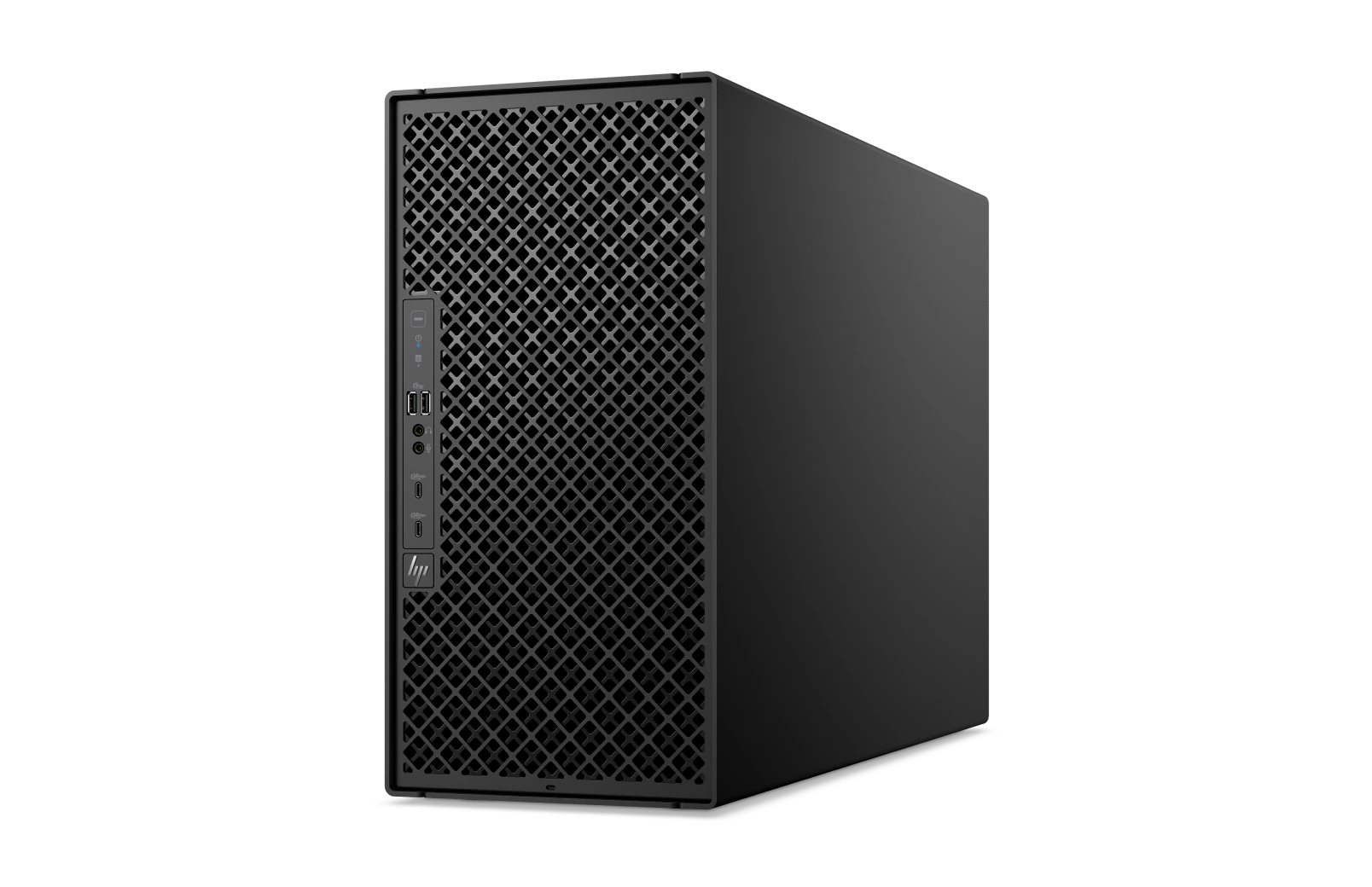
HP’s ZGX Fury AI station. Product rendering: HP. Source: HP.
HP presented Fury at the start of September without disclosing its price, according to the November 10 availability report, which identified US listings at HP and B&H. HP’s store page lists a $132,000 MSRP and a three-year limited warranty covering parts, labor and on-site repair, subject to its terms. The listing estimates arrival on December 7–10, distinguishing order availability from immediate delivery.
The price makes HP’s proposition concrete for organizations considering local AI infrastructure. HP positions Fury as an extension of its Z workstation portfolio into shared, department-scale computing, including for teams handling proprietary or regulated data. In its product documentation, the company distinguishes Fury’s larger development and production-inference workloads from the experimentation and prototyping targeted by its smaller ZGX Nano.
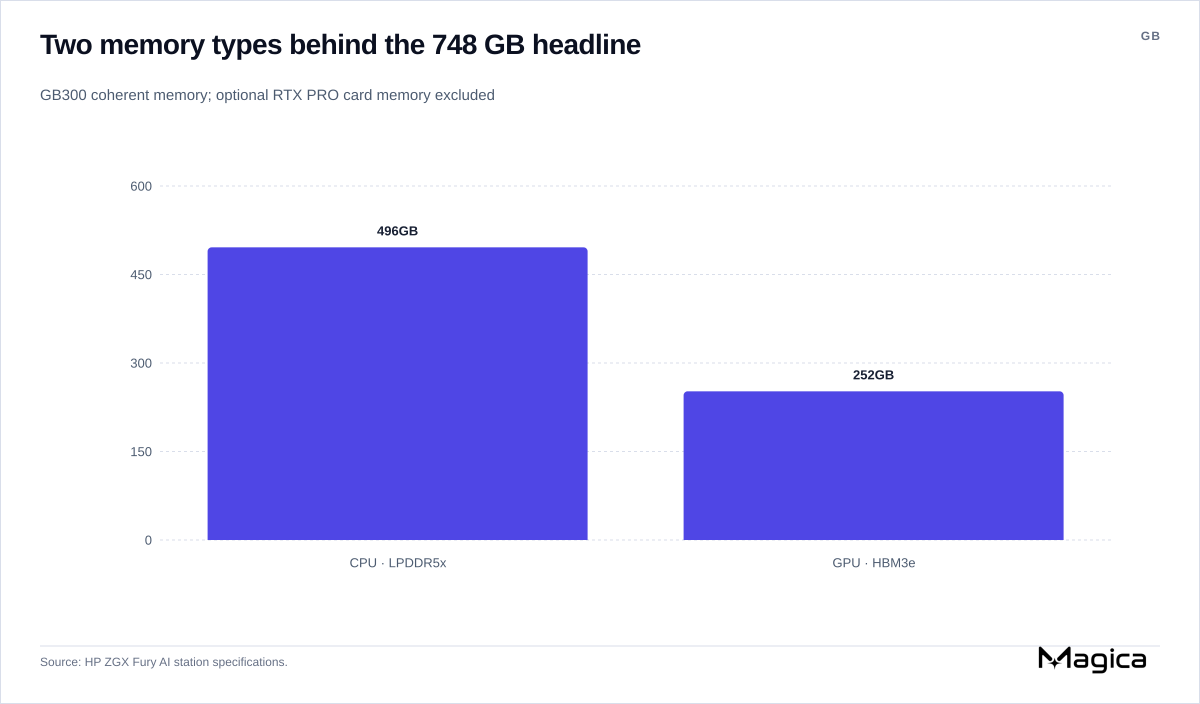
Company-reported specifications: 496 GB of CPU memory and 252 GB of GPU memory comprise GB300’s 748 GB coherent capacity. Capacity does not indicate equal bandwidth. Source: HP.
NVIDIA supplies the computing platform and AI development tools. GB300 combines a 72-core Arm Neoverse V2 Grace CPU with a Blackwell Ultra GPU. HP specifies 496 GB of LPDDR5X CPU memory with 396 GB/s bandwidth and 252 GB of HBM3e GPU memory with 7.1 TB/s bandwidth. The advertised 748 GB is the combined coherent capacity, rather than 748 GB of high-bandwidth GPU memory.
HP’s store lists three configurations:
| Configuration | Optional graphics card memory | Whole-system MSRP |
|---|---|---|
| GB300 without an optional RTX PRO card | None | $132,000 |
| GB300 plus RTX PRO 2000 Blackwell | 16 GB GDDR7 | $133,000 |
| GB300 plus RTX PRO 4000 Blackwell SFF | 24 GB GDDR7 | $136,000 |
These are system prices, not stand-alone graphics-card prices. The base machine already includes the Blackwell Ultra GPU. As the configuration breakdown explains, the top model’s 276 GB of combined GPU memory consists of separate 252 GB HBM3e and 24 GB GDDR7 pools. The optional card does not enlarge GB300’s HBM3e pool; HP describes it as a way to offload video.
HP claims up to 20 petaFLOPS of FP4 compute, fine-tuning of models in the 100-billion-parameter class and inference with models up to one trillion parameters. Its documentation attaches FP4 quantization to the capacity claims. Inference runs an existing model; fine-tuning adapts one. Neither parameter count establishes response speed, accuracy or the number of users a given workload can support.
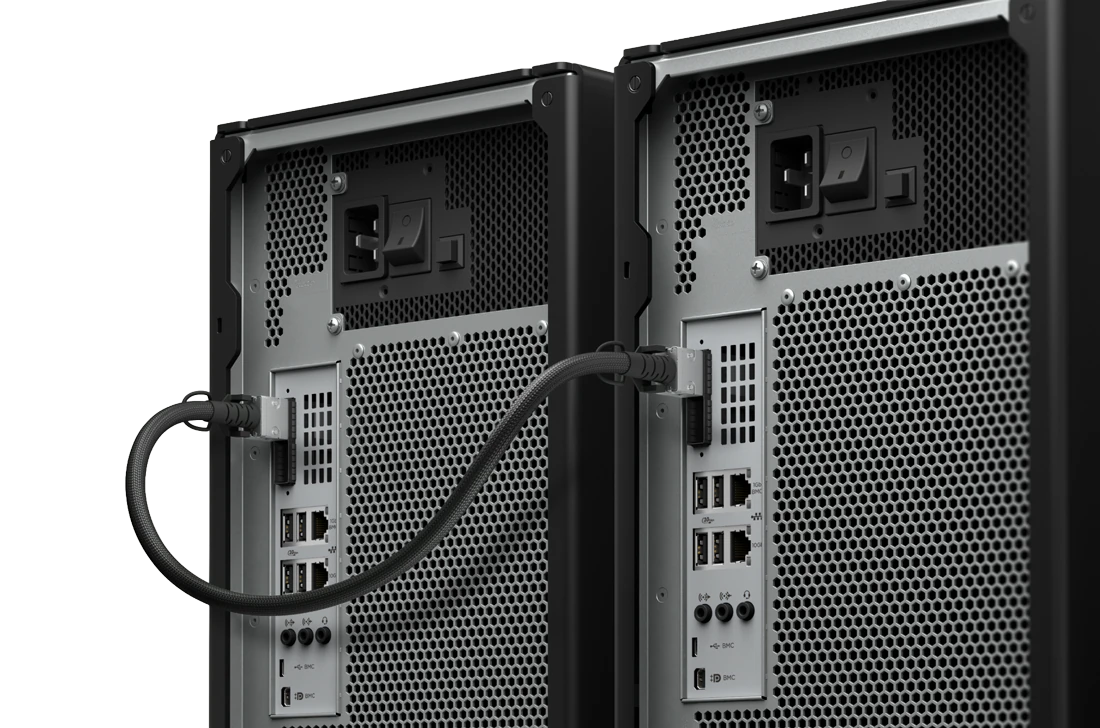
HP illustrates two Fury systems linked through QSFP112 ports. A compatible linking cable is sold separately. Rendering: HP. Source: HP store.
The machine uses liquid cooling, a 1,600W power supply and a tower chassis that also fits a 5U rack, as described in the hardware report. HP lists a starting weight of 90 pounds. The power-supply rating is not a measurement of continuous electricity consumption.
HP requires a dedicated 200–240V AC circuit and says Fury is unsuitable for a standard 120V household outlet. Its front-to-back airflow and included rack rails accommodate deployment in managed IT spaces as well as offices.
NVIDIA ConnectX-8 networking supplies two 400 Gb/s QSFP112 ports for linking systems; HP describes linking two Fury units to scale model capacity and performance. The datasheet footnotes specify a compatible QSFP cable sold separately.
Storage also needs configuration-level checking. The base store specification lists two 2 TB SSDs, while HP describes mirrored RAID 1 for the OS drives, leaving half their combined drive capacity available. Its product specifications separately identify two data-drive slots. Installed capacity and usable capacity therefore need to be distinguished when sizing a deployment.
Fury ships with Ubuntu 24.04 LTS, NVIDIA drivers, CUDA and container tools. HP adds Z Toolkit, a VS Code extension for connecting to and managing development machines, and Z Runtime for pulling, serving and managing models locally. The free toolkit requires an x86 client running Windows 11 or Ubuntu 24.04 or later, with Visual Studio Code installed, according to HP’s datasheet footnotes.
HP also says Fury is the first GB300 AI station certified for the Red Hat Enterprise Linux operating system. That certification is separate from the broader platform HP outlined in its September 9 enterprise announcement: a planned combination of Fury and Red Hat AI Factory with NVIDIA. Red Hat, an enterprise open-source software provider, supplies a platform built on Red Hat Enterprise Linux and OpenShift for deploying and managing AI across hybrid cloud environments. The announcement describes development plans, rather than establishing delivery of the full integrated solution.
The hardware’s lineage also limits claims of novelty. NVIDIA’s May 18, 2025 announcement already described DGX Station as a GB300 desktop platform for individual users or shared computing. It named ASUS, Dell, GIGABYTE, HP and MSI as expected Station suppliers. That early announcement specified 784 GB of unified memory; HP’s current Fury specification is 748 GB.
Computer maker MSI said in its August 28, 2026 shipping announcement that its XpertStation WS300, based on DGX Station architecture, was shipping through ASI, D&H and Newegg. MSI specifies GB300, up to 748 GB of coherent memory and dual 400GbE networking for linking two systems. HP’s memory capacity and shared-computing concept thus have a direct alternative already announced as shipping.
HP argues that on-premises inference makes costs more predictable by eliminating usage-based token fees. That changes how computing is paid for; it does not establish that Fury costs less than cloud services for a particular team.
HP’s product page includes customer testimonials about model serving and verified agent tasks. Those accounts offer evidence of specific uses, but do not establish a like-for-like cloud break-even calculation or a common performance baseline across competing machines.
Buyers need delivered quotes and availability from competing suppliers, plus measurements for the intended model, quantization, context length, concurrent users and response-time target. Electricity, administration and support belong in the same calculation. The decision is whether enough useful work can run on the $132,000 system to justify owning it—and whether HP’s software and service offer is worth choosing over another implementation of the same platform.
The FBI warns that ARTEX can accelerate intrusions, with some reaching privileged access in under three hours. Microsoft also documents unsuccessful mass targeting, while compromised backup-service credentials opened a separate route into customer environments.
Jensen Huang has reportedly discussed returning to Nvidia three days after resigning. Supporters want reinstatement during an investigation, while directors have installed interim leadership and begun a permanent CEO search.
House China committee chairman John Moolenaar demanded answers from Commerce Secretary Howard Lutnick over delayed restrictions on Nvidia customer Megaspeed. The dispute concerns enforcement, overseas access to advanced chips and commercial influence as President Donald Trump prepares to visit China.
Apple reportedly still aims to unveil iPhone-linked glasses at WWDC 2027 and ship before year-end. Siri control of existing apps is the software bet, but delays cloud the schedule and Meta already has an established eyewear lineup.
Treasury Secretary Scott Bessent urged Nvidia to recruit an outside CEO and explain within 10 days whether suspect chip sales inflated earnings. The board is considering internal and external candidates, while export enforcement also faces scrutiny.
Congressional scrutiny and company investigations are testing what Nvidia knew about Megaspeed, a Singapore cloud operator whose Malaysian subsidiary bought nearly $2 billion of its technology. Megaspeed denies wrongdoing; the available reporting has not conclusively traced suspected chip diversion to China.
Commerce Secretary Howard Lutnick is backing narrower restrictions on Chinese access to overseas AI computing, according to a report examining his former firm’s financing relationships. Bitdeer filings establish Cantor’s role and the scale of its client’s planned expansion, but do not establish improper influence on policy.
Microsoft said services were fully restored on Saturday after a global Microsoft 365 outage disrupted email, healthcare communications and public services. It blamed an earlier network capacity upgrade exposed by a later change, with a full technical review still to come.
Cursor says a key exposed by Fireworks led an attacker to unredacted credentials in historical coding-agent records and then its extension cache. Up to 5,000 users potentially received malicious Claude Code builds. Cursor has moved inference off Fireworks; successful endpoint compromises remain uncounted.
Police are investigating a top tax-accountant exam scorer's admission of AI-assisted cheating, while the government reviews national qualification tests held in 2026 and prepares stronger controls.
An early tally puts Japanese listed companies’ first-half net profit growth at 43.2%, led by manufacturers. Filings show AI component demand alongside currency benefits and non-AI earnings gains, while procurement delays and canceled infrastructure reservations expose the costs of expansion.
TSMC plans to back promising chip startups through a new investment arm, alongside separate commitments to OpenAI and Anthropic. The strategy reaches toward future customers and the AI developers shaping chip demand, but the investment rights remain unclear.
Nidus has raised $30 million across pre-seed and seed rounds to automate wire processing in existing U.S. defense factories. Its founders bring manufacturing and government-deployment experience, but customer access and proprietary data still need to translate into measurable production gains.
Nebuly is funding US and European expansion for its AI business-value platform. Adjustable assumptions and private deployment are part of its pitch, but rivals offer similar measurement tools and verified customer returns remain undisclosed.
Han Won-seok says he used a miniature camera, generative AI and a smartphone in tax accountant and CPA exams. His confession puts scrutiny on exam security after proctors reported no suspicious behavior.
Reports linked to AI and child sexual exploitation rose from about 4,700 in 2023 to more than 400,000 in 2025, Childlight finds. The increase exposes growing threats and weaknesses in reporting systems, but does not measure unique victims or confirmed AI-generated images.
Megaspeed says Alice Huang left on August 30, 2025, and has retained outside lawyers for an internal compliance investigation. Singapore’s inquiry began months before that departure; authorities later found insufficient evidence that Huang had committed a crime, while the investigation into the company continues.
Apple's new U.S. study will examine how up to 200,000 adults understand and use health answers from OpenEvidence, a clinician-focused AI company. Optional personal health data adds context, but competing chatbots already offer data connections, and the study has yet to demonstrate better health decisions.
A $1.5 trillion valuation underpins the estimate of 4,250 Anthropic employee millionaires. The offering remains unpriced, selling restrictions limit liquidity, and the latest filing shows computing costs complicating the company’s rapid growth.
Supermicro says Rubin racks are shipping and Nvidia claims production at scale, while supplier reporting points to larger deliveries in 2027. Memory constraints and differing forecast scopes leave the pace of the transition unresolved.