Editorial Team
7 min read
Microsoft said services were fully restored on Saturday after a global Microsoft 365 outage disrupted email, healthcare communications and public services. It blamed an earlier network capacity upgrade exposed by a later change, with a full technical review still to come.
Microsoft said on Saturday, November 14, that it had fully restored services after a global outage of Microsoft 365, its workplace software suite spanning email, meetings, documents and cloud storage. In a reported update on X, the company said it had addressed the underlying issue and restored service to the remaining affected customers and regions.
The disruption, which began on Thursday and continued into Friday, reached beyond office correspondence. Healthcare staff lost access to patient information, public agencies redirected people to telephone lines, and a Colorado jail temporarily required in-person bond payments. Recovery leaves customers with two separate questions: what failed inside Microsoft's network, and which essential tasks their own contingency plans can preserve.
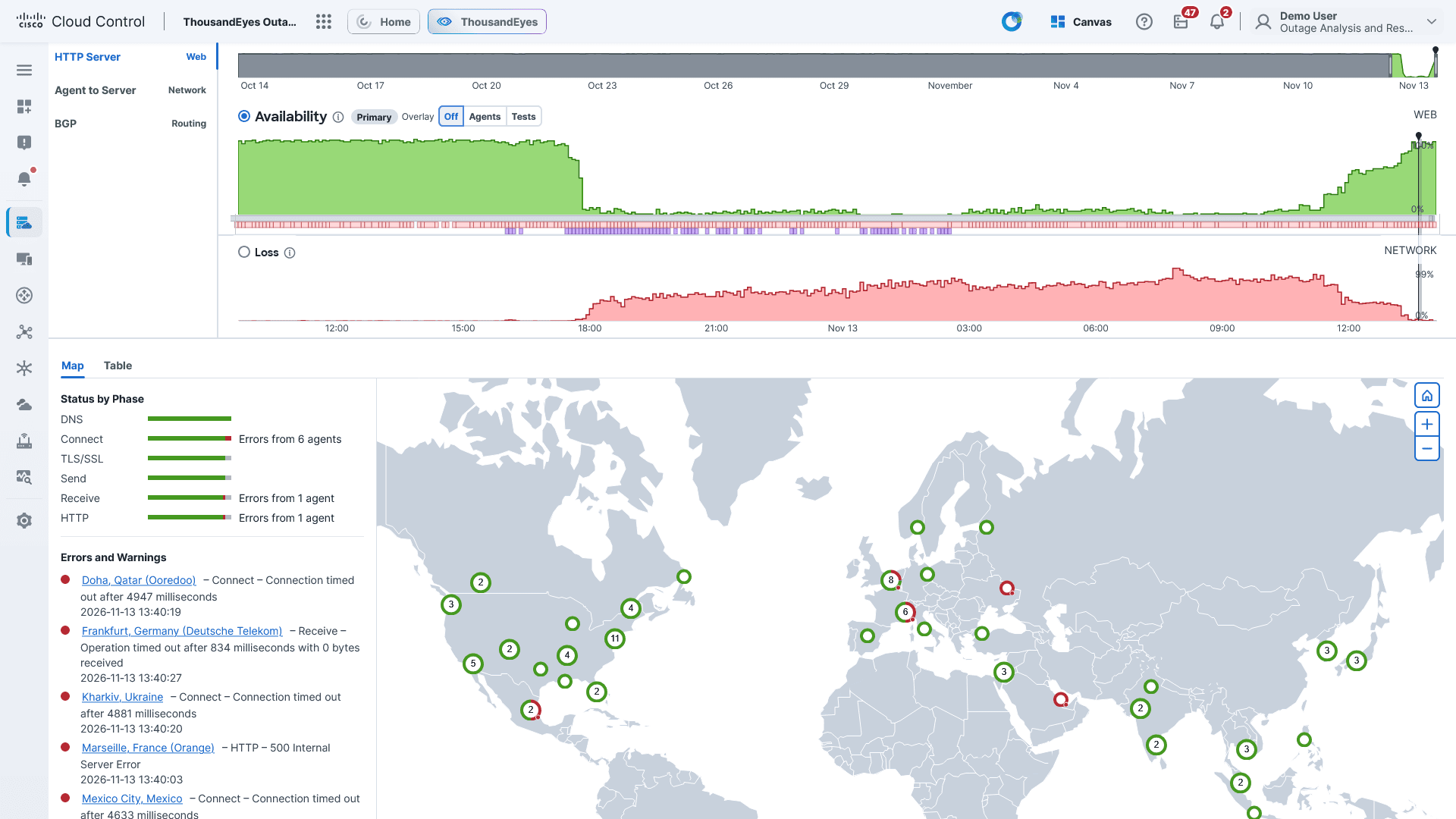
ThousandEyes observed that Outlook availability had largely recovered by 14:00 UTC on November 13, 2026, though significant packet loss and connection timeouts persisted in some locations. Source: ThousandEyes. Source: ThousandEyes.
Microsoft said in a Friday statement reported in the live coverage that an issue introduced during an earlier network capacity upgrade surfaced following a recent network change. It said the incident was unrelated to a cyberattack or AI agents. Copilot, Microsoft's AI assistant, was among the affected products; its unavailability does not establish that AI caused the outage.
The company's explanation describes a sequence of changes, rather than a complete failure mechanism. Earlier reporting on Microsoft’s recovery updates indicated that some servers became overloaded and went offline. After an attempted fix, returning traffic made servers unresponsive again, putting additional pressure on those still online. Engineers limited traffic in some locations and rolled back software configurations on some servers.
By Friday morning, the same account said Microsoft had narrowed most remaining problems to Exchange, the email service behind Outlook, while Teams meetings and chats had returned. Recovery therefore varied across the suite.
Microsoft said it ultimately restored services in stages, checking stability as demand returned. That took longer, the company said, but helped make restoration stable. It apologised and promised a full post-incident report after completing its review.
Network-monitoring provider ThousandEyes, which measures the reachability and performance of services across the internet, provides a separate monitoring timeline. It observed global Microsoft 365 availability problems beginning around 17:30 UTC on November 12, including failed connections, timeouts, server errors and traffic loss inside Microsoft's network. At 03:00 UTC on November 13, it still saw widespread Outlook availability problems.
By 14:00 UTC that day, ThousandEyes observed that Outlook availability had largely recovered, though significant packet loss and connection timeouts persisted in some locations. Those observations measure connectivity; they do not establish the precise upgrade defect or show that every customer's email workflow was functioning normally.
The affected-user total remains unknown. Microsoft said in January that it had more than 450 million paid Microsoft 365 commercial subscriptions, according to the account of workplace disruption. That measures its commercial footprint, not how many users lost service during this incident.
In Britain, NHS.net Connect, a Microsoft-powered system used by more than one million National Health Service staff for email, meetings, calendars and file access, became a point of disruption. NHS sources described staff unable to log in or exchange patient data, according to the account of healthcare impacts. Some staff turned to paper records. NHS England said local services were using established contingency measures to keep critical services and appointments running.
The UK government said emergency 999 calls and the NHS 111 line were unaffected and that it had received limited reports of effects on frontline service delivery. But administrative systems also carry information needed for clinical decisions.
Olivier Picard, chair of the National Pharmacy Association, said in a broadcast interview that his pharmacy could not receive encrypted patient information from a hospital. Staff drove there to collect paper copies instead. He also said the loss of access to NHS records left him making clinical decisions without all the patient information he needed. That is a specific account of disrupted care processes, rather than a measure of nationwide patient harm.
In Colorado, the Arapahoe County Sheriff's Office said its detention facility could not process online bond payments because it relied on Outlook notifications. People seeking immediate release had to have bond posted in person. The office later said the problem was resolved, according to the reported local updates.
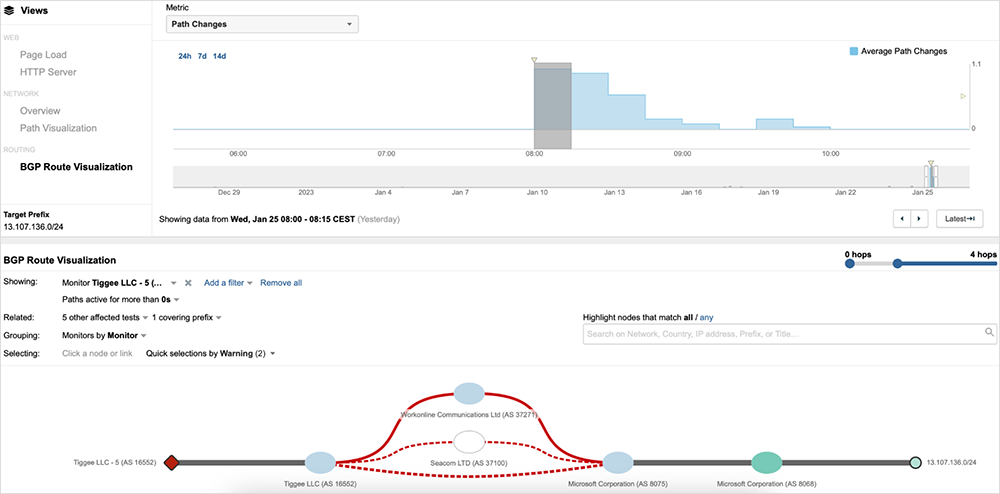
Historical comparison: during the separate January 25, 2023 outage, ThousandEyes observed a direct route withdrawn and an alternate path established through AS 37271. This diagram does not describe the November 2026 failure mechanism. Source: ThousandEyes. Source: ThousandEyes.
Canadian workers switched to texts and phone calls, while cybersecurity company Check Point moved internal discussions to WhatsApp and Slack, according to workplace interviews. These were workable alternatives for communicating, even while normal systems were unavailable.
Other organisations had rehearsed contingencies. Wire-service reporting reproduced in the live account described British insurer Aviva using alternative phone numbers for earnings calls and Bluetooth to transfer recordings. Its chief executive, Amanda Blanc, said it had tested a similar-scale outage of its most critical technology systems about two weeks earlier.
The live account also quoted Mark Gregory, an associate professor at Australia’s RMIT University, recommending backup email options such as Google’s Gmail. It cited LibreOffice, a free and open-source Office alternative, among other suggestions. Those are alternatives to particular functions, rather than evidence of a ready replacement for every connected Microsoft workflow.
This is not Microsoft's first disruption involving network changes. In its analysis of the earlier outage, ThousandEyes attributed a January 25, 2023 outage to a Microsoft routing change that destabilised internet routes and impaired service reachability. It said the bulk of that incident lasted about 90 minutes, with residual connectivity problems into the following day. That was a different incident and measurement window, not evidence of an identical cause this time.
More recently, a Friday account of recent outages described this as Microsoft 365's second large-scale outage in 2026 and third in 13 months. It also noted a separate outage in October at Azure, Microsoft's cloud platform, that affected the productivity suite. These reports make the company's reliability record relevant without establishing that all the failures shared a mechanism.
Switching providers is already the subject of regulatory scrutiny. Britain's Competition and Markets Authority, the competition regulator, said on October 16 that it had proposed strategic market status for Microsoft's business software ecosystem, a designation that could allow targeted competition requirements subject to legal tests. It said that broader ecosystem served over a million UK businesses and public-sector organisations, with around 20 million monthly users. Those figures cover more than Microsoft 365 and are not outage counts.
The regulator's provisional findings identified customer switching barriers and commercial practices and integration advantages that encourage adoption of Microsoft's products. Its possible interventions include examining software bundling, making competing products easier to integrate and assessing customers' freedom to deploy software licences on different clouds. The proposed designation is subject to consultation, with a statutory decision deadline in February 2027; designation would not itself imply wrongdoing.
The same announcement also records progress, rather than describing customers as wholly trapped. In separate cloud-services engagement, the regulator said Microsoft and Amazon Web Services were taking steps including removing data-transfer fees for customers changing providers and reducing them for customers using multiple clouds. It still identified barriers involving identity, access management and portability. These are wider competition and deployment issues, not findings about what caused this outage.
Microsoft's Saturday restoration statement resolves its account of service availability. The promised incident report still needs to explain what defect the capacity upgrade introduced, why the subsequent change exposed it, why initial repairs failed under returning traffic, and what safeguards will change.
Customers have a parallel decision about their own dependencies: which tasks can move to phone calls or separate messaging systems, and which require access to records, identity systems or automated notifications. The reported pharmacy and bond-payment failures give that review concrete tests. A plan that keeps colleagues talking may still leave the underlying service unable to complete its work.
Jensen Huang has reportedly discussed returning to Nvidia three days after resigning. Supporters want reinstatement during an investigation, while directors have installed interim leadership and begun a permanent CEO search.
House China committee chairman John Moolenaar demanded answers from Commerce Secretary Howard Lutnick over delayed restrictions on Nvidia customer Megaspeed. The dispute concerns enforcement, overseas access to advanced chips and commercial influence as President Donald Trump prepares to visit China.
Apple reportedly still aims to unveil iPhone-linked glasses at WWDC 2027 and ship before year-end. Siri control of existing apps is the software bet, but delays cloud the schedule and Meta already has an established eyewear lineup.
Treasury Secretary Scott Bessent urged Nvidia to recruit an outside CEO and explain within 10 days whether suspect chip sales inflated earnings. The board is considering internal and external candidates, while export enforcement also faces scrutiny.
Congressional scrutiny and company investigations are testing what Nvidia knew about Megaspeed, a Singapore cloud operator whose Malaysian subsidiary bought nearly $2 billion of its technology. Megaspeed denies wrongdoing; the available reporting has not conclusively traced suspected chip diversion to China.
Commerce Secretary Howard Lutnick is backing narrower restrictions on Chinese access to overseas AI computing, according to a report examining his former firm’s financing relationships. Bitdeer filings establish Cantor’s role and the scale of its client’s planned expansion, but do not establish improper influence on policy.
Cursor says a key exposed by Fireworks led an attacker to unredacted credentials in historical coding-agent records and then its extension cache. Up to 5,000 users potentially received malicious Claude Code builds. Cursor has moved inference off Fireworks; successful endpoint compromises remain uncounted.
Police are investigating a top tax-accountant exam scorer's admission of AI-assisted cheating, while the government reviews national qualification tests held in 2026 and prepares stronger controls.
An early tally puts Japanese listed companies’ first-half net profit growth at 43.2%, led by manufacturers. Filings show AI component demand alongside currency benefits and non-AI earnings gains, while procurement delays and canceled infrastructure reservations expose the costs of expansion.
TSMC plans to back promising chip startups through a new investment arm, alongside separate commitments to OpenAI and Anthropic. The strategy reaches toward future customers and the AI developers shaping chip demand, but the investment rights remain unclear.
Nidus has raised $30 million across pre-seed and seed rounds to automate wire processing in existing U.S. defense factories. Its founders bring manufacturing and government-deployment experience, but customer access and proprietary data still need to translate into measurable production gains.
Nebuly is funding US and European expansion for its AI business-value platform. Adjustable assumptions and private deployment are part of its pitch, but rivals offer similar measurement tools and verified customer returns remain undisclosed.
Han Won-seok says he used a miniature camera, generative AI and a smartphone in tax accountant and CPA exams. His confession puts scrutiny on exam security after proctors reported no suspicious behavior.
Thousands protested against proposed AI data centres in Scotland as ministers prepare new planning guidance, putting public participation and the scale of electricity demand at the centre of the dispute.
Uber is notifying drivers after a breach at AI infrastructure provider Fireworks exposed personal and driver’s license information. Three reported state counts add up to about 7,870 people. Fireworks has since disclosed wider data exposure, but the precise connection used to reach Uber’s records remains unexplained.
Jensen Huang’s reported resignation puts Nvidia’s financing and advocacy for American open models under scrutiny. Researcher Nathan Lambert warns of a loss of support, while Nvidia’s commercial incentives and continuing model work complicate that forecast.
Altimeter and Atreides want Nvidia's board to leave Jensen Huang's return open while it investigates recent events. Their letter backs interim leadership and acknowledges that directors can ultimately reject his reinstatement.
Elon Musk says Nvidia risks losing supply arrangements made personally by former CEO Jensen Huang. No affected supplier is named. Nvidia’s filing documents both $95.2 billion in commitments and limits to the protection those arrangements provide.
The former Anthropic and OpenAI researcher says a pretraining-efficiency slide helped drive his resignation, turning an investor selling point into an argument for a development pause.
Anthropic’s IPO has reportedly attracted orders for six times the available shares at proposed terms targeting a roughly $1.4 trillion valuation. The sale would add to substantial existing cash reserves as the Claude developer balances costly capacity shortages against long-term computing commitments.