Editorial Team
9 min read
Records detail Chinese data-center investments linked to Hexi founder Kang Wei, husband of former Megaspeed chief Alice Huang. Filings document financing and Huawei business, but do not establish a route for restricted Nvidia chips.
Kang Wei, founder of investment firm Hexi who became an executive at Shanghai-based data-center developer Century Longteng in 2022, developed government-backed Chinese projects with proposed investments exceeding $9 billion from 2021 to 2024, according to a new investigation of Chinese public records.
His wife, Alice Huang, also known as Huang Le, is the former chief executive and chairperson of Megaspeed, a Singapore-based customer of U.S. chip designer Nvidia, and a former Hexi executive and co-owner.
The findings connect the couple’s investment history to China’s computing-infrastructure expansion as U.S. authorities investigate possible violations of advanced-chip export restrictions. They also sharpen a question that ownership records alone cannot answer: whether overseas chip purchases supplied those domestic projects.
The investigation says some Nvidia chips obtained by Megaspeed reached China, citing people familiar with the matter. It explicitly says the Chinese records do not establish that Beijing directed the purchases or that the chips reached Kang-linked data centers.

Company-reported ownership in June 2022: Century Huatong indirectly held 63%, Wuxi Feiye 27% and Shanghai Songjiang Venture Capital Management 10%. These historical stakes do not describe current ownership. Source: Century Huatong guarantee announcement.
The network’s roots predate U.S. restrictions on advanced AI-chip sales to China. The investigation traces its development to late 2021, centered on Century Longteng, where Kang later became an executive. Kang knew Jensen Huang, Nvidia’s former chief executive, through the videogame industry. Jensen Huang has since resigned amid scrutiny of his reported romantic relationship with Alice Huang and the chip trade.
ElevenLabs plans to acquire Kotoba, the startup behind Japanese speech technology used in Salesforce’s Agentforce Voice. The deal adds a 15-person team and deployed products to its existing Japanese operation, but financial terms and integration plans remain undisclosed.
Century Longteng was not wholly owned by Kang. A June 30, 2022 guarantee announcement records a 63% indirect holding for Century Huatong, a Shenzhen-listed group with gaming, data-center and automotive-parts businesses. Wuxi Feiye Investment held 27%, and Shanghai Songjiang Venture Capital Management held 10%. The investigation identifies Wuxi Feiye as a vehicle for Hexi’s private-equity arm and the Songjiang investor as a local government body; the filing describes the latter as state-owned.
Century Huatong’s subsequent annual report says it expanded into internet data centers in 2020–21 and established a cloud-data division in March 2022. Its controlling stake supplied an established listed-company partner alongside private investment and local state capital.
Alice Huang’s role extended beyond Megaspeed. A separate investigation drawing on corporate records compiled by private intelligence firm Tesari identified her as a Hexi co-owner as early as 2016 and a former executive there. It says Hexi held its Century Longteng investment until 2024, so the historical stakes should not be treated as a current ownership map.
Her earlier business history also ran through gaming. An August 2019 acquisition announcement identifies Huang Le and her wholly owned Maple Vale as the vendors of Osmanthus Vale Holdings to Hong Kong-listed game developer and publisher 7Road. The proposed cash consideration was RMB1 billion, subject to conditions and payment adjustments. Although the separate corporate-records investigation describes Osmanthus as a cloud business, the contemporaneous filing describes the target’s principal activities as developing, publishing and operating online games. That corporate-records account says a Singapore subsidiary of 7Road was subsequently spun off as Megaspeed in 2023.
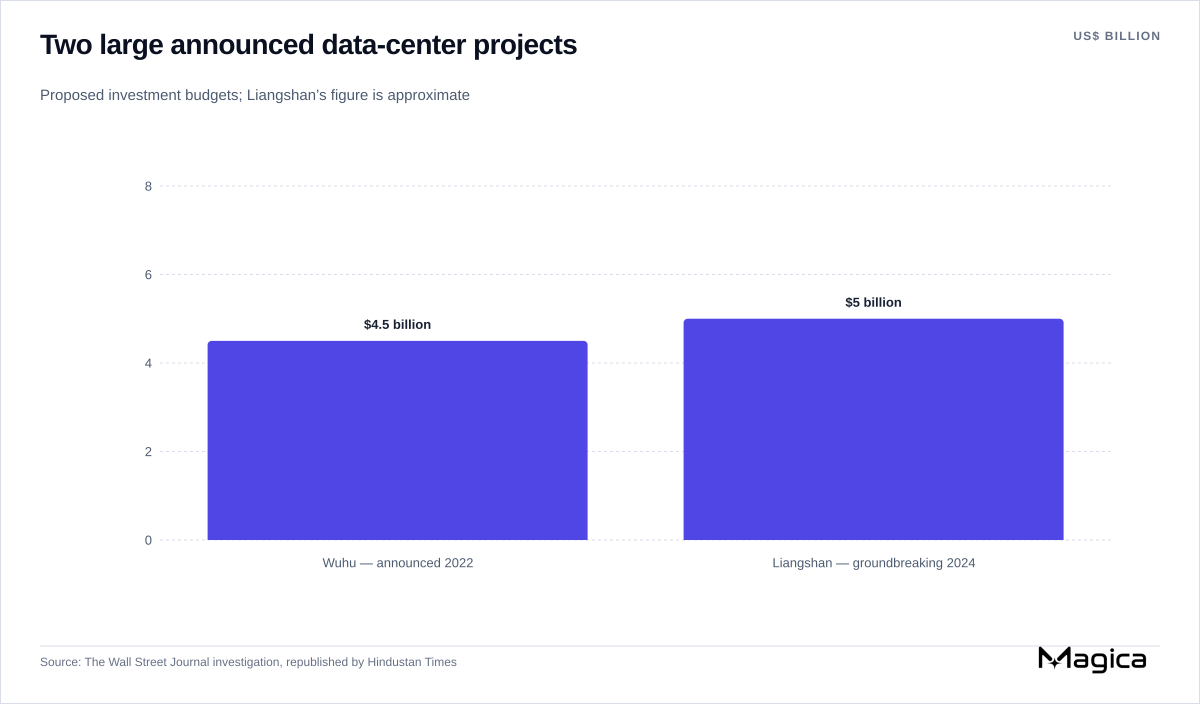
Reported proposed budgets were $4.5 billion for Wuhu and roughly $5 billion for Liangshan. These figures do not establish actual spending or completed capacity. Source: Hindustan Times.
The two biggest announced projects explain the scale of the investment headline. Neither proposed budget establishes how much money was ultimately spent.
In Wuhu, in east-central China, Century Longteng agreed in 2022 to develop a planned $4.5 billion intelligent-computing industrial park. The investigation describes eight data-center buildings across nearly 4.1 million square feet, with about 24,000 server racks planned and government support for electricity and infrastructure. By April 2026, at least one building of roughly 500,000 square feet had been registered as completed. That milestone does not establish the operating status of the whole complex.
In July 2024, Kang attended the groundbreaking of a roughly $5 billion data-center development in Liangshan, Sichuan. Local official accounts identified him as chairman of a Century Longteng-affiliated data-services unit, the investigation says. It does not establish that the full planned capacity was installed.
Ownership also changed within the network. Century Huatong’s 2022 annual report records the disposal of a 31% stake in Wuhu Century Longteng Data Services in December 2022, leaving a 49% holding and ending the group’s control of that entity. An affiliated name does not establish continuing control across years.
The same report provides a baseline for the commercial buildout. The group’s cloud-data segment recorded RMB21.33 million in revenue against RMB65.23 million in cost of revenue for 2022. Including other expenses and charges, its net loss was RMB592.20 million. Segment assets stood at RMB6.01 billion at year-end. These are historical accounts for Century Huatong’s broader cloud-data business, not the finances of every Kang-linked venture or a measure of its 2026 operations.
State backing also had a wider policy context. A February 2022 account carried by the National Development and Reform Commission, China’s economic planning agency, describes the “East Data, West Computing” initiative: a national network intended to relieve energy and land constraints in developed regions by using computing and renewable-energy resources elsewhere. It distinguished non-real-time work, such as offline analysis and storage, from services needing greater network capacity. The policy concerned a range of computing workloads, rather than establishing any particular project’s access to advanced AI chips.
The Shenzhen project supplies more specific evidence of a customer relationship. Huawei, the Chinese telecommunications and technology group, was a customer through Huawei Cloud. Nvidia identified Huawei as a top competitor in 2024, according to the separate investigation.
The public-records investigation, citing a Huawei announcement, says Century Longteng signed a framework agreement in early 2022 to collaborate with Huawei on cloud data centers, energy infrastructure and computing. Kang attended the signing. Huawei was already on a U.S. technology blacklist at the time, the account notes.
The June 2022 filing says controlled subsidiary Shenzhen Yifeng Technology had won a Huawei Cloud project and would provide customized data-center services at its Guangming facility. Century Huatong approved a guarantee of up to RMB100 million for obligations arising from that business, plus guarantees of up to RMB360 million for a three-year acquisition loan associated with Century Longteng’s Shenzhen project.
The annual report subsequently listed an actual guarantee amount of RMB245.2 million against the RMB360 million acquisition-loan limit. The arrangements included equity pledges and a counter-guarantee from Wuxi Feiye in proportion to its 27% stake. The guarantee announcement says the state-owned Songjiang investor did not provide a counter-guarantee. State equity participation therefore should not be confused with a blanket government guarantee of the project’s debts.
Century Huatong said in its annual report that the Shenzhen project’s first phase had topped out and was undergoing electrical and mechanical installation and third-party testing; deliveries were expected to start in the first half of 2023. Those were company statements about progress and a schedule, not confirmation here of subsequent completion.
Huawei was one of several counterparties. The annual report also describes racks being delivered at a Tencent-linked Shanghai project and a March 2022 framework agreement with telecommunications equipment supplier ZTE covering data centers and related businesses. The separate corporate-records investigation says it was unclear whether the Shenzhen facility had acquired Nvidia graphics processors, even though Century Huatong began buying Nvidia chips in 2023. A customer contract does not establish the hardware used to fulfill it.

Singapore’s Ministry of Home Affairs described these milestones. Huang separately received a stern warning for knowingly supplying inaccurate information about her role; investigations into Megaspeed and six others remained ongoing. Source: Singapore Ministry of Home Affairs.
Megaspeed told Nvidia by November 2023 that Chinese e-commerce group Alibaba would be an anchor customer and obtained cloud-partner status giving it priority chip access, according to the public-records investigation. That was Megaspeed’s representation about its customer. Alice Huang’s registered directorship ended that month during a restructuring, but Singapore’s Ministry of Home Affairs later identified her as Megaspeed’s then-CEO, chairperson and a key controller when explaining its investigation.
The investigation also says Alice Huang and Kang pitched projects in Shanghai and Southeast Asia between late 2024 and June 2025, telling prospective investors they could expect to triple their money in three years and expressing confidence they could bring Nvidia chips into China. These were reported sales pitches, not verified returns or proof of shipments. It separately reports that Kang was detained in Shanghai during 2026 in connection with stock-market manipulation inquiries and was recently released.
Singapore’s November 12 statement identifies the practical evidence gap. Police and customs began investigating possible false declarations concerning server purchases in February 2025. Servers bought by companies under investigation passed through Singapore to Malaysia; police were examining whether they then went elsewhere contrary to the declarations. The ministry said Singapore’s investigation was independent and Alice Huang was not investigated for espionage.
In February 2026, police concluded there was insufficient evidence that she had committed offenses relating to the possible inaccurate declarations. Separately, police assessed that she knowingly gave them inaccurate information to downplay her Megaspeed role. She received a stern warning, was barred from re-entering Singapore and left on February 26, 2026. Investigations into Megaspeed and six other individuals remained ongoing.
The ministry said investigators needed records from the servers’ origin and destination jurisdictions. It said U.S. server supplier Supermicro had provided limited cooperation and that repeated requests to U.S. authorities had produced limited information or assistance concerning the company. That is Singapore’s account of the investigative obstacle.
Megaspeed says it operates lawfully and that Alice Huang currently has no role at the company. Attempts to reach her and Kang for the public-records investigation were unsuccessful; Century Longteng did not respond.
The next consequential finding would connect particular shipments to actual destinations, end users and applicable authorizations. The state investment, guarantees and Huawei orders establish a business network. Whether that network received restricted chips remains a separate question for shipment records and the continuing investigations.
Tesla plans €3 billion of expansion at its profitable Grünheide factory to build Cybercabs from 2029, eventually targeting up to one million annually. The driverless taxi still lacks German and EU approval, and its capacity target differs from an older plan for the whole site.
Our World in Data’s comparison finds negative views of AI exceed positive ones across five probability-based surveys. The primary results also reveal substantial mixed views, acceptance of some applications and a sharper divide over who controls development and bears its local costs.
NVIDIA's Nemotron for Science pairs an existing open model with nearly 50,000 chemistry questions and scientific post-training recipes. Partner results suggest scope for specialized agents, but the reported accuracy and inference savings do not establish the full cost of adapting them.
AMD says the Lux AI supercomputer is open to scientific users at Oak Ridge. Half its annual capacity supports the Genesis Mission and half is reserved for paid access, including AMD development, while workload limits and undisclosed rates shape its practical value.
Apple is adding app-by-app and folder-specific permissions, repeat approval requests and clearer warnings in macOS 27.3 beta 2. Existing permissions remain intact, limiting the immediate reach of the privacy changes.
OpenAI reportedly discussed buying Goodfire for more than $5 billion, over four times its February financing valuation. No deal resulted. A disclosed paid assessment agreement offers cooperation without ownership, while the technology’s safety benefits remain to be demonstrated.
Gemini’s regional voice rollout includes more than ten UK options and applies to live conversations and spoken chat responses. Earlier accent consistency problems remain untested in the new release, while pricing and rollout eligibility are unspecified.
Hugging Face is moving language-model requests to OpenRouter’s provider router, adding automatic failover while ending custom provider keys on that route. Provider rates carry no Hugging Face markup, but the selected service—and the resulting bill—can change.
Nasiko’s OpenRuntime combines agent spending reports, model routing and gateway budget limits. Earlier releases and company benchmarks show what it can do, but metering disputes, workload trade-offs and runtime charges complicate the savings case.
A report citing business records identifies Anthropic cybersecurity researcher Paul Crowley as a manager of Red Means No. The disclosure adds to scrutiny of consent safeguards and professional networking at the Bay Area sex parties.
Reported internal Microsoft data puts Claude for Microsoft 365 usage below one-tenth of Copilot’s. Undisclosed measurement details and Claude’s availability inside Copilot limit what the gap says about Anthropic’s workplace business.
South Korea is strengthening device checks and considering public Wi-Fi shutdowns before its November 19 college entrance exam, after a tax-accountant exam top scorer admitted using AI to cheat. The response still depends heavily on human screening, with no electronic device detectors planned for this year's test.
Russia’s objections to observer participation stalled the opening of a Geneva weapons conference, where governments must decide whether to authorize negotiations on autonomous weapons and whether any resulting rules should be binding.
Apple’s iOS 27.3 beta ties higher allowances for server-based AI to existing iCloud+ plans. Basic Siri commands remain free, but undisclosed daily limits leave the value of paid access uncertain.
The partners plan to combine IBM quantum processors, NVIDIA computing and Fermilab physics expertise to study modular quantum systems. A separate decoder release promises faster error-correction research, with important limits on its performance comparisons.
Federal Reserve Chairman Kevin Warsh outlined AI scenarios spanning shared prosperity, job displacement and an investment downturn. The exercise offers no forecast or rate guidance as colleagues worry that the infrastructure buildout is adding to inflation.
OpenAI is offering approved organizations a free classifier for suspected child sexual abuse images, including AI-generated material. Early results suggest less review work, but existing detection alternatives and the need for human review qualify the launch.
Nvidia plans scientific computing racks for early 2027, extending Vera beyond its initial AI deployments. Its 2.4× performance-per-watt claim comes from one airflow simulation against AMD Turin; performance against newer rivals and delivered costs remain unresolved.
OpenAI’s CEO expressed empathy for Nvidia founder Jensen Huang but withheld judgment on reinstatement. His confidence in continued AI financing comes with a direct commercial stake and unresolved deployment risks.