Editorial Team
6 min read
A report citing business records identifies Anthropic cybersecurity researcher Paul Crowley as a manager of Red Means No. The disclosure adds to scrutiny of consent safeguards and professional networking at the Bay Area sex parties.
Paul Crowley, a cybersecurity researcher at AI company Anthropic and coauthor of earlier encryption research, is listed as a manager of Red Means No LLC, a Bay Area sex-party business, according to a November 16 report citing business filings. The report also says at least one woman has alleged she was sexually assaulted at an event. It does not identify Crowley as the alleged assailant or establish his involvement in that incident.
The management disclosure adds an organizational link to a controversy over sexual participation and professional networking in AI research circles. The central questions are how organizers enforced consent rules and whether people felt their professional access depended on attending. Neither question is settled by the reported management affiliations.
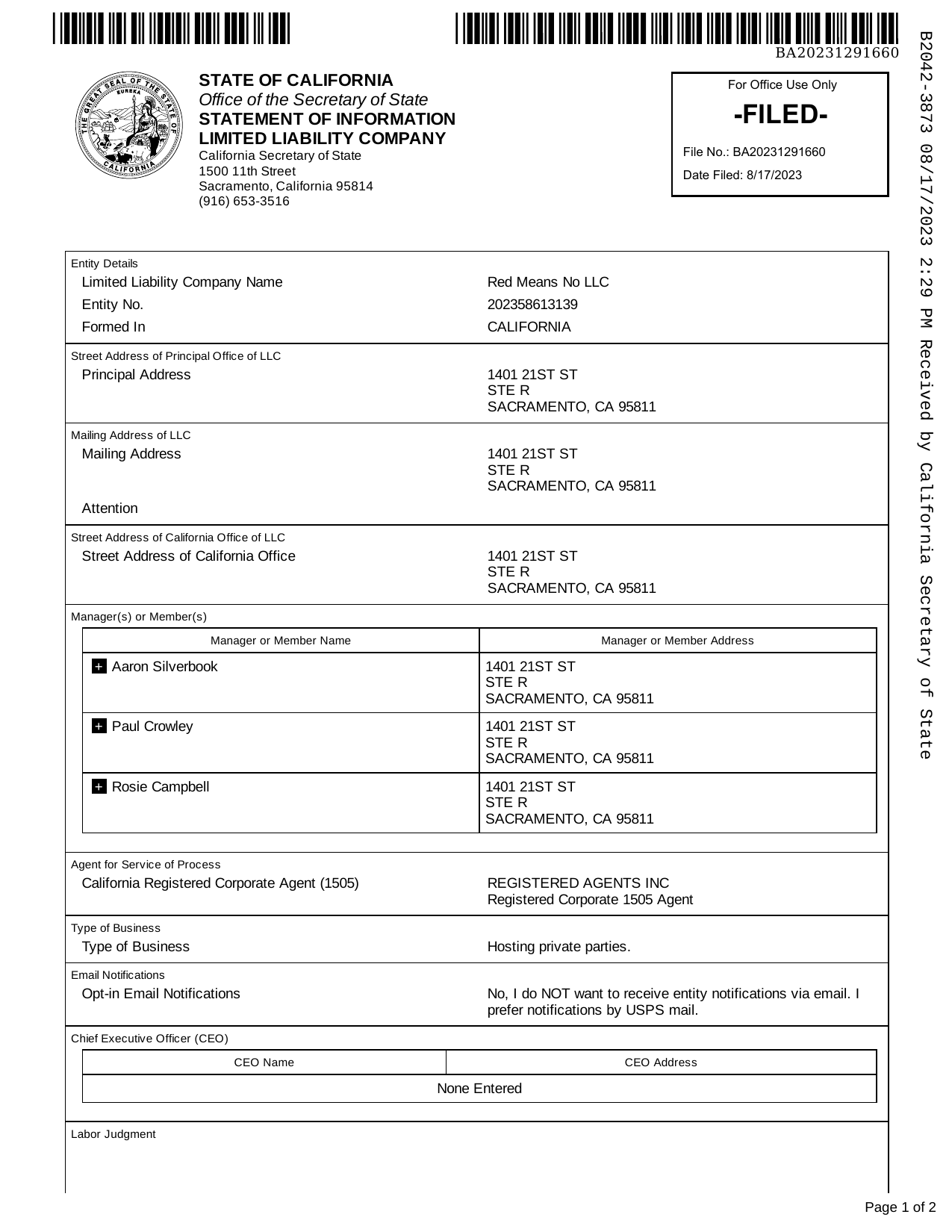
A California Secretary of State filing dated August 17, 2023, lists Paul Crowley under “Manager(s) or Member(s).” It does not establish responsibility for the alleged assault. Source: Washington Free Beacon.
The report says Crowley joined Anthropic in 2025. His prior research includes coauthoring Adiantum, an encryption design for entry-level processors, with Eric Biggers. Google Research's publication record lists their paper in a 2018 cryptography journal.
According to the business-records report, a 2023 filing also listed Aaron Silverbrook, a former director of operations at the Machine Intelligence Research Institute, an AI safety organization, and Rosie Campbell, managing director of Eleos AI, a nonprofit researching the possible welfare and moral status of AI systems. Campbell previously worked on OpenAI's safety team and is no longer listed as a Red Means No manager, the report says.
Records detail Chinese data-center investments linked to Hexi founder Kang Wei, husband of former Megaspeed chief Alice Huang. Filings document financing and Huawei business, but do not establish a route for restricted Nvidia chips.
Those links go beyond former employment. The report cites Silverbrook describing himself as running the media business of Aella, Red Means No's cofounder and an organizer of AI-safety gatherings. It says Campbell conducted a welfare evaluation of Anthropic's Claude 4 AI model. It also identifies Campbell as an advertised guest at an AI-safety meetup organized by Aella. These are specific connections between the organizers and AI-safety networks, rather than a count of party attendees.
Crowley, Silverbrook and Campbell did not respond to requests for comment, according to the report. An Anthropic spokesperson told the publication that the company does not comment on individual employees. The report supplies no evidence that Anthropic sponsors the events. A management listing also does not establish which individual controlled admission, supervised encounters or handled complaints.

Red Means No's published rules describe mandatory stop signals. Written rules do not establish how safeguards were enforced. Source: Red Means No.
Red Means No describes its gatherings as consensual non-consent events: participants agree to encounters that simulate resistance while retaining ways to stop them. Its public rules say actual consent violations are strictly forbidden. The organizer presents the events as a space for women to explore this sexual interest; that is its stated purpose, rather than an independently established safety outcome.
Entering and wearing a wristband gives default consent to a specified set of activities, including sexual touching, vaginal penetration with condoms and lubrication, and light restraint. Participants can restrict those permissions through badges that others must read. Colored wristbands indicate openness to particular genders, and black tape marks body areas as off limits.
The word “red” must stop an encounter, without exception. Triple taps serve the same purpose when someone cannot speak. The organizer says it practices these signals at the beginning of events. Advance dossiers can describe limits and preferences, but participants are not obliged to read them, so the website says custom instructions must also appear on badges.
The rules distinguish default permissions from activities requiring negotiation, including unprotected vaginal penetration and more intense restraint. Other acts, including weapons and severe pain, are prohibited even with agreement. Describing the events solely as places where refusals are ignored would omit these restrictions; publishing restrictions does not demonstrate that they were enforced.
The site also prohibits recordings, requires privacy around attendees' identities, describes sexual-health testing requirements and says entrants will sign a consent form and liability waiver. Accepted applicants receive fuller procedures. The public page does not explain how organizers handled the reported assault allegation.

The reported chronology separates the earlier filing and public criticism from the new management disclosure; it does not date the assault allegation. Source: Washington Free Beacon.
The report identifies Aella, who uses that public name, as a cofounder who described starting the parties in a 2023 post after wanting a different experience from conventional sex parties. It quotes her preferred ratio of two women to three men. That is an organizer's stated design preference, not a measured attendance breakdown.
The criticism predates Crowley's reported management disclosure. The report cites Sonia Joseph, cofounder of AI startup World Mechanics, warning in 2024 that the parties contributed to a coercive climate around boundaries. More recently, it quotes independent AI researcher John Wentworth saying in October that learning an AI-safety expert attended Red Means No improved his assessment of that person. He called attendance a “strong signal” of free thought.
Wentworth's reported statement provides a concrete example of attendance influencing a professional assessment. It does not establish that he made a hiring or funding decision on that basis. Critics cited in the report argue that women may feel pressure to attend sexual events to gain access to professional networks.
The report asserts that the parties attract a disproportionate number of Anthropic and OpenAI employees, but also acknowledges that the share of attendees working in AI is hard to determine. It provides no attendance denominator or comparison population that would establish overrepresentation. The documented management links cannot supply that missing measurement.
The report links the assault allegation to a first-person account, but the underlying account was unavailable for independent review. Its details therefore cannot be verified here, and the allegation remains attributed to the report that cited it.
Assessing the organizers' response would require evidence of how a complaint was received, investigated and resolved, alongside responses to the specific allegation. Assessing professional pressure would require evidence of decisions about jobs, funding or access tied to attendance or refusal to attend. Written consent rules, management affiliations and Wentworth's reported assessment each illuminate a different part of the controversy; none establishes those outcomes on its own.
ElevenLabs plans to acquire Kotoba, the startup behind Japanese speech technology used in Salesforce’s Agentforce Voice. The deal adds a 15-person team and deployed products to its existing Japanese operation, but financial terms and integration plans remain undisclosed.
Tesla plans €3 billion of expansion at its profitable Grünheide factory to build Cybercabs from 2029, eventually targeting up to one million annually. The driverless taxi still lacks German and EU approval, and its capacity target differs from an older plan for the whole site.
Our World in Data’s comparison finds negative views of AI exceed positive ones across five probability-based surveys. The primary results also reveal substantial mixed views, acceptance of some applications and a sharper divide over who controls development and bears its local costs.
NVIDIA's Nemotron for Science pairs an existing open model with nearly 50,000 chemistry questions and scientific post-training recipes. Partner results suggest scope for specialized agents, but the reported accuracy and inference savings do not establish the full cost of adapting them.
AMD says the Lux AI supercomputer is open to scientific users at Oak Ridge. Half its annual capacity supports the Genesis Mission and half is reserved for paid access, including AMD development, while workload limits and undisclosed rates shape its practical value.
Apple is adding app-by-app and folder-specific permissions, repeat approval requests and clearer warnings in macOS 27.3 beta 2. Existing permissions remain intact, limiting the immediate reach of the privacy changes.
OpenAI reportedly discussed buying Goodfire for more than $5 billion, over four times its February financing valuation. No deal resulted. A disclosed paid assessment agreement offers cooperation without ownership, while the technology’s safety benefits remain to be demonstrated.
Gemini’s regional voice rollout includes more than ten UK options and applies to live conversations and spoken chat responses. Earlier accent consistency problems remain untested in the new release, while pricing and rollout eligibility are unspecified.
Hugging Face is moving language-model requests to OpenRouter’s provider router, adding automatic failover while ending custom provider keys on that route. Provider rates carry no Hugging Face markup, but the selected service—and the resulting bill—can change.
Nasiko’s OpenRuntime combines agent spending reports, model routing and gateway budget limits. Earlier releases and company benchmarks show what it can do, but metering disputes, workload trade-offs and runtime charges complicate the savings case.
Reported internal Microsoft data puts Claude for Microsoft 365 usage below one-tenth of Copilot’s. Undisclosed measurement details and Claude’s availability inside Copilot limit what the gap says about Anthropic’s workplace business.
South Korea is strengthening device checks and considering public Wi-Fi shutdowns before its November 19 college entrance exam, after a tax-accountant exam top scorer admitted using AI to cheat. The response still depends heavily on human screening, with no electronic device detectors planned for this year's test.
Russia’s objections to observer participation stalled the opening of a Geneva weapons conference, where governments must decide whether to authorize negotiations on autonomous weapons and whether any resulting rules should be binding.
Apple’s iOS 27.3 beta ties higher allowances for server-based AI to existing iCloud+ plans. Basic Siri commands remain free, but undisclosed daily limits leave the value of paid access uncertain.
The partners plan to combine IBM quantum processors, NVIDIA computing and Fermilab physics expertise to study modular quantum systems. A separate decoder release promises faster error-correction research, with important limits on its performance comparisons.
Federal Reserve Chairman Kevin Warsh outlined AI scenarios spanning shared prosperity, job displacement and an investment downturn. The exercise offers no forecast or rate guidance as colleagues worry that the infrastructure buildout is adding to inflation.
OpenAI is offering approved organizations a free classifier for suspected child sexual abuse images, including AI-generated material. Early results suggest less review work, but existing detection alternatives and the need for human review qualify the launch.
Nvidia plans scientific computing racks for early 2027, extending Vera beyond its initial AI deployments. Its 2.4× performance-per-watt claim comes from one airflow simulation against AMD Turin; performance against newer rivals and delivered costs remain unresolved.
OpenAI’s CEO expressed empathy for Nvidia founder Jensen Huang but withheld judgment on reinstatement. His confidence in continued AI financing comes with a direct commercial stake and unresolved deployment risks.