Editorial Team
7 min read
NVIDIA's Nemotron for Science pairs an existing open model with nearly 50,000 chemistry questions and scientific post-training recipes. Partner results suggest scope for specialized agents, but the reported accuracy and inference savings do not establish the full cost of adapting them.
NVIDIA introduced Nemotron for Science on November 16, bringing its existing Nemotron 3.5 Super VL open model together with scientific evaluations, a new chemistry dataset and methods for adapting models to research tasks. The central proposition is that laboratories can use their own experimental evidence to improve an agent's performance—and run it on infrastructure they control.
For NVIDIA, a designer of graphics processors that also supplies computing infrastructure and software, the offering connects scientific model customization to its broader computing stack. For researchers, the consequential question is whether task-specific gains justify the data preparation, verification and computing required to obtain them.
NVIDIA’s illustration accompanying its Nemotron for Science post-training guide. Illustration: NVIDIA. Source: NVIDIA Technical Blog.
Nemotron for Science is a collection of models, datasets, tools and recipes rather than a newly introduced base model. Its foundation, Nemotron 3.5 Super VL, is an open, customizable model that combines text, image, document and video understanding with reasoning and tool use. NVIDIA's October 15 introduction described a mixture-of-experts architecture with 120 billion parameters, of which 12 billion activate per token. The model was distilled from NVIDIA’s larger Nemotron 3 Ultra, and its October release already supported post-training on an organization’s own data and local, data-center or cloud deployment. The science package extends an established customization strategy.
The supporting tools also have a prior history. NVIDIA's December 2025 Nemotron 3 announcement already included NeMo Gym and NeMo RL, open-source libraries providing reinforcement-learning environments and post-training infrastructure. The science launch applies that customization approach to research tasks and adds chemistry-specific evidence.
The new dataset, LitmusBench v0.2, contains nearly 50,000 questions drawn from molecular properties and experimental drug-discovery data, NVIDIA said in its announcement. It is intended both to evaluate chemistry reasoning and to support post-training, including predictions about solubility and how the body processes molecules.
There is a naming inconsistency in the release materials: the announcement calls it LitmusBench v0.2, while the accompanying technical post calls it “Litmus-Bench V2.0” but links to a repository named v0.2. Researchers reproducing results will need to check the exact dataset revision.
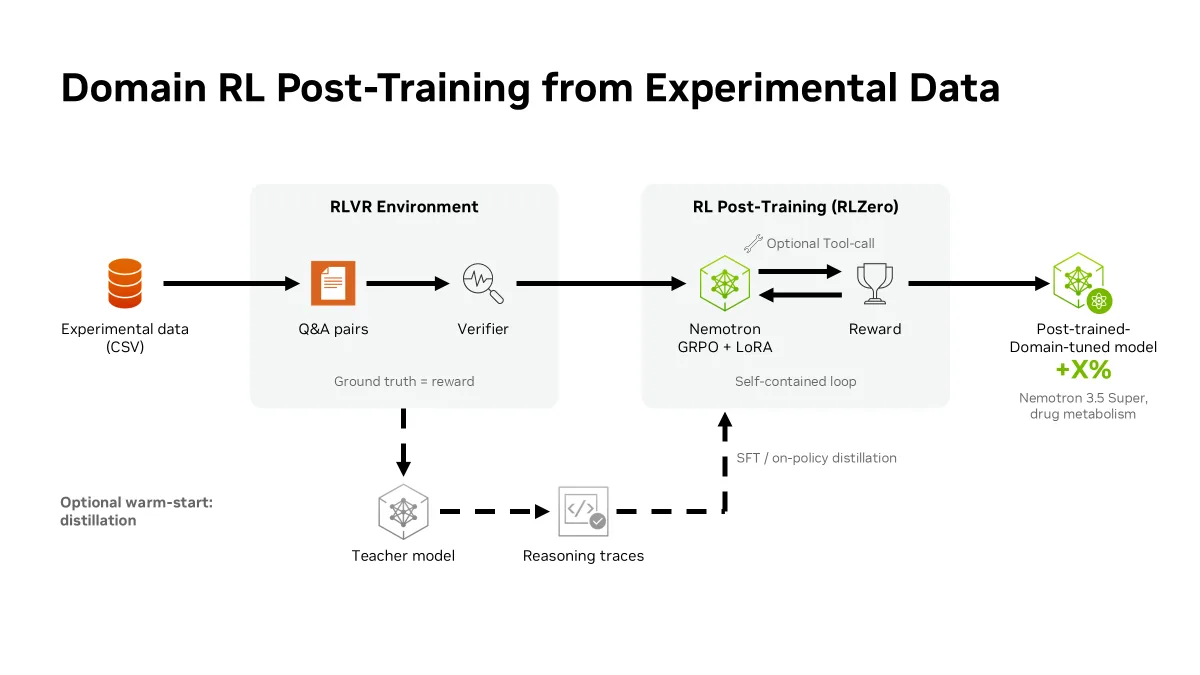
NVIDIA’s post-training workflow turns experimental records into verifier feedback, with optional teacher-model distillation. The “+X%” notation is a placeholder, not a measured gain. Diagram: NVIDIA. Source: NVIDIA Technical Blog.
NVIDIA's post-training recipe illustrates the mechanism using drug-metabolism prediction. Given a starting molecule and an enzyme, the model predicts the resulting metabolite. The example uses experimentally confirmed reactions from MetxBioDB, a biotransformation database.
Experimental inputs and measured outcomes become prompts and reference answers. NeMo Gym supplies an environment in which an automated verifier scores model submissions; NeMo RL supplies the reinforcement-learning framework. This avoids human preference labeling for the reward signal, although researchers still have to choose and validate what the score measures.
In this example, the verifier compares numerical fingerprints of predicted and reference molecular structures using Tanimoto similarity, a score from zero to one. Structural similarity is the optimization target described in the recipe; demonstrating useful laboratory performance requires checking that the chosen reward captures the scientific outcome that matters.
NVIDIA reports that, at an output budget of 16,384 tokens, supervised fine-tuning improved accuracy by 12%, followed by a further 17% improvement through reinforcement-learning post-training. The prose does not specify whether these are relative changes or percentage-point gains, so they cannot responsibly be combined into an overall accuracy increase.
An optional distillation step uses a stronger teacher model to generate examples before reinforcement learning. NVIDIA says its example retained 1,123 reasoning traces from 1,934 training prompts at a similarity threshold of at least 0.7. That is a filter for the example's training material, not an independent test of scientific correctness.
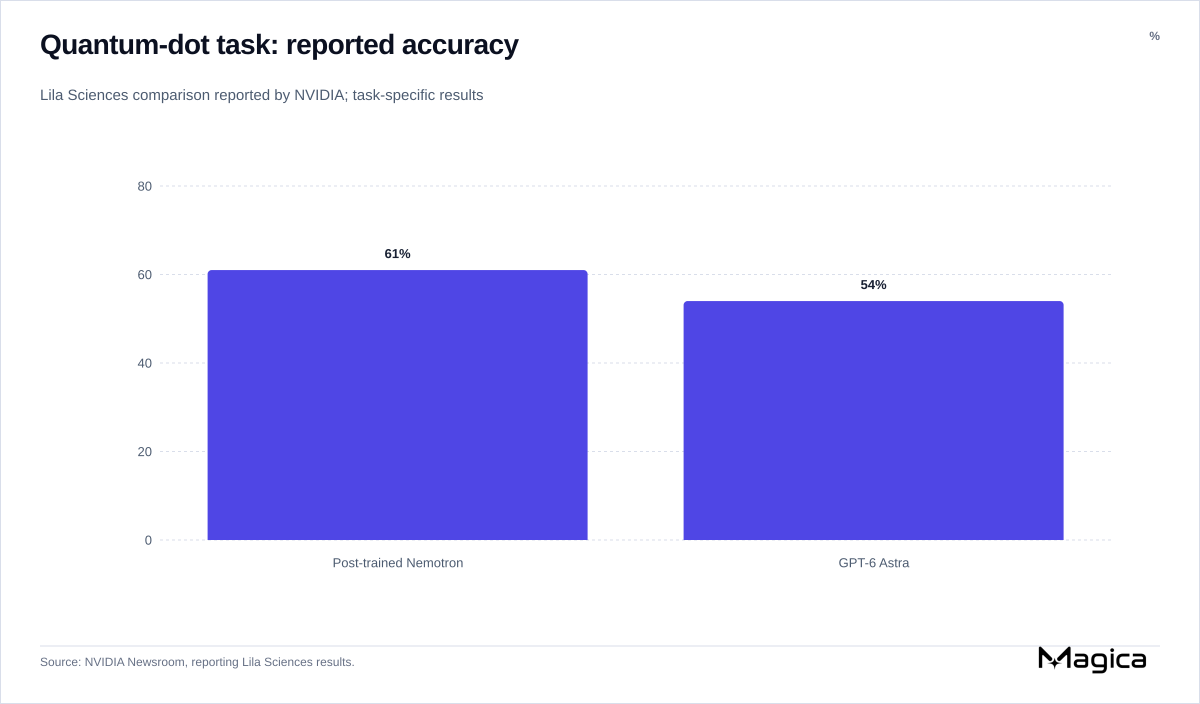
Company-reported accuracy on Lila’s quantum-dot task: 61% for post-trained Nemotron and 54% for GPT-6 Astra. NVIDIA does not disclose sample size or uncertainty. Chart: Magica; source: NVIDIA. Source: NVIDIA Newsroom.
Lila Sciences develops scientific agents and autonomous laboratory infrastructure. It originated at Flagship Pioneering and disclosed a $350 million Series A in October 2025, bringing its total capital raised to $550 million. Its financing disclosure named NVentures, NVIDIA’s venture capital arm, among the backers. NVIDIA therefore has a financial relationship with the partner behind the launch’s strongest economic claim.
According to NVIDIA’s account of Lila’s work, Nemotron matched frontier-level performance when designing execution-ready protocols for automated labs without additional fine-tuning. In a separate result, post-training with laboratory feedback nearly doubled its accuracy for making quantum dots—nanoscale crystals used in screens and solar panels—to 61%. NVIDIA compares that with 54% for GPT-6 Astra and claims 10–20 times lower inference cost.
That is a task-specific comparison reported by the supplier. The announcement does not provide enough detail about sample size, uncertainty or the full cost calculation to establish a general advantage over proprietary models. Inference cost covers running a model; it does not by itself account for preparing experimental data, post-training or maintaining the evaluation system.
Other examples measure different outcomes. NVIDIA says Terray Therapeutics, a life-sciences company, post-trained Nemotron to extract reactants, products and conditions from scientific diagrams. It recovered about 76% of annotated reactions on the RxnScribe test under that benchmark's matching criteria and surpassed previously published results on two benchmarks.
Therna, another life-sciences collaborator, used post-training for mRNA therapeutic design. NVIDIA reports nearly twice the accuracy of frontier models in predicting protein-expression ranges, without naming the comparison models in the announcement. Scientists preferred the adapted model's explanations over the base model's in 96% of comparisons. Preference for an explanation and accuracy of a biological prediction remain different measures.
NVIDIA says the model and LitmusBench v0.2 are available on Hugging Face, and that the model is optimized to run locally on a 128GB DGX Spark system. Its proposed workflows also use CUDA-X, NVIDIA’s accelerated software tools for scientific computation. Local inference on DGX Spark was already described in the October model release. This gives laboratories a route to operating on their own infrastructure while connecting the offering to NVIDIA hardware and software.
Local operation is one deployment option. The October model release also describes hosted inference and cloud deployment. NVIDIA’s December 2025 announcement explicitly envisaged routing tasks between proprietary frontier models and customizable open models in the same workflow. Researchers can therefore assess specialization as part of a mixed-model system, alongside the option of running an uncustomized model.
Running the model locally is distinct from customizing it. The technical recipe's example launch commands use 16 GPUs for supervised fine-tuning and reinforcement-learning post-training. Those examples are not stated minimum requirements, but they show why desktop inference availability should not be read as a complete customization-cost estimate.
Research adoption spans several deployment settings, according to NVIDIA. The U.S. Department of Energy's Argonne National Laboratory is integrating Nemotron into StructBioReasoner, a multi-agent system for designing and evaluating protein-based therapeutic candidates. Jülich Supercomputing Centre is integrating it into discovery agents, while RIKEN offers the models through its RIKYU supercomputing platform's RiVault inference gateway.
At KTH Royal Institute of Technology, an agent repairs broken GROMACS molecular-dynamics setups. NVIDIA says it fixed 81% of test cases during an overnight run on one DGX Spark with reasoning enabled, with every fix checked by GROMACS itself. That is a concrete verification mechanism, though the announcement does not give the test-set size.
The package gives researchers a model, chemistry questions and a path from experimental records to automated feedback. The remaining decision is whether those ingredients improve a laboratory's own tasks enough to cover the effort and computing needed to adapt them.
The next useful comparison is a held-out test of the laboratory’s own task across the starting model, its adapted version and relevant hosted alternatives. Explicit dataset versions, disclosed comparison conditions and end-to-end cost measurements would show whether the accuracy gain survives outside the adaptation data and whether lower inference expense repays the customization effort. NVIDIA's own technical guidance recommends starting with a narrowly defined task and validating the scoring method before expanding the workflow. The reported partner results offer reasons to test the approach; they do not yet answer those questions for another laboratory.
Records detail Chinese data-center investments linked to Hexi founder Kang Wei, husband of former Megaspeed chief Alice Huang. Filings document financing and Huawei business, but do not establish a route for restricted Nvidia chips.
ElevenLabs plans to acquire Kotoba, the startup behind Japanese speech technology used in Salesforce’s Agentforce Voice. The deal adds a 15-person team and deployed products to its existing Japanese operation, but financial terms and integration plans remain undisclosed.
Tesla plans €3 billion of expansion at its profitable Grünheide factory to build Cybercabs from 2029, eventually targeting up to one million annually. The driverless taxi still lacks German and EU approval, and its capacity target differs from an older plan for the whole site.
Our World in Data’s comparison finds negative views of AI exceed positive ones across five probability-based surveys. The primary results also reveal substantial mixed views, acceptance of some applications and a sharper divide over who controls development and bears its local costs.
AMD says the Lux AI supercomputer is open to scientific users at Oak Ridge. Half its annual capacity supports the Genesis Mission and half is reserved for paid access, including AMD development, while workload limits and undisclosed rates shape its practical value.
Apple is adding app-by-app and folder-specific permissions, repeat approval requests and clearer warnings in macOS 27.3 beta 2. Existing permissions remain intact, limiting the immediate reach of the privacy changes.
OpenAI reportedly discussed buying Goodfire for more than $5 billion, over four times its February financing valuation. No deal resulted. A disclosed paid assessment agreement offers cooperation without ownership, while the technology’s safety benefits remain to be demonstrated.
Gemini’s regional voice rollout includes more than ten UK options and applies to live conversations and spoken chat responses. Earlier accent consistency problems remain untested in the new release, while pricing and rollout eligibility are unspecified.
Hugging Face is moving language-model requests to OpenRouter’s provider router, adding automatic failover while ending custom provider keys on that route. Provider rates carry no Hugging Face markup, but the selected service—and the resulting bill—can change.
Nasiko’s OpenRuntime combines agent spending reports, model routing and gateway budget limits. Earlier releases and company benchmarks show what it can do, but metering disputes, workload trade-offs and runtime charges complicate the savings case.
A report citing business records identifies Anthropic cybersecurity researcher Paul Crowley as a manager of Red Means No. The disclosure adds to scrutiny of consent safeguards and professional networking at the Bay Area sex parties.
Reported internal Microsoft data puts Claude for Microsoft 365 usage below one-tenth of Copilot’s. Undisclosed measurement details and Claude’s availability inside Copilot limit what the gap says about Anthropic’s workplace business.
South Korea is strengthening device checks and considering public Wi-Fi shutdowns before its November 19 college entrance exam, after a tax-accountant exam top scorer admitted using AI to cheat. The response still depends heavily on human screening, with no electronic device detectors planned for this year's test.
Russia’s objections to observer participation stalled the opening of a Geneva weapons conference, where governments must decide whether to authorize negotiations on autonomous weapons and whether any resulting rules should be binding.
Apple’s iOS 27.3 beta ties higher allowances for server-based AI to existing iCloud+ plans. Basic Siri commands remain free, but undisclosed daily limits leave the value of paid access uncertain.
The partners plan to combine IBM quantum processors, NVIDIA computing and Fermilab physics expertise to study modular quantum systems. A separate decoder release promises faster error-correction research, with important limits on its performance comparisons.
Federal Reserve Chairman Kevin Warsh outlined AI scenarios spanning shared prosperity, job displacement and an investment downturn. The exercise offers no forecast or rate guidance as colleagues worry that the infrastructure buildout is adding to inflation.
OpenAI is offering approved organizations a free classifier for suspected child sexual abuse images, including AI-generated material. Early results suggest less review work, but existing detection alternatives and the need for human review qualify the launch.
Nvidia plans scientific computing racks for early 2027, extending Vera beyond its initial AI deployments. Its 2.4× performance-per-watt claim comes from one airflow simulation against AMD Turin; performance against newer rivals and delivered costs remain unresolved.
OpenAI’s CEO expressed empathy for Nvidia founder Jensen Huang but withheld judgment on reinstatement. His confidence in continued AI financing comes with a direct commercial stake and unresolved deployment risks.