Editorial Team
10 min read
Our World in Data’s comparison finds negative views of AI exceed positive ones across five probability-based surveys. The primary results also reveal substantial mixed views, acceptance of some applications and a sharper divide over who controls development and bears its local costs.
Negative views of artificial intelligence exceed positive ones across five U.S. adult surveys assembled by Our World in Data, a nonprofit data publication. Its comparison brings together existing polls rather than reporting a new survey—and the results leave considerable room for mixed views and acceptance of particular uses.
The comparison covers surveys conducted from March through October 2026. Its business significance lies in the gap between finding uses for AI and accepting how it is developed or deployed: the underlying research records adoption alongside distrust, concern about jobs and demands for stronger oversight.
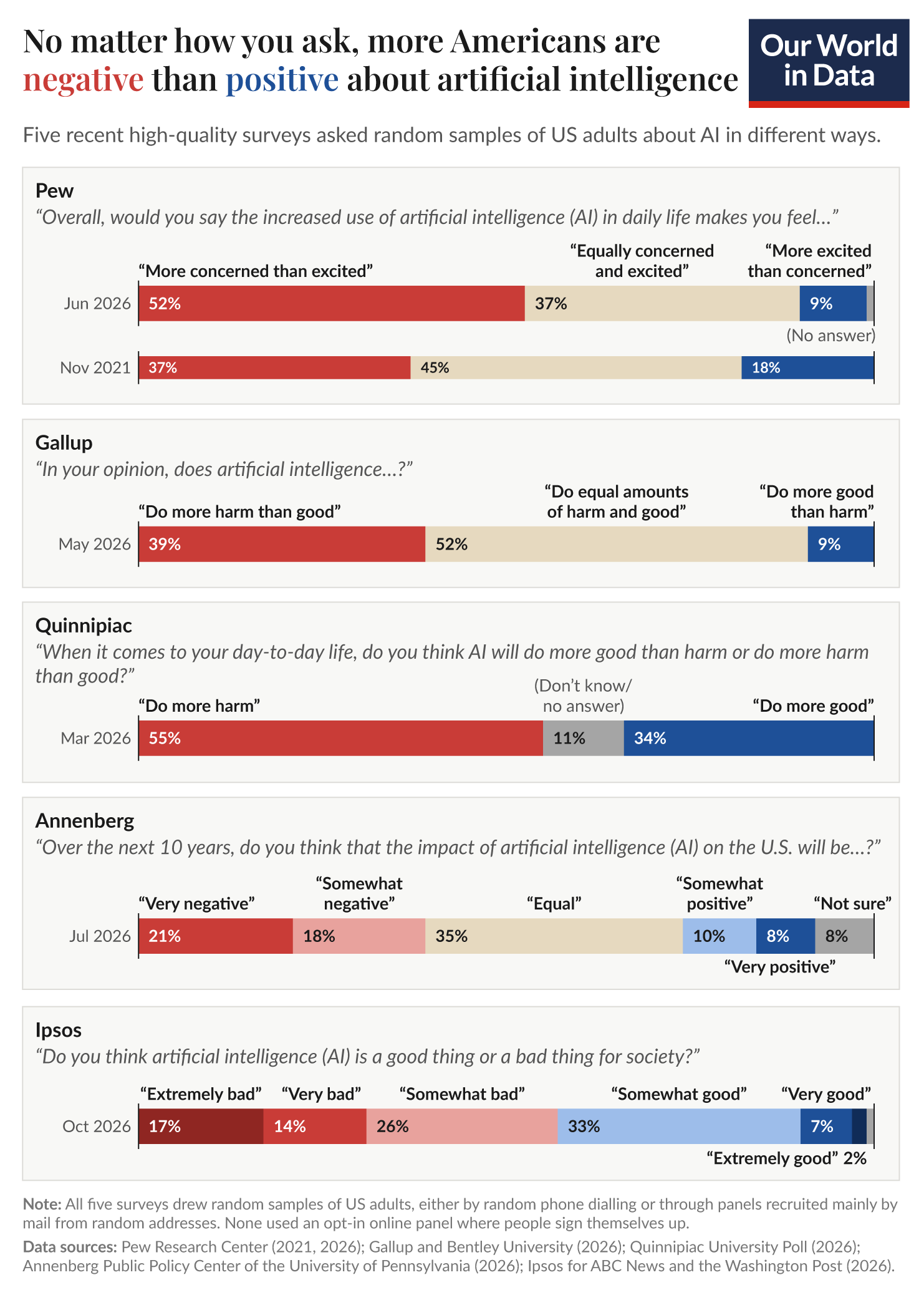
Five surveys using different questions each record more negative than positive responses. Graphic: Max Roser / Our World in Data, CC BY 4.0; underlying survey organizations are credited within the graphic. Source: Our World in Data.
The comparison includes surveys from Pew Research Center, Gallup and Bentley University, Quinnipiac University, the University of Pennsylvania’s Annenberg Public Policy Center, and Ipsos. The publication selected surveys with probability samples, in which recruitment is based on random selection, excluding opt-in online panels. Quinnipiac used randomly generated telephone numbers; the other four used online panels whose members were recruited at random. All five weight results to the U.S. adult population and disclose their questions and results.
The figures below describe distinct measures, rather than interchangeable estimates of one attitude. Percentages refer to U.S. adults; all fieldwork was in 2026. The dates and sample sizes come from the comparison and underlying reports.
| Survey and fieldwork | Adults surveyed | Question focus | Negative response | Positive response |
|---|---|---|---|---|
| Pew, June 22–28 | 3,488 | Concern versus excitement about increased AI use in daily life | 52% more concerned | 9% more excited |
| Gallup–Bentley, May 4–11 | 3,270 | AI’s balance of harm and good | 39% more harm | 9% more good |
| Quinnipiac, March 19–23 | 1,397 | Expected effect on day-to-day life | 55% more harm | 34% more good |
| Annenberg, June 16–July 19 | 1,320 | Expected U.S. impact over the next 10 years | 39% negative | 18% positive |
| Ipsos, October 9–13 | 2,545 | Whether AI is good or bad for society | 57% bad | 42% good |
Sources: the survey comparison and the business survey, March telephone poll, Annenberg topline and October topline. Figures are rounded as published.
Answer choices materially change the picture. In the Gallup–Bentley survey, the largest group—52%—said AI does equal amounts of harm and good. Pew found 37% equally concerned and excited. Annenberg recorded 35% expecting an equal balance of positive and negative effects, with another 8% unsure. The common result is that negative answers exceed positive ones, not that every questionnaire produces a negative majority.
Concern also crosses party lines: the comparison gives Pew’s more-concerned shares as 56% among Democrats and 49% among Republicans, with only about one in ten in either party more excited.
The five results should not be averaged into a national disapproval score. They ask about feelings, harm, society and future national effects over different periods. Their agreement strengthens the directional finding without eliminating sampling uncertainty or the effects of wording.
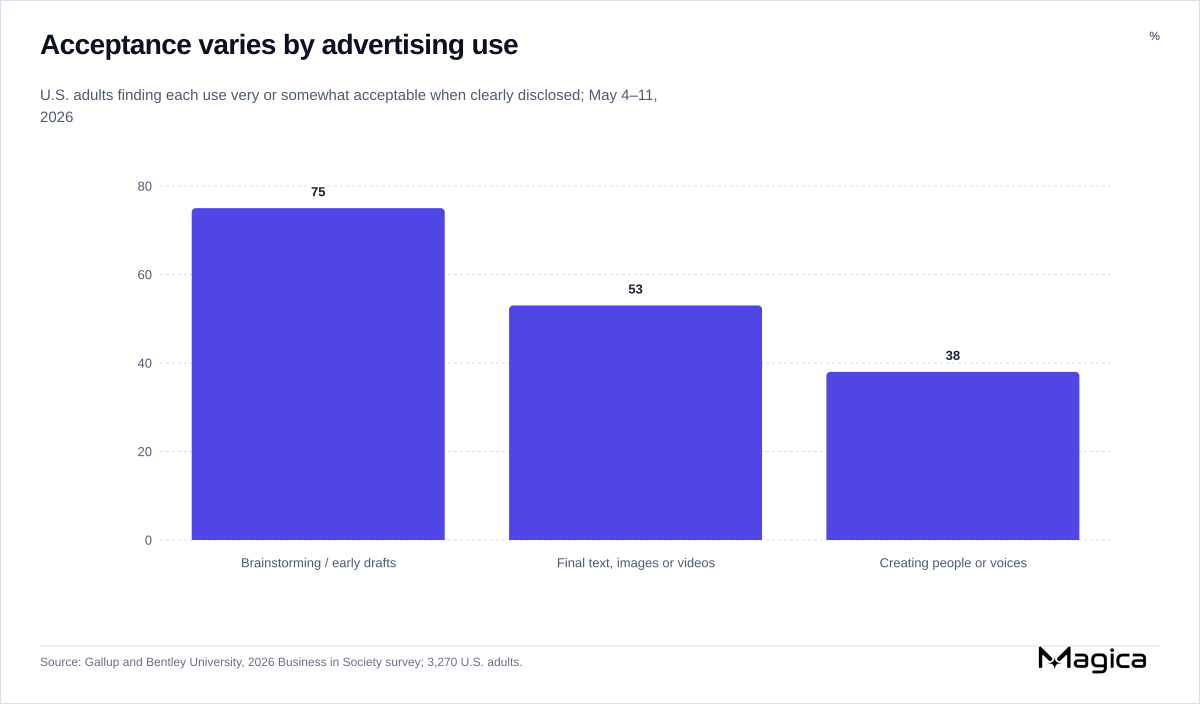
Gallup–Bentley respondents distinguished between advertising uses when AI involvement was clearly disclosed. The results do not establish that disclosure caused greater acceptance. Source: Gallup and Bentley University.
The sharpest qualification comes within the October survey itself. While 57% called AI bad for society, 50% called it good for them personally and 49% bad. With a full-sample margin of sampling error of two percentage points, that personal split offers no clear lead for either side. Strong negative feelings nevertheless exceeded strong positive ones: 17% called AI extremely bad for society, compared with 2% calling it extremely good.
Specific applications also matter. In Annenberg’s earlier February–March wave, 57% expected a positive effect on medical research and discoveries over the next decade, against 16% expecting a negative effect. That finding concerns a specific application and an earlier wave, rather than the June–July national-impact measure. Human involvement matters, too: in the March telephone poll, 81% preferred a combination of human and AI input for reading medical scans even under the hypothetical condition that AI was proven more accurate; only 3% preferred AI alone.
There are practical distinctions within the business survey, too. When AI use was clearly disclosed, 75% found it acceptable for businesses to help employees brainstorm or draft advertisements, and 53% accepted AI-created final text, images or videos. But 62% found creating people or voices in ads unacceptable. These are judgments under a disclosure condition, not evidence that disclosure itself caused greater acceptance.
Adoption provides another reason to avoid equating skepticism with refusal. Quinnipiac’s March survey found 51% had used AI tools to research topics, up from 37% in April 2025. Yet only 21% trusted AI-generated information most or almost all of the time. Those measures establish coexistence, not that use causes either trust or distrust.
Annenberg’s June–July breakdown provides a more direct check on the relationship with use. Among heavy users—those who had used or interacted with AI many times or almost every day in the previous month—29% expected a positive national impact over the next decade and 29% a negative one. Yet 57% of that group expected a negative effect on employment and jobs, and 69% on privacy and data security. Frequent use is compatible with concern about wider consequences; the comparisons do not establish what causes those attitudes.
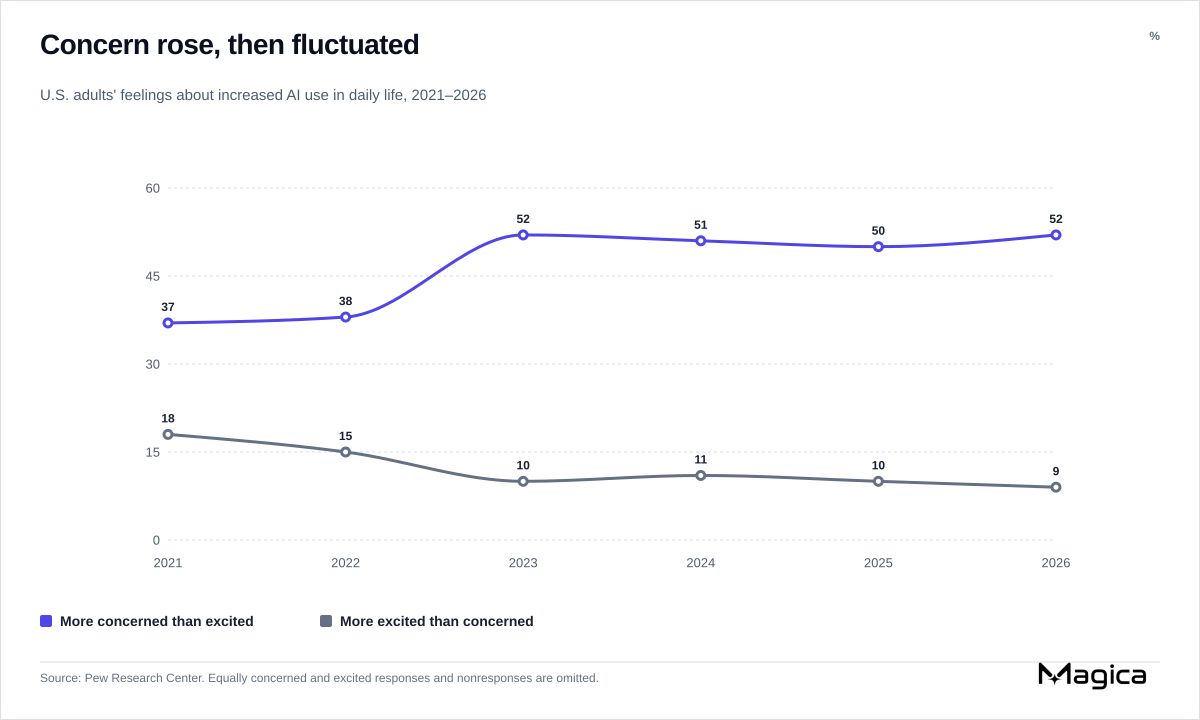
Pew’s published trend shows concern fluctuating after 2023. The 2021 question included a short definition and slightly different terminology; mixed responses and nonresponses are omitted. Source: Pew Research Center — AI sentiment trend.
The longer history also needs care. Pew’s published trend puts the share more concerned than excited at 37% in 2021 and 52% in 2026, while the more-excited share fell from 18% to 9%. But concern was already 52% in 2023 and stood at 50% in 2025. This is a substantial shift from 2021, not an uninterrupted annual climb. Our World in Data also notes that the 2021 question used a short definition and slightly different terminology, although Pew presents the results as one trend.
There is counterevidence to a blanket deterioration story in Annenberg’s panel, too. Its report finds no statistically significant change in the share expecting a negative U.S. impact between February–March and June–July 2026.
The research points to concerns about the institutions deploying AI as well as the technology. The annual Gallup–Bentley study found 27% trusted businesses some or a lot to use AI responsibly, down from 31% in 2025 but above 21% in 2023. It also found 79% expected AI to reduce the total number of U.S. jobs over the next decade. That is a public expectation, not a measured employment effect.
The March telephone poll distinguishes broad labor-market fears from personal exposure: 70% of all adults expected fewer job opportunities, while 30% of employed adults were concerned AI might make their own job obsolete. The populations and questions differ, so those figures do not measure a single gap in risk.
In Quinnipiac’s September 24–27 telephone poll of 1,202 U.S. adults, 74% expressed little or no trust in AI company leaders. Meanwhile, 86% supported requiring developers to meet independent safety standards even if development slowed. Asked directly about pace, 47% wanted U.S. companies to slow development of powerful AI systems until safety could be evaluated and 30% wanted a stop pending evaluation; 14% favored the current pace and 5% acceleration.
The same survey found 69% considered keeping up with China important and 91% considered establishing guardrails important. The poll release reports that 65% held both views. Support for competition therefore cannot simply be read as opposition to safeguards.
Concern also reaches the most severe scenarios. In that poll, 38% were very concerned and 35% somewhat concerned that future AI systems could potentially threaten human survival. The combined 73% measures concern about a possibility; it does not mean respondents assigned extinction a 73% probability or expected it to happen. Asked which worried them more, 52% selected humans using AI to harm humanity, compared with 33% selecting autonomous AI agents. Concern extends to human control and misuse, rather than solely to systems acting independently.
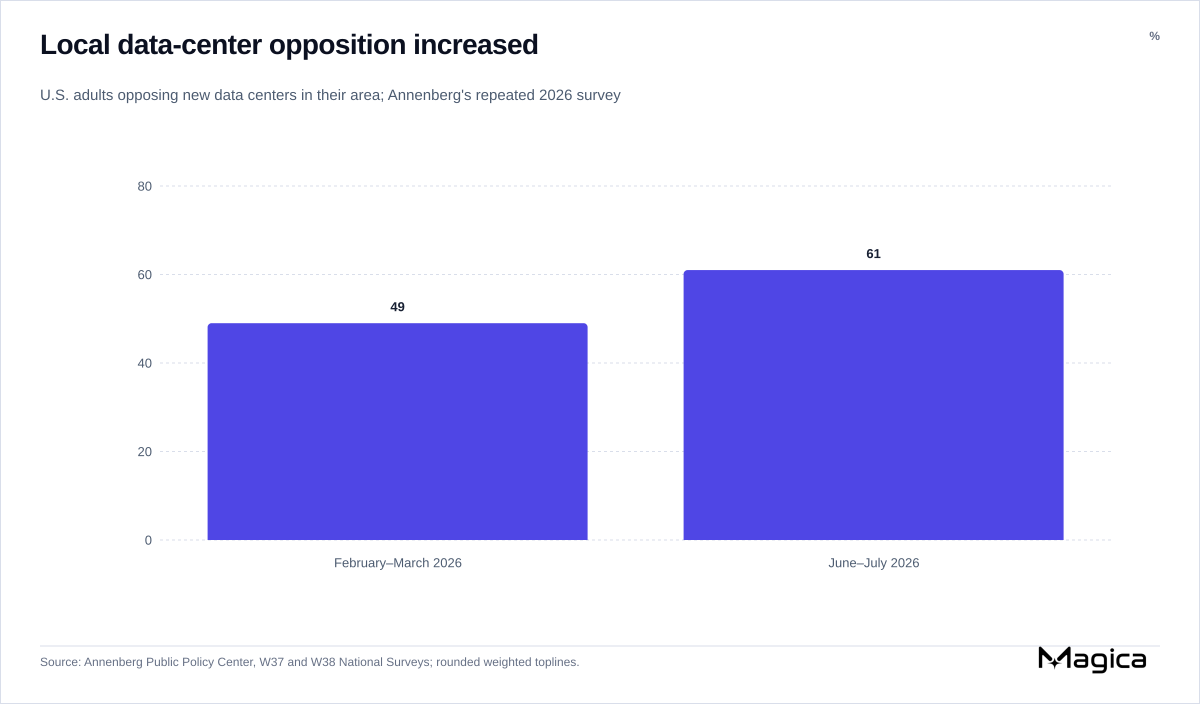
Annenberg’s repeated question concerned data centers generally, offered a neutral option and did not specify AI facilities. Its methods appendix reports a statistically significant increase in opposition. Source: Annenberg Public Policy Center.
Infrastructure makes the trade-offs local. Opposition to an AI data center in respondents’ communities was 72% in Quinnipiac’s September survey, compared with 65% in its March poll. Among March opponents, 72% cited electricity costs, 64% water use and 41% noise. Among supporters, 77% cited job creation, 53% tax revenue and 47% the potential for a tech hub. Respondents were choosing from supplied lists, and multiple answers were allowed. Those are respondents’ stated reasons, not findings about a particular facility’s costs or benefits.
Annenberg’s repeated survey asked about new data centers generally, rather than specifically AI facilities, and offered a neutral response. Opposition rose from about 49% in February–March to 61% in June–July. Its methods appendix estimates an increase of about 12 percentage points, with a 95% confidence interval of roughly 7 to 17 points. A separate analysis of the 1,241 people interviewed in both waves also finds a statistically significant increase. That provides stronger evidence of a change in local attitudes than comparing unrelated poll questions.
The evidence gives developers and policymakers a question about authority: what independent evaluation would satisfy the demand for safeguards? The September poll measures support for safety standards and a slower pace, but does not specify an evaluator, a test or a threshold for allowing development to proceed.
There is some evidence about who respondents want in charge. In Annenberg’s February–March wave, 52% wanted the federal government to lead AI regulation, 15% preferred state governments and 33% were unsure. That preference identifies a level of government, without settling the content of a regulatory regime.
Future polling needs to test concrete safeguards and repeat comparable questions to establish whether acceptance changes. The existing surveys do not show whether a specified safety regime would restore trust or whether hypothetical opposition would translate into a local permitting decision. Those are the next evidentiary tests for claims that useful applications, stronger oversight or promised local benefits can win broader consent.
Records detail Chinese data-center investments linked to Hexi founder Kang Wei, husband of former Megaspeed chief Alice Huang. Filings document financing and Huawei business, but do not establish a route for restricted Nvidia chips.
ElevenLabs plans to acquire Kotoba, the startup behind Japanese speech technology used in Salesforce’s Agentforce Voice. The deal adds a 15-person team and deployed products to its existing Japanese operation, but financial terms and integration plans remain undisclosed.
Tesla plans €3 billion of expansion at its profitable Grünheide factory to build Cybercabs from 2029, eventually targeting up to one million annually. The driverless taxi still lacks German and EU approval, and its capacity target differs from an older plan for the whole site.
NVIDIA's Nemotron for Science pairs an existing open model with nearly 50,000 chemistry questions and scientific post-training recipes. Partner results suggest scope for specialized agents, but the reported accuracy and inference savings do not establish the full cost of adapting them.
AMD says the Lux AI supercomputer is open to scientific users at Oak Ridge. Half its annual capacity supports the Genesis Mission and half is reserved for paid access, including AMD development, while workload limits and undisclosed rates shape its practical value.
Apple is adding app-by-app and folder-specific permissions, repeat approval requests and clearer warnings in macOS 27.3 beta 2. Existing permissions remain intact, limiting the immediate reach of the privacy changes.
OpenAI reportedly discussed buying Goodfire for more than $5 billion, over four times its February financing valuation. No deal resulted. A disclosed paid assessment agreement offers cooperation without ownership, while the technology’s safety benefits remain to be demonstrated.
Gemini’s regional voice rollout includes more than ten UK options and applies to live conversations and spoken chat responses. Earlier accent consistency problems remain untested in the new release, while pricing and rollout eligibility are unspecified.
Hugging Face is moving language-model requests to OpenRouter’s provider router, adding automatic failover while ending custom provider keys on that route. Provider rates carry no Hugging Face markup, but the selected service—and the resulting bill—can change.
Nasiko’s OpenRuntime combines agent spending reports, model routing and gateway budget limits. Earlier releases and company benchmarks show what it can do, but metering disputes, workload trade-offs and runtime charges complicate the savings case.
A report citing business records identifies Anthropic cybersecurity researcher Paul Crowley as a manager of Red Means No. The disclosure adds to scrutiny of consent safeguards and professional networking at the Bay Area sex parties.
Reported internal Microsoft data puts Claude for Microsoft 365 usage below one-tenth of Copilot’s. Undisclosed measurement details and Claude’s availability inside Copilot limit what the gap says about Anthropic’s workplace business.
South Korea is strengthening device checks and considering public Wi-Fi shutdowns before its November 19 college entrance exam, after a tax-accountant exam top scorer admitted using AI to cheat. The response still depends heavily on human screening, with no electronic device detectors planned for this year's test.
Russia’s objections to observer participation stalled the opening of a Geneva weapons conference, where governments must decide whether to authorize negotiations on autonomous weapons and whether any resulting rules should be binding.
Apple’s iOS 27.3 beta ties higher allowances for server-based AI to existing iCloud+ plans. Basic Siri commands remain free, but undisclosed daily limits leave the value of paid access uncertain.
The partners plan to combine IBM quantum processors, NVIDIA computing and Fermilab physics expertise to study modular quantum systems. A separate decoder release promises faster error-correction research, with important limits on its performance comparisons.
Federal Reserve Chairman Kevin Warsh outlined AI scenarios spanning shared prosperity, job displacement and an investment downturn. The exercise offers no forecast or rate guidance as colleagues worry that the infrastructure buildout is adding to inflation.
OpenAI is offering approved organizations a free classifier for suspected child sexual abuse images, including AI-generated material. Early results suggest less review work, but existing detection alternatives and the need for human review qualify the launch.
Nvidia plans scientific computing racks for early 2027, extending Vera beyond its initial AI deployments. Its 2.4× performance-per-watt claim comes from one airflow simulation against AMD Turin; performance against newer rivals and delivered costs remain unresolved.
OpenAI’s CEO expressed empathy for Nvidia founder Jensen Huang but withheld judgment on reinstatement. His confidence in continued AI financing comes with a direct commercial stake and unresolved deployment risks.