Editorial Team
6 min read
Tesla plans €3 billion of expansion at its profitable Grünheide factory to build Cybercabs from 2029, eventually targeting up to one million annually. The driverless taxi still lacks German and EU approval, and its capacity target differs from an older plan for the whole site.
Tesla plans to invest about €3 billion in expanding its Grünheide factory east of Berlin to manufacture the Cybercab, its two-seat driverless taxi without a steering wheel or pedals. The US electric-car maker announced the project on November 16, putting a production timetable behind a vehicle that still lacks German and European Union approval.
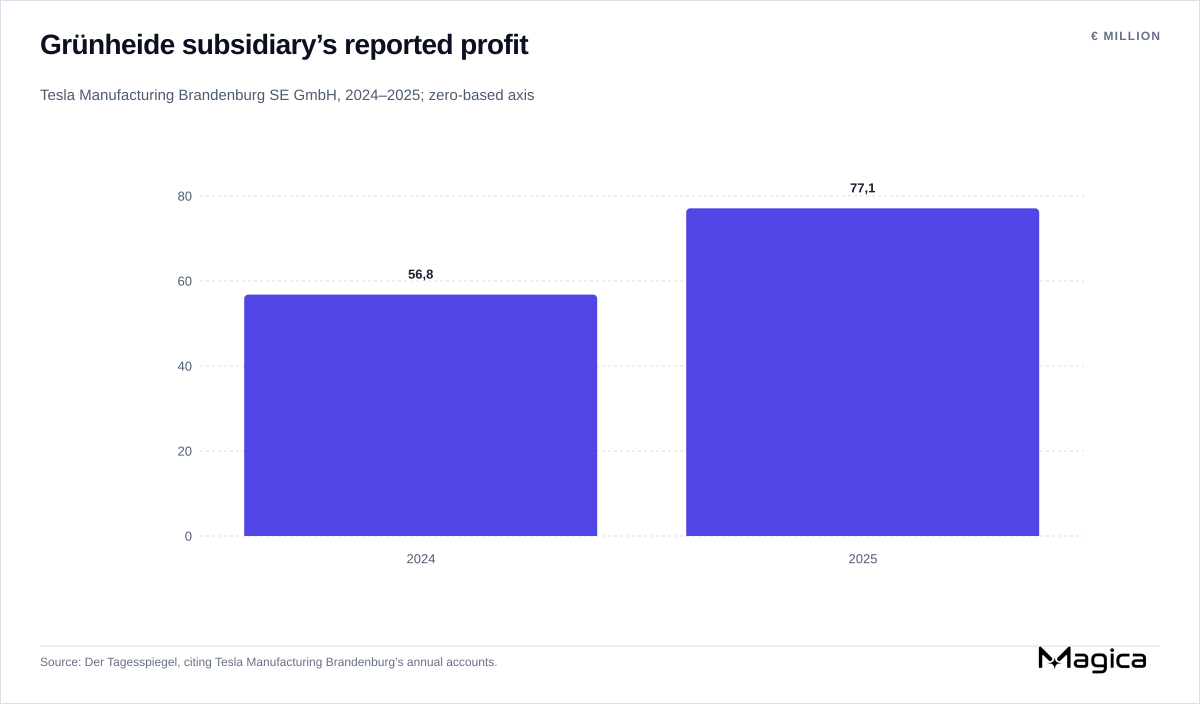
Company-reported profits for Tesla Manufacturing Brandenburg were €56.8 million in 2024 and €77.1 million in 2025. These figures concern the existing manufacturing business. Source: Der Tagesspiegel.
André Thierig, Tesla’s senior director of manufacturing for the site, said in his announcement that the first investment step would fund a new production building. Output would start in 2029 and eventually rise to as many as one million Cybercabs annually. Hiring for construction and production planning has already begun.
The factory opened in March 2022 and makes the Model Y electric SUV. It is Tesla’s only European vehicle-production site. Its existing manufacturing record matters: before the announcement, Thierig said the investment decision rested in the United States and argued that Model Y production had demonstrated that cars could be built profitably in Germany, according to the account of the expansion decision.
That report, citing Tesla Manufacturing Brandenburg’s annual accounts, puts the German manufacturing subsidiary’s 2025 profit at €77.1 million, against €56.8 million in 2024. Production nevertheless fell by 9,000 vehicles to 202,000. The Model Y was Europe’s best-selling electric car in 2025, the report says.
The subsidiary’s profit is evidence of an established manufacturing business; it does not establish returns for the proposed robotaxi line. Nor should last year’s production be confused with current output: the same report puts Model Y production at about 7,000 vehicles a week, with a target of 7,500.
Tesla had previously paused its expansion plans during a sales downturn and made them dependent on better market conditions. Demand has since improved, according to the local account. The factory is also preparing battery-cell production for 2027. Cybercab adds a new product to an existing industrial expansion rather than replacing the Model Y at Grünheide.
Tesla says it will submit the new building’s permit application before the end of 2026, start construction in the first half of 2027 and produce Cybercabs alongside the Model Y. The planned hall north of the existing main building would cover roughly 500,000 square metres, twice the footprint of the current main production hall, according to the expansion report.
The application builds on an expansion proposal submitted in 2023. In its October 2024 announcement, Brandenburg’s environment ministry described a planned increase in the whole site’s annual vehicle capacity from 500,000 to one million, alongside an increase in battery-cell capacity from 50 to 100 gigawatt-hours annually. Those were planned capacities, not actual output.
The new target of up to one million Cybercabs a year concerns the additional production building. Although the headline number is the same, its scope differs from the older site-wide vehicle target. The announcements do not explain how those capacity figures will be reconciled.
The state environmental authority granted the first partial permit in October 2024, following Tesla’s March 2023 application. It covered specified building extensions and infrastructure, including extensions without installation of production equipment. The ministry said that phase used Tesla-owned land and required no further tree clearing. That approval does not establish that all permissions for the newly announced Cybercab project are complete.
Cybercab was unveiled in 2024. It is designed for driverless operation, unlike Tesla’s Full Self-Driving (Supervised) driver-assistance system, which requires a human driver’s attention.
A report on the US rollout dates Cybercab’s public launch to September 2026 and puts roughly 573 on roads in Austin, with Dallas to follow. It says Tesla has about 1,307 robotaxis registered in Texas, most of them modified Model Ys. That distinction matters: Tesla’s existing robotaxi service is broader than its purpose-built Cybercab fleet.
The report describes restrictions on late-night Cybercab operation and a federal investigation into Tesla’s self-certification of a vehicle lacking some equipment required by US safety standards. It also reports no major incidents in more than two months of operation. That is a limited observation from a short, restricted rollout, rather than evidence of performance at the proposed production scale.
Tesla also faces established alternatives. Autonomous-driving rival Waymo uses additional sensors, including lidar, whereas Tesla relies on cameras alone. Neither the investment announcement nor the reported fleet count establishes which approach offers better operating economics.
The production shift extends beyond Germany. Tesla has announced plans to stop making its Cybertruck electric pickup in 2027, partly to free capacity for Cybercab manufacturing in Austin, according to the rollout report. Grünheide’s stated plan instead supplements the existing SUV line.
A November 15 account of Tesla’s US personal-use offer describes invitations to selected customers at $29,990 plus $300 a month, with estimated December delivery. It quotes Tesla chief executive Elon Musk saying the fee is too high and should be about $115. Operation is restricted to selected areas in Texas and Florida. These terms do not establish European prices or taxi-fleet profitability.
Tesla says the €3 billion will also cover ancillary buildings and another wastewater-treatment facility. Environmental groups and residents have long challenged the factory and expansion because the site lies partly in a water-protection area. Thierig says the enlarged operation can stay within its contracted water allocation. That remains the company’s assurance about future consumption.
Tesla is immediately seeking several hundred staff in construction and production planning, but has not specified the total permanent employment created by the expansion. The company said the factory had 12,600 employees in October after about 2,000 recent hires, according to the local account.
IG Metall, the union seeking a collective bargaining agreement at the factory, welcomed the investment and argued that increased demand for staff could give employees more scope to press for better working conditions. The plant has no such agreement; Tesla says its pay exceeds collectively agreed rates.
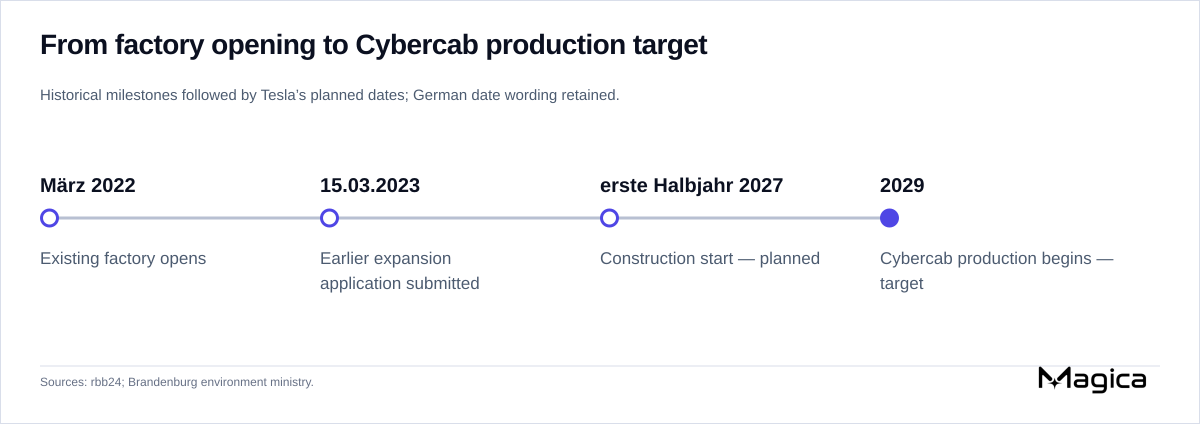
The 2023 application concerned the earlier expansion proposal. The company-reported construction and production dates are targets; road approval remains separate. Source: rbb24.
The first milestone is Tesla’s promised building application, followed by its proposed 2027 construction start. The €3 billion is an announced investment plan, and 2029 remains a production target.
Commercial deployment requires a separate answer. Cybercab has no German or EU approval, and Thierig has provided no date for its use on German roads. Asked about authorization, he said the plant was not responsible for approval of fully autonomous driving and wanted to have the right product ready when it could go on the road.
The next evidence must therefore address both sides of the plan: permissions and progress for the factory, and authorization and operating results for the vehicles. Manufacturing capacity alone will not establish a market for a million Cybercabs a year.
Records detail Chinese data-center investments linked to Hexi founder Kang Wei, husband of former Megaspeed chief Alice Huang. Filings document financing and Huawei business, but do not establish a route for restricted Nvidia chips.
ElevenLabs plans to acquire Kotoba, the startup behind Japanese speech technology used in Salesforce’s Agentforce Voice. The deal adds a 15-person team and deployed products to its existing Japanese operation, but financial terms and integration plans remain undisclosed.
Our World in Data’s comparison finds negative views of AI exceed positive ones across five probability-based surveys. The primary results also reveal substantial mixed views, acceptance of some applications and a sharper divide over who controls development and bears its local costs.
NVIDIA's Nemotron for Science pairs an existing open model with nearly 50,000 chemistry questions and scientific post-training recipes. Partner results suggest scope for specialized agents, but the reported accuracy and inference savings do not establish the full cost of adapting them.
AMD says the Lux AI supercomputer is open to scientific users at Oak Ridge. Half its annual capacity supports the Genesis Mission and half is reserved for paid access, including AMD development, while workload limits and undisclosed rates shape its practical value.
Apple is adding app-by-app and folder-specific permissions, repeat approval requests and clearer warnings in macOS 27.3 beta 2. Existing permissions remain intact, limiting the immediate reach of the privacy changes.
OpenAI reportedly discussed buying Goodfire for more than $5 billion, over four times its February financing valuation. No deal resulted. A disclosed paid assessment agreement offers cooperation without ownership, while the technology’s safety benefits remain to be demonstrated.
Gemini’s regional voice rollout includes more than ten UK options and applies to live conversations and spoken chat responses. Earlier accent consistency problems remain untested in the new release, while pricing and rollout eligibility are unspecified.
Hugging Face is moving language-model requests to OpenRouter’s provider router, adding automatic failover while ending custom provider keys on that route. Provider rates carry no Hugging Face markup, but the selected service—and the resulting bill—can change.
Nasiko’s OpenRuntime combines agent spending reports, model routing and gateway budget limits. Earlier releases and company benchmarks show what it can do, but metering disputes, workload trade-offs and runtime charges complicate the savings case.
A report citing business records identifies Anthropic cybersecurity researcher Paul Crowley as a manager of Red Means No. The disclosure adds to scrutiny of consent safeguards and professional networking at the Bay Area sex parties.
Reported internal Microsoft data puts Claude for Microsoft 365 usage below one-tenth of Copilot’s. Undisclosed measurement details and Claude’s availability inside Copilot limit what the gap says about Anthropic’s workplace business.
South Korea is strengthening device checks and considering public Wi-Fi shutdowns before its November 19 college entrance exam, after a tax-accountant exam top scorer admitted using AI to cheat. The response still depends heavily on human screening, with no electronic device detectors planned for this year's test.
Russia’s objections to observer participation stalled the opening of a Geneva weapons conference, where governments must decide whether to authorize negotiations on autonomous weapons and whether any resulting rules should be binding.
Apple’s iOS 27.3 beta ties higher allowances for server-based AI to existing iCloud+ plans. Basic Siri commands remain free, but undisclosed daily limits leave the value of paid access uncertain.
The partners plan to combine IBM quantum processors, NVIDIA computing and Fermilab physics expertise to study modular quantum systems. A separate decoder release promises faster error-correction research, with important limits on its performance comparisons.
Federal Reserve Chairman Kevin Warsh outlined AI scenarios spanning shared prosperity, job displacement and an investment downturn. The exercise offers no forecast or rate guidance as colleagues worry that the infrastructure buildout is adding to inflation.
OpenAI is offering approved organizations a free classifier for suspected child sexual abuse images, including AI-generated material. Early results suggest less review work, but existing detection alternatives and the need for human review qualify the launch.
Nvidia plans scientific computing racks for early 2027, extending Vera beyond its initial AI deployments. Its 2.4× performance-per-watt claim comes from one airflow simulation against AMD Turin; performance against newer rivals and delivered costs remain unresolved.
OpenAI’s CEO expressed empathy for Nvidia founder Jensen Huang but withheld judgment on reinstatement. His confidence in continued AI financing comes with a direct commercial stake and unresolved deployment risks.